
Behringer EUROLIVE F1220D Bi-Amped 250 Watt Monitor Speaker System with 12" Woofer, 3" Tweeter and Feedback Filter
4.5Editor score
Bi-amped 12-inch monitor system
Adjustable feedback filter
Integrated speaker protection limiter
Stage monitor speakers help performers hear the mix clearly without asking the sound engineer for more volume. The right model balances output, low-frequency extension, coverage, portability, and connection options, with the right balance depending on the venue, band, and monitoring demands.
This guide compares ten stage monitor options across portable and higher-output systems, including passive, powered, active, coaxial, and conventional two-way designs. The evaluation focuses on documented specifications, monitoring features, connectivity, enclosure format, and practical applications rather than unsupported testing claims.
The picks range from a lightweight 8-inch model for rehearsals to 10-inch, 12-inch, and 15-inch systems for larger stages. Each selection highlights a different use case, while product ratings and prices should both be checked at the time of purchase because availability and pricing can change.
4.5Editor score

4.8Editor score

4.6Editor score
As an Amazon Associate we earn from qualifying purchases.
This side-by-side comparison highlights each monitor's driver format, output, coverage or frequency characteristics, controls, and intended applications, making it easier to match a speaker with a rehearsal room, club stage, mobile event, or full-size sound system.



The Electro-Voice Pxm 12MP stands out as the most complete monitoring solution in this group, carrying a 4.8 rating and a feature set aimed at musicians, DJs, and audio engineers. Its 12-inch coaxial driver, 700-watt Class-D amplifier, and 90-degree by 90-degree coverage pattern are designed to deliver intelligible monitoring across the stage rather than only toward one narrow position.
We may earn a commission when you buy through this link, at no additional cost to you.
A particularly useful feature is the adjustable 55-degree monitoring angle. That geometry allows performers to move closer to or farther from the cabinet without the same loss of vocal intelligibility. The integrated mixer accepts two XLR and quarter-inch combination inputs plus stereo RCA, while the DSP includes four EQ presets, high and low shelving filters, parametric midrange EQ, adjustable low-cut filters, a tunable feedback notch, and recallable user settings.
The system is also designed to grow beyond basic stage monitoring. Its adjustable subwoofer-matching low-pass filters can be coordinated with a dedicated subwoofer, allowing the monitor and subwoofer to form a compact three-way main PA. System protection and limitation are integrated into the design, while the coaxial format keeps the signal consistent across the coverage area. These capabilities add complexity, but they also make the speaker more versatile than a simple wedge.
This is a strong choice for working performers who need clear monitoring, flexible positioning, and substantial DSP control without building an external signal-processing chain. It is especially relevant for a band that may alternate between stage monitoring and compact main-speaker duties. The Electro-Voice Pxm 12MP earns the Editor's Choice position because it combines broad coverage, thoughtful ergonomics, serious connectivity, and monitoring-specific processing in one purpose-built enclosure.
The 90-degree by 90-degree pattern and adjustable monitoring angle help distribute useful high-frequency information to performers who are not sitting directly in front of the speaker. That makes the cabinet more practical for rehearsals, club stages, and mobile setups where musician position can change.
The onboard mixer and extensive DSP eliminate the need for several external stage tools. Parametric midrange control, shelving EQ, feedback filtering, low-cut adjustment, and user presets make it easier to shape a monitor around a changing mix and a specific stage environment.
We may earn a commission when you buy through this link, at no additional cost to you.
The Behringer EUROLIVE F1220D is a value-focused 12-inch monitor system with a 4.5 rating and a straightforward bi-amped design. It uses a 12-inch woofer for low-frequency output and a 3-inch tweeter for high-frequency reproduction, providing a conventional two-way architecture that is easy to understand and deploy.
We may earn a commission when you buy through this link, at no additional cost to you.
The system is powered by 250 watts of Class-D amplification, a format noted for strong output and relatively low weight. An adjustable feedback filter and integrated limiter support system control and speaker protection. Those features are particularly relevant in live environments, where a monitor may be operated close to a microphone or pushed hard enough to reveal unwanted feedback.
Its main limitation is that the specification focuses on amplification, drivers, and protection rather than a large collection of input and processing options. Users working from a simple analog mixer will find that focus helpful because it keeps the signal path understandable. Performers who require digital presets, Bluetooth, extensive onboard EQ, or a multi-channel mixer may prefer a more integrated system.
The F1220D is best suited to rehearsals, small clubs, churches, and mobile performers who want a capable 12-inch monitor without carrying unnecessary complexity. Its dedicated woofer and tweeter, protective controls, and favorable rating make it a persuasive budget selection. For those needs, it delivers the core qualities of a stage monitor more effectively than adding features that may never be used.
Using separate 12-inch and 3-inch drivers gives the system distinct low- and high-frequency sections. This conventional arrangement is useful for musicians who want a recognizable monitor with enough low-end weight to evaluate kick drums, bass, and full-band playback.
The adjustable feedback filter and integrated limiter add useful safeguards for a stage environment. They do not replace proper microphone placement, but they can help engineers manage gain and maintain consistent operation when the monitor is positioned close to a vocal source.
We may earn a commission when you buy through this link, at no additional cost to you.
The Gemini AS-2108P is a compact 8-inch powered floor monitor that combines stage-oriented connectivity with a 3.7 rating. Its 300-watt rating, 8-inch woofer, and 1-inch piezo compression driver make it suitable for vocal monitoring, band practice, DJ use, and small-venue reinforcement where portability matters.
We may earn a commission when you buy through this link, at no additional cost to you.
The connection panel is unusually accommodating for a portable monitor. It provides two channels with switchable XLR and quarter-inch microphone or line inputs, RCA and auxiliary input, and an XLR mix output. An onboard two-channel mixer, bass and treble EQ, and individual gain controls allow a performer to combine instruments or playback sources without relying on a separate mixer for every basic task.
The wired-only design is a deliberate choice rather than a missing feature. It avoids Bluetooth latency and interference, which can be valuable in live sound. The trade-off is that users cannot stream directly from a phone or computer over Bluetooth, so a wired playback connection is necessary for those sources. The 11-pound weight, impact-resistant ABS cabinet, top handle, and 35mm pole socket improve its portability and versatility.
The AS-2108P is a strong fit for rehearsals, worship teams, mobile DJs, and performers who need one compact self-contained speaker. It may not offer the refined coverage or processing found in higher-end dedicated monitors, and its 3.7 rating is among the lower scores here. Even so, the broad input selection, floor-monitor format, and manageable weight make it a practical option for smaller and changing environments.
Switchable XLR and quarter-inch inputs, RCA, auxiliary connectivity, and mix output provide options for microphones, instruments, phones, mixers, and recording devices. That flexibility is useful when a rehearsal space does not have a permanent monitor system.
At 11 pounds, the speaker is light enough to move between a car, rehearsal room, and small stage without specialized handling. The molded ABS enclosure, ergonomic handle, and pole socket make it adaptable to both floor-monitor and conventional PA positions.
We may earn a commission when you buy through this link, at no additional cost to you.
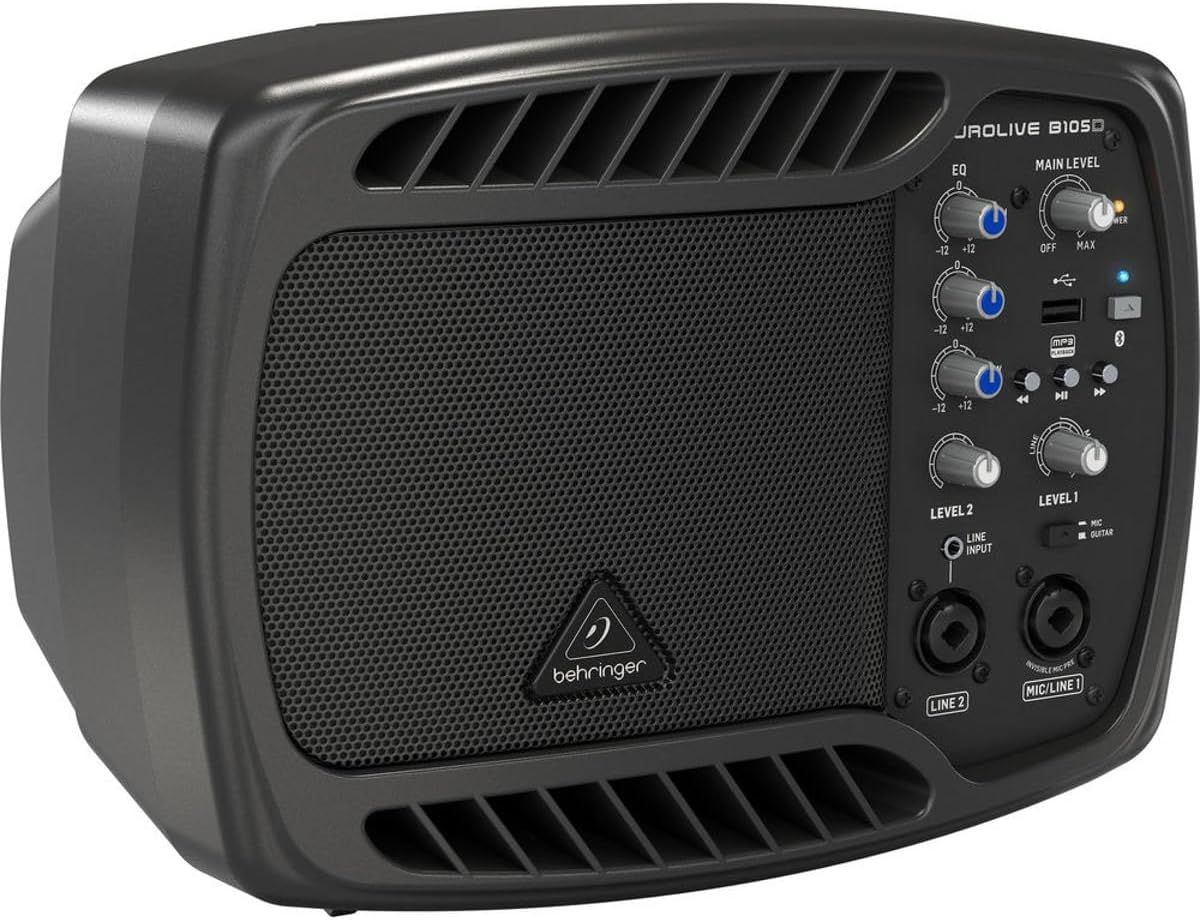
The Behringer EUROLIVE B105D is an ultra-compact 50-watt PA and monitor system with a 3.8 rating. Rather than attempting to serve as a large-stage monitor, it focuses on vocal and keyboard monitoring, multimedia playback, press conferences, and home-recording applications where a compact powered solution is more useful than maximum output.
We may earn a commission when you buy through this link, at no additional cost to you.
Its three-channel mixer is described as ultra-low noise and includes a three-band equalizer, allowing several sources to be combined and shaped directly at the speaker. Class-D amplification keeps the package light, while the included MP3 player supports files from USB sticks. Bluetooth audio streaming adds another playback option for compatible phones, tablets, and other devices.
That convenience creates an important limitation: this is not designed to match the low-frequency weight or maximum level of a 12-inch, 15-inch, or high-output coaxial monitor. Performers who need to hear a full band at high stage levels may find the available headroom limited. Its better natural role is focused vocal monitoring, keyboard playback, compact multimedia use, or a rehearsal environment where convenience outweighs large-scale output.
The B105D is a compelling pick for a singer, keyboardist, presenter, or mobile musician who wants monitoring and playback in one compact box. Its rating is modest compared with the leaders, but the combination of USB playback, Bluetooth, mixer controls, and Class-D efficiency is unusually convenient. It fills a distinct niche between a personal practice monitor and a full-range stage system.
The included MP3 player and Bluetooth streaming let a performer move through backing tracks without carrying another playback device. USB-stick support is especially convenient for rehearsals where the same arrangement and reference files are used repeatedly.
The onboard mixer and three-band EQ provide a simple way to combine and adjust microphones, instruments, or playback sources. It removes the need for a small desk mixer when the goal is focused practice or a modest monitoring setup.
We may earn a commission when you buy through this link, at no additional cost to you.
The Seismic Audio SA-10MTSingle is a passive 10-inch floor monitor with a 4.5 rating. It is intended for performers who already have an amplifier and want a dedicated wedge with a horn-loaded high-frequency section, rather than a self-contained powered speaker.
We may earn a commission when you buy through this link, at no additional cost to you.
Its two-way design combines a 10-inch woofer with a 4-by-10-inch titanium horn. The woofer uses a 40-ounce magnet and 2-inch voice coil, while power handling is listed at 150 watts RMS and 300 watts peak. These specifications give engineers useful information when matching the monitor to an amplifier and evaluating its headroom.
Because the system is passive, cable routing and amplifier selection become central to the setup. A performer will need a suitable power amplifier, a speaker cable, and an understanding of impedance and output requirements. That added complexity is not necessarily a disadvantage: passive systems can offer flexible amplifier matching and keep the signal chain under direct control.
The single-speaker package is best for musicians who need to expand a passive monitor system gradually, use one wedge at a time, or already own compatible equipment. The 4.5 rating reflects a favorable reception, while the titanium horn and 10-inch woofer make it a more specialized alternative to the many powered choices in this roundup.
The floor or stage-monitor shape is intended to direct sound upward toward a performer. Compared with placing a conventional speaker on its side, this purpose-built enclosure can simplify positioning in a rehearsal room or on a stage.
Using external amplification gives the user control over the amplifier and signal path. The documented 150-watt RMS and 300-watt peak handling figures provide a foundation for matching equipment, though the rest of the amplifier specifications should be checked before connection.
We may earn a commission when you buy through this link, at no additional cost to you.
The Seismic Audio SA-10MT-PW-Pair is a matched pair of powered 10-inch wedge monitors with a 4.4 rating. It provides two active floor or stage monitors in one package, making it a more immediately usable option for performers who need monitoring on both sides of a stage.
We may earn a commission when you buy through this link, at no additional cost to you.
Each enclosure uses a two-way 10-inch configuration with a titanium horn. The powered design means the monitors do not require separate power amplifiers, which can reduce setup complexity and help organize rehearsal rooms or stages where external rack equipment is undesirable. The listed applications include PA floor monitors, live sound, stage use, and studio work.
The advantage of a matched pair is consistency. A performer can compare a left-side and right-side monitor with the same general driver and horn design rather than combining unrelated cabinets. The trade-off is logistics: carrying two substantial floor monitors takes more planning than moving a single compact powered speaker, particularly for mobile acts working from a small vehicle.
This pair is best for a band that wants dedicated powered wedges without the complexity of a large digital monitor processor. It suits rehearsal spaces, small stages, and performers who value a straightforward 10-inch two-way sound. The 4.4 rating is solid, and the inclusion of two matching monitors makes it a strong alternative to building the same setup one enclosure at a time.
Two matching powered monitors simplify the task of building a balanced stereo or dual-floor monitoring setup. The package removes the need to source a second compatible cabinet and helps maintain consistent tonal character across both sides of the stage.
Because each enclosure is active, the user can focus on routing and gain rather than selecting external power amplifiers. That makes the pair practical for rehearsal rooms and smaller stages where a compact, self-contained monitor system is valuable.
We may earn a commission when you buy through this link, at no additional cost to you.
The Behringer EUROLIVE F1320D is an active 300-watt two-way monitor with a 4.5 rating. It combines a 12-inch woofer with a 1-inch compression driver, offering a conventional arrangement designed for live and playback applications where a larger low-frequency driver is desirable.
We may earn a commission when you buy through this link, at no additional cost to you.
Its Class-D amplifier is highlighted for high power, strong sonic performance, and low weight. The integrated sound processor, adjustable feedback filter, and limiter provide additional system control and protection. These features make the F1320D appealing to users who want a capable monitor without adding a rack processor for basic feedback and gain management.
The trade-off is that the feature set is more analog and focused than the DSP-equipped alternatives. Users who want recallable presets, extensive parametric EQ, automatic limiting profiles, or system preset management will need to perform more of that work elsewhere. Conversely, engineers who prefer a straightforward signal chain may appreciate a design that does not place many processing decisions behind menus.
The F1320D is a strong option for small and medium stages, worship teams, rehearsal rooms, and mobile performers using a 12-inch monitor. Its high-output active design, broad driver complement, and 4.5 rating make it a versatile choice. It is especially compelling for users who want the F1320D's combination of 12-inch bass capability, compression-driver clarity, and built-in protection in a relatively manageable system.
The 12-inch woofer provides more low-frequency scale than an 8-inch monitor, while the 1-inch compression driver handles high-frequency output. The 300-watt active design gives the system more apparent authority for a full band without requiring an external amplifier.
The adjustable feedback filter, integrated limiter, and sound processor support dependable live operation. While correct placement remains essential, these controls provide useful tools for controlling gain-related behavior and protecting the system.
We may earn a commission when you buy through this link, at no additional cost to you.
The YAMAHA DBR10 is a 700-watt powered speaker with a 4.4 rating and a strong emphasis on clean digital power. Its bi-amped 10-inch architecture is designed for high-performance main or monitor use, making it suitable for performers who need a substantial monitor system with a maximum output level of 129 decibels.
We may earn a commission when you buy through this link, at no additional cost to you.
FIR-X tuning is the key processing feature, with a listed frequency range from 55 hertz to 20 kilohertz at minus 10 decibels. The 10-inch powered configuration, high output capability, and seven-year warranty position the DBR10 as a serious option for a working mobile system. It can serve in a front-of-house role or be incorporated into a stage monitoring setup where a more conventional powered speaker is preferred.
A potential limitation is the less explicit wedge identity. The product information describes it as a high-performance main or monitor speaker, but it does not emphasize a specific floor-monitor angle in the same way as dedicated wedge products. Users whose priority is a shaped floor cabinet may need to inspect the physical enclosure closely. The same applies to any need for a relatively light, compact 8-inch system.
The DBR10 is best for bands, DJs, and mobile production companies that prioritize high output, consistent processing, and the option to use one powered cabinet in multiple roles. Its 4.4 rating and substantial documented performance make it a premium general-purpose choice in this guide, particularly for users who want more power than a typical rehearsal monitor can provide.
The 700-watt amplifier and 129-decibel maximum level target demanding live applications. FIR-X tuning adds controlled signal processing without requiring a separate processor for basic deployment.
The DBR10 is documented for main or monitor use, giving a performer flexibility in how the system is deployed. That versatility is valuable for mobile acts that alternate between presentations, DJ sets, rehearsals, and live stage reinforcement.
We may earn a commission when you buy through this link, at no additional cost to you.
The Mackie Thump12v4 carries the highest rating in this roundup at 4.9, and its combination of a portable 12-inch format, 1400-watt peak power, Bluetooth, and DSP makes it a versatile modern powered system. It is designed to move easily between rehearsals, mobile events, and full-room use while retaining application-specific voicing controls.
We may earn a commission when you buy through this link, at no additional cost to you.
SoundCheck DSP provides voicing modes intended for different uses, reducing the need to rebuild basic tonal settings when the cabinet changes role. Bluetooth supports streaming, linking with a second speaker, and app control. These wireless functions are convenient for mobile performers, although wired connections remain important in live environments where predictable latency and interference-free operation are priorities.
The stated 1400 watts is peak output, so it should not be treated as a continuous-output comparison without checking additional amplifier specifications. The product's lightweight, one-hand-carryable design is nevertheless a meaningful benefit. A 12-inch driver gives the cabinet more low-frequency potential than a compact 8-inch monitor while remaining more manageable than the largest models in the guide.
The Thump12v4 is an excellent choice for mobile musicians, DJs, and performers who want one powered loudspeaker to handle monitoring, playback, and main-speaker duties. Its 4.9 rating, large-driver format, DSP presets, and Bluetooth linking make it especially appealing. The main question is whether a floor wedge is required; for conventional stage positions, its versatility may be a greater advantage.
SoundCheck voicing modes allow the speaker to move between applications without extensive manual readjustment. This is useful for mobile performers who may use the same cabinet for a rehearsal, a party, or a small event.
The 12-inch driver provides more low-frequency scale than a small practice monitor, while the stated light weight and one-hand handling support frequent transport. That balance makes the system attractive for users who move equipment frequently.
We may earn a commission when you buy through this link, at no additional cost to you.
The Mackie Thump215 is a large 15-inch powered loudspeaker with a 4.6 rating and a 1400-watt ultra-efficient Class-D amplifier. It is built for users who need more low-frequency scale and output than a standard 10-inch or 12-inch stage monitor can provide, particularly on larger stages or with powerful full-band playback.
We may earn a commission when you buy through this link, at no additional cost to you.
Its documented frequency response extends from 40 hertz to 23 kilohertz, while maximum SPL reaches 129 decibels. These figures indicate a system designed for substantial output. The 15-inch format should also give performers a more physical sense of kick drums and bass, although its enclosure will be bulkier than the smaller monitors included here.
Mackie describes the unit as lightweight for easy loading despite the large driver. Even so, a 15-inch cabinet is inherently less convenient to carry than an 8-inch or 10-inch model, and users with limited transport capacity should consider how it will be moved between locations. The built-in feedback eliminator and Music Ducking mode add practical value for live playback and spoken-word applications.
The Thump215 earns the Best Premium position because it combines a substantial 15-inch system, high output, extended low-frequency reach, and integrated live-use processing. It is best for bands and mobile production companies that need a powerful floor-level system for a larger stage. Users seeking a light rehearsal monitor should choose a smaller model, but those who prioritize maximum monitor impact will find this option especially relevant.
The 15-inch driver and response down to 40 hertz give performers a more substantial low-frequency reference than smaller monitor formats. That capability can help a drummer or bassist evaluate kick and bass content more confidently in a full-band mix.
The integrated feedback eliminator can assist with gain management, while Music Ducking provides a dedicated function for lowering background audio during spoken passages. These features make the powered speaker useful in environments that combine performance with announcements or presentation material.
We may earn a commission when you buy through this link, at no additional cost to you.
Choosing a stage monitor involves balancing driver size, output, coverage, controls, enclosure design, and transport requirements. The right choice should help a performer judge the mix from a natural stage position while fitting the available space, signal chain, and level of mobility.
Choose the smallest model that can still reproduce the parts of the mix you need to evaluate. A 10- or 12-inch system is often the practical middle ground for band practice and small stages.
Powered monitors offer the simplest deployment, while passive monitors reward users with compatible existing equipment. Match the configuration to your setup rather than choosing based only on the speaker's advertised power.
Match the monitor's coverage and angle to where performers will stand. A dedicated coaxial or wedge design is often more predictable than adapting a general-purpose speaker and discovering its best position by trial and error.
Simple EQ suits quick rehearsal setup, while extensive DSP helps a working engineer shape repeatable monitor tones. Choose processing depth based on how much time and expertise you can devote to sound checks.
Prioritize the connection types your signal chain will actually use. Bluetooth can improve rehearsal convenience, but balanced wired inputs remain important for dependable live-stage operation.
Compare output using consistent specifications and listen to the intended source material. More advertised power is useful when the stage is loud, but headroom depends on the entire signal chain rather than the speaker alone.
Balance cabinet size against real-world handling. The most powerful monitor is not automatically the best choice if it cannot be loaded, positioned, and removed safely by the people using it.
Use built-in feedback tools as a safety net, not a substitute for correct gain staging. Mic placement, EQ decisions, and monitor positioning still determine whether the stage remains stable.
Start by placing the monitor where the performer can hear it without turning away from the audience. Aim the wedge or coaxial cabinet toward the intended listening position, allow appropriate airflow around the enclosure, and keep microphones behind the monitor's main coverage area whenever possible. Connect the source with balanced cables when the equipment supports them, and confirm that the input is assigned to the correct channel before raising the level.
Build the mix at a moderate monitor level before making EQ changes. Listen for vocal intelligibility, unwanted low-frequency buildup, harsh high frequencies, and feedback, then adjust one parameter at a time. Save or recall useful DSP settings when the speaker supports presets, and document the positions, channel levels, and processing used for each performer. This makes setup faster and more consistent when the same production moves between venues.
Power down using the proper sequence, and do not disconnect or reconnect signal cables while the amplifier is active. Keep the grille, controls, connectors, and cabinet free of dust, moisture, and debris. Inspect cables for damaged insulation or connectors, avoid placing the speaker near excessive heat or wet conditions, and use suitable transport protection for the larger 12-inch and 15-inch models.
A stage monitor is designed to send a controlled mix back toward performers on stage. A regular PA speaker is usually positioned to project sound toward the audience. Some powered speakers can perform both roles, but monitor-specific models often have wedge geometry, coverage patterns, feedback controls, or DSP features that make them better for floor-level musician monitoring.
Usually, yes. A powered monitor combines its speaker and amplifier in one enclosure, so it does not require a separate power amplifier. The performer or engineer still needs an appropriate source, cables, and the correct input selection. Passive monitors can be equally flexible for an experienced user, especially when suitable amplification is already available.
A 10-inch model is often easier to transport and sufficient for many rehearsal or small-stage applications. A 12-inch monitor generally provides more physical low-frequency output and can better represent kick and bass content. The right choice also depends on cabinet shape, coverage, processing, output level, and how much the system must be moved.
It depends on the number of sources and the level of control required. Several models include onboard mixers and EQ, allowing a performer to combine microphones, instruments, or playback without another device. A separate mixer becomes more useful when many sources require independent level control, multiple monitor mixes, or more precise processing.
Bluetooth can be useful for rehearsals, quick playback, and less critical applications, but balanced wired connections are generally more dependable for live performance. The products in this guide differ: the Behringer B105D and Mackie Thump12v4 support Bluetooth, while the Gemini AS-2108P is intentionally wired-only. Latency, interference, and connection stability should be considered before relying on wireless audio onstage.
Begin by placing the monitor behind the vocal microphone and pointing it toward the performer rather than the microphone. Keep the vocal channel and monitor level under control, reduce problematic EQ boost, and use the speaker's feedback filter as an additional tool. The Mackie Thump215, Behringer F1220D and F1320D, and Electro-Voice Pxm 12MP all include dedicated feedback-related controls.
A matched pair is useful when two performers need similar monitoring or when consistent sound is desired across both sides of a stage. The Seismic Audio SA-10MT-PW-Pair includes two powered 10-inch wedges for that purpose. A single monitor may be sufficient for one performer, a rehearsal room, or a setup where musicians take turns using the same position.
There is no single specification that works for every situation. Driver size affects low-frequency scale, coverage influences how well the monitor reaches the performer, and output determines how much level is available in a loud room. Connectivity, onboard processing, enclosure shape, portability, and the existing signal chain are equally important in practical use.
The Electro-Voice Pxm 12MP is the strongest all-around choice because it combines a dedicated 12-inch coaxial monitor, wide documented coverage, an adjustable monitoring angle, a three-channel mixer, and detailed DSP. The Behringer EUROLIVE F1220D is the best budget-focused option for performers who want a capable 12-inch two-way system with feedback filtering and protection, while the Mackie Thump215 stands out as the premium high-output choice.
The right comparison depends on what the speaker must do. A musician seeking a portable practice solution may favor the Gemini AS-2108P or Behringer B105D, while a working band may prioritize the Mackie models, Yamaha DBR10, or Electro-Voice's advanced monitoring control. Passive users should also consider the Seismic SA-10MTSingle, and anyone building a complete system should evaluate coverage, processing, and connectivity together rather than focusing on wattage alone.
Before purchasing, verify the latest product details, current customer rating, available accessories, and current price directly on the listing. Product prices and availability can change, and the needs of a rehearsal room may differ greatly from those of a club, church, or touring stage. The most valuable monitor is ultimately the one that provides a useful, repeatable mix from the performer's actual position.