
30 Amp AC Disconnect Switch
4.4Editor score
Galvanized steel outdoor enclosure
Thirty-amp double-pole isolation
Lockable pull-out handle design
Our Generator Disconnect Switch guide compares ten options for whole-home, manual, automatic, outdoor, motor, and portable generator applications.
A generator disconnect switch is the safety link between a generator or other auxiliary power source and the electrical system it supports. The right model should isolate power reliably, resist outdoor conditions, match the electrical load, and prevent unsafe backfeeding while making operation clear and dependable.
We compared all ten products by examining their switching mechanisms, current and voltage ratings, pole configurations, enclosure protection, installation features, intended applications, and available safety approvals. The list covers residential transfer equipment, general-purpose safety switches, heavy-duty disconnects, and compact options for motors or portable systems.
Each review explains the standout qualities and practical limitations of its featured switch, helping readers distinguish between a full home transfer panel, a service-entrance device, and a simple isolation switch. Product availability and pricing can change, so confirm the current listing and electrical requirements before purchasing.
4.4Editor score
4.9Editor score
4.6Editor score
This side-by-side comparison highlights each switch's capacity, electrical configuration, environmental protection, and primary use so readers can quickly identify the option that fits their generator, property, and installation plan.





This 200 amp manual generator transfer switch carries a 4.2 rating and is designed for homeowners seeking a substantial-capacity alternative to a small inlet or load selector. Its stated 48,000-watt capacity and 200 amp rating position it as a whole-home-oriented device for installations where the generator must support numerous 120-volt and 240-volt loads.
We may earn a commission when you buy through this link, at no additional cost to you.
The galvanized steel NEMA 3R enclosure is a central strength because a generator connection is commonly placed outdoors near the home or generator. The product's double-throw lever provides a direct mechanical way to change between utility and generator power while preventing simultaneous sources from being connected. A lock hole and grounding position add operational security and electrical isolation, while pre-installed wiring lugs simplify conductor termination.
There are important trade-offs. A manual device cannot begin supplying power without someone physically changing its position, and a 200 amp system demands careful load management, conductor sizing, utility coordination, and code-compliant installation. The absence of electronic controls also means the switch offers no automatic sensing, battery power, or remote status indication. Its 4.2 rating reflects a capable design, but buyers should expect a more involved installation than a compact safety disconnect.
This switch makes the most sense for a homeowner with a suitably sized standby or portable generator, substantial household demand, and a preference for dependable mechanical control. It is particularly attractive to users who value outdoor durability and long service life over automatic convenience. For smaller essential loads, a dedicated transfer panel may be more proportionate; for hands-free operation, an automatic service-entrance model is the better direction.
The 200 amp and 48,000-watt specifications make this one of the stronger choices for supporting high-demand appliances. It still requires a generator and electrical system capable of carrying the intended loads safely.
The double-throw design, lock hole, grounding position, and galvanized NEMA 3R enclosure focus on physical isolation and dependable outdoor operation rather than electronic convenience.
We may earn a commission when you buy through this link, at no additional cost to you.
The original EZ Generator Switch holds a 4.7 rating and offers a focused approach to transferring selected household loads without the need to touch existing circuit breakers. It is built around essential loads such as heating, lighting, refrigeration, solar equipment, inverters, and sump pumps, allowing users to define what receives backup power.
We may earn a commission when you buy through this link, at no additional cost to you.
Its most compelling feature is compatibility with multiple neutral arrangements. The switch is battery inverter friendly and supports bonded or floating neutrals, which broadens its usefulness across generator, inverter, and renewable-energy setups. UL, CSA, and ETL approval also gives buyers recognized safety certifications, while the claim that no backfeeding or contact with existing breakers is required simplifies the installation concept.
The limitation is that it does not eliminate the need for responsible electrical design. A user must identify the loads to transfer, ensure the generator can support them, and connect the system according to applicable requirements. “Essential loads” also means it should not be interpreted as a universal whole-home solution without confirming the electrical configuration and capacity. The 4.7 rating suggests strong satisfaction among buyers who understood its purpose.
This is a compelling selection for homeowners who want a smaller, more focused backup circuit than a large service-entrance switch. It is also useful for users with battery, solar, inverter, or mixed-source equipment. Those wanting automatic switching, continuous whole-home coverage, or a simple motor isolator should consider one of the more specialized products elsewhere in this guide.
By transferring defined essential loads directly, the switch can simplify the operating pattern of a backup system. The selected circuits must still be planned around generator capacity.
Support for bonded or floating neutrals and battery inverter use makes this a practical option for mixed power environments where a simple generator-only design may be unnecessarily restrictive.
We may earn a commission when you buy through this link, at no additional cost to you.
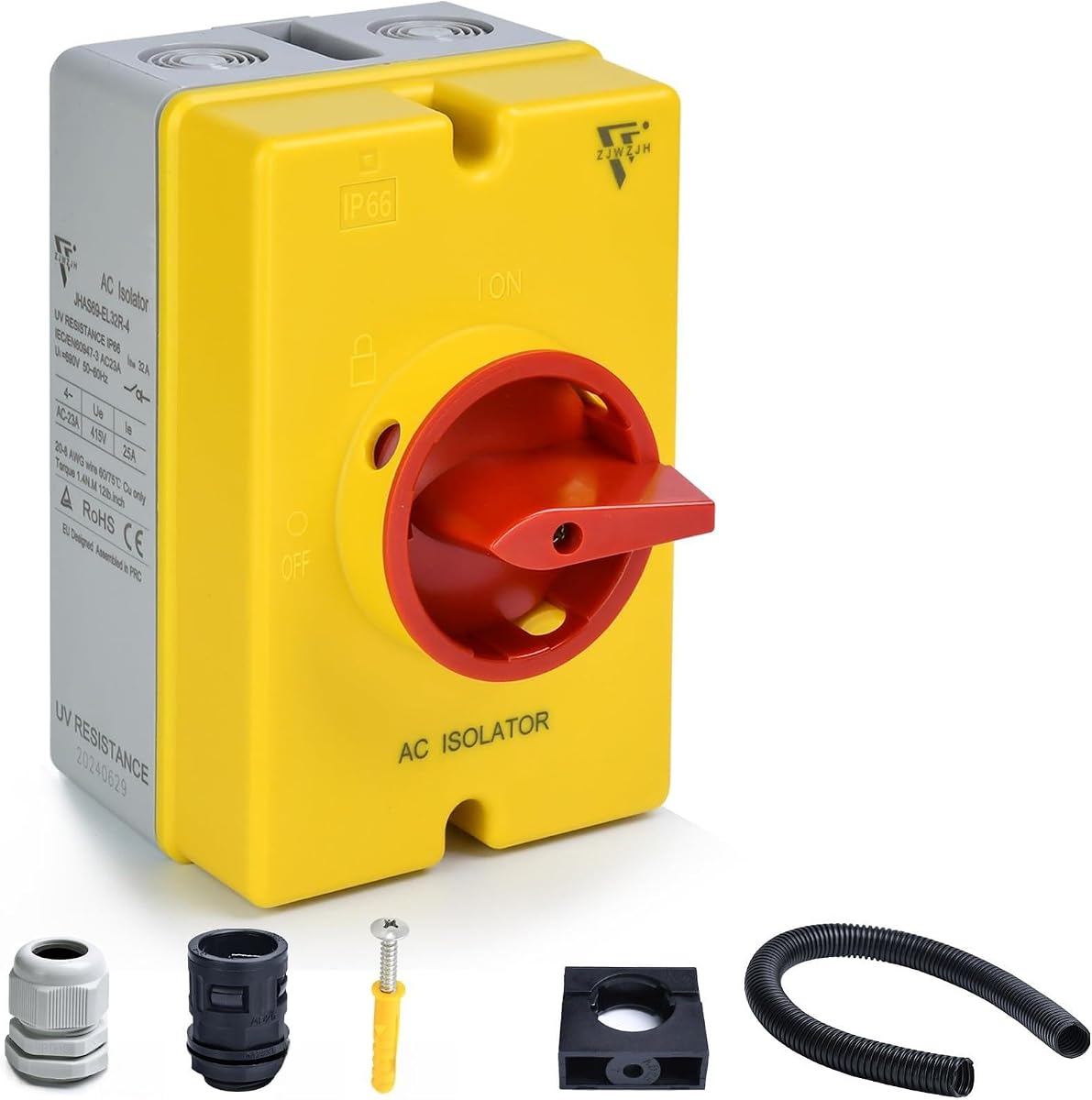
This 32 amp, four-pole AC disconnect carries a 4.4 rating and is purpose-built for motor and equipment isolation, including three-phase generator applications. Unlike a residential transfer panel, it does not alternate between utility and generator sources; it provides a visible way to disconnect a circuit when maintenance, repair, or emergency isolation is needed.
We may earn a commission when you buy through this link, at no additional cost to you.
The IP66 enclosure protects against dust, corrosion, windblown debris, rain, splashing water, and hose-directed water, making it suitable for exposed indoor or outdoor installations. The switch supports 120, 220, 240, 440, 480, and 690-volt AC applications, while its rotating handle can accommodate a hanging lock. Screws, cable connectors, corrugated pipe fittings, and fixed components are included in the package.
Its four-pole, three-phase format is the main limitation for typical homeowners. A standard residential generator connection usually relies on a different pole count, neutral arrangement, and switching objective. Buyers should also avoid treating the broad voltage compatibility as permission to ignore conductor sizing, short-circuit protection, grounding, or local code. The load-breaking capability is particularly relevant to motor isolation, where the product's stated performance is an advantage.
This disconnect is best for industrial, agricultural, commercial, or technically equipped users who need a rugged isolation point for a three-phase motor or generator-fed piece of equipment. It is less suitable for someone seeking an automatic or manual home transfer solution. For that objective, a residential transfer switch or safety switch provides a more appropriate electrical architecture.
The four-pole configuration and stated motor load-breaking capability make this switch most useful where a complete positive break across a three-phase circuit is required.
Its IP66 housing and corrosion-resistant construction suit demanding outdoor settings where moisture, dust, and weather would shorten the life of a basic indoor enclosure.
We may earn a commission when you buy through this link, at no additional cost to you.
The 63 amp safety disconnect earns a 4.7 rating and stands out as a versatile, economical isolation device for generators, welders, boats, industrial machinery, and other electrically powered equipment. Its two-pole design, 440-volt ceiling, and universal applications make it broader than a switch intended only for residential transfer equipment.
We may earn a commission when you buy through this link, at no additional cost to you.
Quick-make, quick-break operation is valuable for maintenance work because the handle acts decisively rather than lingering through a slow transition. Clear ON/OFF indicators improve operating awareness, and the silver-alloy contacts are designed for conductivity, arc resistance, reduced oxidation, and lower contact-welding risk. Its UV-resistant ABS enclosure is rated IP66 for protection against dust and powerful water jets.
Buyers must recognize that this is a disconnect, not an automatic transfer switch. It isolates a circuit but does not by itself manage the simultaneous connection of utility and generator power. It also is not a service-entrance device for an entire home. The material choice also warrants attention: although the housing is described as rugged, it should be installed within its environmental rating and protected from conditions beyond its stated limits.
This model is a strong pick for a workshop, dock, construction area, farm, or other application where equipment needs a secure local off position. It is particularly attractive for buyers who want a straightforward mechanical switch without electronics, programming, or control wiring. Whole-home users should choose a dedicated transfer switch instead.
The direct lever, quick-make and quick-break action, and clear status markings provide a simple isolation point without batteries, sensors, or programmable controls.
Silver-alloy contacts support conductivity and arc resistance, while the UV-resistant IP66 housing is well suited to dusty, wet, and demanding industrial environments.
We may earn a commission when you buy through this link, at no additional cost to you.
The General Electric TGN3323 is included because it represents the recognizable safety-switch format that many electricians already understand. It is described as re-certified and is positioned primarily as a safety switch, which makes it relevant when a buyer wants a conventional disconnect for generator-fed equipment or another electrical load rather than a programmable home transfer panel.
We may earn a commission when you buy through this link, at no additional cost to you.
The main advantage is familiarity. A recognizable safety switch can be easier to specify, install, and replace when it matches the requirements of an existing electrical arrangement. Its re-certified status may provide reassurance, although buyers should still inspect the current condition, listing details, and certification documentation before using it in a new installation.
The supplied information is limited to “Safety Switch,” and no customer rating is available. That makes a detailed comparison of voltage, amperage, pole configuration, enclosure rating, and fuse arrangement impossible from the product data provided. Those omissions matter because generator disconnects are not interchangeable: a switch that looks familiar can still be wrong for the conductor size, grounding arrangement, motor load, or required fault protection.
The TGN3323 is best considered a candidate for buyers or professionals seeking a conventional, re-certified safety switch in a known series. Verify its exact electrical ratings and current certification label before purchase. It is not the strongest recommendation for a reader who needs a clearly specified home transfer panel, automatic standby switch, or modern whole-home surge-protected device.
The established safety-switch format may be useful for technicians who need a conventional replacement or prefer equipment already represented in their installation plans.
Because the supplied data provides few technical details and no rating, buyers should confirm every electrical specification and certification marking before treating it as generator-compatible.
We may earn a commission when you buy through this link, at no additional cost to you.
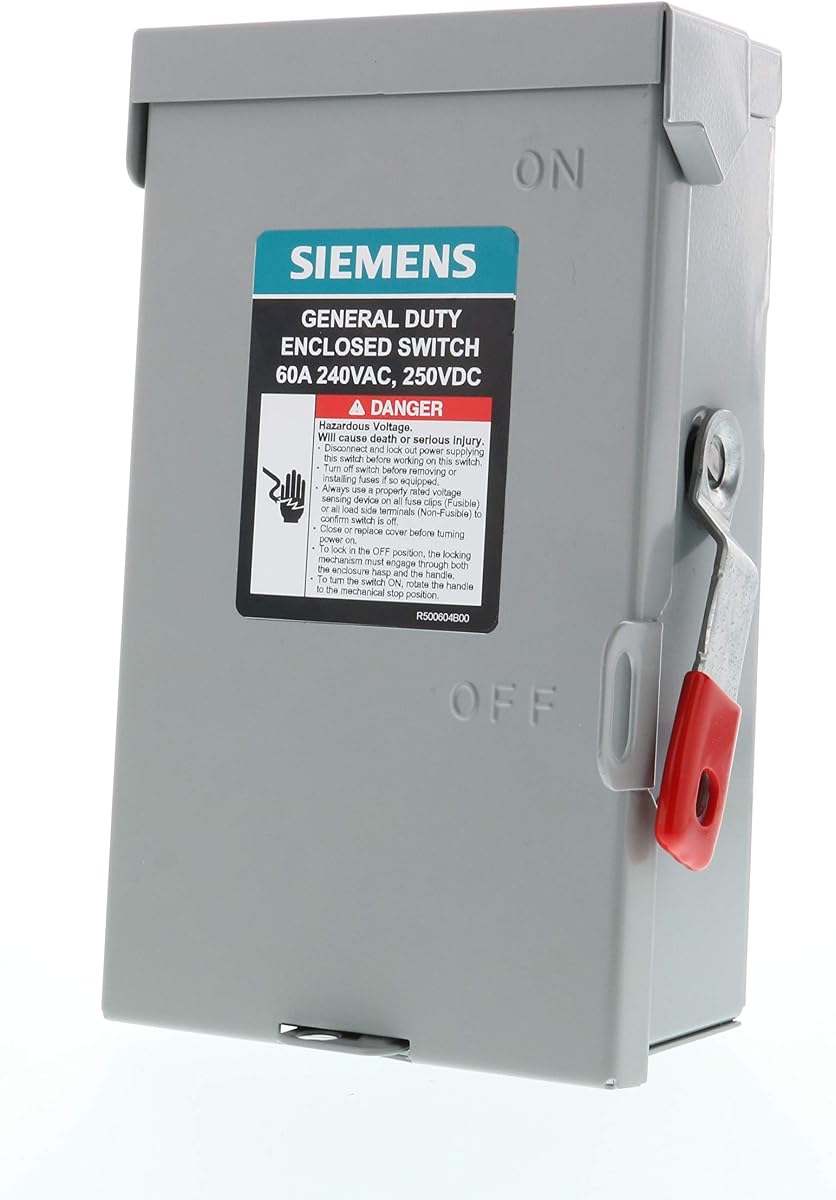
The Siemens 60 amp safety switch has a 4.6 rating and offers a proven general-duty format for outdoor isolation. It is a two-pole, 120/240-volt, single-phase, two-wire, non-fusible device, making it suitable for equipment circuits where overcurrent protection is provided elsewhere and a visible local disconnect is required.
We may earn a commission when you buy through this link, at no additional cost to you.
Its visible blade and double-break action give users a clear indication of the switch position and help create a deliberate break in the circuit. The quick-make, quick-break mechanism supports positive operation, while ON/OFF indicators are embedded in the steel door so they do not scratch or fade. Its compact size also makes it easier to handle and fit into available installation space.
The key limitation is that a safety switch is not the same as a transfer switch. It provides isolation rather than automatically or manually changing between two sources. Because it is non-fusible, the upstream circuit's fault-current and overcurrent protection must be evaluated carefully. Users also need to check conductor size, voltage, enclosure requirements, and local code before installation.
This switch suits a user who needs a conventional, clearly visible generator or equipment disconnect near a workshop, garage, or outdoor installation. It is a sensible option for a new circuit designed around a properly protected supply. If the real goal is to power essential circuits from a backup generator while retaining utility service, a purpose-built transfer panel would be a better selection.
The visible blade, double-break design, and quick-break action make the switch's state easy to understand during operation, inspection, and maintenance.
A steel door with embedded status indicators and a compact form gives this model a practical balance for space-conscious general-duty installations.
We may earn a commission when you buy through this link, at no additional cost to you.
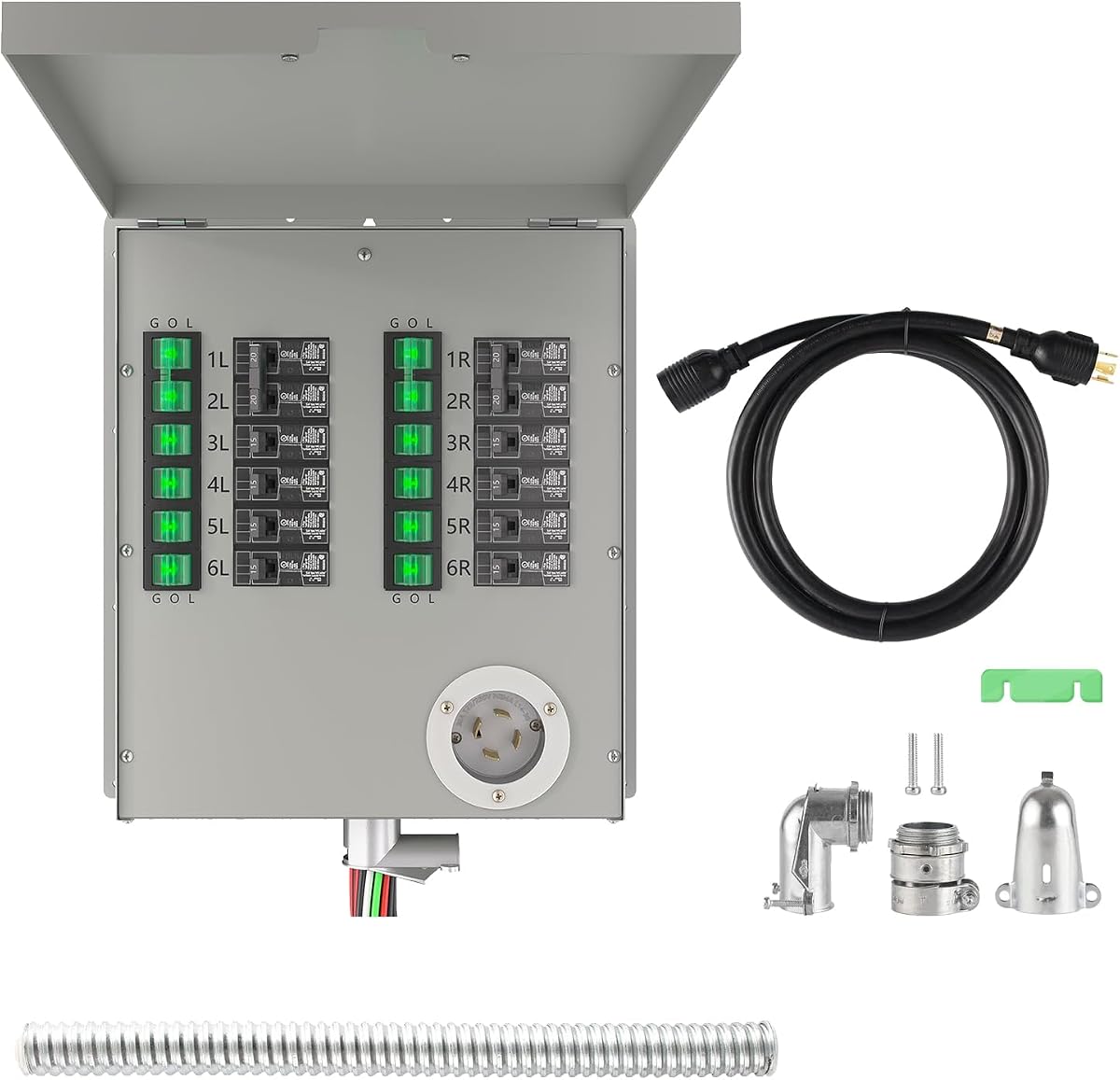
The Nature's Generator 30A non-automatic transfer switch earns a 4.9 rating, the highest among the products with available customer feedback in this guide. It is designed as a twelve-circuit residential backup panel for 120/240-volt applications and offers a more focused alternative to replacing an entire home service entrance.
We may earn a commission when you buy through this link, at no additional cost to you.
The product is compatible with gasoline, diesel, propane or LPG dual-fuel generators, lithium battery portable power stations, solar generators, mini wind turbines, and micro hydro generators. That broad source compatibility is useful for buyers who may change backup technologies over time. Twelve illuminated rocker switches provide visible generator-power status, while the included L14-30P inlet, 30A cord, and pre-wired components simplify connection planning.
As a manual device, it still requires the user to initiate the change to generator power, and its 30 amp rating makes generator and load selection critical. A home with central air, electric heating, a large well pump, or other high-demand equipment may exceed the practical capability of this system. The panel is UL approved, but installation must still comply with local electrical rules and the generator manufacturer's guidance.
This is the strongest fit for a homeowner seeking a dedicated, manageable set of backup circuits rather than automatic whole-home service. It is particularly attractive for essential loads such as refrigeration, lighting, communications, sump pumps, and selected appliances. Buyers wanting zero-interruption standby power should consider the automatic Generac service-entrance model instead.
The panel lets users decide which residential circuits receive backup power, and illuminated rocker switches make generator status easier to identify during operation.
Compatibility with conventional generators and several renewable or battery-based sources broadens the panel's usefulness for evolving household power needs.
We may earn a commission when you buy through this link, at no additional cost to you.
This two-pole, 60 amp safety switch carries a 3.9 rating and focuses on straightforward outdoor equipment isolation. It is rated for 120/240-volt, single-phase, two-wire service and uses a non-fusible configuration, making it a practical option when a visible disconnect is needed and protection is already handled by the associated circuit.
We may earn a commission when you buy through this link, at no additional cost to you.
Embedded ON and OFF indicators make the switch state visible without relying on a loose handle. Padlocking provisions on both the handle and door add a useful layer of control during maintenance or unattended operation. Its quick-make, quick-break mechanism and double-break action support deliberate operation and dependable electrical disconnection, while the outdoor design suits garages, workshops, and exterior equipment locations.
Its lower 3.9 rating may give cautious buyers pause, although that number alone does not reveal whether dissatisfaction concerned quality, installation, expectations, or another issue. More importantly, this is not a transfer device and will not safely alternate between utility and generator sources. The stated fault-current conditions differ depending on fuse class, so a qualified installer must verify the switch's suitability within the intended circuit.
This product is best for a user who values padlock security and a clear local off position for a generator-fed machine or other outdoor equipment. It is less suitable for residential essential-load transfer. Once a properly protected supply circuit has been designed, it can provide a robust, understandable safety point with no electronic components to program.
Padlock locations on the handle and door help prevent unauthorized operation and allow the switch to be secured during service or unattended periods.
The quick-break double-break mechanism and embedded position indicators offer a clear mechanical way to establish and verify an open circuit.
We may earn a commission when you buy through this link, at no additional cost to you.
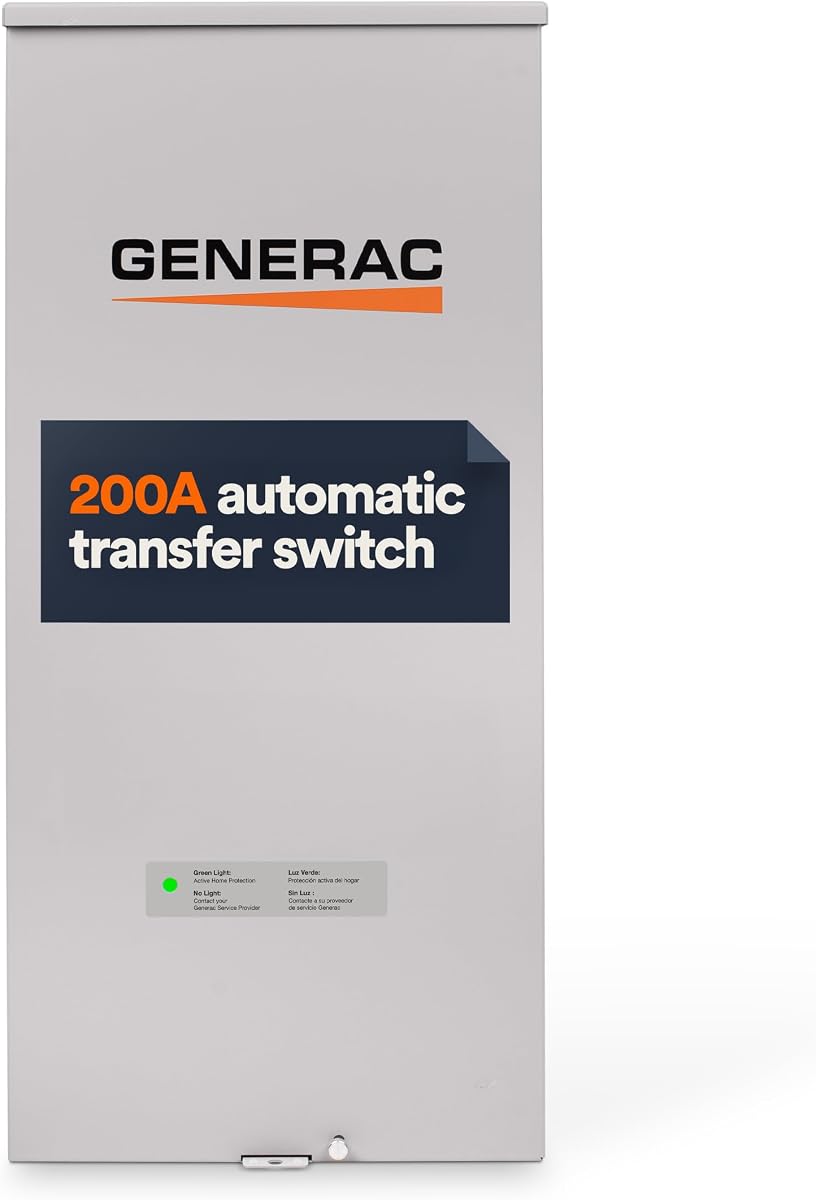
The Generac 200 Amp Next Gen automatic transfer switch has a 4.6 rating and represents the premium, fully integrated approach in this guide. It is a service-entrance-rated device designed to replace the home's main disconnect and transfer the entire property to a compatible Generac standby generator without manual action.
We may earn a commission when you buy through this link, at no additional cost to you.
Its factory-installed surge protection device adds a meaningful layer of defense for appliances and electronics exposed to transient utility voltage spikes. The 200 amp rating supports simultaneous 120-volt and 240-volt loads, including HVAC, well pumps, ranges, sump pumps, and refrigerators on a single-phase system. A NEMA 3R aluminum enclosure with corrosion-resistant powder coating provides indoor or outdoor protection against rain, snow, ice, and debris.
The mechanical interlock physically prevents utility and generator power from connecting at the same time, reducing backfeed risk and supporting NEC Article 702 installation requirements. Compatibility is specific: it is designed for single-phase Generac standby systems using Evolution or Power Zone 200 controllers. Replacing the main utility disconnect also makes this a major service-entrance project rather than a simple add-on accessory.
This switch is the leading choice for a homeowner investing in a compatible Generac standby system who values automatic transfer, whole-home capacity, surge protection, and integrated safety. It is less appropriate for portable generators, budget installations, or properties using a different generator ecosystem. The added capability and specialized installation requirements justify its position as the premium selection.
Automatic sensing removes the need to walk to the switch during an outage, while the physical interlock prevents the two sources from being connected simultaneously.
The 200 amp service rating and integrated surge protection provide a comprehensive approach for a properly matched Generac standby installation.
We may earn a commission when you buy through this link, at no additional cost to you.
The 30 amp pull-out disconnect has a 4.4 rating and is a compact option for isolating a 120/240-volt, single-phase, three-wire, two-pole circuit outdoors. It is a non-fusible, UL-certified AC disconnect intended to provide a local off position rather than alternate between utility and generator power.
We may earn a commission when you buy through this link, at no additional cost to you.
Its galvanized steel cover is designed to resist rain, dust, and rust in outdoor conditions. The pull-out handle provides a straightforward on and off action and stores in a closed compartment when removed, reducing the chance of losing a small but essential part. A lock hole allows an added padlock, while pre-drilled holes on the side, bottom, and back provide installation and wiring flexibility.
The 30 amp rating is a meaningful limit for larger machines, whole-home circuits, and high-demand appliances. A non-fusible switch also relies on properly coordinated circuit protection, and the installation must meet local requirements for conductors, grounding, short-circuit protection, and disconnect locations. The pull-out design also requires deliberate handling because a removed handle is intended to prevent unintended energization.
This is a good choice for a portable generator feeding a properly designed outdoor circuit, a small workshop, a campsite power arrangement, or another 30 amp installation requiring local isolation. It is especially useful where a compact galvanized enclosure and lockable handle are priorities. It should not be selected for whole-home backup or automatic standby transfer.
The compact galvanized enclosure, recessed handle storage, and lock hole create a practical isolation point for generator-fed equipment in exposed locations.
Pre-drilled side, bottom, and back knockouts give installers more routing choices while leaving ample internal space for conductors.
We may earn a commission when you buy through this link, at no additional cost to you.
Choosing a generator disconnect switch requires matching the device's switching function, electrical ratings, neutral arrangement, environmental rating, and installation method to the generator and the circuits it will serve. The most important distinction is whether the equipment transfers between two sources or simply isolates one circuit.
A transfer switch changes the source supplying selected loads, normally moving between utility and generator power while preventing the two sources from being connected together. A safety disconnect or AC isolator provides a visible off position but does not perform that source change. Readers searching for a home backup solution should generally focus on transfer equipment, while a safety switch may be appropriate for generator-fed machinery, a maintenance disconnect, or a separately designed supply circuit.
The switch's amperage rating must comfortably match the connected circuit or equipment, and it must be coordinated with conductor size and the generator's output. A 30 amp model may be ideal for a small essential-load system, while a 200 amp service-entrance model is intended to support a much broader home load. Do not rely on a headline watt figure alone; evaluate individual appliances, motor startup demand, simultaneous loads, and whether the generator can sustain the intended operating level.
Residential systems commonly involve 120/240-volt, single-phase power, while industrial equipment may use three-phase circuits and several pole arrangements. A two-pole switch generally opens the two ungrounded conductors of a single-phase supply, while a four-pole device may also interrupt a neutral or serve a three-phase arrangement. Verify voltage, frequency, pole count, phase, neutral, and grounding requirements against the equipment and local code before selecting a model.
Automatic transfer switches detect utility failure and move to standby power without attendance, making them appropriate for installed standby generators. Manual switches require a person to operate a lever or selector, which is less convenient but can be simpler and avoid dependence on sensing electronics. A manual system may be appropriate for a portable generator, an essential-load panel, or a user who prefers direct control. The choice should reflect how often the system is expected to operate and how quickly power must become available.
A generator disconnect is often installed near a home exterior, garage, workshop, or generator shelter, where rain, dust, sunlight, and temperature affect long-term reliability. Look for a clearly stated outdoor rating such as NEMA 3R or IP66, along with corrosion-resistant materials and durable door or handle components. An IP or NEMA designation is meaningful only when the complete enclosure, glands, covers, and installation method preserve the intended level of protection.
Safe standby power arrangements must prevent utility and generator sources from being connected simultaneously. Mechanical interlocks, double-throw designs, and proper transfer-switch architecture are central to that protection. A simple pull-out or safety disconnect does not provide source-transfer interlocks, so it should not be installed as though it were a transfer switch. For complex installations, an electrician should verify that the selected device and complete system satisfy applicable backfeed and service requirements.
Consider the amount of wiring the switch expects, the space available in the enclosure, knockout locations, included lugs, cord or inlet kits, and the need for a separate panel or service disconnect. Pre-wired panels and included connection hardware can reduce assembly work, while a service-entrance switch may eliminate the need for a separate main disconnect. Installation complexity varies from a compact equipment disconnect to a full panel replacement, so labor and permitting requirements deserve as much attention as the hardware.
UL, CSA, ETL, and other recognized approvals can provide important evidence that a product has been evaluated for defined safety requirements. Approval does not eliminate the need to follow installation instructions, code, and local inspection. Automatic systems may also be limited to particular generator brands, controller types, and voltage systems. Check the compatibility list carefully, especially when connecting a switch to a portable generator, inverter, solar system, or a standby unit from a different manufacturer.
Before operating any generator disconnect, confirm that the connected generator voltage, frequency, phase, and neutral arrangement match the switch and load equipment. Start the generator outdoors in an open area and away from doors, windows, and ventilation intakes. Allow it to stabilize, connect the generator using the approved plug, inlet, or transfer procedure, and verify the switch displays the expected source before energizing the intended circuits.
Operate a manual transfer switch only when the generator is running and its output is stable. Move the selector or lever decisively to the intended position, then confirm which source supplies the loads. Do not attempt to defeat an interlock or operate the mechanism under load unless the manufacturer expressly permits it. For a pull-out disconnect, follow the labeled removal sequence and store the handle in its protected compartment when isolation is required.
Inspect the enclosure, cover, handle, seals, wiring area, and grounding provisions periodically. Tighten any accessible fasteners that the manufacturer identifies for routine service, remove dirt and vegetation that could retain moisture, and look for rust, cracked parts, discoloration, or heat damage. Test operation and the required protective functions according to the product instructions and applicable code. Because energized equipment can present serious hazards, uncertain wiring, scorching, damaged enclosures, or failed interlocks should be evaluated by a qualified electrician before the system is used again.
No. A generator disconnect switch generally isolates a circuit so it can be made visibly safe for maintenance or operation. A transfer switch also changes the power source, usually moving connected loads between utility and generator while preventing both sources from operating together. Choose based on whether the application needs source selection, emergency isolation, or both.
Not by itself in most cases. A simple safety disconnect or pull-out switch does not automatically coordinate utility and generator sources. Backfeeding protection requires a correctly designed transfer arrangement, often with a mechanical interlock and properly arranged conductors. A qualified electrician should verify the entire installation rather than assuming a disconnect provides that protection.
The correct size depends on the generator's output, connection rating, circuit voltage, and the loads connected. A 30 amp model may suit a properly designed 30 amp circuit, while larger appliances and whole-home systems require more capacity. Match the switch to conductor size and overcurrent protection, and never use a higher-rated switch to justify undersized wiring.
Some models are specifically designed for outdoor installation, while others are intended for indoor use. Look for a stated NEMA or IP enclosure rating and confirm that all covers, fittings, and accessories preserve that protection. Even an outdoor-rated switch should be installed according to its orientation, clearance, and mounting instructions.
A manual transfer switch requires someone to change the source position after the generator is running and stable. An automatic switch senses the loss of utility power and transfers without manual action, which is useful for standby systems that must operate unattended. Manual equipment can be simpler for portable generators, while automatic equipment generally requires compatible standby-generator controls.
Only when it is specifically designed and installed as a suitable service-entrance or whole-home transfer device with adequate capacity. A compact safety disconnect usually protects one circuit and does not replace the home's main panel. Whole-home backup also requires careful generator sizing, load management, inlet or transfer equipment, and code-compliant electrical work.
A lock hole allows a padlock to secure the handle or cover in the appropriate position. This can discourage unauthorized operation and help ensure the equipment remains isolated during maintenance. It is a security and operating control, not a substitute for electrical protection, grounding, interlocks, or code-compliant installation.
The required arrangement depends on the generator, transfer equipment, panel, and applicable electrical code. Some switches support bonded or floating neutrals, while others are designed for one specific configuration. Confirm the manufacturer's wiring instructions and have the installation inspected by a qualified electrician to avoid an unsafe neutral arrangement.
The Nature's Generator 30A transfer switch is the most compelling residential essential-load option, combining a 4.9 rating, twelve controlled circuits, visible status indicators, and broad generator-source compatibility. The Generac 200 Amp automatic transfer switch is the premium choice for a compatible standby system, offering service-entrance capacity, automatic transfer, surge protection, and mechanical anti-backfeed protection. For a lower-cost general-purpose isolation device, the 63 amp two-pole safety disconnect provides rugged outdoor construction and useful versatility.
Prioritize function before features. Choose a true transfer switch when backup loads must change sources, and choose a safety disconnect when the primary goal is local equipment isolation. Then match current, voltage, poles, phases, neutral configuration, enclosure protection, generator compatibility, and installation requirements. The most feature-rich unit is not the right choice if its electrical design does not match the equipment it must control.
Product details, availability, approvals, and pricing can change, so review the current listing and manufacturer documentation before buying. Confirm the generator instructions, switch wiring diagram, local code requirements, and any needed professional assessment. Those final checks can prevent an attractive-looking but electrically unsuitable disconnect from becoming a costly installation mistake.