
CPS VG200
4.5Editor score
NIST-traceable calibration
Four selectable pressure units
Automatic temperature compensation
Complete hose and case kit
A digital vacuum gauge turns an invisible pressure difference into a clear, easy-to-read measurement, making it essential for HVAC evacuation, refrigeration diagnostics, leak checks, and pump performance assessments. The best unit balances accurate readings, practical measurement range, useful alerts, and a connection method suited to the equipment you already use.
We compared 10 digital vacuum gauges using the supplied specifications, customer ratings, supported units, sensor capabilities, connection details, display features, alarms, and recording functions. The list covers professional HVAC meters, connected gauges, full-range options, a focused automotive tester, and a budget-friendly model with broader diagnostic functions.
Each review explains where the gauge stands out, what trade-offs to consider, and which type of technician or hobbyist may benefit most. Product features and availability can change, and marketplace prices fluctuate, so readers should confirm current specifications and listings before purchasing.
4.5Editor score

4.3Editor score
4.4Editor score
As an Amazon Associate we earn from qualifying purchases.
The following comparison highlights measurement ranges, supported units, connectivity, and the environments each gauge is designed to serve, from deep-vacuum HVAC work to automotive pressure diagnostics.



The CPS VG200 is a premium digital vacuum gauge built around straightforward field operation and a strong 4.5 customer rating. Its five-digit LCD presents measurements in microns, millibar, torr, and inches of mercury, giving technicians the units commonly encountered during HVAC evacuation without forcing them to rely on a separate conversion tool.
We may earn a commission when you buy through this link, at no additional cost to you.
Calibration to strict NIST standards is the feature that makes the VG200 particularly compelling for users who place a premium on measurement credibility. Two-button operation keeps menu navigation uncomplicated, while automatic temperature compensation corrects readings as ambient conditions change. The cleanable sensor is also rated to withstand up to 400 PSI of positive pressure, an unusually useful margin for a meter that may be exposed to pressure spikes during connection or testing.
The included accessories add practical value rather than merely inflating the package. A T-fitting, gauge hook, and padded vinyl case create a more service-ready setup, and the hook can help position the instrument during longer evacuation procedures. The trade-offs are that there is no app connection, electronic reporting, or advanced leak-test mode, so buyers wanting connected documentation must handle records manually.
The VG200 is a strong choice for professional HVAC and refrigeration technicians who want dependable accuracy, a simple interface, and a complete kit. It is especially suitable for routine evacuation work where clear readings and fast unit selection matter more than wireless data or automated test workflows.
NIST-standard calibration gives the VG200 a clear identity for users who compare gauges against trusted references. Automatic temperature compensation further supports stable readings, while the four-unit selection matches common HVAC and vacuum-service conventions.
The supplied T-fitting, hook, and padded case make the instrument easier to deploy and protect between calls. These details matter in field work because a protected, organized gauge is more likely to remain available when needed.
We may earn a commission when you buy through this link, at no additional cost to you.
The Digital Vacuum Gauge Pro differentiates itself with two purpose-built diagnostic modes: Smart Evacuation and Pressure Leak Detection. Its 3.6 customer rating is not among the highest in this group, but the listed specifications provide an unusually ambitious feature set for users who want more than a single vacuum reading.
We may earn a commission when you buy through this link, at no additional cost to you.
Evacuation mode displays the vacuum level alongside temperature difference, water-vapor saturation temperature, and elapsed measurement time. That information can help a technician judge whether moisture and non-condensable gases have been removed before charging. Leak-test mode tracks differential pressure, initial pressure, and test duration, making it possible to assess whether a sealed static system holds pressure.
The meter offers four units, automatic temperature compensation, altitude-aware self-calibration, and a three-inch backlit display. Users can establish an alarm threshold, after which the screen flashes and an audible signal sounds as the measured value reaches the setpoint. The main limitation is the stated relative vacuum range of 0 to 50 mbar, which does not cover the broad atmospheric range offered by some full-range gauges.
This model is best for technicians who actively want evacuation and leak-test workflows in one instrument. Buyers focused solely on reaching very low micron readings may prefer a gauge designed around deep-vacuum measurement, while those who value diagnostic modes and configurable alerts will find this option especially useful.
Temperature difference, saturation temperature, and elapsed time give the evacuation display more diagnostic context than a bare pressure value. These parameters can help users distinguish a pump that is struggling from a system that has reached a suitable vacuum condition.
A configurable threshold combines a flashing screen with an audible alarm. This makes the meter useful when the technician must look away while keeping the evacuation process under observation.
We may earn a commission when you buy through this link, at no additional cost to you.
The Super Stars ST-VG90 is a compact HVAC vacuum gauge with a professional Pirani sensor and a broad stated measurement range from 99999 to 0.1 Pa. Its 3.1 customer rating is the lowest in this comparison, so buyers should weigh the documented range and features carefully against the limited consistency reflected in customer feedback.
We may earn a commission when you buy through this link, at no additional cost to you.
Four units—Pa, mBar, mmHg, and micron—make the display adaptable to different international and industry standards. A preset vacuum alarm combines a buzzer with a visual indicator, while the optional backlight and automatic power-off function support field use and battery conservation. The pocket-sized format should appeal to technicians who prefer carrying a smaller instrument.
The stated compatibility with vacuum pumps of 5 CFM or higher helps define the operating context. One-key calibration and rapid unit switching support an efficient workflow, but the supplied data does not provide a specific accuracy tolerance. That omission matters because a wide range alone does not establish how closely the instrument tracks a known reference.
The ST-VG90 is a practical option for users who prioritize compact size, multiple units, and clear target alerts. It may suit independent technicians or students, but professionals who need documented accuracy specifications or a stronger customer-rating profile should compare those details before committing.
The pocket-sized design, one-key calibration, and quick unit changes reduce setup time. For technicians who move between service vehicles or work in confined spaces, a compact meter can be easier to carry and operate.
The combined buzzer and visual alert help users recognize when a preset level has been reached. Automatic shutdown adds another layer of convenience by conserving battery life between jobs.
We may earn a commission when you buy through this link, at no additional cost to you.
The Pro HVAC Micron Gauge is designed for rapid monitoring of HVAC systems, with a stated range of 0 to 75,000 microns, plus or minus 5% accuracy, and a 0.5-second display refresh. Its 3.2 customer rating suggests that prospective buyers should consider the complete specification set rather than relying on broad customer sentiment alone.
We may earn a commission when you buy through this link, at no additional cost to you.
A professional Pirani sensor supports the device's intended HVAC role. Full-scale and zero-point calibration provide two different ways to manage instrument accuracy, while an algorithm compensates for temperature-related sensor drift. The large backlit LCD and fast refresh make changing readings easier to follow during a live evacuation.
The gauge accepts a standard 1/4-inch SAE tapered connection and includes 14 PSI overpressure protection, which adds resilience during connection changes. It operates across 32 to 122 degrees Fahrenheit and can switch among Pa, mBar, mmHg, and microns. The accessory package includes a bend sensor connector, tee connector, storage bag, manual, and three batteries.
This is a sensible option for HVAC technicians who need continuous visual feedback, temperature compensation, and several connection accessories. It may be less compelling for users seeking a highly rated premium meter, but the combination of fast refresh, alerts, and dual calibration remains focused on real-world service work.
A 0.5-second refresh rate and large backlit screen make the display useful during a changing evacuation. Audio and visual alerts then provide an additional signal when the selected target is reached.
Dual calibration addresses both zero-point and full-scale concerns, while automatic temperature correction is intended to reduce drift. Together, these features support consistency across changing working environments.
We may earn a commission when you buy through this link, at no additional cost to you.
The Supco VG64 combines a 4.2 customer rating with a conventional, technician-friendly design. It covers 0 to 12,000 microns, offers seven selectable units, and provides a fast 0.5-second response, making it a credible option for routine HVAC service and refrigeration diagnostics.
We may earn a commission when you buy through this link, at no additional cost to you.
Its advanced sensor is designed to remain accurate when exposed to oil residue and is listed as typically requiring no cleaning. Compatibility with A2L refrigerants is another important detail for modern service work, where technicians may work with refrigerant systems beyond legacy applications.
The backlit LCD, durable housing, compact build, and removable magnetic hanging strap support field operation. The magnetic strap is particularly useful during a long evacuation because it can keep the display in view. The trade-off is the absence of app connectivity, electronic reports, and remote monitoring, so results must be recorded manually.
The VG64 is best for technicians who prefer a dependable, self-contained instrument with a generous choice of units. Those who need atmospheric-pressure readings or wireless documentation may find a wider-range or connected gauge more appropriate.
The sensor is designed to tolerate oil residue and typically avoid repeated cleaning. That makes the VG64 a practical choice for refrigeration systems where contamination is a normal part of servicing.
The magnetic strap helps keep the meter visible during an evacuation, while the backlit display supports readability. Its quick response provides near-real-time feedback without requiring a connected device.
We may earn a commission when you buy through this link, at no additional cost to you.
The Elitech VGW-Mini is a connected digital vacuum gauge aimed at HVAC and refrigeration technicians who want remote monitoring and formal records. Its 3.6 rating places it in the middle of the group, but the app integration creates a distinct profile compared with standalone digital meters.
We may earn a commission when you buy through this link, at no additional cost to you.
The Elitech Tools app for iOS and Android can display the evacuation process, send notifications when readings exceed a preset target, and store data for export in Excel and PDF formats. The meter also evaluates the physical state of water by comparing ambient temperature with the saturation temperature corresponding to the system's vacuum.
Accuracy is stated as plus or minus 10% or plus or minus 10 microns across a 0 to 19,000-micron range. A notable operational note concerns the oil-proof film inside the sensor head: the manufacturer suggests removing it when connecting directly to a vacuum pump and reinstalling it when connecting to the system. Forgetting this step can lead to a delayed numerical display.
The VGW-Mini is well suited to users who value electronic records, phone notifications, and a broader tool ecosystem. Those wanting simple stand-alone operation or stronger customer ratings may favor another option, while reporting-focused technicians will find the app functions especially valuable.
Recording readings and exporting them in Excel or PDF formats reduces the chance of copying a value incorrectly. The connected workflow can also make it easier to retain a record after leaving the job site.
By comparing ambient and saturation temperatures, the meter estimates the physical state of water in the system. This context can help technicians interpret an otherwise difficult-to-read vacuum trend.
We may earn a commission when you buy through this link, at no additional cost to you.
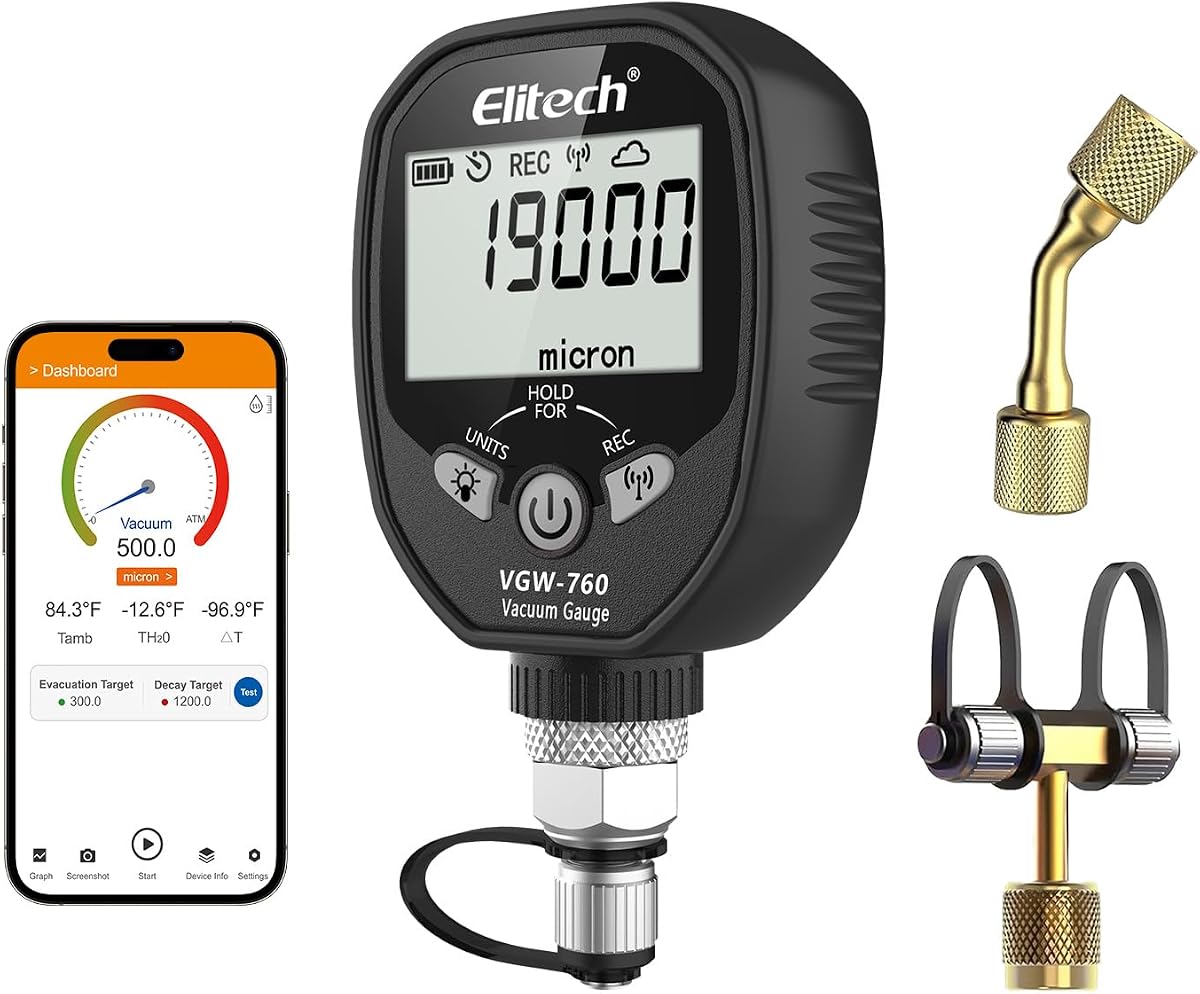
The Elitech VGW-760Pro is notable for covering 760,000 microns down to zero, effectively spanning atmospheric pressure through deep vacuum in one instrument. Its 4.1 customer rating and combination of full-range measurement, wireless monitoring, and offline recording make it a strong option for technicians who need more than a narrow HVAC vacuum window.
We may earn a commission when you buy through this link, at no additional cost to you.
The connected features include configurable targets, notifications when readings exceed the predetermined value, and data export in Excel and PDF formats. The meter also offers the same intelligent water-state assessment as the VGW-Mini, comparing ambient temperature with the saturation temperature that corresponds to the measured vacuum.
Stated accuracy is plus or minus 10% or plus or minus 10 microns, and the standard 1/4-inch SAE connection fits common HVAC setups. The oil-proof sensor-head film requires the same careful removal and reinstallation sequence described by the manufacturer, and this step can influence how quickly a numerical reading appears.
The VGW-760Pro is ideal for service professionals who need to monitor the full evacuation curve, retain records, and receive remote alerts. It is less essential for someone interested only in the final deep-vacuum reading, but for broader diagnostics, the expanded range can be a major advantage.
The atmospheric-to-zero range lets a technician observe the entire pull-down rather than only the final micron level. That makes the instrument useful for pump evaluation, system diagnostics, and initial pressure assessments.
Offline recording protects the ability to capture readings where connectivity is inconsistent. Once data is synchronized, target notifications and document exports can support more organized job records.
We may earn a commission when you buy through this link, at no additional cost to you.
The testo 552i combines a 4.3 customer rating, deep-vacuum capability, and a mature connected workflow. It measures down to single-digit resolution, with stated accuracy of plus or minus 10 microns plus 10% of the measured vacuum in the 100-to-1000-micron range.
We may earn a commission when you buy through this link, at no additional cost to you.
Its 45-degree service-port angle is a thoughtful mechanical detail. The probe can be connected without forcing the hose and instrument into an awkward straight-on position, reducing strain around the port. The IP54 housing also provides meaningful protection for an instrument regularly exposed to moisture, dust, and crowded service environments.
The 552i automatically connects to testo digital manifolds and operates through a single service port. Live readings can be viewed on the manifold or in the testo Smart App, where technicians can document results, manage service tasks remotely, and send reports from the job site. This integration is more specialized than a general-purpose standalone gauge.
The testo 552i is the strongest overall recommendation for technicians who already use testo digital manifolds or want a connected, report-friendly workflow. It is less suitable for users who need a full atmospheric-to-micron range or prefer a completely self-contained instrument with no ecosystem dependency.
The 45-degree service-port design helps the gauge sit more naturally at the connection point. This can improve access around tight equipment layouts and reduce unnecessary strain on the hose assembly.
Automatic connection to testo digital manifolds keeps the setup streamlined and avoids adding a separate port where possible. Live manifold readings, app access, and remote report delivery support a documentation-focused workflow.
We may earn a commission when you buy through this link, at no additional cost to you.
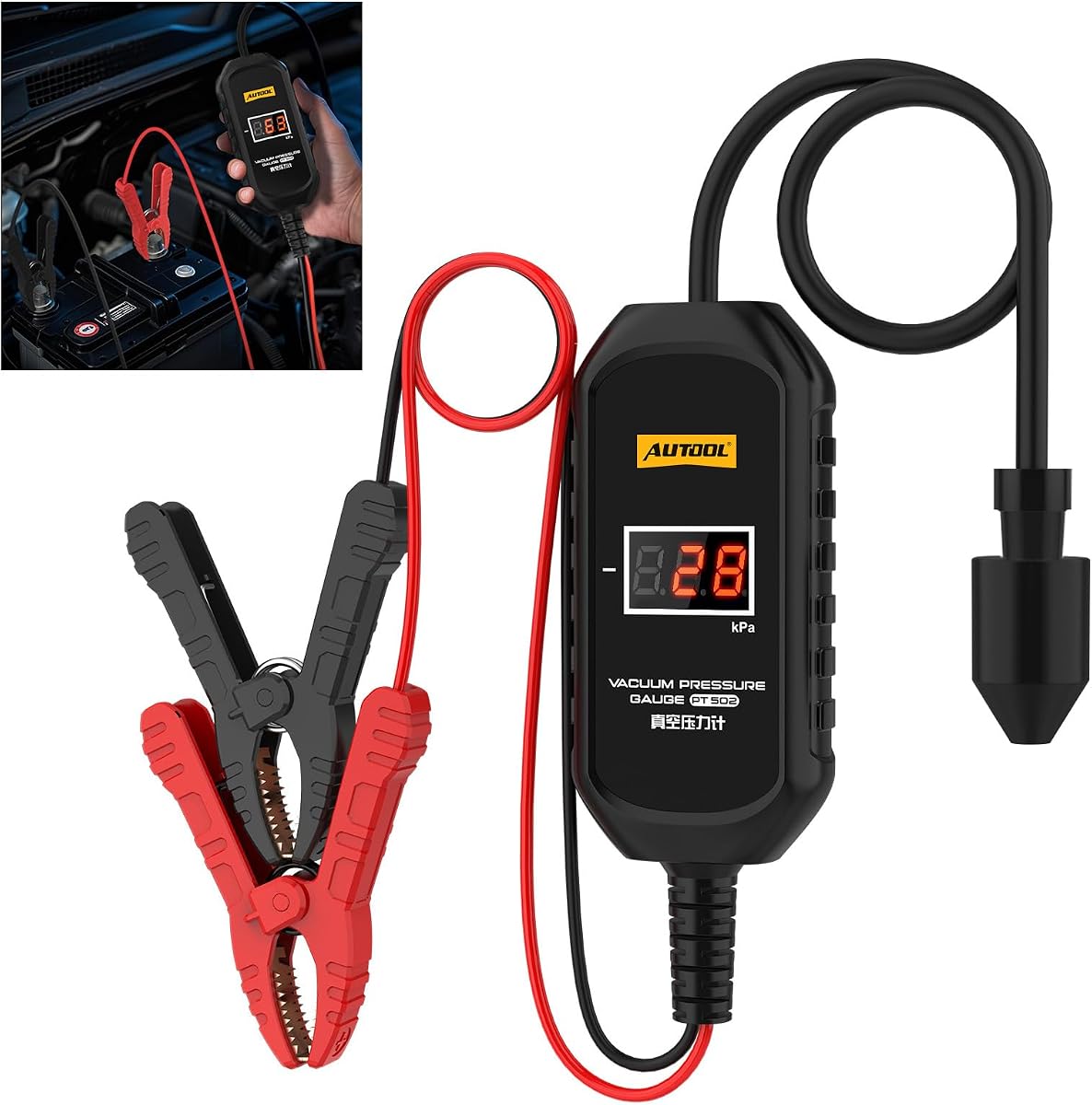
The AUTOOL PT502 is a budget-friendly digital vacuum pressure gauge built for automotive diagnostics rather than refrigerant evacuation. Its 4.4 customer rating is among the strongest in this guide, and its focused use case makes it a useful choice for monitoring intake, exhaust, EGR, hose, and related negative-pressure applications.
We may earn a commission when you buy through this link, at no additional cost to you.
The digital sensor measures from negative 101 kPa to zero and provides a clear real-time readout, avoiding the estimation required with a traditional analog gauge. That is valuable when checking pressure changes without repeatedly dismantling components or relying on visual needle movement.
Automatic temperature compensation is included for operation from minus 10 to 60 degrees Celsius. The meter runs on an external 12-volt supply with reverse polarity protection, reducing the risk of damage if the power leads are connected incorrectly. It cannot, however, provide the micron-level deep-vacuum measurements required for HVAC evacuation.
The PT502 is a good budget choice for automotive technicians, students, and weekend mechanics who need a readable pressure tester. HVAC professionals should choose a Pirani-style deep-vacuum gauge instead, while vehicle-focused users will appreciate the straightforward 12-volt operation.
A live digital value makes changes easier to compare and repeat than a moving analog needle. This supports diagnostics involving intake, exhaust, EGR components, and sealed hoses.
The 12-volt power arrangement suits workshop use, and reverse polarity protection helps guard against an incorrect battery connection. An external supply also means the meter does not depend on replaceable batteries during automotive testing.
We may earn a commission when you buy through this link, at no additional cost to you.
The Digital Vacuum Gauge Tester is a compact HVAC-focused meter with a perfect 5.0 customer rating, a large backlit LCD, and a straightforward target-monitoring process. It is designed for real-time tracking during refrigeration-system vacuuming and for checking dehumidification, impurity removal, and system conditions.
We may earn a commission when you buy through this link, at no additional cost to you.
Its Pirani sensor is specified for fast response and low-pressure detection. The stated accuracy is plus or minus 5% from 0.1 to 1000 Pa, with 0.01 Pa resolution below 10 Pa. Maximum overload pressure is 72 PSI, and the working temperature range extends from minus 23 to 122 degrees Fahrenheit.
Users can set and save a target vacuum, activate monitoring mode, and rely on periodic buzzer prompts. At the preset level, the screen flashes and an audible alert sounds. The meter can then be stopped manually with any key or will switch itself off after 35 seconds, helping preserve battery life.
The included tool bag, three AA batteries, extension connector, tee connector, and manual create a ready-to-use package. The gauge is best for HVAC learners, maintenance technicians, and owners seeking a simple meter with strong customer feedback, although professionals needing wireless reports should choose a connected model.
Pressing SET opens a direct path to choosing and saving the desired vacuum. The combined buzzer and flashing display then provide clear feedback when the selected threshold is reached.
The non-slip housing, matching tool bag, and included connectors support easy transport between jobs. Three AA batteries and automatic shutdown help keep the meter ready for repeated service calls.
We may earn a commission when you buy through this link, at no additional cost to you.
The right digital vacuum gauge depends on the system being tested, the vacuum depth required, and whether connectivity, automatic alerts, or formal reporting are important. These factors help narrow the field before comparing individual models.
Start by identifying the equipment and diagnostic task. HVAC and refrigeration gauges generally need micron-level readings, a 1/4-inch SAE connection, and a sensor designed to follow an evacuation down toward a target vacuum. Automotive gauges instead measure negative pressure in engine intake, exhaust, EGR, hose, and fuel-related systems, often in kilopascals. A wide unit display cannot transform a shallow-pressure automotive meter into a deep-vacuum HVAC instrument, so match the instrument to the job rather than relying on the shared product-category name.
Range determines whether the meter can capture the beginning and end of a pressure change. A full-range model extending toward atmospheric pressure is useful for monitoring the complete evacuation curve, while a gauge focused on 0 to 12,000, 19,000, or 75,000 microns may be more relevant to standard service. At the low end, resolution and stated accuracy show how precisely a technician can distinguish fine vacuum changes. Pay attention to the exact tolerance and its applicable range rather than assuming every displayed digit is equally precise.
Pirani sensors are common in HVAC meters because they provide rapid readings across a useful low-pressure range. Other gauges may use sensor technology suited to different needs, so compare the stated measurement method, accuracy, calibration procedure, and operating range. NIST-standard calibration, dual-point calibration, automatic self-calibration, and temperature compensation are different features, not interchangeable claims. A good purchase should clearly state what was calibrated and how the meter handles changing ambient conditions.
Digital gauges commonly display Pa, mBar, hPa, torr, mmHg, inches of mercury, and microns. Microns are especially common in HVAC evacuation work, while torr, millibar, and inches of mercury appear in many service procedures and reference documents. A four-unit display may be sufficient for most technicians, but a seven-unit option can be helpful when collaborating across manufacturers or international standards. Confirm that the gauge supports the unit required by your documentation instead of assuming every model displays microns.
Compatibility begins with the physical connection. The 1/4-inch SAE fitting, listed as 7/16-20 UNF on several models, is standard for many HVAC service applications. A tee fitting, hook, extension connector, or adapter can simplify setup, but included accessories do not guarantee universal compatibility. Verify the connection format used by your pump, manifold, service port, or test hose. For automotive use, examine hose fittings and the method by which the meter receives its 12-volt power.
A large backlit LCD is valuable in basements, mechanical rooms, and other dim service environments. An audible alarm lets a technician monitor the evacuation without watching the screen continuously, while a visual alert confirms that the alarm state is active. Configurable target values are especially useful for repeatable procedures. A fast refresh rate can make a live evacuation easier to interpret, but too many simultaneous readings may obscure the primary value. Consider whether a simple display or a multi-parameter diagnostic screen better matches the work.
Wireless capability can simplify monitoring through a compatible digital manifold or phone app. It may also provide target notifications, offline recording, remote task control, and report export in PDF or spreadsheet formats. That is valuable for technicians who must document completed service or share results with customers. Connectivity introduces an ecosystem requirement, however, and may be unnecessary for a simple gauge used only to confirm a target. Check device compatibility, offline behavior, and report functions before paying for features you will not use.
Service tools encounter temperature changes, condensation, oil residue, and occasional pressure spikes. Automatic temperature compensation helps maintain consistent readings, while overpressure protection adds a layer of resilience. A cleanable sensor is beneficial in refrigeration work, and a removable oil-proof film may protect the sensor while it is not connected to a pump. That film can also delay a reading if left in the wrong position, so follow the stated procedure. A carrying case, hanging strap, or tool bag adds protection between calls.
Begin by inspecting the gauge, sensor, connector, and hose for damage or contamination. Confirm that the connection matches the service port or pump, select the required unit, and allow the instrument to acclimate when automatic temperature compensation is listed among its features. Review the target level required by the equipment or service procedure, and familiarize yourself with the controls before connecting the gauge.
Attach the gauge securely and begin the evacuation or pressure test according to the system's service instructions. Observe the trend rather than focusing only on the final number, and use the alarm or target function when available. If a model includes a removable oil-proof film, follow the manufacturer's installation guidance precisely so the sensor can respond as intended. For connected gauges, confirm the app or manifold pairing before the procedure begins.
After testing, disconnect the gauge without creating a sudden pressure change, switch it off, and clean the exterior and reusable fittings according to the manual. Do not immerse the electronic instrument unless its documentation explicitly permits it. Store the gauge in its case or tool bag, remove batteries from models that will remain unused for an extended period, and arrange recalibration or verification if readings become inconsistent with a trusted reference.
Microns are the most common unit for deep HVAC vacuum targets, but torr, millibar, and inches of mercury are also frequently used in service procedures. A gauge supporting several units lets you match the display to manufacturer instructions without converting values manually. Always confirm the stated accuracy in the range where the final target will be measured.
No, resolution does not automatically equal total accuracy, and many standard evacuation procedures do not require a reading at that extreme level. What matters is that the range reaches the target and the sensor provides reliable, repeatable readings there. A 75,000-micron or 760,000-micron top-end rating is useful for observing the complete pull-down, while a lower maximum can still be adequate for deep-vacuum confirmation.
Wireless capability is most useful when you want remote monitoring, app-based records, report export, or integration with a compatible digital manifold. It is less important when a standalone display and audible target alert provide everything required by the service procedure. Confirm compatibility and charging or battery arrangements before choosing a connected model.
A multi-unit display may support several pressure formats, but the measurement range, sensor design, connection, and power method still determine the appropriate application. Automotive meters commonly use a 12-volt supply and measure negative pressure in kilopascals, while HVAC meters use a 1/4-inch SAE connection and Pirani sensor for deep vacuum. Matching the intended task is more important than matching the product name.
A delayed numerical response can result from a protective film remaining in the wrong position, especially on gauges that use a removable oil-proof membrane. Follow the manufacturer's instructions for removing the film when connecting directly to a vacuum pump and reinstalling it when connecting to the system. Also allow time for the instrument to stabilize after connection and confirm that the selected units are correct.
Calibration checks or adjusts the instrument against known conditions, while temperature compensation adjusts the displayed result for changes in ambient or sensor temperature. A product may offer one, both, or a specific calibration method such as zero-point, full-scale, or automatic calibration. Reviewing the exact procedure is more informative than looking only for the word calibration.
An audible alarm is valuable during long evacuations because it confirms a target has been reached without requiring constant visual attention. A visual flash is also useful when the meter is outside the technician's line of sight. The best setup combines a clear backlit display, a configurable target, and both audible and visual alerts.
Disconnect the gauge safely, clean loose contamination from the connector and exterior, and follow the manual's sensor-cleaning instructions. Protect the instrument with its supplied case, bag, or strap, and remove batteries if it will be stored unused for a long period. Readings that no longer align with expected behavior should be checked or recalibrated before the gauge is used for final confirmation.
The testo 552i stands out as the best overall option for technicians who value deep-vacuum resolution, protected construction, and a connected workflow with compatible digital manifolds. The CPS VG200 is the premium pick for straightforward NIST-standard accuracy, automatic temperature compensation, a durable sensor, and a complete field kit. The AUTOOL PT502 is the budget selection for automotive negative-pressure diagnostics rather than HVAC evacuation.
Your priorities should determine the remaining choice. A full atmospheric-to-micron range is valuable for monitoring an entire evacuation, a compact four-unit meter suits many standard HVAC tasks, and wireless recording helps technicians produce organized documentation. Always match the measurement range, sensor, connection, alerts, and power method to the actual system being serviced.
Marketplace listings, connected apps, accessories, and availability can change, and prices fluctuate over time. Before purchasing, confirm the current specifications and ensure the gauge is compatible with your pump, manifold, service ports, preferred units, and documentation workflow. Those checks will produce a more dependable match than relying on the category name alone.