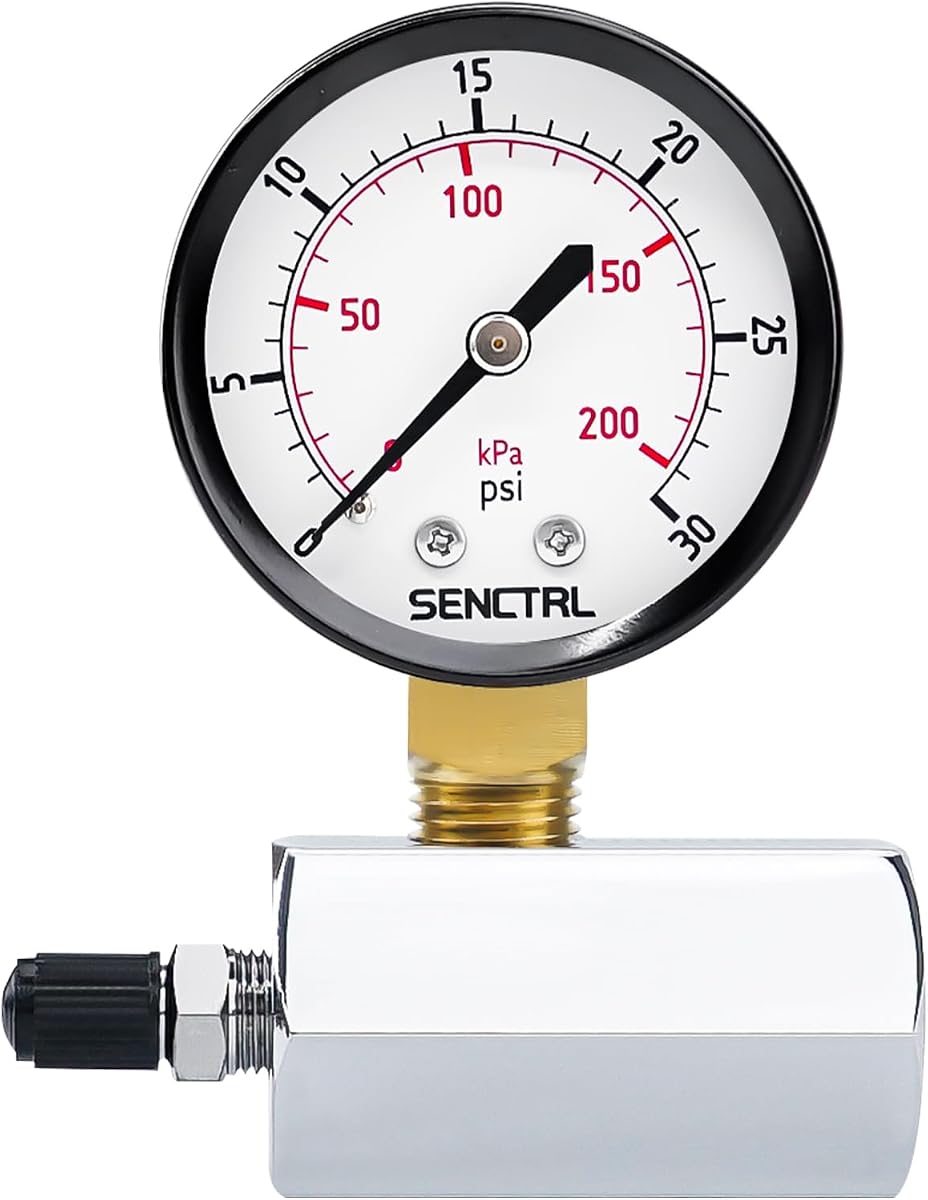
SENCTRL 0-30 Psi Gas Pressure Test Gauge
4.5Editor score
Direct 3/4-inch FNPT connection
Dual 0-30 psi scale
Steel case resists corrosion
A gas line pressure gauge helps professionals inspect pressure in natural gas, propane, and related piping systems, while some models can also support automotive fuel-pressure diagnosis. The most useful unit combines an appropriate pressure range, readable dial, durable wetted materials, and a connection that matches the equipment being tested. Gauge-only tools and complete test kits serve different needs.
This guide compares ten products by examining their stated pressure ranges, scale markings, dial dimensions, connection sizes, body or hose configurations, materials, accuracy, and intended applications. The list includes direct gas-line assemblies, manifold testing kits, tank gauges, and fuel-pressure tools, with each review clarifying where a product fits and where its capabilities end.
Each pick highlights a particular strength, including readable displays, convenient connection options, compact construction, or broader testing capability. Product ratings reflect the supplied customer feedback, while technical claims come from the listed product information. Availability and pricing can change, so confirm the current listing and fit before purchasing.
4.5Editor score

4.7Editor score

4.5Editor score
As an Amazon Associate we earn from qualifying purchases.
The comparison below organizes all ten products by intended use, pressure scale, connection, and included equipment, making it easier to distinguish a direct gas-line gauge from a manifold kit or an automotive fuel-pressure tester.


The SENCTRL 0-30 Psi Gas Pressure Test Gauge is a compact assembly intended to measure pressure in a gas line or tank, and its 4.5 rating reflects generally favorable customer feedback. It combines a two-inch dial with a steel case, chrome-plated valve body, and direct 3/4-inch female NPT connection, making it a practical option when a full hose kit is unnecessary.
We may earn a commission when you buy through this link, at no additional cost to you.
The gauge presents pressure on dual scales covering 0-30 psi and 0-200 kPa. That is especially useful for technicians who routinely work with one unit system but may need to interpret the other. Its stated accuracy is plus or minus 3-2-3 percent across the range, while the black steel case is designed to resist corrosion and the chrome-plated steel body should hold up well in repeated service environments.
The main limitation is its specialized design. This is not a manifold kit with a long hose, and its 3/4-inch FNPT connection must match the line or adapter being used. The 30 psi ceiling also makes it unsuitable for higher-pressure gas testing. Even so, the fixed connection creates a straightforward installation path and avoids the need to assemble several separate components.
This is a strong selection for a technician who wants a basic, directly connected gauge for a compatible gas line or tank. It offers the clearest connection-oriented design in the group without requiring a large carrying case or lengthy hose. Verify thread type and line size first, and choose it when low-pressure readings and direct access are the main priorities.
The integrated 3/4-inch FNPT inlet allows the assembly to connect directly to a compatible gas line. This reduces setup time and makes the gauge well suited to routine checks where a hose-mounted manifold tester would be unnecessary.
A 0-30 psi and 0-200 kPa face makes the reading useful in two measurement systems. The two-inch dial keeps the assembly compact, although users who need greater visual resolution may prefer a larger manifold gauge.
We may earn a commission when you buy through this link, at no additional cost to you.
The Uharbour 30psi Brass Gas Line Pressure Tester carries a 4.3 rating and centers on a durable forged-brass construction intended for low-pressure natural-gas testing. It is designed for gas or air pressure measurement and includes both a 3/4-inch NPT female inlet and a 1/4-inch NPT tank valve, giving it more connection flexibility than a fixed single-port gauge.
We may earn a commission when you buy through this link, at no additional cost to you.
Its two-inch transparent-face gauge uses dual bar and psi scales, which can make interpretation easier for users accustomed to either measurement convention. The listed accuracy is described as compliant with ASME B40.100, and the brass body is intended to resist corrosion. The product information specifically highlights suitability for underground and indoor gas lines, as well as tubes carrying compatible gases that will not obstruct the port or attack the copper alloy.
The assembly requires more attention during setup than the SENCTRL model. PTFE tape should be applied and the components tightened properly to help prevent leakage, while the different inlet and valve thread sizes must be matched to the intended setup. A fixed 30 psi range also limits use where higher pressures may be encountered.
Choose the Uharbour tester when a durable brass body, separate tank valve, and dual-scale readout are priorities. It is a versatile option for compatible residential gas-line work, especially for users who want both an inline inlet and a smaller auxiliary connection. Confirm both thread sizes and prepare every threaded joint carefully before testing.
The forged brass construction is the defining feature of this tester. Brass is well suited to many fuel-gas applications because it offers a practical balance of durability and corrosion resistance when the connected medium is compatible with the alloy.
Separate 3/4-inch and 1/4-inch NPT connections provide more ways to route the tool. The smaller tank valve makes the assembly more adaptable than a one-piece gauge, though correct sealing and thread matching remain essential.
We may earn a commission when you buy through this link, at no additional cost to you.
The Gas Test Pressure Gauge 60 Pound offers a wider 0-60 psi range than most of the dedicated residential gas-line options in this guide. It has a 4.3 rating and combines a brass valve, forged steel body, steel gauge case, and a two-inch dial. The dual psi and kPa scales and 3-2-3 percent accuracy specification make it a versatile direct-connection tester.
We may earn a commission when you buy through this link, at no additional cost to you.
One notable feature is the Burdon tube type movement. The gauge also uses a durable glass lens described as non-fading, helping protect the dial while maintaining clear visibility. Its 3/4-inch FNPT connection permits direct attachment to a compatible gas line, while the bell-shaped forged steel body gives the assembly a substantial feel and a larger pressure range.
The extended range comes with a trade-off. A 0-60 psi dial generally divides the scale more coarsely than a 0-30 psi gauge, so it may be less convenient for reading very small changes at low line pressure. It is also a direct assembly without a long hose, meaning it is less suited to remote appliance manifolds or installations that require flexible access.
This product is best for users whose test pressures may exceed 30 psi but who still want a straightforward 3/4-inch FNPT assembly. It combines brass and steel components in a rugged format while preserving a dual scale. If low-pressure resolution is more important than the higher ceiling, one of the 0-30 psi assemblies may be a better fit.
The 0-60 psi range gives technicians additional measurement headroom compared with the many 30 psi options. It is useful when the connected system may operate above the midpoint of a 30 psi gauge, while still supporting common low-pressure test work.
A sturdy steel case and durable glass lens help protect the movement. The two-inch dial with dual scales supports practical readings, though users checking minor changes may need to look closely at the available increments.
We may earn a commission when you buy through this link, at no additional cost to you.
The MEASUREMAN 2-inch Brass Gas Pressure Test Gauge Assembly prioritizes dial visibility with its stated 2.5-inch face, larger than the two-inch gauges common among several competitors. Its 4.3 rating, brass test body, black steel case, and 3/4-inch female NPT adapter make it a straightforward choice for compatible gas-line pressure checks.
We may earn a commission when you buy through this link, at no additional cost to you.
The gauge measures 0-30 psi on a dual scale, which is useful across pressure ranges commonly encountered in low-pressure gas work. Stated accuracy of plus or minus 3-2-3 percent provides a consistent tolerance specification across the scale. Brass wetted parts and a dry gauge design are also highlighted in the product information.
Its main limitation is the absence of a hose or auxiliary manifold accessories. The fixed adapter favors a direct connection but may be less convenient for hard-to-reach appliances. As with other 0-30 psi units, the gauge is not appropriate when substantially higher test pressures are required. The larger dial is a meaningful advantage, but it does not change the basic connection format.
This MEASUREMAN assembly is a good fit for technicians who prioritize a larger readable face and brass contact components without needing a full test kit. It is particularly practical for a compatible fixed gas-line connection. Users should verify that the 3/4-inch NPT thread matches the system and understand that the tool is intended for gas-line pressure testing rather than manifold pressure.
The 2.5-inch dial is the main visual advantage. A larger face can reduce the effort required to read small changes, making the assembly more comfortable for routine checks than a compact two-inch model.
Brass wetted parts provide a familiar, durable choice for compatible fuel-gas testing. Combined with a black steel case, the construction balances protection of the gauge and the parts exposed to the measured medium.
We may earn a commission when you buy through this link, at no additional cost to you.
The BETOOLL Fuel Pressure Test Kit is an automotive-focused gauge-and-hose set rather than a residential natural-gas pressure tester. It has a 4.4 rating and covers 0-100 psi, with a 0-7 bar secondary scale. Three hose adapters accommodate common SAE sizes, making the kit useful for checking fuel pressure across a range of compatible gasoline-engine systems.
We may earn a commission when you buy through this link, at no additional cost to you.
The kit is designed to help diagnose low fuel pressure, a faulty pressure regulator, leaking injectors, fuel leaks, and clogged filters. Its brass connectors and corrosion-resistant rubber hose are intended for repeated use. Compared with a simple gas-line gauge, this package offers a flexible hose and multiple adapters that can make it easier to connect at several test points.
It should not be treated as a natural-gas or propane pressure gauge. The product information explicitly says never to use the kit on diesel engines, and the listed application is engine fuel-pressure diagnosis. The scale markings and connection adapters also differ from the low-pressure manifold kits used with household gas appliances, so choosing it for gas-line work would be a category error.
This is a solid choice for automotive technicians who need a broad fuel-pressure range and several common SAE adapters. It can help isolate fuel-system faults without removing components for individual tests. It is not an alternative to a dedicated natural-gas manifold kit, and its use should remain limited to compatible gasoline fuel systems rather than diesel engines.
A 0-100 psi scale covers many common gasoline fuel-pressure checks. The dual psi and bar display also allows readings to be interpreted in two systems, which can be helpful when comparing values with service documentation.
The included 6.30 mm, 7.89 mm, and 9.49 mm SAE adapters cover three frequently encountered hose sizes. This variety reduces the need to locate one specific adapter before a diagnostic session.
We may earn a commission when you buy through this link, at no additional cost to you.
The MEASUREMAN Natural Gas or LP Gas Manifold Pressure Test Kit is the most complete dedicated household-gas package among the picks. It carries a 4.5 rating and includes a 2.5-inch dial, 40-inch rubber hose, one-eighth-inch NPT male brass fitting, and a molded plastic storage box. Its pressure range of 0-35 inches of water column is specifically appropriate for manifold-level gas readings.
We may earn a commission when you buy through this link, at no additional cost to you.
The listed operating references are 2.5 to 4 inches W.C. for natural gas and 10 to 12 inches W.C. for LP gas, which makes this kit more relevant to appliance manifold checks than a 0-30 psi line gauge. A beryllium diaphragm capsule, brass movement and connection, black steel case, snap-on acrylic window, and lower mount support a purpose-built low-pressure design.
Users must recognize that inches of water column are a different measurement scale from psi. The 35-inch W.C. range is appropriate for low-pressure manifold work but not for systems requiring higher readings. The one-eighth-inch NPT connection may also require an appropriate mating fitting or adapter, and the long hose adds bulk compared with a direct gauge assembly.
This kit is the strongest pick for a technician who regularly tests appliance manifolds, especially when both natural gas and LP service are part of the workload. The long hose, dedicated low-pressure scale, and protective case create a more complete setup than a simple inline gauge. Confirm the appliance connection and the required W.C. reading before using it in service.
The 0-35-inch W.C. face targets the much lower pressures commonly found at appliance manifolds. This makes the kit more useful for those checks than a 0-30 psi or 0-100 psi gauge whose scale would occupy only a small portion of its range.
The 40-inch hose, brass fitting, and molded plastic box provide a more organized field setup. The case helps protect the gauge and accessories during storage and transport, which is valuable for technicians who move between appliances or job sites.
We may earn a commission when you buy through this link, at no additional cost to you.
The DANCO Gas Test Gauge is built for tank-pressure testing up to 15 psi, and its 4.2 rating indicates generally positive customer feedback. The most useful feature is its one-tenth psi increment scale, allowing users to observe relatively small pressure differences during a leak test or other low-pressure check.
We may earn a commission when you buy through this link, at no additional cost to you.
The body is brass with a chrome-plated finish, while the clear face is made from plastic intended to resist breaking. A sturdy steel case adds protection, and the design fits onto 3/4-inch MPT threads. These features combine a low range with a durable exterior for use around tanks and compatible gas equipment.
The 15 psi maximum is the main constraint. It is considerably lower than the 30- and 60-psi options and inappropriate for any application that can produce readings beyond that ceiling. The MPT thread is also different from the female NPT connection found on many competing gas-line gauges, so buyers must confirm their existing connection and avoid assuming standard NPT compatibility.
This gauge is a specialized choice for low-pressure tank tests where fine tenth-psi resolution is valuable. It is less versatile than a manifold kit but may be better when the job calls for a compact, direct gauge and the system operates well below 15 psi. Check the MPT thread carefully and choose it only when its specific low-pressure focus matches the test.
Tenths-of-a-pound increments are valuable when small changes need to be observed. The 0-15 psi scale gives those small divisions more visual space than they would receive on a gauge with a much higher maximum.
A brass body, chrome plating, plastic face, and steel case provide a practical protective combination. The design is compact and direct, but the 3/4-inch MPT thread should be compared carefully with the equipment before purchase.
We may earn a commission when you buy through this link, at no additional cost to you.
The MEANLIN MEASURE 0-35-inch WC Manifold Gas Pressure Test Kit has a 4.7 rating, the highest among the ten products, and offers a well-rounded setup for natural-gas or LP manifold testing. It includes a 2.25-inch dial, 40-inch hose, one-eighth-inch NPT barbed connection, and three hex bushings that expand connection compatibility.
We may earn a commission when you buy through this link, at no additional cost to you.
The supplied bushings cover 1/8-inch by 1/4-inch NPT and 1/8-inch by 3/8-inch NPT combinations, along with the one-eighth-inch NPT barbed connection. This makes the kit more adaptable than a manifold gauge sold with only one fitting. The pressure range is 0-35 inches W.C., and the zero-adjustable setting provides useful control before a test.
Its operating temperature range is listed as 32-131 degrees Fahrenheit, or 0-55 degrees Celsius. A helpful product note explains that NPT thread size is nominal and does not represent actual diameter, reducing the chance of a mistaken assumption during fitting selection. Compared with the MEASUREMAN premium kit, the main missing feature is a protective molded case.
This is the editor's choice because it balances low-pressure manifold relevance, connection flexibility, hose length, and a strong customer rating. It suits technicians who work across natural-gas and LP appliances and want more than one fitting option. Its 35-inch W.C. scale is purpose-built for manifold pressures, so it should not be mistaken for a high-psi line gauge.
Three hex bushing options reduce dependence on a single connector size. That flexibility is useful when access points vary between appliances, while the barbed fitting and forty-inch hose make remote or confined installations more manageable.
The 0-35-inch W.C. range and adjustable zero are tailored to low-pressure manifold checks. A 2.25-inch dial provides a balanced compromise between readability and the size of a hose-mounted field tool.
We may earn a commission when you buy through this link, at no additional cost to you.
The Boltigen Fuel Pressure Gauge is an inline automotive fuel-monitoring tool with a 4.4 rating. It measures 0-15 psi and uses a glycerin-filled gauge to help keep readings stable. The one-eighth-inch NPT connection, center-back mounting position, and visible face allow a technician to monitor fuel pressure while the engine or system is operating.
We may earn a commission when you buy through this link, at no additional cost to you.
The kit includes 3/8-inch and 5/16-inch brass barb fittings, along with attached clamps for installation. Stainless steel and brass construction provide corrosion resistance and durability. Together with the inline layout, these fittings allow the gauge to sit in the fuel line where the reading remains visible during testing or diagnostic work.
This product is for automotive, marine, and industrial fuel-system applications rather than household natural-gas testing. Its 0-15 psi range is suitable only for systems that remain within that limit, and the hose and fitting sizes differ from those found on gas-line pressure tools. It should not be selected merely because it resembles a gas gauge with a similar low-pressure range.
The Boltigen kit is most appropriate for a technician who wants continuous, stable visibility of fuel pressure in a compatible system. The glycerin fill helps damp movement and improve reading stability, while the inline design eliminates much of the need to repeatedly connect a remote test gauge. Confirm the system pressure, fitting sizes, and mounting position before installation.
The glycerin-filled movement is intended to reduce the effect of vibration and movement on the pointer. This makes the gauge more suitable for live monitoring than a basic test gauge used only for instantaneous readings.
The center-back mount positions the dial where it can remain visible during operation. Brass barb fittings and included clamps simplify the inline arrangement, provided the hose sizes match the vehicle or fuel system.
We may earn a commission when you buy through this link, at no additional cost to you.
The OTC 5630 Fuel Pressure Test Kit is a professional automotive diagnostic package with a 4.5 rating. It is intended to locate faults involving fuel filters, pressure regulators, fuel lines, and fuel pumps without removing each component from the vehicle. Its 0-100 psi range and 0-700 kPa secondary scale cover many common gasoline fuel-pressure tests.
We may earn a commission when you buy through this link, at no additional cost to you.
The large dial is enclosed in an impact-resistant rubber housing, which is useful during frequent shop use. Solid brass fittings, hose, and tubing support durability, while the integrated pressure relief valve provides a controlled way to release pressure during testing. These features make the kit more substantial than a simple gauge and hose set.
This is an automotive fuel tester, not a natural-gas or propane line gauge. Its scale, hose arrangement, and relief-valve design are intended for vehicle fuel systems, and there is no inch-of-water-column scale for low-pressure manifold work. Using it outside its intended application would be inappropriate even if a physical connection could be adapted.
The OTC 5630 is a strong choice for automotive technicians who need a complete, purpose-built pressure diagnostic kit. It combines a broad range, large display, durable brass components, and a pressure relief valve in one package. Choose it for vehicle fuel-system troubleshooting rather than as a substitute for one of the dedicated natural-gas or LP pressure testing products in this guide.
The kit is designed around common fuel-system faults and can help isolate components without removing them individually. That diagnostic focus makes it more useful than a basic inline fuel gauge for a broad troubleshooting session.
The impact-resistant rubber housing protects the large gauge in a working environment. Solid brass fittings and tubing add durability, and the pressure relief valve supports safer, cleaner test procedures when pressure needs to be released.
We may earn a commission when you buy through this link, at no additional cost to you.
The right gauge depends on the medium, pressure scale, connection, and location of the test. Gas-line, manifold, tank, and automotive fuel systems require different tools, so begin with the intended measurement rather than comparing dial sizes alone.
A useful gauge must cover the normal operating and test pressure of the system without sacrificing too much resolution. A 0-15 psi gauge can reveal small changes at low pressure but cannot safely or accurately display a higher reading. A 0-30 psi model offers more room for line testing, while a 0-60 psi option is useful when additional headroom is needed. Manifold systems generally use inches of water column, so a 0-35-inch W.C. scale is more appropriate than a psi scale. Match the instrument to the job rather than choosing a range based only on what appears largest.
Psi and inches of water column are not interchangeable. A household manifold gauge measuring 0-35 inches W.C. is intended for very low pressures commonly encountered at appliance connections, while a 0-30 psi assembly is designed for line-level testing. A user who expects a manifold reading on a psi gauge may be using the wrong tool and could draw an incorrect conclusion. Product listings often identify intended use, but it is still important to understand the scale before attaching a gauge to any system.
Connection details are critical because NPT and MPT threads are not automatically interchangeable. Several picks use 3/4-inch female NPT, while others use one-eighth-inch NPT, one-quarter-inch NPT, or 3/4-inch MPT. NPT is a nominal designation and does not directly indicate the measured thread diameter. Check the existing port, the fitting included with the kit, and whether an adapter is needed before purchase. A correct connection without proper thread sealing can still produce a leak, so follow the listed instructions for tape, sealant, and tightening.
Dial size affects how quickly a reading can be interpreted. The two-inch and 2.25-inch options are compact and portable, while the 2.5-inch MEASUREMAN face offers more visual room. A large dial becomes especially valuable when measuring subtle changes or working in poor lighting. Look for a clear face, a durable lens, readable dual scales, and a pointer that is easy to follow. More scale divisions can also improve resolution, but only if they remain legible rather than appearing crowded.
A direct gauge with a 3/4-inch FNPT connection is efficient when the test port is nearby and the correct thread is available. A hose-based manifold kit is more useful when the gauge must reach an appliance, regulator, or confined connection. It can also be easier to position the dial at eye level. Direct assemblies are compact and have fewer parts, while kits provide greater placement flexibility. Consider the normal distance from the connection to where you need to read the pressure before choosing between the two styles.
Brass, steel, and stainless steel are common in the listed products, but the connected medium still matters. Brass is widely used for compatible fuel-gas and fuel-pressure tools, while the supplied information for the Uharbour tester specifically notes suitability for gases that do not obstruct the port or corrode the copper alloy. A protective case or chrome finish helps protect the tool, but it does not make an incompatible medium safe. Review the manufacturer's stated material restrictions and the characteristics of the system being tested.
Natural-gas manifold pressure, gas-line pressure, tank pressure, and automotive fuel pressure represent different applications. The BETOOLL, Boltigen, and OTC products are designed for fuel-system diagnosis, not household gas-line testing. The MEASUREMAN and MEANLIN MEASURE kits use inches of water column for manifold work, while the SENCTRL, Uharbour, Gas Test, MEASUREMAN, and DANCO units offer psi scales for line or tank checks. Choosing by shape alone can lead to the wrong scale, connection, and use case.
Field use makes portability and organization important. A molded storage case, as included with the MEASUREMAN manifold kit, helps protect a gauge and its accessories between jobs. Hose-based tools are more flexible but bulkier, while direct assemblies are easier to carry. Consider whether the kit must move between service vehicles, appliance rooms, or confined mechanical spaces. Also note whether included clamps, bushings, or valves must remain organized to prevent loss during frequent use.
Begin by identifying the system, test point, required scale, and thread format. Verify that the gauge range is appropriate and that its connection matches the port without relying on thread appearance alone. Clean the fitting, inspect threads and seals, and apply the specified sealant or PTFE tape where required. Tighten the connection evenly and carefully, taking care not to damage the relatively small threads found on many manifold fittings.
Open or isolate the system according to the applicable operating procedure, then connect the gauge before pressurizing the test area. Place a hose-based gauge where the dial can be read safely and directly. For a direct assembly, make sure the valve position and orientation permit correct attachment. After the test, close the relevant valve, relieve pressure through the designated path, and disconnect the gauge only after the system is safe.
Wipe the gauge and hose clean after use, but avoid immersing the instrument or directing harsh fluid into the dial. Store the tool in a dry, protected place, and keep the case or components organized when a kit is supplied. Periodically inspect seals, threads, hoses, clamps, and the lens for wear or damage. Replace a damaged fitting rather than trying to make an incompatible connection secure with extra tape.
No. Automotive fuel-pressure gauges are designed for compatible vehicle fuel systems, while household natural-gas and propane testing requires a gauge with the correct pressure scale, connection, and material compatibility. The BETOOLL, Boltigen, and OTC products in this guide are fuel-testing tools, not substitutes for a dedicated gas-line or manifold gauge.
The correct range depends on the system and the type of test. A 0-15 psi tank gauge is limited to relatively low readings, while 0-30 and 0-60 psi assemblies provide more range for line-level work. Appliance manifold testing generally uses an inches-of-water-column scale, such as 0-35 inches W.C.
A line gauge usually connects directly to a suitably threaded gas-line port and may display psi. A manifold gauge commonly uses a hose and low-pressure inches-of-water-column scale because appliance manifold pressures are much lower. The correct choice depends on where the pressure is being measured and what units the system uses.
No. They are different nominal pipe sizes and must match the available port or be joined with properly rated adapters. NPT size is a nominal designation rather than an exact diameter, so confirm the thread standard and the listed product dimensions rather than relying on visual comparison alone.
PTFE tape can help seal compatible threaded connections when applied correctly. The Uharbour product specifically instructs users to wrap the tape and tighten all parts before use. Excessive or improperly applied tape can also cause fitting problems, so follow the manufacturer instructions and avoid forcing a connection that does not belong.
No. A higher maximum offers more headroom but can reduce resolution at low pressures. A 0-60 psi dial may be less useful for small changes than a 0-15 or 0-30 psi gauge. Select a range that comfortably covers the expected pressure while preserving useful divisions in the area where readings will occur.
Some manifold kits are designed for both natural gas and LP, but the expected operating references differ. The listed MEASUREMAN and MEANLIN MEASURE kits cover natural gas and LP with reference ranges of 2.5 to 4 inches W.C. and 10 to 12 inches W.C. respectively. Always use the appropriate reference for the fuel being tested.
Store it in a clean, dry environment away from impact and excessive heat. Keep hose fittings, clamps, bushings, and adapters together, preferably in the supplied case when one is provided. Inspect the lens, seals, threads, and hose before each use, and do not use a fitting that appears cracked, stripped, or incompatible.
The SENCTRL 0-30 Psi Gauge is a concise choice for a compatible direct 3/4-inch FNPT connection, while the MEANLIN MEASURE manifold kit stands out for its 0-35-inch W.C. scale, long hose, multiple bushings, and highest customer rating. For a more complete protected setup, the MEASUREMAN natural-gas and LP manifold kit adds a molded storage case and dedicated low-pressure components.
Prioritize the system and scale before any secondary feature. Use a psi-rated direct assembly for suitable line or tank checks, a manifold kit with inches of water column for appliance pressures, and an automotive fuel kit only for compatible fuel systems. Thread type, connection size, dial readability, hose length, and material compatibility are equally important once the correct category is selected.
Before purchasing, verify the current product listing, included accessories, connection details, and manufacturer instructions. Customer ratings and product availability can change over time, and current pricing may also vary. Taking a few minutes to match the gauge to the intended service can prevent connection problems, inaccurate readings, and an unsuitable purchase.