
Surecom SR-629 2 in 1 Duplex Cross Band Radio Repeater Controller
4.1Editor score
Real-time duplex cross-band linking
Built-in rechargeable Li-ion battery
DTMF password-protected remote control
Compatible with popular handheld radios
A cross band repeater radio links VHF and UHF transmissions, allowing a radio on one band to receive communications and retransmit them on the other. The right model can improve group reach across terrain, buildings, vehicles, and outdoor routes, but capability depends heavily on radio design, antenna compatibility, power, and intended portability.
This guide compares ten controllers, handheld transceivers, and mobile radios using the supplied specifications, including supported bands, display functions, repeater modes, battery details, GPS or APRS functions, and installation features. It covers options suited to ham operators, emergency-preparedness users, travelers, clubs, and vehicle-based communication teams without claiming hands-on testing.
The recommendations show how the category divides between lightweight portable units, feature-rich GPS radios, dedicated repeater controllers, and higher-power mobile installations. The top picks represent the strongest balance of functionality and value for most buyers, while specialized users may favor a particular form factor. Prices and availability can change, so confirm current listings before purchasing.
4.1Editor score
4.3Editor score

3.8Editor score
As an Amazon Associate we earn from qualifying purchases.
The comparison below places each controller, portable transceiver, and mobile installation side by side. Focus on form factor, radio bands, navigation features, and installation needs rather than treating every cross-band radio as the same type of product.




The Surecom SR-629 is a dedicated cross-band repeater controller rather than a conventional handheld or mobile radio. It holds a 4.1 rating and stands out for a simple, practical approach: connect two compatible handheld radios, assign their operating roles, and use the controller to relay received audio in real time. The multi-LED display shows radio status and the controller battery level.
We may earn a commission when you buy through this link, at no additional cost to you.
Its key strength is flexibility without requiring a full mobile installation. The supplied information says it works with most popular handheld radios, operates from a built-in Li-ion battery for up to 72 hours, and can also accept external 5-volt power. DTMF remote control lets an operator turn the repeater on or off remotely, while the password can be changed through a connected radio.
There are clear trade-offs. The SR-629 does not include the two radios needed to form a complete system, and users must confirm connector type, audio compatibility, and programming requirements. Its 2-pin 46-K cable arrangement may not suit every radio without the appropriate connection solution. The 72-hour figure also depends on real-world transmit duty cycle and battery condition.
This is a compelling budget choice for hams, clubs, or emergency-preparedness groups that already own compatible handhelds and want a portable cross-band base station. It delivers the essential relay function, remote management, and flexible power options without requiring a permanently installed mobile radio, making it the strongest value-oriented recommendation in this roundup.
The internal battery makes the SR-629 useful away from a vehicle or fixed station. That portability is especially helpful for field exercises, temporary trail operations, and emergency deployments where finding AC power could be difficult.
DTMF control and password protection reduce the need for direct physical access after configuration. The status LEDs also provide a quick indication of linked radios and remaining controller battery level.
We may earn a commission when you buy through this link, at no additional cost to you.
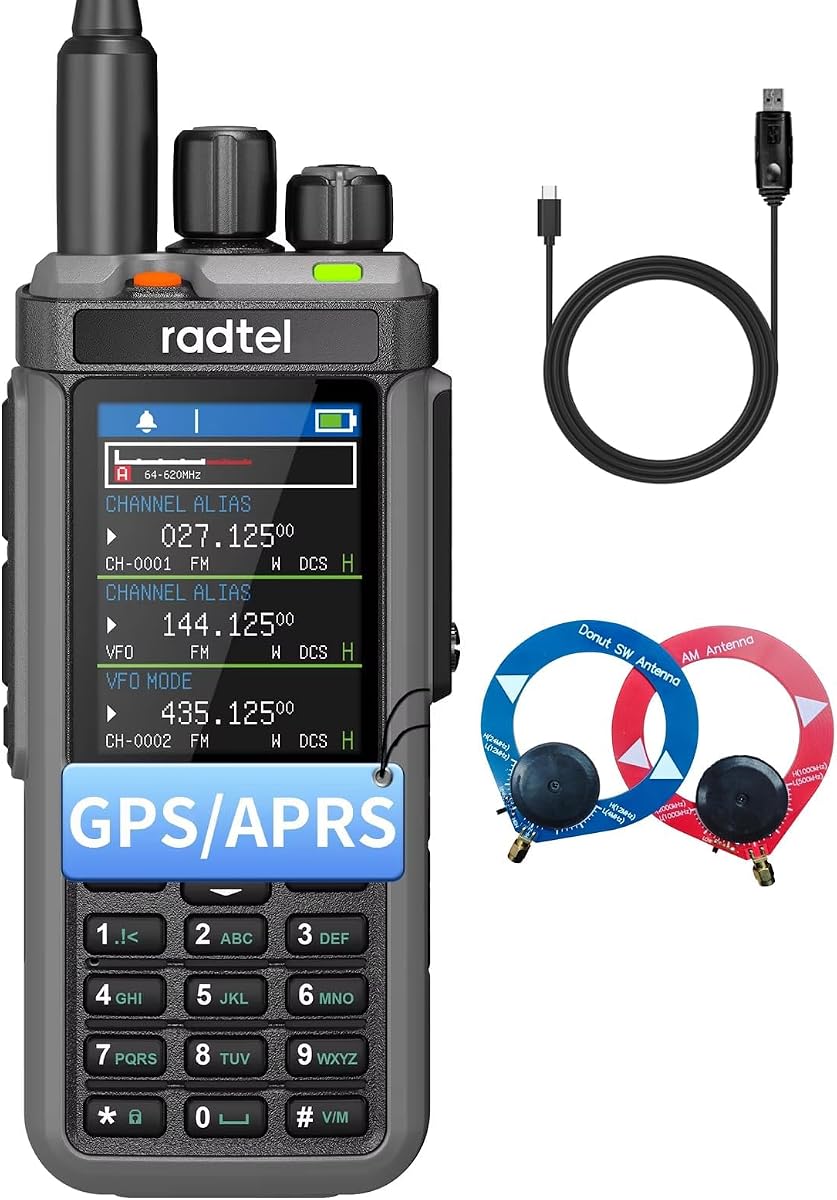
The Radtel RT-880G earns the Editor's Choice position by combining a portable cross-band repeater with GPS, APRS, broad reception, and a color display. Its 4.3 rating is among the stronger results in the group, while the breadth of functions gives it broader utility than a basic relay controller.
We may earn a commission when you buy through this link, at no additional cost to you.
GPS positioning can show distance and direction from a selected starting point, record tracks manually or on a timer, and query coordinates. APRS encoding and decoding supports real-time position communication and automatically calculates direction and distance when coordinates are present. For cross-band work, the radio links UHF and VHF frequencies to improve coordination across different band allocations.
The RT-880G also supports reception across AM, FM, USB, LSB, CW, CB, LW, MW, shortwave, SSB, and air-band ranges. A port for a shortwave antenna expands reception options, while customizable side keys and keyboard functions allow faster access to frequently used settings. The 2400mAh battery and USB-C charging add convenience for extended portable use.
Its main drawback is complexity. A radio with this many bands, navigation features, three VFO-related operating modes, and programmable controls has a steeper learning curve than a simple controller. Reception capability also does not automatically mean the unit can transmit on every received band. Overall, it is the most versatile all-in-one pick for users who want communications and position information in one device.
GPS and APRS turn the RT-880G into more than a range extender. These functions suit hiking groups, search-and-rescue teams, travel clubs, and anyone who benefits from sharing position while maintaining VHF or UHF contacts.
The wide receive selection makes the radio appealing for monitoring, emergency information, and amateur-band activity. Transmit permissions remain limited to authorized bands, so operators should verify frequency rules and local licensing requirements.
We may earn a commission when you buy through this link, at no additional cost to you.
The Retevis MA1 is a mobile cross-band transceiver intended for users who want more than a portable relay. It has a 3.8 rating, lower than the other selections, but its dedicated construction, advanced receiver filters, transmit noise cancellation, and remotely mountable panel make it a specialized option for vehicle and fixed-base installations.
We may earn a commission when you buy through this link, at no additional cost to you.
Its cross-band relay can act as a signal tower, rebroadcasting a call so teammates beyond direct radio reach can connect. Updated firmware version 2.39 reportedly reduces problems such as nonlinear volume adjustment and PTT delay. The receiver filtering is designed to reduce unwanted signals, while TX noise cancellation helps users remain intelligible around engines, sirens, and other ambient noise.
The reversible flip panel protects ports from bumps and can be positioned for easier viewing. An upgraded radio bracket is intended to simplify installation and improve stability. The MA1 also supports local FM or AM listening and receive-only aircraft-band monitoring through its A channel, adding functions beyond basic relay service.
This is a premium mobile recommendation rather than a universal choice. It is best for licensed operators or groups willing to plan a proper installation, select an appropriate antenna, and learn the radio's controls. The low rating should be weighed carefully, but the specialized filtering, noise cancellation, and installation design justify consideration for demanding mobile use.
Advanced receiver filters and transmit noise cancellation target two common complaints in mobile communications: interference from crowded bands and background noise that masks a transmitted message. These are meaningful advantages in traffic, storms, and off-road settings.
The reversible panel and upgraded bracket offer more installation flexibility than a basic handheld setup. A stable mounting method and a correctly matched antenna remain essential for realizing the MA1's range potential.
We may earn a commission when you buy through this link, at no additional cost to you.
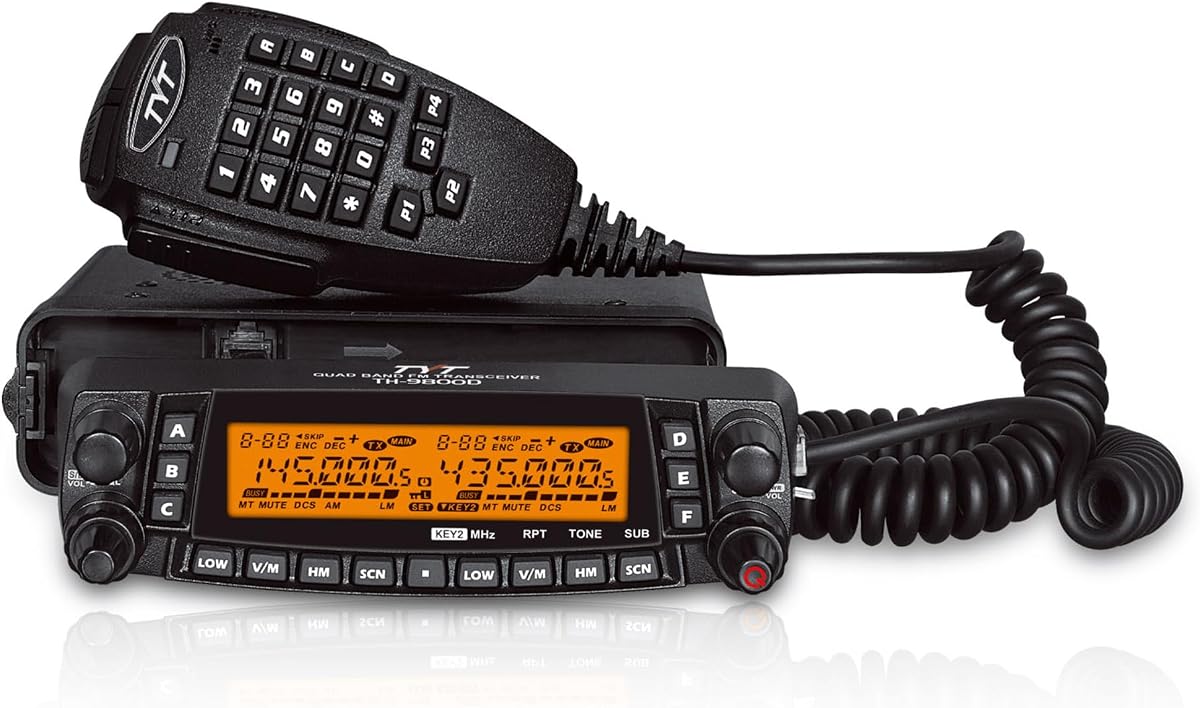
The TYT TH-9800 is a high-output mobile radio for operators who want one chassis to cover multiple amateur bands. It carries a 4.0 rating and supports transmission on 10-meter, 6-meter, 2-meter, and 70-centimeter bands. That combination makes it more versatile than a conventional dual-band mobile unit.
We may earn a commission when you buy through this link, at no additional cost to you.
It can transmit at 50 watts on some bands and 40 watts on others, while also receiving additional frequencies. An alphanumeric display, full direct-entry keypad microphone, 800 memory channels, and support for CTCSS, DCS, DTMF, and 2-Tone or 5-Tone signaling suit organized club networks and regular users of repeaters.
The remote-mountable faceplate is a major installation advantage. It allows the radio body to sit under a seat or in the trunk while the control head is placed for easy visibility and access. The downside is that this is a vehicle-oriented system rather than a grab-and-go radio, and it needs the appropriate compatible antenna for dependable operation.
The supplied information also notes that matching CTCSS settings on both radios can prevent unwanted noise during transmission and that a backup fuse is included. Buyers should compare the TH-9800 with the TH-9800D listed later, particularly regarding programming support and updated features. For a conventional high-power mobile installation, the TH-9800 remains a capable choice.
Quad-band coverage lets mobile users monitor and transmit across four major amateur allocations without carrying separate radios. This convenience is especially useful for clubs traveling between different repeater systems.
The detachable control head makes it possible to locate the radio body separately from the display and microphone. A planned installation and compatible antenna will matter more to real-world performance than the headline power figure alone.
We may earn a commission when you buy through this link, at no additional cost to you.
The Surecom SR-628 is another dedicated controller, but it differentiates itself with clear Input A and Input B operating logic, two K-plug 46-K cables, and support for radio combinations including VHF, UHF, and cross-band pairings. Its 4.2 rating is slightly higher than that of the SR-629.
We may earn a commission when you buy through this link, at no additional cost to you.
When two radio units are connected, a signal received by one is transmitted in real time by the other. The controller can therefore create a two-way conversation area using two different frequency bands. The included information describes two audio ports for mobile or handheld radios, while a multi-LED display indicates radio status and the built-in battery level.
DTMF remote control with password protection allows the repeater to be switched on or off remotely. Its internal trunk-line board and enclosure are described as refined compared with earlier controller designs, and the simplified connection process reduces the amount of configuration required for a working relay setup.
Its biggest limitation is the need for two compatible radios with the correct connector and audio arrangement. The supplied K-plug cables are especially relevant for users with Kenwood, Puxing, Wouxun, or Quansheng equipment, while other systems may need a different connection method. It is a strong choice for builders who already own appropriate radios and want more explicit channel-direction control.
Input A and Input B make it easier to understand which radio transmits or receives at a given moment. This is useful when building a fixed base station and documenting the configuration for other club members.
Password-protected DTMF commands allow an authorized operator to control the repeater remotely. That is convenient at a club site, event base, or temporary installation where direct panel access is not always possible.
We may earn a commission when you buy through this link, at no additional cost to you.
The UV-98PLUS combines portable cross-band operation with GPS, APRS, a 2.4-inch color display, and broad reception. Its 4.2 rating and extensive feature list make it a strong all-in-one option for travelers, outdoor groups, and amateur operators who want navigation functions without carrying a separate GPS device.
We may earn a commission when you buy through this link, at no additional cost to you.
GPS positioning provides distance, direction, coordinate queries, and manual or timed track recording. APRS encoding and decoding allows position information to be shared, while the radio calculates distance and direction when coordinates are included. The 1024 channels, three VFO channels, triple PTT, and triple frequency standby provide flexible monitoring and transmission management.
A dedicated port accepts a shortwave antenna, improving reception options. The radio can also receive many different mode and frequency categories, including AM, FM, USB, LSB, CW, CB, LW, MW, shortwave, SSB, and air-band signals. The 2400mAh battery uses USB-C charging for convenient extended operation.
The important limitation is that reception does not grant transmit authority. The supplied specifications state that transmissions are confined to FCC-authorized 144–148MHz and 420–450MHz ranges. New operators should also expect a learning curve because of the number of bands, channels, and location features. Within those bounds, it is a feature-rich portable choice.
Manual and timed track recording are useful for documenting a route or sharing progress with a group. APRS support adds a standards-based method for transmitting position information over compatible amateur systems.
Three VFO channels, triple PTT, and triple standby make it easier to organize several communication paths. These functions are especially helpful for coordinators monitoring separate teams or repeaters.
We may earn a commission when you buy through this link, at no additional cost to you.
The Iradio UV-98PLUS is a portable 10-watt radio with cross-band repeater support, 1024 channels, three VFO channels, and triple frequency standby. It has a 5.0 rating, the highest listed rating among these ten products, although that figure should be considered alongside the limited number of customer reviews commonly associated with new listings.
We may earn a commission when you buy through this link, at no additional cost to you.
Its accessory package is notably complete. The listed contents include the radio, antenna, back clip, power adapter, charging base, Type-C cable, and programming cable. That arrangement is helpful for a buyer who wants a ready-to-program portable unit rather than a bare transceiver that requires several separately purchased accessories.
The cross-band repeater function allows the radio to link VHF and UHF traffic, extending its usefulness for team communication. Eleven NOAA weather forecast channels are included for users in the United States, adding useful access to weather information for outdoor, emergency, and security work.
Despite its strong feature set, this is a one-radio package. A complete two-node cross-band system generally requires another compatible radio, and users should verify programming software support, included antenna characteristics, regulatory permissions, and regional weather-channel access. It is a strong pick for a portable first radio, especially when package completeness matters.
The supplied charging base, power adapter, Type-C cable, programming cable, antenna, and back clip reduce the number of extra purchases needed to begin configuring the radio.
Cross-band capability and weather channel access align well with hiking clubs, search teams, security teams, and families building a coordinated communication kit. The operator remains responsible for correct programming and frequency authorization.
We may earn a commission when you buy through this link, at no additional cost to you.
The TH-9800D is a quad-band mobile radio with a dual display, cross-band repeat, adjustable output, and a detachable control head. Its 4.0 rating places it alongside the TYT TH-9800, and the supplied specification gives it a clearly defined frequency layout for amateur communication.
We may earn a commission when you buy through this link, at no additional cost to you.
Transmit ranges cover 28–29.7MHz, 50–54MHz, 144–148MHz, and 420–450MHz. The radio can deliver up to 50 watts and provides high, medium, and low power settings. Two frequencies can be shown simultaneously, and the cross-segment relay function supports linked communication across different band segments.
The remote-mount faceplate allows the radio body to be installed separately from the controls, and the unit stores up to 800 alphanumeric memory channels. A programming cable and software are included, with compatibility also offered for free CHIRP software. That gives users more flexibility in organizing a large set of repeaters, clubs, or local channels.
As with any powerful mobile radio, real-world performance depends on a suitable antenna, grounding, mounting, and programming. The manufacturer invites users to contact through Amazon Message if programming issues arise, which is a useful support signal but not a substitute for a clear programming manual. This is a strong modernized quad-band option for a professionally planned vehicle installation.
The dual display makes it easier to watch two frequencies at once, while 800 alphanumeric memory locations support complex radio lists. These are useful features for operators who switch among multiple repeaters or teams.
Included software plus CHIRP compatibility provides multiple ways to configure the radio. Users should preserve a backup file after programming and confirm settings for power, offsets, tones, and cross-band operation.
We may earn a commission when you buy through this link, at no additional cost to you.
The Radioddity GD-88 stands apart because it supports analog FM and DMR Tier II, conventional and digital cross-band repeating, same-frequency repeating, GPS, and APRS. Its 4.0 rating reflects a capable platform with distinctive functionality for technically experienced amateur operators and emergency communications planners.
We may earn a commission when you buy through this link, at no additional cost to you.
Two independent VFOs provide VHF and UHF operation, while dual mode and dual standby let users move between analog and digital systems and monitor two channels. The cross-band function can transmit on one band while receiving on the other, including a transition between an analog band and a digital one. That ability is uncommon among portable radios in this roundup.
Same-Frequency Repeater mode uses DMR TDMA in a way that allows multiple GD-88 units to form a mesh-style network. This can extend the path between single-VFO radios through several linked units. The built-in GPS receiver supports APRS position beacons, and four customizable keys can be assigned to functions such as power, scan, repeater operation, and talk-around.
The complexity is both the main attraction and the main drawback. Analog users who do not need DMR will encounter additional menus, and mesh or same-frequency behavior depends on compatible radios and correct settings. For users building a mixed analog-digital communications network, however, the GD-88 offers capabilities that conventional cross-band handhelds cannot match.
The ability to repeat between analog and digital traffic is valuable for agencies and volunteer groups operating a mixture of equipment. It can reduce the need for separate repeater hardware when both formats must remain connected.
GPS and APRS support pair position reporting with the radio's networking features. The same-frequency repeater function also creates the possibility of extending coverage through several cooperating units rather than relying on one central station.
We may earn a commission when you buy through this link, at no additional cost to you.
The Y23UV-98plus is a portable radio centered on broad reception, cross-band operation, and flexible monitoring. It carries a 4.2 rating and includes a donut antenna, a 2.4-inch color display, 1024 channels, and a rechargeable battery. It is especially relevant to users who want to monitor many radio categories from one handheld.
We may earn a commission when you buy through this link, at no additional cost to you.
The listed receive support covers full-band AM, FM, USB, LSB, CW, CB, LW, MW, shortwave, SSB, and air-band signals. The overall frequency coverage is described as 136–520MHz with dual-band functionality. A port for a shortwave antenna is provided, and the included donut antenna gives the package a usable starting configuration.
Cross-band operation links VHF and UHF frequencies, while triple standby allows the radio to monitor three frequencies. Side keys and keyboard functions can be customized, while the 2400mAh battery and USB-C interface simplify charging. These qualities make the radio suitable for travel, base-camping, monitoring, and amateur operations that need multiple standby channels.
The central caution is that broad receive support does not mean unrestricted transmitting. Users must remain within the bands and rules that apply to their license and jurisdiction. It is also worth recognizing that the UV-98PLUS family includes many closely related listings with different included accessories and feature sets, so the package contents should be checked carefully. Within those constraints, it offers an attractive combination of monitoring and portable cross-band capability.
Support for numerous receive modes and frequency ranges makes the radio useful beyond conventional VHF-UHF communication. The included antenna and shortwave port provide options for listeners, campers, and emergency-preparedness users.
Triple standby helps users keep track of multiple frequencies without constantly switching. Customizable controls can make the most important menu actions easier to reach while moving.
We may earn a commission when you buy through this link, at no additional cost to you.
A useful cross-band repeater radio must match the number of radios you own, the environment in which it will operate, and the level of control you need. Begin with form factor, then examine band support, antenna requirements, power, navigation, programming, and regulatory limitations.
A dedicated controller, such as the Surecom SR-629 or SR-628, works with separate handheld or mobile radios. It is useful when you already own compatible equipment or want to build a relay from radios selected for different jobs. A complete transceiver, such as the Radtel RT-880G, UV-98PLUS, or Y23UV-98plus, integrates the radio and repeater functions into one portable unit. Integrated designs are simpler for a first system, while controllers offer more freedom in radio selection and installation.
Cross-band repeaters usually receive on one band and transmit on the other, allowing VHF and UHF users to communicate through one station. Some models also support same-band combinations. Check whether the product performs only VHF-to-UHF linking or also supports VHF-to-VHF and UHF-to-UHF arrangements. The Radioddity GD-88 is notable for adding analog-to-digital and digital-to-analog cross-band paths, which can matter to organizations operating mixed radio fleets.
Portable users should compare battery capacity, charging method, weight, antenna size, and expected operating time. The UV-98PLUS family uses a 2400mAh battery with USB-C charging, while the SR-629 controller has a stated battery life of up to 72 hours. Mobile installations have a different power profile: the TYT and TH-9800D models can draw substantially more power during transmission and need a suitable vehicle electrical supply, grounding, and a properly fused installation.
Antenna compatibility can determine whether a cross-band setup performs as intended. The TYT TH-9800 requires a compatible four-band antenna and is not compatible with a dual-band antenna. Controller cable connectors also matter: the SR-629 includes two 2-pin 46-K cables, while the SR-628 is listed with two K-plug 46-K cables for specified radio brands. Portable radios may include an antenna, but owners should still check connector type, tuning range, and whether an external antenna is permitted.
GPS and APRS are valuable when a team needs position information alongside voice communication. The Radtel RT-880G, UV-98PLUS GPS Radio, and Radioddity GD-88 support positioning, distance and direction calculation, track recording, or APRS messaging. These features can improve coordination during hiking, travel, search operations, and emergency response. They also add menu complexity, consume battery power, and require compatible software or network infrastructure for some APRS functions.
A radio that is difficult to program can be frustrating even when its hardware is capable. Look for included programming cables, manufacturer software, CHIRP compatibility, remappable buttons, and direct-entry controls. The TH-9800D includes programming software and offers CHIRP compatibility, while the Radtel and Y23UV-98plus products list programming cables. Controller users should also consider DTMF password protection, remote on-off control, and clear status indicators, which simplify operation at unattended or shared sites.
Maximum transmit power is only one part of range. Antenna height, placement, terrain, radio sensitivity, and interference all influence the result. High-power mobile radios such as the TYT TH-9800 and TH-9800D can provide stronger signals than a 10-watt handheld, but they require careful installation and appropriate antennas. A portable radio may still outperform a poorly installed mobile system in practical use. Avoid choosing solely by the wattage figure.
Cross-band operation is not a license to transmit on every supported frequency. The UV-98PLUS GPS Radio is explicitly limited to FCC-authorized 144–148MHz and 420–450MHz transmit ranges, and other devices may have their own restrictions. Radio users must comply with licensing rules, band plans, output limits, tone requirements, and emergency-use priorities. Where licensing is required, confirm that the product is legal and appropriate for the intended user before purchasing or transmitting.
Begin by inventorying the radios that will participate in the cross-band system. Match frequencies, bandwidths, CTCSS or DCS tones, power settings, and connector wiring before activating the repeater. For a controller-based setup, label Input A and Input B, document which unit receives and transmits, and confirm that each radio can use the required audio connection. A written configuration record makes troubleshooting much easier when a club member or volunteer later needs to restore the system.
Program each radio conservatively and test on a noncritical channel or with a low-power setting before operating at full capability. Verify the cross-band direction, audio levels, squelch behavior, emergency features, and time-out behavior. For GPS or APRS models, confirm that location data appears correctly before relying on it. After testing, save a separate programming file, record the antenna and cable configuration, and keep a backup of all controller settings.
Care for the hardware according to its form factor. Charge portable batteries from a reliable USB power source and avoid using a swollen, damaged, or unusually hot battery. Keep handheld antennas firmly seated and prevent moisture from entering the charging base or accessory sockets. For mobile installations, secure the radio body and control head, inspect the power connection and fuse, and use a compatible antenna. Clean the microphone and speaker openings gently, and keep radios away from excessive heat, direct prolonged sunlight, and moisture.
A cross band repeater receives a transmission on one radio band and retransmits it on another, commonly linking VHF with UHF. It can connect groups using different bands and extend the practical coverage of a centrally located station. The function may be built into a transceiver or provided by a dedicated controller connected to two radios.
A controller-based system requires two compatible radios because one generally handles reception and the other handles retransmission. A transceiver with a built-in cross-band function contains the necessary radio circuitry, but operating a useful network often still involves more than one unit. A second compatible radio is advisable if you want continuous communication through a relay.
No. A controller must be electrically, acoustically, and connector compatible with the attached radios. Confirm connector pinouts, audio levels, control functions, supported radio models, and programming requirements. The Surecom SR-628 is listed for certain Kenwood, Puxing, Wouxun, and Quansheng setups, while the SR-629 is described as working with most popular handhelds, but specific compatibility still needs verification.
No. A radio may receive broad ranges while remaining limited to authorized transmit bands. The UV-98PLUS GPS Radio, for example, transmits only within 144–148MHz and 420–450MHz, and it cannot transmit outside those ranges. Users must also follow local licensing, band-plan, power, and operating rules.
Not necessarily. Handheld radios are convenient, battery-powered, and easy to carry, while high-power mobile radios can offer stronger signals and are better suited to vehicle installations. Actual range depends on antenna height, terrain, interference, receiver quality, and propagation. A portable radio with an effective antenna can outperform a poorly installed high-power system in some circumstances.
GPS provides the radio's position, while APRS can encode and communicate that information over compatible amateur systems. These features can show distance, direction, coordinates, recorded tracks, and position beacons. They are useful for outdoor groups and emergency response, but they add programming complexity and do not replace voice communication.
It depends on the radio and application. Many portable models include an antenna suitable for normal handheld use, while some support a shortwave antenna or other external connections. For mobile radios, a compatible multi-band antenna is usually essential to performance. Buyers should verify the supported frequency range and connector before purchasing any replacement or external antenna.
Start with basic power and audio, then compare the programmed receive and transmit frequencies on both radios. Check tones, offsets, squelch, connector wiring, antenna placement, and the selected Input A or Input B role. Listen with a separate receiver to determine whether the relay is transmitting, and review the controller LEDs or status display for error clues. Save known-good programming files before making major changes.
The Surecom SR-629 is the best budget starting point for builders who already own compatible handhelds, while the Radtel RT-880G is the most balanced all-in-one choice because it combines cross-band operation, GPS, APRS, broad reception, and a color display. The Retevis MA1 takes the premium mobile position with a dedicated relay radio, advanced filtering, transmit noise cancellation, and flexible panel placement.
Your priority should depend on the job. Choose a controller for radio flexibility, a portable integrated model for field convenience, a high-power mobile radio for a planned vehicle base, and the Radioddity GD-88 when analog and digital interoperability is essential. GPS models suit teams that need location reports, while NOAA and broad-band reception are useful additions rather than substitutes for a good antenna and disciplined configuration.
Before ordering, verify the included radio or cables, connector type, frequency limits, programming software, antenna compatibility, and local operating permissions. Current prices and product configurations can change, so review the latest listing and seller information carefully. That final check helps ensure the selected cross band repeater radio fits both your communication system and the way you actually intend to use it.