
Skar Audio FSX65-4
4.6Editor score
300 watts maximum power
150 watts RMS handling
4-ohm single driver
92.5 dB sensitivity
Ferrite magnet motor
A 6.5 inch mid bass speaker fills the important space between a dedicated subwoofer and a small tweeter, giving music enough weight to feel powerful while keeping vocals clear and present. The right driver depends on enclosure depth, amplifier output, impedance, sensitivity, and whether the system prioritizes car audio, professional playback, or home studio use.
The products in this guide were compared using their documented specifications and supplied feature details, including power handling, voice-coil construction, cone material, sensitivity, frequency range, impedance, and mounting dimensions. The list includes individual drivers, matched pairs, and speakers intended for compact custom enclosures, making it useful for both upgrades and new builds.
Each pick highlights a different practical path: a sensibly rated 4-ohm driver, an efficient 8-ohm option, a high-output professional model, or a matched pair ready for installation. Ratings and specifications are included to simplify comparison, but availability, promotions, and prices can change, so verify the current listing before purchasing.
4.6Editor score

4.6Editor score

4.5Editor score
As an Amazon Associate we earn from qualifying purchases.
The comparison below places all ten models side by side, with particular attention to impedance, power handling, sensitivity, voice-coil size, frequency coverage, and the intended role of each driver. Because maximum power and RMS power describe different conditions, use the RMS figures when matching an amplifier and enclosure.

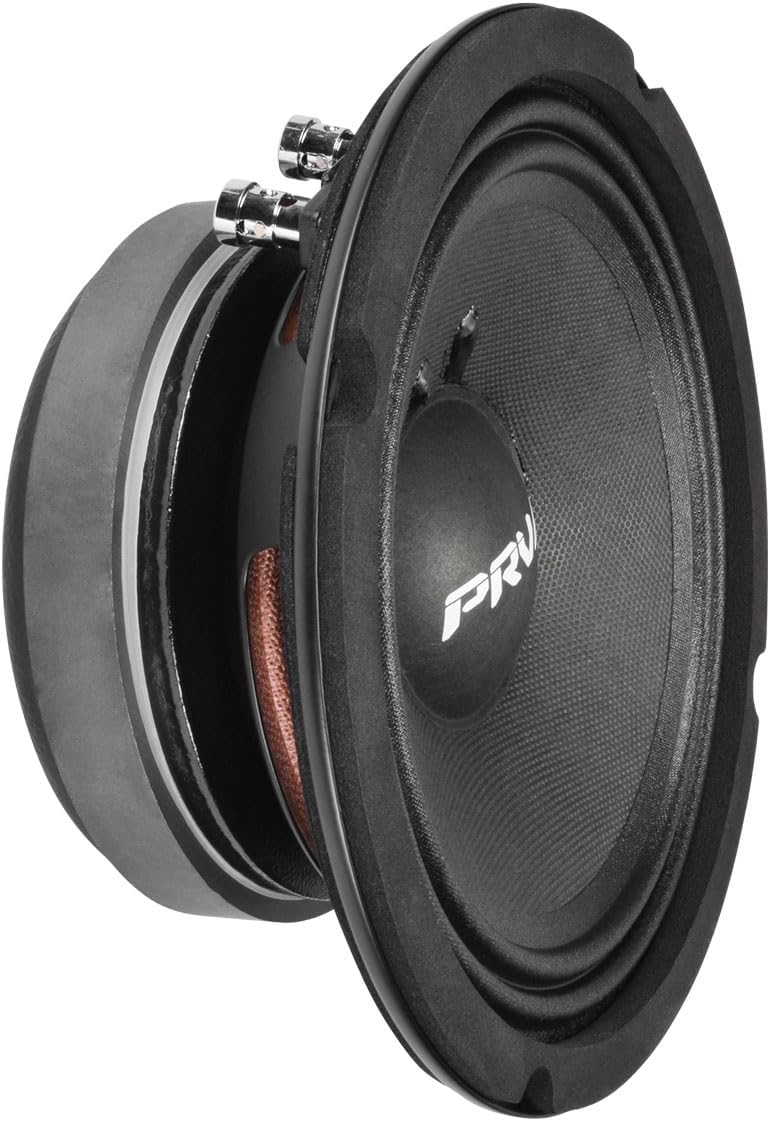


The Skar Audio FSX65-4 is a sensible entry point for anyone building a compact car or professional system around one 6.5-inch mid bass driver. It carries a 4.6 rating, handles 300 watts maximum and 150 watts RMS, and uses a 4-ohm impedance that pairs readily with many common automotive amplifier arrangements. Its 92.5 dB sensitivity also gives installers a clear benchmark when estimating output.
We may earn a commission when you buy through this link, at no additional cost to you.
The 1.5-inch ferrite-magnet voice coil is substantial for a general-purpose midrange driver, while the solid-composition paper dust cap supports a straightforward, natural-looking construction. Because the speaker is supplied individually, installers can buy exactly the number of units required for a stereo pair, a single amplified door, a small stage monitor, or a multi-speaker distributed system. That flexibility makes it less convenient than a ready-made pair but more adaptable for unusual layouts.
The main trade-off is the absence of a stated frequency-response range in the supplied specifications. It is clearly positioned as a pro audio midrange loudspeaker rather than a full-range coaxial, so it should be paired with an appropriate high-frequency driver and crossover in a serious three-way system. Its RMS rating also makes amplifier matching more important than the large maximum-power number might initially suggest.
Choose the FSX65-4 when you want a single, reasonably powerful 4-ohm driver without paying for a matched pair. It is especially suitable for a straightforward custom enclosure, a door installation, or a small professional reinforcement project where accurate dimensions, crossover design, and amplifier control can be handled before cutting.
Selling one driver at a time gives unusual freedom for asymmetric installations. Installers can build a stereo pair over time, use a single unit in a powered cabinet, or distribute several speakers around a room while maintaining the same 4-ohm load and 150-watt RMS target.
The 150-watt RMS specification provides a more realistic basis for amplifier selection than the 300-watt maximum figure. Pairing the driver with an amplifier that can deliver clean, controlled power in its intended impedance should make system integration more predictable.
We may earn a commission when you buy through this link, at no additional cost to you.
The PRV Audio 6MB200-4 v2 is an all-around compelling choice for a car audio or small professional installation. Its 4.6 rating reflects a favorable balance of user response, and the documented 200-watt power handling, 93.5 dB sensitivity, 4-ohm impedance, and 1.5-inch voice coil give installers the basic information needed to design a reliable system.
We may earn a commission when you buy through this link, at no additional cost to you.
PRV describes this model around deep midbass response, strong vocal presence, durability, and smooth reproduction. Its natural paper cone and double-roll surround are particularly relevant to a mid bass role because the driver must reproduce both vocal fundamentals and the lower edge of the midrange while remaining controlled when pushed. The stated optimization for small custom enclosures makes it a sensible candidate for door panels, rear decks, compact stage systems, and home studio cabinets.
Its 200-watt rating is lower than the output headline on some competing models, but maximum-power numbers are not directly comparable across manufacturers. The 93.5 dB sensitivity helps determine how much amplifier power is needed to achieve a target level. Buyers should also accept that this is a dedicated mid bass driver: a properly selected tweeter, crossover, enclosure, and amplifier remain part of the complete design.
This is the model to choose when the goal is a balance of vocal clarity, useful sensitivity, moderate power handling, and enclosure flexibility. It is a particularly strong first choice for a two-speaker car build using readily available 4-ohm amplifier channels.
At 93.5 dB sensitivity, the driver is designed to produce substantial output without requiring extreme amplifier power. That makes it attractive for builds where clean headroom matters and the amplifier must also power additional system components.
The emphasis on small custom enclosures means this speaker is not limited to a conventional full-size cabinet. Its paper cone, double-roll surround, and single-driver format suit projects where space, weight, and controlled installation matter.
We may earn a commission when you buy through this link, at no additional cost to you.
The PRV Audio 6MB400 stands out for delivering substantial stated power handling in a compact 6.5-inch format. It is rated at 4.5 and is specified to handle 400 watts at 8 ohms. That combination makes it attractive for high-output car installations, compact professional systems, and projects that need more headroom than a 200-watt mid bass model can offer.
We may earn a commission when you buy through this link, at no additional cost to you.
Its supplied frequency range of 95 Hz to 7,500 Hz provides unusually clear guidance for system designers. A naturally damped paper cone and double-roll surround support controlled excursion, while the description emphasizes human-vocal reproduction and dynamic midbass. Compact push terminals, silver tinsel leads, and a high-temperature CCAW voice coil are also useful construction details for a driver intended for demanding environments.
The 8-ohm impedance is the most important planning consideration. Although that load can make amplifier matching straightforward, an installer should not assume it can replace a 4-ohm speaker without checking amplifier specifications. The speaker is also sold singly and requires an appropriate enclosure to realize its potential. Its stated 95 Hz lower limit means a separate subwoofer remains necessary for conventional deep-bass reproduction.
Choose the 6MB400 when high power handling, useful efficiency, and a documented bandwidth are more important than buying a ready-matched pair. It is a strong candidate for a carefully designed one-speaker cabinet, an 8-ohm amplifier channel, or a larger multi-driver system in which each driver must be wired correctly.
The documented 95 Hz to 7,500 Hz range gives crossover designers a useful starting point. It covers the lower mid and vocal region while leaving the sub-bass and uppermost high-frequency bands to dedicated drivers.
The compact push terminals, silver tinsel lead wires, high-temperature CCAW voice coil, and double-roll surround reflect a design emphasis on both electrical durability and controlled movement under substantial output.
We may earn a commission when you buy through this link, at no additional cost to you.
The DS18 6PRO300MB-4 has the highest customer rating in this group at 4.7, making it an easy model to shortlist. It is a 4-ohm professional mid bass loudspeaker rated for 300 watts maximum and 150 watts RMS. Its 96 dB sensitivity is also among the strongest figures here, supporting high output with comparatively efficient conversion of amplifier power into sound.
We may earn a commission when you buy through this link, at no additional cost to you.
A 5-inch voice coil provides ample wire length within the motor for controlled low-frequency movement, while the stated 80 Hz to 6 kHz frequency range offers a useful balance between bass fundamentals and vocal presence. The manufacturer positions the driver for pro car audio and pro audio systems, making it a versatile choice for anyone who wants one component to perform both mid bass and midrange duties.
The specifications do not include a crossover, enclosure, or grille, so the speaker should be treated as a component rather than an instant solution. Its 4-ohm load must be respected when choosing an amplifier. Buyers should also note the single-speaker format and plan for a matching second unit if the goal is stereo playback.
This DS18 model is a compelling option for listeners who prioritize efficiency and vocal impact. Select it when you want a relatively compact 4-ohm mid bass driver with a higher sensitivity figure, especially in a professionally amplified car system where strong midrange output and practical power handling are both important.
A 96 dB sensitivity rating means the driver can produce a high output level with less amplifier power than a less efficient model. That extra headroom can reduce strain and leave amplifier capacity available for a separate subwoofer or additional system channels.
The stated 80 Hz to 6 kHz range supports a conventional three-way plan: use the 6PRO300MB-4 for lower mids and vocals, a subwoofer for the lowest bass, and dedicated tweeters for upper-frequency detail.
We may earn a commission when you buy through this link, at no additional cost to you.
The ORION Cobalt CM654 is a convenient matched-pair solution for a car stereo that needs more mid bass authority without building two separate purchases. It has a 4.6 rating, supplies two speakers, and combines 1,000 watts maximum power with a 250-watt RMS rating. Its 4-ohm impedance is familiar to many automotive amplifiers, while the 96.67 dB efficiency figure points to strong output potential.
We may earn a commission when you buy through this link, at no additional cost to you.
The bullet design is intended to help the driver reach higher frequencies while retaining low- to midrange content. A high-temperature 1.5-inch voice coil supports the power target, and the listed mounting depth of 2.75 inches makes the driver potentially manageable in more locations than a deep high-excursion model. It remains important to leave clearance around the bullet and to account for the complete 2.84-inch overall depth.
Fitment deserves close attention because the measured overall diameter is 6.54 inches and the mounting diameter is 5.67 inches. A speaker advertised as 6.5 inches therefore does not automatically fit every nominal 6.5-inch opening. The specified 2.63-inch mounting depth and 5.67-inch cutout should be checked against the door, rear deck, or custom enclosure before ordering.
Choose the CM654 for a straightforward matched-pair upgrade with high efficiency and useful midrange output. It is especially appealing to installers who want more presence than a conventional full-range speaker can provide but do not need a high-excursion driver for a competition-style subwoofer enclosure.
Buying a matched pair simplifies channel symmetry, visual consistency, and system planning. The product is listed as a pair with a shared 4-ohm design, making it convenient for a conventional stereo upgrade.
The 5.67-inch mounting diameter, 2.63-inch mounting depth, and 6.54-inch overall diameter should be compared with a physical template. Bullet clearance and grille depth can add further installation constraints.
We may earn a commission when you buy through this link, at no additional cost to you.
The Pyle PLG64 is the most approachable specification-led option in this guide. It has a 4.0 rating and provides 300 watts peak power, 4-ohm impedance, a 60 Hz to 5,000 Hz response, and a 1-inch high-temperature aluminum voice coil. It also lists a 30-ounce magnet, treated rubber surround, polypropylene cone, and several practical dimensions.
We may earn a commission when you buy through this link, at no additional cost to you.
Those measurements make it easy to plan a basic installation. The stated mounting depth is approximately 2.59 inches in one specification section and 2.84 inches in another, while the listed cutout is 5.68 inches and overall dimensions are 6.53 inches wide and high. Because two mounting-depth values appear in the supplied details, installers should verify the exact drawing in the current product listing.
Compared with many dedicated mid bass designs, the PLG64 has a 1-inch voice coil and a peak rather than RMS power figure. It is therefore better viewed as a flexible mid bass woofer for moderate systems than as a high-excursion driver built around sustained low-frequency output. Its 5 kHz upper frequency limit also means it will need tweeter support if the goal is full-range reproduction.
Choose the Pyle when installation dimensions, familiar 4-ohm impedance, and a straightforward car component replacement are the priorities. It can work for a simple upgraded front stage, but buyers should avoid treating the 300-watt peak number as a continuous power target or assuming it can replace a dedicated subwoofer.
The supplied 5.68-inch cutout and 6.53-inch overall width make it possible to check basic fit before installation. Verify the mounting depth against the current listing, particularly because the supplied details contain two slightly different values.
The 300-watt figure is peak power rather than a stated RMS value. An appropriately sized amplifier, protection, and enclosure remain necessary to obtain clean performance without overdriving the smaller 1-inch voice coil.
We may earn a commission when you buy through this link, at no additional cost to you.
The PRV Audio 6MB200 v2 is closely related in concept to the 4-ohm version but gives installers a different electrical option. It has a 4.6 rating, handles up to 200 watts, and combines 8-ohm impedance with 93.5 dB sensitivity. The 1.5-inch voice coil, natural paper cone, and double-roll surround support a dedicated mid bass role.
We may earn a commission when you buy through this link, at no additional cost to you.
An 8-ohm driver can be valuable in systems with limited amplifier flexibility. It may simplify series wiring in certain multi-speaker arrangements and can suit home studio or professional systems where an 8-ohm load is more appropriate. Sensitivity remains high enough to produce substantial output, although the actual level depends on the amplifier, enclosure, and listening distance.
As a single driver, it is flexible but less convenient for a ready-made stereo set. The supplied description emphasizes outstanding vocals, midbass punch, and use in small custom enclosures for both car audio and home studio applications. Those goals still depend on a correctly designed cabinet, appropriate crossover points, and separate tweeters for high-frequency detail.
Pick the 6MB200 v2 when an 8-ohm loading option is specifically useful and you prefer the same basic motor and cone approach as the 4-ohm model. It is a sensible choice for a custom single-speaker cabinet, distributed installation, or home studio monitor project with a properly planned high-frequency companion.
The 8-ohm impedance offers another wiring option when amplifier channels or existing cabinets are optimized for that load. It should be selected deliberately based on the amplifier rather than treated as a direct substitute without checking total system resistance.
Like the 4-ohm counterpart, this model uses a paper cone, double-roll surround, 1.5-inch voice coil, and 200-watt handling target. The primary distinction in the supplied data is the 8-ohm load, which changes how it fits into an amplifier plan.
We may earn a commission when you buy through this link, at no additional cost to you.
The ORION XTRPRO XPM654MBF is the most elaborate matched-pair option listed. It has a 4.3 rating, is supplied as a pair, and is described with 1,600 watts maximum power and 400 watts RMS. Its 2-inch high-temperature voice coil, 99.3 dB efficiency, and 54-ounce magnet structure signal a serious high-output design for professional car audio.
We may earn a commission when you buy through this link, at no additional cost to you.
The bullet element is intended to extend high-frequency reach without sacrificing low-to-midbass content. That approach makes the pair appropriate for a three-way car system in which these drivers handle mid bass and midrange, a subwoofer covers the lowest octaves, and tweeters handle the top end. The very high efficiency can help generate strong output with controlled amplifier power.
Physical fitment is the largest practical concern. The supplied measurements list a 7.01-inch overall diameter, 3.74-inch overall depth, 5.75-inch mounting diameter, and 3.28-inch mounting depth. Those figures mean it will not fit many shallow factory locations, and a custom enclosure may be needed. The bullet also needs unobstructed clearance.
Choose the XPM654MBF when you prioritize output, efficiency, and a matched premium pair over shallow mounting convenience. It is best suited to a serious custom build in which enclosure geometry, amplifier headroom, crossover design, and installation depth have already been considered.
The 99.3 dB efficiency figure is the standout specification. It indicates that the driver can achieve high sound pressure with comparatively efficient amplifier use, making it attractive for high-output vehicle systems.
The 3.28-inch mounting depth and 7.01-inch overall diameter set this pair apart from more compact drivers. Measure the intended location, account for the bullet and grille, and use a custom enclosure when necessary.
We may earn a commission when you buy through this link, at no additional cost to you.
The PRV Audio 6MB550FT is the dedicated high-excursion choice in this roundup. It carries a 4.5 rating, is specified at 8 ohms, and handles 550 watts RMS. That continuous-power figure is unusually high for a 6.5-inch driver and makes the model relevant to demanding pro audio, high-output car, and home installations.
We may earn a commission when you buy through this link, at no additional cost to you.
Its construction is aimed at controlled movement. The rigid cast aluminum frame uses spokes to reduce reflections back into the cone, while a forced vent in the backplate helps cool the voice coil. A special spider, double-roll surround, and copper tinsel lead wires support low distortion, high-current transfer, and linear travel. The supplied description notes 5.40 mm Xmax and 14 mm peak-to-peak excursion before damage.
The CCAW voice coil uses 14.8 mm winding wire, and the high-strength paper cone is specially treated for damping and linearity. Together, those details suggest that the driver is intended to produce substantial cone travel without sacrificing clarity. A frequency range is not stated in the supplied information, so crossover and enclosure calculations require additional manufacturer data or careful listening tests.
This is the pick for a serious high-output build that values excursion and RMS capability above shallow mounting convenience. Use a robust 8-ohm-capable amplifier, provide a well-braced enclosure that allows the specified movement, and confirm crossover behavior before final system integration.
The 5.40 mm Xmax and forced backplate ventilation indicate a design built for substantial travel and sustained output. These features make the driver especially relevant when the enclosure must produce stronger low-mid impact than a conventional midrange can.
The cast aluminum frame, large ferrite magnet, machined plates, copper tinsel leads, and CCAW winding form a detailed motor and suspension package. Matching that capability with an appropriate 8-ohm amplifier is essential.
We may earn a commission when you buy through this link, at no additional cost to you.
The Rockville RM64PRO is a two-pack of efficient 4-ohm mid bass and midrange car speakers with a 4.4 rating. Each speaker is CEA-rated at 200 watts peak and 100 watts RMS, and the pair reaches 103 dB sensitivity. That sensitivity is the highest in the group, making the set notable for high output potential and broad amplifier flexibility.
We may earn a commission when you buy through this link, at no additional cost to you.
The 85 Hz to 7 kHz operating range supports a conventional three-way car audio arrangement, with the RM64PRO handling kick drums, vocals, and the transition toward a dedicated tweeter. A Kevlar-reinforced black pulp cone, matching dust cap, treated cloth accordion surround, and linear progressive Conex spider are designed to balance stiffness, damping, and controlled excursion.
The motor uses a 1.5-inch high-temperature CCAR voice coil and a 90-ounce magnet. The high-tensile expanded steel basket is intended to damp vibration, while the open frame promotes airflow during demanding playback. Fitment information is unusually complete: the listed mounting depth is 3.07 inches, the cutout is 5.79 inches, and the overall mounting diameter is 6.16 inches.
Choose the RM64PRO when a ready-made pair, exceptional sensitivity, and 4-ohm wiring are the priorities. It is well suited to staged car upgrades in which vocal presence and fundamental impact must coexist. Because each driver is rated at 100 watts RMS, amplifier selection should reflect that continuous limit rather than the more attention-grabbing peak figure.
The 103 dB sensitivity makes this pair well suited to producing high levels with controlled amplifier power. It can be particularly useful when amplifier capacity must be shared among several components in a complete car system.
Listing each speaker at 200 watts peak and 100 watts RMS provides a more consistent basis for comparison. Use the 100-watt RMS figure for amplifier matching and system headroom rather than sizing the amplifier solely from peak power.
We may earn a commission when you buy through this link, at no additional cost to you.
A well-chosen 6.5 inch mid bass speaker should fit the enclosure, match the amplifier, and reproduce the intended frequency band without wasting the capabilities of the rest of the system. The most important factors are impedance, continuous power handling, sensitivity, excursion, mounting depth, and crossover compatibility.
Impedance describes the electrical load the driver presents to its amplifier, and every channel must be operated within its supported load. This guide includes both 4-ohm and 8-ohm choices. A 4-ohm driver is common in car audio and works with many appropriately rated automotive amplifier channels, while an 8-ohm driver can simplify certain series-wiring arrangements or suit an amplifier designed around that load. For multiple drivers, calculate the combined resistance before connecting them. Two 4-ohm speakers in parallel create a 2-ohm load, which many amplifiers cannot support safely. Series wiring raises resistance but also affects power delivery to each speaker.
Choose an impedance that matches the amplifier naturally and allows the intended number of drivers. In general, use 4-ohm drivers for conventional automotive channels and 8-ohm drivers when the amplifier is designed for that load or the wiring plan requires it. Never rely on an amplifier's maximum wattage alone; its stable impedance range and current capability matter more.
Maximum power describes a peak condition, while RMS power is a more useful indicator of sustained handling. The FSX65-4 and DS18 6PRO300MB-4 are each listed at 150 watts RMS, the PRV 6MB550FT handles 550 watts RMS, and the Rockville pair uses 100 watts RMS per speaker. These figures should guide amplifier sizing and system protection. An amplifier that is far larger than the driver's continuous rating may deliver too much energy during peaks, while an undersized amplifier may struggle to reach the desired level cleanly. The right target depends on enclosure behavior, system gain, dynamic headroom, and whether the driver is used alone or in a multi-speaker array.
Prioritize the RMS rating when matching equipment, and treat peak wattage only as a secondary comparison. Do not assume a speaker needs an amplifier delivering precisely its RMS rating. A clean, stable amplifier with suitable headroom and protection is generally more valuable than a larger headline wattage figure.
Sensitivity indicates how efficiently a speaker converts amplifier power into sound pressure. Higher-sensitivity drivers can produce more output for the same amplifier power, which can help in a large vehicle, an outdoor performance, or a professional reinforcement application. The Rockville RM64PRO leads the listed models at 103 dB, while the ORION XTRPRO XPM654MBF is rated at 99.3 dB and the DS18 6PRO300MB-4 at 96 dB. The two PRV 6MB200 variants sit at 93.5 dB, while the Skar FSX65-4 is listed at 92.5 dB.
A sensitivity difference of several decibels is meaningful, although it should not be treated as a complete measure of sound quality. Enclosure volume, excursion, distortion, crossover slope, amplifier behavior, and room or cabin acoustics all affect the final result. Use sensitivity to estimate system gain and efficiency, then focus on the role the driver must perform in the complete system.
The cone and surround shape how a driver moves air and how it behaves through the lower midrange. Natural or treated paper cones appear throughout this list and are valued for natural tonal character and damping. The Pyle PLG64 uses a yellow CD polypropylene cone, while the Rockville uses a Kevlar-reinforced black pulp cone. Double-roll surrounds, rubber surrounds, and treated cloth accordion surrounds are all designed to balance compliance, linearity, and durability. The specific material alone does not determine quality, so treat these differences as design details rather than automatic guarantees of preference.
Look for a construction that matches the environment and the intended excursion. A robust treated surround may be useful in a car door or outdoor cabinet, while a lightly damped paper cone can suit a controlled studio enclosure. Verify the driver's documented displacement and recommended enclosure characteristics before choosing a cabinet volume.
A conventional midrange speaker and a high-excursion mid bass driver may share a nominal diameter but behave very differently. The PRV 6MB550FT offers the clearest high-excursion specifications in the group, including 5.40 mm Xmax, 14 mm peak-to-peak movement, a special spider, and a double-roll surround. The PRV 6MB400 also emphasizes linear cone travel in tight enclosures. These details matter when the goal is strong low-mid impact in a shallow or highly braced cabinet.
Choose a high-excursion model when the enclosure is designed around substantial movement and a separate subwoofer handles the very lowest frequencies. Choose a more conventional efficient midrange for vocal-focused installations where physical displacement and enclosure depth are limited. Never encourage excursion beyond the manufacturer's supported range.
A 6.5 inch mid bass speaker usually needs support at both ends of the spectrum. The Rockville covers 85 Hz to 7 kHz, the PRV 6MB400 covers 95 Hz to 7,500 Hz, the DS18 spans 80 Hz to 6 kHz, and the Pyle covers 60 Hz to 5,000 Hz. These documented ranges can guide a three-way crossover, but they are not instructions to set the crossover at the lowest and highest figures. The crossover point should account for the driver's response, distortion near its limits, enclosure reflections, and the capabilities of the tweeter.
Build the crossover around the complete system rather than selecting the driver in isolation. A dedicated subwoofer should cover the bottom end, the mid bass driver should handle vocals and lower midrange content, and tweeters should reproduce upper detail. Where a frequency response is not listed, obtain the manufacturer's technical data before committing to precise crossover settings.
Nominal speaker size is not a reliable installation measurement. The models in this guide list mounting depths ranging from roughly 2.59 inches to 3.28 inches, with some additional depth required for bullets, terminals, grilles, and rear clearance. Overall diameters also vary. The ORION XPM654MBF has a listed 7.01-inch overall diameter, while the Rockville RM64PRO has a 6.16-inch overall mounting diameter. Measure the actual opening and available depth before ordering, and create a template when the tolerance is close.
Fit should be a non-negotiable filter. Check mounting diameter, cutout diameter, mounting depth, overall depth, grille clearance, terminal position, and the path for wiring. A deeper model may require a custom enclosure or door modification. A compact replacement that will not physically fit is never a value, regardless of its power or sensitivity rating.
Most products here are sold as one speaker, while the ORION Cobalt CM654, ORION XTRPRO XPM654MBF, and Rockville RM64PRO include pairs. Buying a pair simplifies channel matching and stereo installation, while individual drivers offer flexibility for one-speaker cabinets, distributed arrays, and staggered installations. The Rockville is especially straightforward because its 4.6 rating reflects a user-friendly two-pack design.
Choose a matched pair for a conventional car front stage or stereo home studio. Choose individual units when the enclosure plan requires one driver, when the project will expand over time, or when unusual wiring and placement make symmetry more complicated. Confirm whether the listed power and sensitivity figures apply to each speaker or the complete pair before calculating amplifier needs.
Begin with a complete system plan rather than installing the driver immediately. Confirm its impedance, RMS rating, sensitivity, mounting requirements, and recommended crossover region. Choose an amplifier that supports the resulting load, use an appropriate enclosure, and connect the speaker with correctly sized wire and reliable terminals. This preparation reduces the risk of poor bass response, coil damage, or installation problems.
Set the crossover conservatively and listen before making permanent EQ adjustments. Keep the mid bass driver out of the subwoofer's lowest-frequency range and ensure the tweeter handles the upper end. If a three-way system is being built, use the manufacturer's frequency response, impedance data, and enclosure recommendations where available. Raise gain carefully, listen for clipping, and use proper amplifier protection rather than driving the driver to distortion.
For long-term care, keep the drivers dry, protect them from direct physical impact, and ensure vent openings or enclosure ports cannot be blocked. Check fasteners and wiring periodically, particularly in a car where vibration and temperature changes are constant. Do not operate a damaged cone, torn surround, loose terminal, or overheated voice coil. Cleaning should use gentle methods that do not saturate the cone or move the suspension.
A 6.5 inch mid bass speaker is optimized for lower midrange and mid bass frequencies, often including the vocal fundamentals that add body and clarity. A subwoofer is designed for much lower bass frequencies and typically reproduces kick fundamentals and deep bass. In a three-way system, the 6.5-inch driver handles vocals and lower mids, the subwoofer handles the bottom end, and tweeters cover high frequencies.
Choose the impedance that your amplifier can support under the intended wiring arrangement. A 4-ohm driver is common in car audio and works with many automotive amplifier channels, while an 8-ohm driver may suit certain home or professional amplifiers. For multiple drivers, calculate the final combined load because parallel wiring can lower impedance and series wiring can raise it.
No. Higher power handling is useful only when the amplifier, enclosure, and system design can take advantage of it. A highly sensitive driver may produce excellent output with less amplifier power, while a lower-power driver can still be sufficient in a modest system. Match the driver's RMS rating, sensitivity, excursion, and impedance to the rest of the installation.
For the best full-range result, yes. Most of these drivers are intended to handle lower midrange and vocal content, leaving upper frequencies to a dedicated tweeter. A coaxial or full-range setup can work in some applications, but a properly designed three-way system usually provides better division of labor and more control over tonal balance.
The correct enclosure depends on the driver's displacement, Xmax, sensitivity, suspension, and intended output. Sealed, ported, and bandpass designs can each work, but they require different volume and tuning. Follow the manufacturer's enclosure data when available and use an enclosure that allows the specified excursion without the cone contacting the grille or internal braces.
First confirm the speaker's impedance and RMS power rating. Then select an amplifier that supports that impedance and can deliver clean, controlled power near the speaker's RMS target. Leave sensible headroom for transients, use amplifier settings appropriate to the impedance, and avoid assuming that a large maximum-wattage rating guarantees clean output.
It can work if the speaker fits, the mounting area is rigid, and the enclosure is appropriately designed for the environment. Many factory doors lack the space and acoustics for a high-output midrange installation, so shallow or deep models may require a custom baffle, rear enclosure, or another location. Check all dimensions and protect the door from moisture and excessive vibration.
Maximum watts describes a short-duration peak condition, while RMS watts indicate sustained power handling under standardized test conditions. RMS is the more useful figure for amplifier matching and long-term reliability. A 300-watt peak driver may have a much lower RMS rating, so compare the two values carefully and never size the amplifier from the peak figure alone.
The best overall choice is the PRV Audio 6MB200-4 v2 because it combines a 4-ohm load, 93.5 dB sensitivity, 200-watt handling, and an enclosure-focused design in a flexible single-driver format. The Skar Audio FSX65-4 stands out as the value-oriented alternative with 150 watts RMS, while the PRV 6MB550FT represents the premium route for high-excursion, 550-watt-RMS applications. Each is best chosen by matching its electrical and physical characteristics to the intended system.
Prioritize impedance, RMS power, sensitivity, and fitment before focusing on the largest headline specification. A high-sensitivity model can be exceptionally effective with modest amplification, while a high-power model demands a suitably robust amplifier and enclosure. Confirm the frequency response, crossover point, and cutout dimensions before cutting a panel, and remember that a dedicated subwoofer and tweeter usually complete the musical picture.
Ratings and specifications provide a useful starting point, but listings and promotions can change over time. Check the current product page for the latest package contents, dimensions, compatibility details, and price before ordering. That final verification helps ensure that the selected 6.5 inch mid bass speaker still matches the system you have planned.