
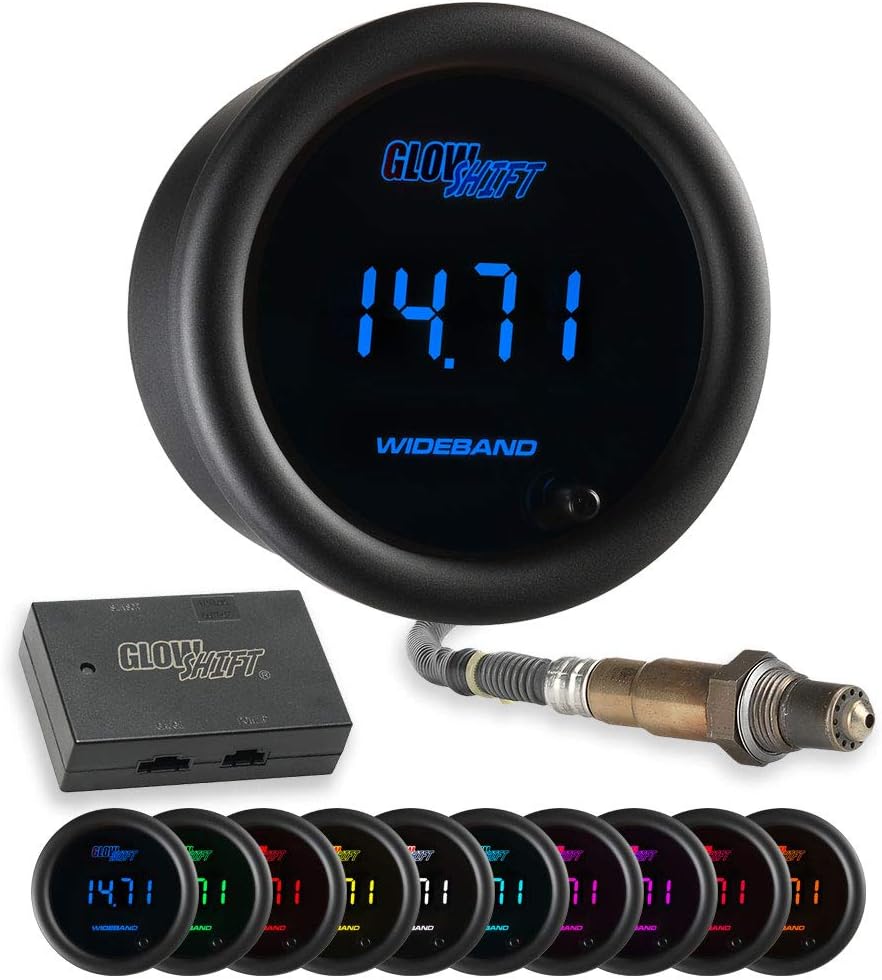
GlowShift Black 7 Color Digital Wideband Air Fuel Gauge Kit
4.4Editor score
52mm digital gauge
LSU 4.9 sensor included
Seven display color modes
Aftermarket O2 systems give drivers and tuners a clearer view of engine air-fuel ratio than a conventional narrowband sensor alone. The right setup can reveal mixture conditions, support calibration, improve data logging, and make performance work more precise. A useful system should match the engine, fuel, exhaust layout, and display needs.
The products in this guide include complete wideband gauge kits, standalone controllers, multi-channel instruments, and specialized Holley equipment. We compared their stated sensor types, display options, outputs, included installation hardware, calibration features, electrical compatibility, and intended tuning applications. Products with different architectures are grouped thoughtfully rather than treated as identical.
Each review highlights the most relevant benefits, limitations, and ideal buyer, while the comparison table makes the major differences easier to scan. The top picks cover budget-conscious, all-around, and premium configurations. As with all automotive equipment, availability and pricing can change, so confirm the current listing and full kit contents before purchasing.
4.4Editor score

4.2Editor score

4.5Editor score
As an Amazon Associate we earn from qualifying purchases.
This side-by-side comparison covers ten aftermarket O2 solutions ranging from a single 52mm wideband gauge to a dual-channel data-logging meter and a specialized Holley WBO2 sensor. Compare sensor type, channels, outputs, display functions, and included installation components before choosing the architecture that fits your vehicle.


The Universal Digital Wideband Air/Fuel Ratio AFR Gauge is a straightforward 2-inch instrument for monitoring air-fuel ratio in a wide range of engine and data-logging environments. It carries a 3.8 rating, and its strongest qualities are its compact 52mm housing, real-time digital feedback, and stated compatibility with systems operating up to 16V.
We may earn a commission when you buy through this link, at no additional cost to you.
Its digital wideband technology is designed to read and report AFR values quickly, making the gauge more informative than a simple indicator lamp. The standard 52mm housing should fit many common instrument pods, while the listed compatibility with engine management systems and data loggers gives it broader potential than a standalone display. The 16V ceiling also makes it relevant to a broader range of modern electrical systems.
The main ambiguity is package completeness. Unlike several competing listings, this description does not clearly state that a wideband O2 sensor is included. A buyer should therefore verify whether the gauge is being sold as a controller-and-display unit or as a full sensor kit. The product data also provides fewer display and connection specifics than the more comprehensive Gauge kits, which can make system matching more involved.
This gauge is best for a tuner who already has a compatible wideband sensor and control setup, or who values a small, standard-size display over elaborate color controls. It may also suit builders seeking a simple gauge for an engine management system or logger. Confirm the sensor requirement, output format, and required wiring before buying; those details are the decisive factors for this otherwise compact and versatile option.
The 52mm housing is a major practical benefit because it can fit into many standard pods and leaves more space available for other instruments. Its stated engine management and data logger compatibility makes the display useful for standalone monitoring as well as integrated tuning setups.
The absence of free-air calibration when used with the specified wideband system can simplify setup. Buyers should still confirm that the sensor, controller, output, and calibration arrangement already in the vehicle are supported by this gauge.
We may earn a commission when you buy through this link, at no additional cost to you.
The Wideband UEGO Air/Fuel Ratio Gauge is a complete-looking 52mm kit built around a 4.9 LSU sensor and a 0-5V analog output. It holds a 4.1 rating and distinguishes itself with a digital LED readout plus a color-changing indicator that communicates rich-to-lean conditions at a glance.
We may earn a commission when you buy through this link, at no additional cost to you.
The included LSU 4.9 sensor is presented as a fast-response component capable of reacting to small AFR changes, which is valuable when a tuner needs immediate information. The 0-5V output provides a practical path for connecting the system to data loggers and engine management systems, although buyers should confirm compatibility by model number rather than relying on appearance.
The listed 10-20 AFR range is a meaningful limitation for vehicles running E85 or other high-ethanol blends, because ethanol mixtures use a different stoichiometric range than gasoline. The black and silver bezels and reversible black and white faceplates provide visual customization, but the color-changing needle is the more operationally important feature. The product also states that no free-air calibration is needed when paired with its wideband system.
This kit is a solid choice for a gasoline-powered project that wants a traditional 52mm gauge, fast wideband feedback, and an analog signal for external recording or control. It suits builders who can install a standard 52mm instrument and need visible lean-to-rich cues during tuning. For flex-fuel or multi-fuel use, verify display range and calibration support before committing.
The changing LED needle reduces the need to interpret a number before recognizing an unusual mixture. It is particularly helpful during repeated throttle inputs, when immediate lean or rich feedback matters more than a perfectly uniform display.
A 0-5V analog output turns the display into a broader monitoring system when paired with a compatible logger or engine management unit. Confirm the receiving device's expected signal range and grounding arrangement before installation.
We may earn a commission when you buy through this link, at no additional cost to you.
The 30-0300 Wideband UEGO Air Fuel Ratio Gauge is a feature-rich single-sensor kit with a 4.2 rating. Its 24-color-coded LED display, four-digit center readout, reversible faceplate, and three operating modes make it one of the more adaptable dashboard instruments in this guide.
We may earn a commission when you buy through this link, at no additional cost to you.
The ability to switch among air-fuel ratio, lambda, and oxygen percentage is useful because different tuning workflows emphasize different representations. A 20ms typical response is also specified for the LSU 4.9 configuration, supporting rapid monitoring. Buyers can choose resistor trim calibration or free-air calibration, while the sensor is factory calibrated through a connector resistor and the resistor method is recommended for most users.
Its calibration flexibility is a clear strength, but it also means the installer should understand the difference rather than treating the modes as interchangeable. The product data specifies a 12-month warranty, which is shorter than the longer support commitments advertised by some other brands in the list. The narrow 52mm format is familiar and convenient, but buyers seeking integrated engine control rather than a display should look elsewhere.
This kit is a strong match for performance builders who want one gauge to present AFR, lambda, or oxygen information in several colors. It is particularly suitable for users who appreciate clear factory calibration and fast response. Confirm the sensor's exhaust fitment, electrical connection, and compatibility with any external logger before installation.
Switching between AFR, lambda, and oxygen percentage lets a tuner retain the same hardware while changing the information shown. This is useful during different stages of calibration, data review, and roadside diagnosis.
The included LSU 4.9 sensor uses a factory calibration resistor, and the manufacturer recommends resistor trim mode for most users. This provides a defined starting point while preserving a free-air option for installers who need it.
We may earn a commission when you buy through this link, at no additional cost to you.
The Holley EFI Wbo2 Sensor is a specialized wideband sensor listing intended for Sniper Tbi applications. It has a 4.1 rating, and its clearest advantage is platform focus: instead of trying to serve many engine configurations, it is presented as a direct-fit sensor for the named Holley EFI setup.
We may earn a commission when you buy through this link, at no additional cost to you.
The black e-coating is intended to provide rust protection, which is relevant because an exhaust-mounted sensor is exposed to heat, moisture, and road debris. The listing notes that one sensor is required per vehicle, providing an important installation detail. It also states a power steering fitment claim, although the available product information is too limited to explain the exact component or connection involved.
Unlike the other products in the guide, this is not a complete gauge, controller, wiring, and sensor kit. It is a focused sensor option, so it should be compared against a system component rather than directly against full dashboard packages. The limited description also means buyers should confirm physical dimensions, connector style, and compatibility with the exact Holley EFI model before ordering.
This sensor is best for a Holley EFI Sniper Tbi owner who needs a dedicated replacement or a straightforward wideband addition and already has the necessary controller and display. It is not the natural choice for a builder seeking an all-in-one instrument. Confirming the exact vehicle and EFI configuration is essential because the listing is highly application-specific.
A platform-specific listing can simplify part matching for a Holley EFI Sniper Tbi build. The benefit depends on using the exact application named in the product data rather than assuming universal compatibility.
The black e-coating is described as rust protection, an important consideration for a component installed in the exhaust environment. Correct sensor handling and mounting remain essential regardless of the finish.
We may earn a commission when you buy through this link, at no additional cost to you.
The Innovate Motorsports 38070 LM-2 is a complete dual-channel air/fuel ratio meter built for serious tuning and data acquisition. It carries a 4.2 rating and stands out through patented DirectDigital wideband sensor control, two O2 channels, all-fuel compatibility, and the ability to log directly to an SD card.
We may earn a commission when you buy through this link, at no additional cost to you.
Dual-channel monitoring is the decisive feature for engines with separate banks or other applications where independent readings are valuable. The LM-2's OBD-II scan tool can read and clear diagnostic trouble codes and log as many as 16 channels of CAN OBD-II data. Direct SD card recording further reduces the need to rely on a separate logging computer during a test session.
This is not simply a decorative dashboard gauge. It is a dedicated measurement and logging device, so setup, sensor placement, channel configuration, and data interpretation require more attention than a basic display kit. Its all-fuel capability is broad, but users still need to configure the instrument for the specific fuel and engine rather than assuming every reading is directly interchangeable.
The LM-2 is our Editor's Choice because it combines wideband measurement, dual channels, vehicle diagnostics, and flexible logging in one serious platform. It is best for performance engineers, race teams, advanced hobbyists, and anyone who needs recorded data from both sides of an engine. Choose a simpler 52mm gauge if dashboard visibility is the only goal; choose the LM-2 when data depth is the priority.
Two O2 channels allow simultaneous comparison of separate exhaust areas, making imbalance easier to investigate. For V-type engines, the two channels can support left- and right-bank analysis when the installation and sensor placement are appropriate.
Direct SD card logging captures measurements for later review, while OBD-II tools add diagnostic data to the session. This combination is more useful for repeatable tuning than a simple real-time display alone.
We may earn a commission when you buy through this link, at no additional cost to you.
The Wideband Air/Fuel Ratio AFR Gauge Kit is a complete-looking single-sensor package with a 3.2 rating. It includes a controller box, an LSU 4.9-style O2 sensor, and a thin 52mm digital gauge designed to deliver real-time air-fuel ratio information.
We may earn a commission when you buy through this link, at no additional cost to you.
The core appeal is simplicity. A builder gets the sensor, controller, and display in one package, reducing the need to assemble a system from separate components. The stated compatibility with 12V and 16V vehicles covers a broad range of modern and classic applications, while the standard pod size supports straightforward dashboard integration.
The listing describes the gauge as a diagnostic tool that can indicate dangerous lean or rich conditions, but the available specifications are less detailed than those of several competing products. There is no stated fuel-specific AFR range, output protocol, calibration method, or specific data-logging feature in the supplied information. Those omissions matter because they limit how confidently the kit can be matched to advanced engine management systems.
This product is best for a tuner who wants a familiar round digital gauge, a supplied sensor and controller, and simple real-time monitoring. It may be particularly useful in a project where a dedicated standalone display is preferred over integrated engine management. Buyers should verify output compatibility, supported fuel ranges, sensor dimensions, and installation instructions before committing.
Supplying the sensor, controller, and gauge together creates a more unified starting point than buying a display alone. It is a practical option for a clean installation where simplicity matters.
A digital AFR display makes lean and rich conditions easier to observe during tuning. For advanced data capture, confirm whether the controller provides a suitable output and what parameters can be recorded.
We may earn a commission when you buy through this link, at no additional cost to you.
The GlowShift Black 7 Color Dual Wideband Air Fuel Gauge Kit is the most complete premium package in this guide. It has a 4.5 rating, two 52mm digital displays, two 4.9 LSU sensors, two control boxes, and a broad set of installation hardware designed to monitor both sides of a performance engine.
We may earn a commission when you buy through this link, at no additional cost to you.
Dual monitoring makes this kit appropriate for engines where left and right banks need separate AFR readings. It supports gasoline readings from 10.00 to 20.00 AFR and E85 readings from 6.00 to 12.00 AFR, which is a meaningful advantage for flex-fuel vehicles. The display provides seven solid colors and two cycling modes, and connecting the dimmer wire to the headlight switch reduces brightness by 30% when the lights are on.
The package is impressively complete: two stainless and mild-steel weld-in bungs, sensor harnesses, gauge-to-controller wiring, a power harness splitter, data logging wires, a visor, brackets, hardware, and instructions are included. The tradeoff is installation scale. Two sensors, two control boxes, and dual wiring need careful routing, sealing, grounding, and channel labeling, while the price position is naturally higher than single-channel kits.
This is our Best Premium pick because it offers a coherent dual-bank solution rather than simply adding more display colors. It is best for serious V-engine builders, race applications, and flex-fuel vehicles where independent readings matter. The setup effort is substantial, so consider the single-gauge alternatives if one exhaust channel is sufficient.
Independent left and right readings make it easier to identify uneven fuel delivery, injector differences, or bank-specific tuning issues. The kit supplies the separate sensors, control boxes, and wiring needed to support that approach.
Separate gasoline and E85 ranges make the gauge relevant to flex-fuel performance vehicles. Selecting the correct fuel mode is important so that displayed values remain meaningful for the mixture being used.
Seven solid colors and two cycle modes allow the instrument to coordinate with different interiors and factory lighting. Dimmer-wire support reduces nighttime brightness when connected to the headlight switch.
We may earn a commission when you buy through this link, at no additional cost to you.
The GlowShift Black 7 Color Digital Wideband Air Fuel Gauge is a well-rounded single-channel kit with a 4.4 rating. It includes an LSU 4.9 sensor, control box, weld-in bung, sensor harness, gauge wiring, power harness, data logging wire, visor, mounting hardware, and instructions in a standard 2-1/16-inch format.
We may earn a commission when you buy through this link, at no additional cost to you.
The gauge supports gasoline readings from 10.00 to 20.00 AFR and E85 readings from 6.00 to 12.00 AFR, making it useful across conventional and flex-fuel performance vehicles. Seven solid colors and two color cycle modes provide more visual flexibility than a basic monochrome display, while the dimmer connection can reduce brightness by 30% with the headlights on.
Although the kit is more affordable than the dual-channel GlowShift package, it remains comprehensive for one exhaust location. The data logging wire provides a path for recording information, though users may need suitable logging equipment and configuration to interpret it. The included visor, bracket, and hardware improve the installation experience, but the sensor bung still requires appropriate fabrication and sealing.
This is our Best Budget selection because it combines a genuine wideband kit with attractive display features, fuel-specific ranges, and extensive included components. It is best for a single-cylinder bank, a naturally aspirated build, or a tuner who wants one reliable gauge without paying for dual-channel hardware. For a V engine, compare it with the dual kit or a multi-channel logger.
The inclusion of the sensor, controller, bung, harnesses, data logging wire, mounting parts, and instructions gives buyers a strong foundation. That completeness reduces the chance of discovering several missing essentials after installation.
Seven selectable solid colors and two cycle modes create strong visual appeal. If one measurement location meets your needs, this kit preserves those display features without paying for a second sensor and control box.
We may earn a commission when you buy through this link, at no additional cost to you.
The Innovate Motorsports 3884 LC-2 is a compact standalone lambda controller with a 4.4 rating. The kit includes the controller, an LSU 4.9 wideband sensor, a 3-foot sensor cable that gives an overall length of 5 feet, a mild-steel exhaust bung, programming cable, and manual.
We may earn a commission when you buy through this link, at no additional cost to you.
Its core strength is flexible integration. Two configurable linear 0-5V analog outputs can feed compatible instruments, data loggers, or other systems, while calibration capability allows the user to optimize sensor accuracy. The integrated green and red status LED gives quick feedback on operating condition, and the all-fuel compatibility expands its relevance beyond gasoline-only builds.
Unlike the GlowShift kits and several 52mm gauge packages, the LC-2 does not include a dashboard display. That makes it a different kind of solution: a compact control unit that can be integrated into a broader monitoring setup. The 3-foot sensor cable also means thoughtful sensor placement is important, as exhaust routing and controller placement must work within the available cable length.
The LC-2 is best for a tuner who already has a display, wants a dedicated controller, or needs analog signals for a data logging system. It is also a clean solution when a large gauge would be impractical. Choose a complete gauge kit instead if you want a turnkey dashboard instrument with minimal additional purchases.
Two configurable 0-5V outputs provide more connection options than a single-output controller. They can support compatible monitoring equipment, but each destination must use the correct signal configuration.
The ability to calibrate the O2 sensor helps the controller establish an appropriate baseline for accurate readings. Following the included manual is especially important for installation in a new or modified exhaust system.
We may earn a commission when you buy through this link, at no additional cost to you.
The GlowShift 10 Color Digital Wideband Air Fuel Ratio Gauge Kit is a visually distinctive single-channel package with a 4.5 rating. It combines a 2-1/16-inch tinted-lens digital gauge, LSU 4.9 sensor, control box, weld-in bung, multiple wiring lengths, a data logging wire, visor, mounting hardware, and installation instructions.
We may earn a commission when you buy through this link, at no additional cost to you.
Its defining feature is the display. Ten solid color modes plus two cycle modes provide more choices than the seven-color GlowShift kit, and the digital format is designed for quick glance readability. Startup self-calibration is also highlighted, helping the gauge establish an optimized operating state without making calibration a prominent daily task.
The stated 10.00 to 20.00 AFR range is suitable for gasoline performance applications, but the product data does not specify a separate E85 range. That makes it less obviously suited to flex-fuel tuning than the single-channel GlowShift Black 7 Color kit, which explicitly lists gasoline and E85 ranges. The tinted lens and numerous color modes are also matters of personal preference.
This kit is best for a gasoline-powered build that values visual customization and automatic startup behavior. It is a strong all-around option for a single exhaust location, especially when the owner wants a more expressive dashboard than a standard monochrome gauge. For multi-bank monitoring, the dual GlowShift kit or a dedicated logger will serve more demanding applications better.
Self-calibration at startup is designed to keep the gauge operating as intended and reduce the need for repeated manual intervention. The owner should still verify the displayed value against the tuning workflow being used.
Ten solid modes and two cycling modes allow the gauge to match many dashboard themes. The quick-glance digital layout and tinted lens create a distinctive instrument that can serve as a visual focal point.
We may earn a commission when you buy through this link, at no additional cost to you.
Choosing an aftermarket O2 system means matching measurement capability to the engine, exhaust, fuel, data needs, and available dashboard space. Sensor technology, channel count, calibration method, outputs, and installation hardware can vary substantially, so the most feature-rich kit is not automatically the right one.
A wideband LSU 4.9 sensor measures a broader air-fuel range than a conventional narrowband sensor and is the common basis for the complete kits listed here. The LC-2 and LM-2 also use a wideband approach, while the Holley item is an application-specific WBO2 sensor. Confirm that the sensor type matches the controller and gauge you already own or are purchasing as one system.
A mixed sensor and controller pairing can produce unreliable calibration or incorrect readings. Use the manufacturer compatibility information and verify connector and exhaust-bung dimensions before ordering.
Single-channel systems monitor one exhaust area, which may be enough for a single-bank or simpler engine. Dual-channel products such as the LM-2 and the GlowShift dual kit support independent readings from two locations, making them more useful for V engines, split exhaust systems, and bank-by-bank tuning.
More channels improve diagnostic depth but also mean more sensors, control boxes, harnesses, and installation work. Choose two channels only when you will actively use the separate readings.
A dashboard gauge is useful for immediate observation, but a tuner may also need to record AFR, lambda, and related engine data. Look for a data logging wire, configurable analog output, CAN OBD-II logging, or direct SD card recording, depending on the equipment already in the vehicle.
Confirm the voltage range, signal format, channel count, and software compatibility of the logger or engine management system. A gauge being advertised as compatible does not guarantee that every recording feature will work without configuration.
Gasoline and ethanol have different stoichiometric air-fuel relationships, so a display designed for gasoline may not present meaningful values for E85. The GlowShift 7 Color kits explicitly list separate gasoline and E85 ranges, while other listings focus on a stated 10-20 AFR range.
Confirm the supported fuel and select the correct mode after installation. For dedicated race-fuel or flex-fuel work, also verify the controller's calibration and logging configuration.
Calibration procedures differ among wideband systems. The 30-0300 kit offers resistor trim and free-air modes and notes that its sensor is factory calibrated. The LC-2 supports calibration, and the GlowShift 10 Color kit highlights startup self-calibration. Other products state that free-air calibration is unnecessary when used with their specified wideband system.
Choose a process that you can perform correctly and repeat when needed. Factor in the instructions, sensor placement, and whether a dedicated calibration tool is included.
Most complete gauge kits use the common 52mm, or 2-1/16-inch, housing. That standardized size simplifies pod selection, but a dual-gauge kit still needs twice the display area. The LM-2 and LC-2 prioritize controller functionality and may require a separate display for dashboard use.
Measure the pod, consider visibility while driving, and check whether a visor, bracket, and appropriate harness routing are included. A visually attractive gauge is less useful if it cannot be mounted securely or read safely.
The GlowShift kits list extensive hardware, including sensors, control boxes, weld-in bungs, harnesses, mounting pieces, and instructions. The Holley WBO2 listing is much more focused, and the Universal Digital Wideband AFR Gauge does not clearly identify a sensor in the supplied description. Comparing only the headline gauge can therefore produce a misleading impression of completeness.
Make a checklist of every required component before buying. Look for the sensor, controller, bung, sensor cable, gauge cable, power connection, ground, analog or data output, mounting hardware, and written instructions.
Several products explicitly support 12V and up to 16V systems, which is useful across modern and classic vehicles. The LC-2 and LM-2 are designed as dedicated components with their own connection requirements. Always verify grounding, power requirements, signal output, and the receiving device's voltage expectations.
A compatible fit is more than physical sensor fit. Electrical mismatches can affect readings, damage components, or prevent useful data capture, so complete the wiring plan before installation.
Begin by identifying the purpose of the system: live dashboard monitoring, wideband feedback during tuning, multi-bank comparison, or recorded data analysis. Then match the controller, sensor, gauge, and any logger or engine management unit according to the manufacturer's instructions. Confirm sensor dimensions, connector orientation, output voltage, fuel selection, and channel assignments before fitting anything to the exhaust.
Installation requires careful attention to exhaust-bung placement, sensor seating, sealing, wiring routing, grounding, and heat exposure. Follow the supplied instructions for sensor orientation and connection. Protect wiring from moving parts, sharp edges, and high-temperature areas, and make sure the controller and display are mounted in a location where they will not interfere with controls or create visibility problems.
For care, keep sensors and bungs free of oil, coolant, silicone residue, and excessive soot, and use only the cleaning and calibration methods approved for the specific wideband sensor. Review readings for sudden changes, inspect connections when readings become erratic, and protect the controller and wiring from moisture. Recheck calibration and fuel settings after major exhaust or fuel-system changes, and record recurring patterns rather than relying on a single isolated reading.
A conventional narrowband sensor is designed mainly to indicate whether a mixture is rich or lean around a narrow operating window. A wideband sensor provides a broader AFR measurement, making it much more useful for tuning, data logging, and identifying changes under load. For those jobs, a wideband controller and gauge or meter are generally the more informative choice.
You may not need a separate gauge if the engine management system already receives a compatible wideband signal and provides the readings you need. A dedicated gauge can still provide quicker visibility, a simpler layout, or independent monitoring. If you plan to record and compare data, examine the controller's output and logger compatibility rather than choosing only by display appearance.
It is not automatically necessary, but dual-channel monitoring allows independent readings from the left and right banks. That can help identify fuel distribution or calibration differences that a single averaged reading may conceal. The tradeoff is added wiring, sensors, controller hardware, installation effort, and cost, so single-channel systems remain reasonable for many projects.
It can, but the controller, sensor calibration, and display must be configured for the fuel in use. E85 has a different stoichiometric range from gasoline, so a product designed only for a 10-20 AFR window may not provide the correct interpretation. Choose a system that explicitly supports the intended fuel or can be configured and calibrated for it.
A 0-5V analog output sends the wideband measurement as a changing voltage signal that compatible data loggers, gauges, or engine management systems can read. It allows the O2 system to become part of a larger monitoring setup. The receiving device must support the expected output range and grounding method, and its display software must interpret the signal correctly.
Choose a gauge kit when you want a turnkey combination of controller, sensor, wiring, and a visible dashboard instrument. Choose a standalone controller when you already have a display or want to send signals to a logger, engine management unit, or other instrument. A dedicated meter such as the LM-2 is also appropriate when multi-channel logging and vehicle diagnostic data are priorities.
Calibration needs vary by product and installation. Some kits provide factory calibration, specify resistor trim as the preferred method, or use startup self-calibration, while others include a user calibration procedure. Follow the instructions for the exact controller and sensor, and recalibrate when required after sensor replacement, sensor movement, or substantial exhaust-system changes.
Confirm the bung size and thread, sensor length, cable length, connector orientation, electrical requirements, and controller compatibility. The sensor must be installed according to the manufacturer's instructions, with appropriate sealing and protection from contamination. Also plan the power, ground, and output wiring before cutting or drilling exhaust components.
The Innovate Motorsports 38070 LM-2 is the most capable all-around choice for users who prioritize dual-channel measurement, diagnostics, and direct data logging. The GlowShift Black 7 Color Dual kit is the premium dashboard option for monitoring two banks with rich color customization, while the single-channel GlowShift Black 7 Color kit offers the strongest balance of complete hardware, useful fuel ranges, and value.
Before buying, prioritize system compatibility over appearance. Confirm the sensor type, channel count, calibration process, fuel support, output format, and physical fit. A simpler single-channel gauge is often the rational choice for one exhaust location, while dual-channel hardware earns its complexity when independent bank readings or deeper data acquisition will actually be used.
Finally, verify the current listing, package contents, dimensions, installation instructions, and warranty terms before ordering. Availability and pricing for automotive parts can change, and exhaust modifications, sensor fitment, and electrical requirements vary by vehicle. A careful fit check provides a much stronger foundation than choosing solely by the most colorful display.