
Renogy Flexible Solar Panel 100 Watt
4.4Editor score
240-degree flexible mounting
Low-profile 0.1-inch construction
Handles demanding wind loads
Discover the best flexible solar panels for RV rooftops, comparing output, bendability, weather resistance, efficiency, installation, and system compatibility.
Flexible solar panels can make excellent additions to an RV rooftop because they conform to curved surfaces, weigh less than conventional glass modules, and can provide useful charging capacity without the bulk of rigid panels. The right choice depends on roof curvature, available space, battery architecture, and how the panel will be secured.
This guide compares ten flexible solar panel products for RV rooftops using the supplied specifications, customer ratings, construction details, power ratings, and installation features. It covers single panels and multi-panel kits, ranging from compact 100W models to higher-output 800W configurations designed for 12V, 24V, and 48V systems.
Each review explains the panel's strongest benefits, practical limitations, and ideal installation scenario so readers can compare products without relying on generic marketing claims. The featured selections are the 100W Renogy for budget-conscious buyers, the 200W ZETAWALE as the editor's choice, and the 800W kit as the premium option. Prices and availability can change.
4.4Editor score

4.8Editor score
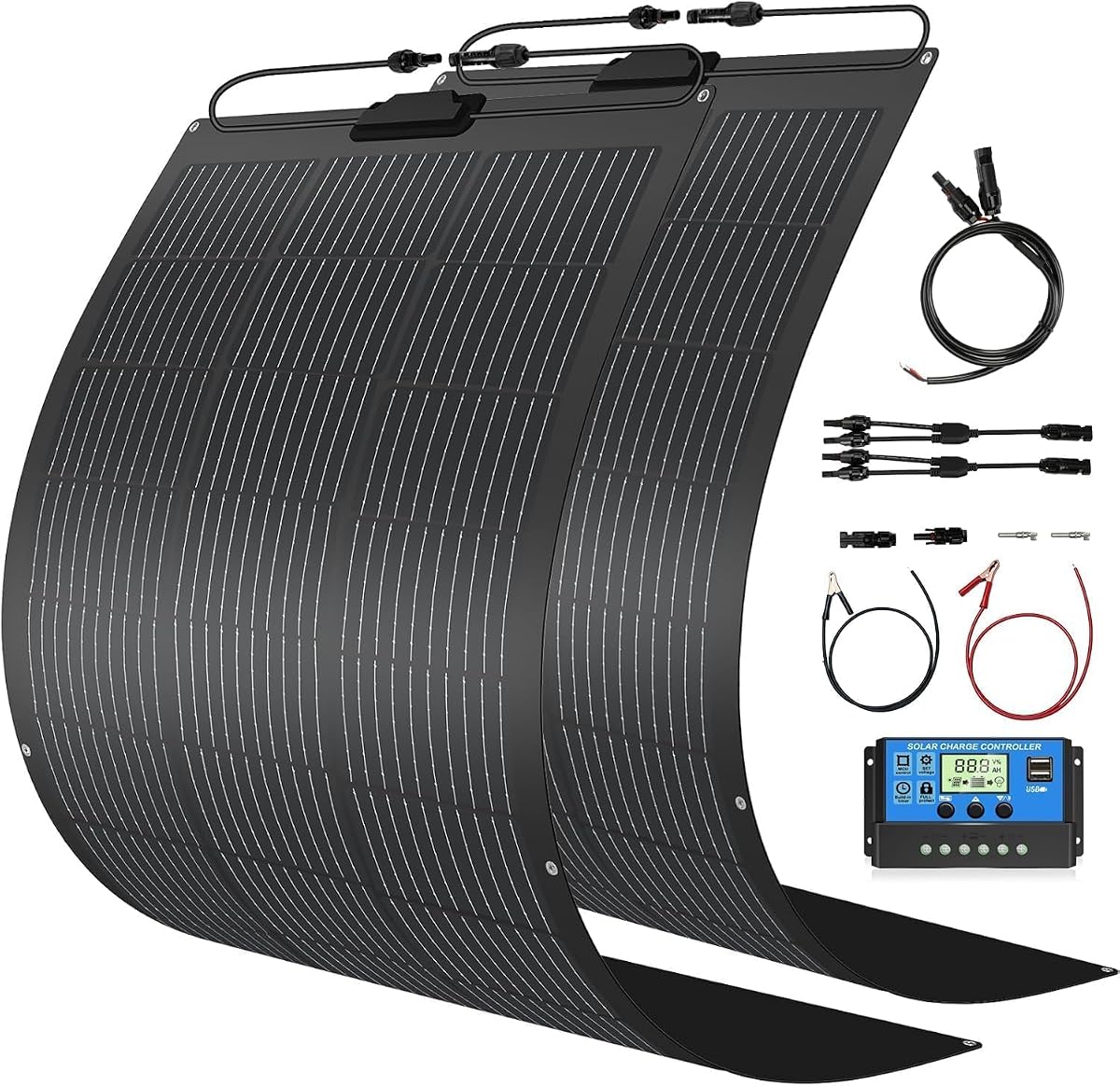
5.0Editor score
The comparison below places each flexible solar panel side by side, focusing on rated output, flexibility, construction, and the practical features that matter most when powering an RV.

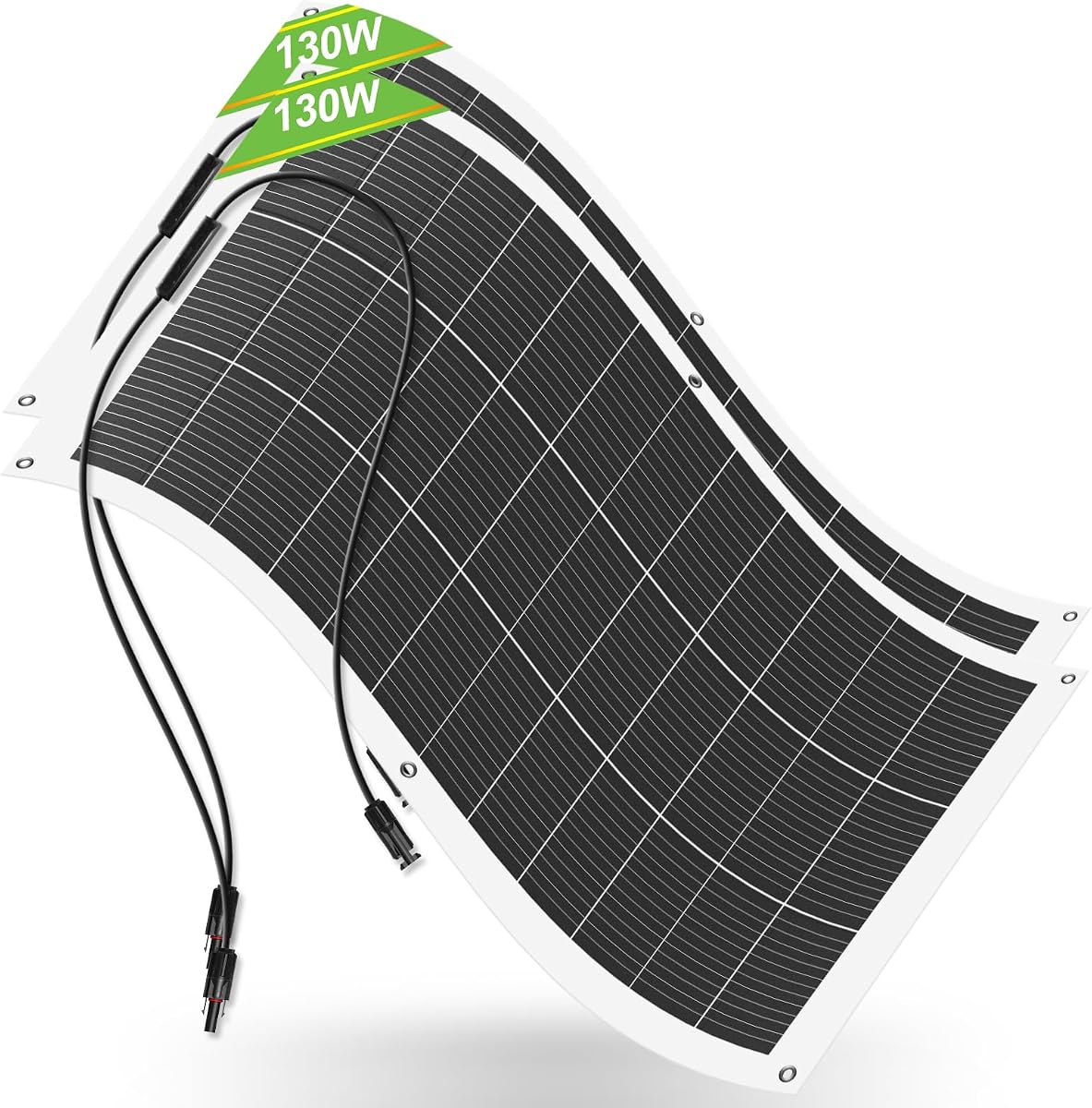

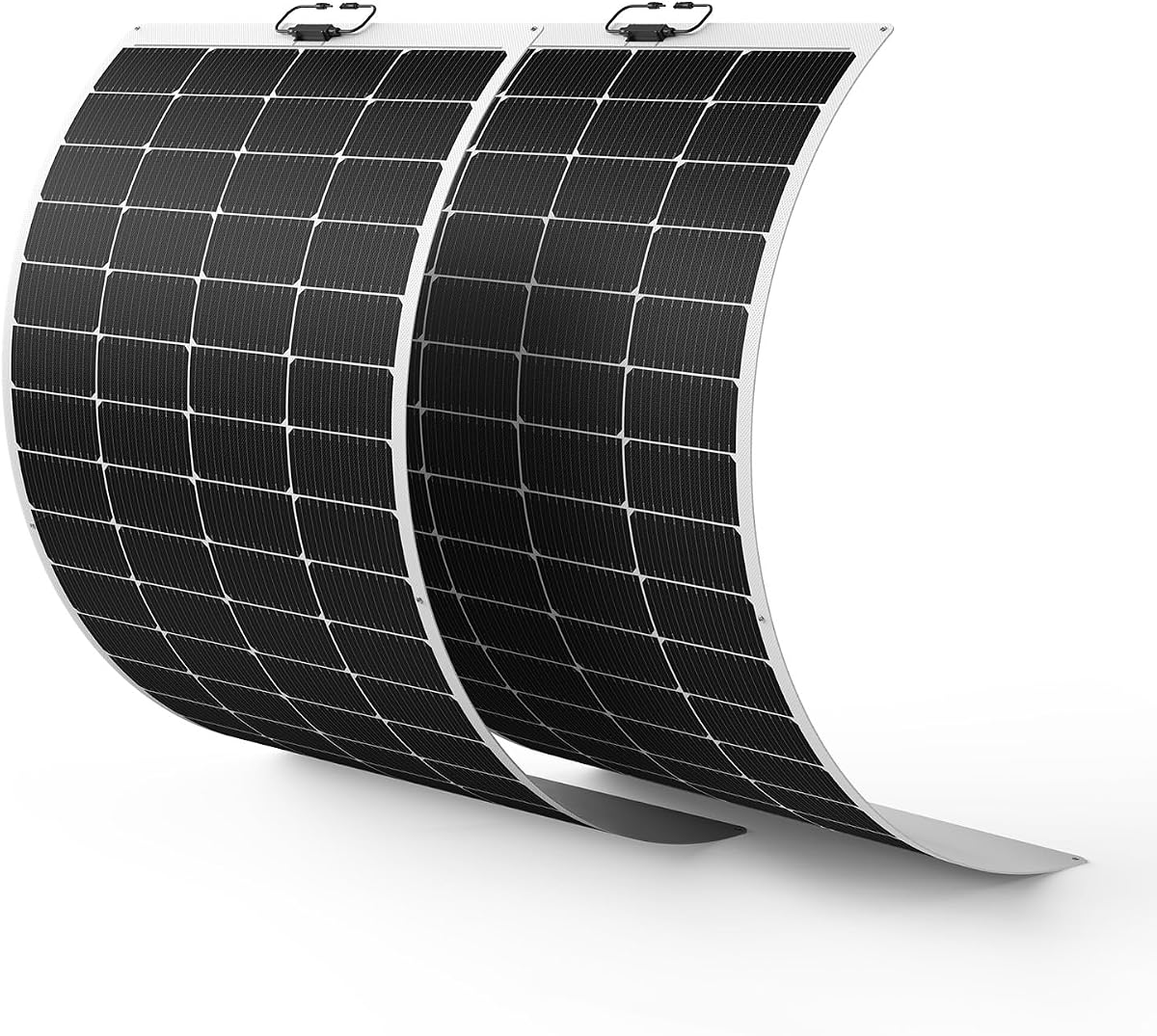


The Renogy Flexible Solar Panel 100 Watt is a compact, established-looking option for RV owners who want a low-profile panel without committing to a large rigid installation. It carries a 4.4 customer rating, and its defining advantage is the combination of 240-degree bendability, a thickness of only about one-tenth of an inch, and a weight roughly 70 percent below conventional panels.
We may earn a commission when you buy through this link, at no additional cost to you.
Its construction is particularly relevant on a curved RV roof. The flexible laminate can conform to contours where a rigid glass panel would need an elevated frame, while the lightweight design reduces the amount of material supported by the roof. The stated wind rating of up to 2,400 Pa and snow-load rating of up to 5,400 Pa also make it suitable for exposed travel conditions when correctly mounted.
The main limitation is output. At 100 watts, this panel is most appropriate for maintaining a smaller battery bank, topping up a portable power station, or supplementing an existing solar system. It does not include the detailed voltage and controller compatibility information found in some of the higher-output listings, so owners should verify those requirements before purchasing accessories.
This is the best budget recommendation for a smaller RV, a lightweight touring rig, or a traveler who wants a discreet panel for supplementary charging. It is less suited to someone seeking to run large appliances continuously, but for a straightforward flexible rooftop panel, the Renogy combines useful capacity with strong environmental specifications and a compact physical design.
The approximately 0.1-inch profile sits much lower than a typical framed rigid module. Its 240-degree flexibility lets it follow compound roof curves, making it easier to integrate without adding a conspicuous support structure.
Stated wind and snow-load figures indicate that the panel was designed with exposed rooftop installation in mind. Correct attachment, roof preparation, and secure edge protection remain essential to realizing those limits in practice.
We may earn a commission when you buy through this link, at no additional cost to you.
The 800W Solar Panel Kit is the most substantial option in this guide, combining two 400W flexible monocrystalline panels into a high-output package for RVs, boats, vans, and off-grid sites. Its 5.0 rating is the highest among the listed products, while the stated 24-percent-plus efficiency and total 800W rating target travelers with more demanding charging needs.
We may earn a commission when you buy through this link, at no additional cost to you.
Each panel weighs about 4.4 pounds and is listed at approximately 0.1 inch thick, helping preserve the low-profile advantage of flexible technology. ETFE construction provides UV resistance and strong light transmission, while the IP68-rated junction box and salt-spray resistance are particularly relevant for marine and wet environments. Compatibility extends to 12V and 24V lead-acid and LiFePO4 batteries.
Its most significant trade-off is curvature. The panels bend to 30 degrees rather than the 180 to 270 degrees offered by some competing models. They therefore suit gently curved or relatively flat sections better than sharply rounded roofs. The large combined output also demands more roof area, careful wiring, and a charge controller sized for the system.
This kit is the premium recommendation for an RV owner who wants meaningful charging capacity for refrigerators, lights, CPAP equipment, or other sustained loads. It is less attractive for a small roof or only occasional weekend use, but for a vehicle designed for extended off-grid living, the two-panel format and detailed system compatibility make it a compelling complete starting point.
The paired 400W modules provide substantially more rated capacity than any other single product in the comparison. That makes the kit better suited to maintaining everyday electrical loads and replenishing a larger battery bank during prolonged travel away from hookups.
The kit is designed for both common RV battery voltages and works with lead-acid and LiFePO4 chemistry. That broad compatibility simplifies initial system planning, although a correctly configured charge controller remains necessary.
We may earn a commission when you buy through this link, at no additional cost to you.
The 200W Flexible Solar Panel offers a useful middle ground between compact charging modules and large multi-panel arrays. It uses monocrystalline cells with a stated 25-percent efficiency and a semi-flexible design rated to bend between 180 and 240 degrees. Its 3.4 rating is lower than those of the other products, so prospective buyers should weigh the technical specifications carefully.
We may earn a commission when you buy through this link, at no additional cost to you.
The panel is clearly oriented toward mobile and curved applications. The product information specifically identifies RV roofs, boat hulls, van exteriors, campers, and cabins. Its ETFE coating, scratch-resistant surface, and IP67 waterproof and dustproof rating are designed to handle rain, snow, sand, and extended outdoor exposure.
Installation is simplified by pre-drilled mounting holes and a thin, lightweight construction that one person can handle. The specification provides an operating range of minus 20 to 65 Celsius, which is useful for year-round use in varied climates. However, the product data gives fewer details about supplied cables, voltage configuration, and accessories than some competing listings.
This panel makes sense for an RV owner seeking a balance of efficiency, moderate output, and flexible installation. Its lower customer rating warrants checking recent reviews and confirming the complete kit contents before buying. It is best suited to owners comfortable comparing technical details themselves and ensuring their controller and battery configuration match the panel.
The stated minus 20 to 65 Celsius range covers demanding cold and hot conditions. It makes the panel suitable for year-round RV travel where summer heat and winter cold can materially affect less tolerant components.
Bending capability of 180 to 240 degrees allows the panel to follow many RV roof contours. Pre-drilled holes simplify mechanical attachment, though adhesive compatibility and the roof's finish should be verified.
We may earn a commission when you buy through this link, at no additional cost to you.
The ECO-WORTHY 260W set uses two 130W flexible panels to provide more capacity than a conventional single-panel setup while preserving a thin, adaptable construction. It has a 4.2 rating and stands out for its stated 270-degree maximum bending angle, one of the highest flexibility figures among the products reviewed.
We may earn a commission when you buy through this link, at no additional cost to you.
Each panel is only 0.1 inch thick, and the set weighs 6.28 pounds according to the supplied information. The pre-installed IP68 junction box includes built-in diodes, while a pair of 2.9-foot cables supports series or parallel arrangements. The product data also states that the 18BB monocrystalline construction offers up to 25-percent efficiency.
The mounting system is unusually accommodating for non-permanent installations. Six metal-reinforced holes are pre-drilled around the edge, and the panel can be secured with adhesive, silicone, double-sided tape, cable ties, or hook-and-loop fasteners. This variety gives owners more options than a panel that requires a single proprietary mounting method.
This set is a good fit for owners who need more than a small maintenance panel and value flexible roof integration. The short included cables and the need to protect edges during installation are practical considerations. Those limitations are manageable when the panels are positioned close to the charge controller and permanently secured using an appropriate method.
A maximum bend of 270 degrees allows the laminate to wrap around demanding contours that would challenge conventional modules. This is particularly useful on rounded camper roofs, boat surfaces, and other irregular structures.
Metal-reinforced holes support mechanical attachment, while the stated compatibility with adhesive, silicone, tape, ties, and hook-and-loop makes the panels adaptable to temporary or permanent installations. The method should still match the roof material and expected movement.
We may earn a commission when you buy through this link, at no additional cost to you.
The ECO-WORTHY 400W HJT set combines two 200W flexible panels with 18-busbar heterojunction technology and an all-black finish. Its 4.5 rating places it among the stronger-reviewed products, while its claimed 25-percent conversion efficiency targets RVs and other installations where appearance and output density both matter.
We may earn a commission when you buy through this link, at no additional cost to you.
Compared with conventional 12BB cells, the narrower busbar spacing in the 18BB design can improve electrical performance and reduce the risk of microcracks. The ETFE material offers more than 95-percent light transmittance, helping the panel capture available sunlight while maintaining a refined appearance.
Mounting hardware is straightforward. Each panel has four rust-resistant metal grommets and includes six stainless-steel zip ties, while the rear surface can also be glued to a suitable substrate. A built-in blocking diode is designed to prevent reverse current at night or in low light, adding an important layer of battery protection.
This is a refined choice for an RV owner who wants a substantial power package with a modern visual finish. The data does not provide a specific maximum bend angle, so buyers should confirm fit before committing. High-efficiency modules also benefit from airflow, meaning roof placement and heat management deserve attention despite the panel's flexible format.
The 18BB layout uses more numerous, thinner busbars than a traditional 12BB panel. According to the supplied details, this improves power delivery while reducing the potential for cell damage associated with microcracks.
The all-black surface reduces the visual impact of a substantial rooftop installation. That makes the pair especially appropriate for owners who prefer their solar equipment to blend with a modern RV rather than dominate the roofline.
We may earn a commission when you buy through this link, at no additional cost to you.
The ZETAWALE 200W Flexible Solar Panel is the strongest all-around recommendation because it combines a 4.8 rating with unusually detailed attention to partial shading, electrical compatibility, and roof flexibility. It uses N-type 16BB monocrystalline cells with up to 25-percent conversion efficiency, making it well suited to modern RV electrical systems.
We may earn a commission when you buy through this link, at no additional cost to you.
Its standout technical feature is the Arch Pro anti-shading bypass diode system. According to the product information, it bypasses shaded cells to reduce hot-spot risk and helps stabilize output under partial shade from trees, walls, sails, or other obstructions. This is especially valuable on RV roofs, where a roof vent, satellite dish, rack, or nearby structure may shade part of a panel.
The panel bends up to 270 degrees and weighs 7.94 pounds, allowing it to conform to curved roofs and irregular surfaces. ETFE fiberglass construction is described as scratch resistant, self-cleaning, impact resistant, and suitable for marine and transportation environments. It also supports 12V, 24V, and 48V off-grid configurations.
Installation options include adhesive backing, hanging holes, and sealant mounting, with 2.95-foot pre-attached cables included. This is the editor's choice for travelers who want flexible geometry, strong partial-shade performance, and broad system compatibility in one panel. The main compromise is the space and weight required by a 200W module.
Roof-mounted panels encounter partial shade more often than ground-mounted arrays. The Arch Pro bypass-diode design is intended to isolate shaded cell sections, reduce hot-spot risk, and preserve more usable output when conditions are not ideal.
Support for 12V, 24V, and 48V systems gives the panel more flexibility than listings centered only on 12V RV batteries. The charge controller and wiring still need to be configured correctly for the intended battery bank.
We may earn a commission when you buy through this link, at no additional cost to you.
The Callsun 400W set is a distinctive two-panel array with a heat-reflective white backsheet. Its 4.4 rating is solid, and the design specifically targets large RVs, catamarans, boats, and sheds where heat buildup and a clean white appearance can be important.
We may earn a commission when you buy through this link, at no additional cost to you.
The white backsheet is intended to reflect excess heat and reduce power loss in hot climates. This approach gives the array a different visual character from conventional all-black solar modules, making it particularly suitable for white yacht decks and light-colored RV roofs. Premium ETFE coating and multi-layer bonding are also credited with resistance to hail, yellowing, and cracking.
Each panel bends up to 240 degrees and weighs 50 percent less than rigid panels, according to the supplied information. The system can be connected in series or parallel to suit 12V or 24V battery banks and portable power stations. An IP68 junction box, Grade A+ materials, connection cables, a user manual, and a five-year warranty support the package.
This set is best for owners of a large RV or boat who prioritize heat management and a clean appearance. The 400W combined capacity requires enough uninterrupted roof area, and hot-roof performance still depends on ventilation and correct placement. For those with the space, its combination of reflective construction, flexible mounting, and system flexibility is appealing.
Solar efficiency can decline as cell temperature rises. The reflective white backsheet is designed to reject more incoming heat, which can help preserve output during hot weather while also creating a coordinated appearance on white marine and RV surfaces.
Series and parallel connection options allow the array to align with different battery-bank and portable-power-station arrangements. Correct fusing, cable sizing, and charge-controller configuration remain essential when combining the panels.
We may earn a commission when you buy through this link, at no additional cost to you.
The BLUETTI two-panel set is purpose-built for travelers using compatible BLUETTI power systems, particularly the RVSolar 48V configuration. Each panel is rated at 100W, and together they provide 200W of nominal capacity. The product has a 4.5 rating and a 23.4-percent efficiency specification.
We may earn a commission when you buy through this link, at no additional cost to you.
Its strongest advantage is straightforward integration. The panels use a standard solar connector compatible with BLUETTI solar generators and other brands, and the package includes two pairs of parallel connection cables plus a user manual. The set can also be used with other suitable power setups, although its design and supplied information are clearly oriented toward BLUETTI users.
Physical installation is uncomplicated. Each panel bends up to 240 degrees, carries an IP67 rating for water, dust, and corrosion resistance, and can be secured with adhesive, hooks, or ties without drilling. That makes the set practical for RV roofs, rooftop tents, boats, and balconies where drilling may be undesirable.
This is a strong choice for an RV owner who already uses compatible BLUETTI equipment or wants a recognized connector and parallel cabling arrangement. It is less compelling for someone seeking the highest output from a single roof area because each panel is only 100W. Within its intended ecosystem, however, it is convenient, efficient, and flexible.
The standard solar connector and included parallel cables streamline integration with compatible BLUETTI generators. Owners using another system should still verify voltage, connector pinout, and charge-controller requirements before connecting the panels.
Adhesive, hooks, and ties provide several ways to secure the panels without penetrating the roof. The best method depends on the roof material, exposure, and whether the installation is permanent or removable.
We may earn a commission when you buy through this link, at no additional cost to you.
The Renogy 200W Flexible Solar Panel raises the rated output of the brand's entry into flexible panels while preserving a 240-degree bend and an all-black, glare-free appearance. Its 4.1 rating is moderate, but the stated electrical and mechanical specifications make it a balanced option for a typical RV rooftop.
We may earn a commission when you buy through this link, at no additional cost to you.
The panel uses half-cut PERC cell technology intended to improve light capture and electrical performance. Renogy states that it can average 800 to 1,000 watt-hours per day depending on solar availability, providing a useful way to understand expected output without guaranteeing a fixed result. Actual production will vary with weather, orientation, temperature, shading, and system losses.
For physical protection, the IP67-rated junction box and solar connectors are designed for outdoor use. The stated load limits reach 2,400 Pa for wind and 5,400 Pa for heavy snow. Pre-drilled mounting holes and 12 AWG cables measuring 27.6 inches support faster installation and more conventional rooftop attachment.
This panel is worth considering for an RV owner who wants more capacity than a 100W module but does not need a large array. Its curve-following form, light weight, and complete installation provisions make it versatile. The modest customer rating means recent owner feedback should be reviewed, particularly regarding long-term output and connector durability.
Half-cut PERC technology is intended to improve light capture and electrical behavior. It can be particularly useful where roof space is limited and every additional watt of usable output matters.
Pre-drilled holes and supplied 12 AWG solar cables simplify attachment and connection. The included cable length gives installers room to route wiring from a panel position to a nearby junction or controller enclosure.
We may earn a commission when you buy through this link, at no additional cost to you.
The Xantrex Solar Max Flex Panel is a 110W flexible module built around simplicity and environmental protection. It carries a 4.0 rating and stands apart through its peel-and-stick installation, which allows mounting without drilling, while its polyolefin encapsulation is specifically designed to keep moisture away from the cell layers and module interior.
We may earn a commission when you buy through this link, at no additional cost to you.
The panel uses mesh-grid technology with more than 2,000 points of contact per cell. According to the supplied information, this precision-engineered construction is intended to support long-lasting performance in difficult weather. The POE thermoplastic encapsulate also offers protection in humid and salt-mist conditions, making the panel a natural fit for boats and coastal RV use.
Installation is the most attractive feature for many travelers. Removing the protective layer and pressing the panel onto a prepared surface eliminates the need for tools, brackets, and roof penetrations. That convenience must be balanced against the importance of cleaning the bonding surface and preventing water or trapped debris from entering the adhesive edges.
This is a specialized recommendation rather than a general high-output solution. With a 110W rating, it works best for maintaining a modest battery bank, powering small essentials, or supplementing another charging method. RV or marine owners who value drill-free mounting and moisture resistance will find its design compelling.
The peel-and-stick backing turns mounting into a surface-preparation and positioning task rather than a hardware installation. It is especially convenient for removable setups and owners reluctant to penetrate a fiberglass or aluminum roof.
The POE thermoplastic encapsulate is designed to protect the panel's internal layers from moisture and corrosion. That focus makes the module well suited to humid, salty environments where long-term sealing is critical.
We may earn a commission when you buy through this link, at no additional cost to you.
Choosing a flexible RV solar panel requires balancing output, flexibility, weather resistance, electrical compatibility, roof space, and mounting method. The following factors help narrow the options before you invest in a complete system.
Prioritize enough capacity for your typical trip and battery capacity. More solar does not compensate for an undersized bank if stored energy remains low during poor weather.
Match bendability to the roof shape and plan any cable routing before purchasing. A sharply curved surface needs a panel that can truly follow it without stressing the cell area.
Use efficiency to compare output per unit of roof area. Do not rely on it to compensate for a poorly matched controller, excessive cable length, or an undersized battery.
Verify voltage, connector pinouts, and charge-controller settings before wiring. Correct configuration protects both the panel and the RV battery system.
Choose a weather rating appropriate to the environment, then install it so water cannot collect around edges. Long-term reliability depends on both the module and the workmanship of the attachment.
Favor a light panel that can sit securely without obstructing roof access. Preserve ventilation and leave enough room to clean the surface and inspect connections.
Choose a mounting method that suits the roof and your willingness to maintain the installation. Adhesive is convenient, but surface preparation and edge sealing determine whether it lasts.
Minimize shade first, then use diode-equipped panels to limit its effects. Strategic placement and separate controller channels can improve real-world output.
Before mounting, map the roof and measure the available flat and curved areas. Check for vents, hatches, antennas, air-conditioning units, roof racks, and the path of cables to the charge controller. Confirm the battery system's nominal voltage, select a compatible charge controller, and verify the panel connectors before making any electrical connections. Keep the panel's orientation as close to unobstructed sunlight as practical.
Clean the roof and panel with a soft cloth and mild, RV-safe cleaner, then allow both surfaces to dry completely. Follow the mounting instructions for the selected attachment method, provide drainage paths around the panel edges, and avoid driving fasteners through the active cell area. Route cables with strain relief and secure them where they cannot chafe against sharp roof edges. Bring the battery system into a safe state before connecting or disconnecting electrical leads.
Periodic care is simple but important. Wash away accumulated dust, pollen, bird residue, and road grime with clean water and a nonabrasive cloth. Inspect adhesive edges, grommets, cable jackets, and connectors for lifting, cracking, corrosion, or water intrusion. Check the charge controller and battery state regularly, and use the monitoring features available on compatible systems to identify unusual drops in output that could indicate shading, connection, or battery problems.
Yes, flexible solar panels are specifically designed to conform to curved and irregular surfaces. Their bend ratings range from 30 degrees to 270 degrees, so owners should select a model whose specified curvature matches the roof contour. Even highly flexible panels need secure attachment, protected edges, and cable routing that allows for normal roof movement.
A 200W panel is rated to produce 200 watts under specified test conditions, not continuously throughout the day. Real output depends on sunlight, temperature, orientation, shading, and electrical losses. The Renogy listing estimates an average of 800 to 1,000 watt-hours daily depending on solar availability, but that figure can vary substantially with weather and installation.
It depends on the voltage configuration of the panels and the intended battery system. Parallel connection generally retains panel voltage while combining current, while series connection raises voltage and requires compatible charge-controller and fusing arrangements. Use only configurations explicitly supported by the manufacturer and verify voltage, connector polarity, and controller settings before connecting the panels.
Solar panels work from available light, but their output is dramatically lower in shade. RV roof equipment such as vents, antennas, and air conditioners can create partial shade that affects multiple cells. A panel with effective bypass diodes, such as the ZETAWALE model highlighted in this guide, can reduce some shading effects, but careful placement remains the most reliable way to improve output.
The products reviewed support several drill-free methods, including peel-and-stick adhesive, approved roof adhesive, sealant, double-sided tape, cable ties, hook-and-loop fasteners, and zip ties. The right choice depends on whether the installation is temporary, the roof material, and how much movement it experiences. Clean and dry the bonding surface and protect vulnerable edges for a durable attachment.
ETFE generally offers stronger UV resistance, better light transmission, greater scratch resistance, and improved long-term outdoor durability than basic PET construction. Several products in this comparison emphasize ETFE for marine, RV, and exposed rooftop use. The correct choice still depends on the overall panel design, mounting method, climate, and system components rather than surface material alone.
The appropriate battery bank depends on daily energy use, travel duration, and the amount of sunlight expected. A small 100W panel may be suitable for maintaining a modest 12V bank, while 200W panels support more consistent charging and larger loads. For 400W to 800W arrays, a larger battery bank and correctly configured charge controller are normally needed to take full advantage of the available generation.
Yes, if the selected panel and attachment method are compatible with fiberglass and the roof is properly prepared. Clean away wax, dirt, and oils, provide a sound bonding surface, and avoid drilling where leak prevention is a concern. Protect panel edges, leave access to roof fixtures, and confirm that the attachment method will tolerate road vibration and temperature changes.
The strongest all-around option in this guide is the ZETAWALE 200W panel because it combines a 4.8 rating, 270-degree flexibility, anti-shading bypass diodes, and compatibility with 12V, 24V, and 48V systems. The Renogy 100W model is the practical budget selection for smaller roofs and supplementary charging, while the 800W dual-panel kit offers the highest capacity for substantial off-grid electrical demand.
The right choice ultimately depends on your roof shape, battery architecture, and expected loads. Buyers with heavily curved roofs should prioritize bendability and secure attachment; travelers facing partial shade should examine bypass-diode design; and owners with limited space may value the listed 25-percent and 23.4-percent efficiency figures. In every case, the panel should be paired with a correctly sized charge controller, protected wiring, and an adequate battery bank.
Product specifications and availability can change, so verify the current listing, included accessories, connector configuration, warranty terms, and compatibility details before purchasing. Comparing current customer feedback alongside the technical specifications will help ensure that the selected flexible solar panel fits both the RV and the traveler's energy plan.