
Plant Covers Freeze Protection 10 x 30 ft
4.4Editor score
Large 10 by 30 foot size
Lightweight breathable polypropylene
Cuttable for multiple applications
Garden row covers create a protective microclimate around vegetables, flowers, shrubs, seedlings, and tender perennials. The best choice depends on fabric weight, coverage area, support design, breathability, and how easily the material can be secured without damaging plants during sudden cold or windy weather.
We compared ten row covers using the supplied specifications, customer ratings, material details, dimensions, and intended uses. The list includes large floating blankets, cut-to-fit fabric, a supported hoop kit, and compact covers designed specifically for raised beds, allowing buyers to compare several garden layouts.
Each pick reveals what makes it useful, from broad bed coverage to raised tunnels, thicker insulation, UV resistance, and multi-season pest control. Product ratings and availability can change over time, and current prices should always be checked before ordering, so consider the garden area and protection needs first.
4.4Editor score

4.6Editor score

5.0Editor score
As an Amazon Associate we earn from qualifying purchases.
The comparison below highlights each product's material, dimensions, principal protection, and installation approach, making it easier to identify the right row cover for a large row, raised bed, or individual plant.




This floating row cover is the strongest all-around choice in the group because its 7-by-100-foot roll can accommodate long rows, multiple raised beds, scattered plants, and large shrubs without forcing the gardener to purchase several smaller covers. It carries a 4.6 rating, and its standout quality is the balance between generous material weight and low bulk.
We may earn a commission when you buy through this link, at no additional cost to you.
The 0.9 oz non-woven fabric is described as breathable and designed to admit air, moisture, and sunlight while helping stabilize conditions around the plants. Because the material can be cut without a special tool, one roll can become direct covers, bed-width panels, or a larger floating sheet. It can rest over crops, wrap trees and shrubs, or sit above garden hoops, making it useful well beyond a single winter emergency.
The principal trade-off is that the fabric is thinner than several options in this list, including covers using 1.5 oz or 1.77 oz material. It also does not include hoops or ground fasteners. Gardeners who require a rigid tunnel, very heavy snow resistance, or the highest possible tear resistance may need a more substantial product, but those needs cannot be judged from fabric weight alone because exposure, support, and local conditions also matter.
This is the best general recommendation for gardeners with an expansive plot, mixed plant types, or a need to customize coverage. Its oversized roll is especially valuable for separating sections of a garden with one continuous piece. Buy it when flexibility, coverage area, and year-round utility matter more than having a complete support system bundled in the box.
The long roll can cover an entire bed, wrap a large shrub, or be divided into smaller panels for separate crops. This flexibility makes the cover useful across vegetable gardens, raised beds, potted plants, and perimeter plantings without requiring a rigid, one-size-fits-all structure.
Its breathable construction allows light, air, and moisture to reach covered plants while reducing direct contact with plastic. The result is a more practical barrier for frost, wind, insects, birds, and strong seasonal sun than an impermeable sheet.
We may earn a commission when you buy through this link, at no additional cost to you.
This frost cloth kit is the most convenient supported design among the ten products because it includes six garden hoop sets rather than requiring the gardener to design and purchase a support frame separately. Its 5.0 rating reflects a particularly strong customer reception, and the 10-by-30-foot dimensions are practical for long rows, raised beds, and greenhouse-adjacent plantings.
We may earn a commission when you buy through this link, at no additional cost to you.
The kit includes 12 straight tubes, 12 curved tubes, 18 connectors, and 18 clips. That inventory allows the included hoops to be assembled into six supported structures, with the cover clipped over the frame. The raised profile helps avoid placing the fabric directly against stems and leaves, preserves space for growth, and makes the cover easier to lift for inspection than a loose sheet.
Its 1.5 oz non-woven fabric is thicker than common 0.9 oz covers and is described as breathable. That combination suits gardeners who want more substantial seasonal protection without moving to plastic. The limitation is coverage: 10 by 30 feet may not be enough for a large property or several widely separated beds, and the included accessories cover only the rows supported by the six hoop sets.
Choose this kit for gardeners who value a ready-to-assemble raised row cover and want an organized installation. It is especially attractive for seedlings, flowers, vegetables, young plants, and beds where enough vertical clearance is needed for continued growth. The bundled hardware and thicker fabric justify treating it as the premium, convenience-focused option.
The hoop frame suspends the fabric above foliage, reducing the chance that it will crush tender stems or restrict vertical growth. This creates a tunnel-like space that is more practical for fast-growing vegetables and seedlings than a cover laid directly over the bed.
Straight and curved tubes form each hoop, connectors join the pieces, and clips hold the fabric in place. Including all of these components makes the kit a more integrated solution than loose garden fabric that still requires separately sourced supports and fasteners.
We may earn a commission when you buy through this link, at no additional cost to you.
The AlpineReach cover is a strong choice for gardeners seeking protection from both cold and bright winter sun across a large planting area. Its 10-by-50-foot size offers extensive coverage, while the 1.2 oz fabric represents a middle ground between lightweight floating cloth and heavier winter-grade options.
We may earn a commission when you buy through this link, at no additional cost to you.
The product information identifies low 28°F temperatures as part of its protection positioning. Its breathable and permeable design is intended to allow light, air, and water through while forming a warmer microclimate around plants. That same fabric serves as a windbreaker and offers UV protection, reducing the chance of sun scorch when winter sunshine is unexpectedly strong.
One drawback is that this is a fabric roll rather than a framed cover, so the gardener must provide hoops, stones, stakes, or another way to hold it in position. The stated temperature figure should also be treated as a product specification rather than a guarantee for every crop, since plant sensitivity, wind, moisture, and the number of layers all affect real-world performance.
This cover is well suited to large vegetable rows, perennial beds, and gardeners who want one material for frost, wind, sun, and mild pest exclusion. It also fits an early-spring or late-autumn strategy because the breathable construction can support warmer conditions and faster germination beneath the fabric.
A useful row cover must handle more than low nighttime temperatures. This material also serves as a windbreaker and provides UV shielding, making it appropriate for gardens where intense winter sunlight can scorch foliage after a cold night.
At 10 by 50 feet, the cover provides a substantial surface for long beds, grouped crops, and multiple nearby planting areas. The material can also be divided into more manageable panels when different plants need separate ventilation schedules.
We may earn a commission when you buy through this link, at no additional cost to you.
This 10-by-30-foot floating row cover is the budget-focused selection because it provides a useful amount of fabric in a familiar lightweight format. Its 4.4 rating reflects steady customer approval, while the 0.9 oz non-woven polypropylene construction is designed to be manageable, breathable, and suitable for frost protection.
We may earn a commission when you buy through this link, at no additional cost to you.
The fabric allows sunlight to reach covered plants and can be used loosely over a bed, supported on hoops, or cut into smaller sections. Gardeners can secure it with soil, stones, or staples. Its use is not limited to winter: the manufacturer also describes it as useful for germination and rapid seedling growth, supporting earlier spring planting and a longer growing season.
The main compromise is its position at the lighter end of the fabric weights in this comparison. It offers less material than the 1.5 oz and 1.77 oz products, and it does not include any accessories. Buyers should therefore match the cover to crops that need protection from moderate cold, wind, pests, and intense sun rather than expecting a heavily insulated tunnel.
This is a sensible first row cover for a standard vegetable bed, a group of annual flowers, or young plants needing inexpensive seasonal protection. Its main advantage is the combination of a 10-by-30-foot sheet, easy cutting, and several installation methods, which lets a gardener begin with a simple approach and add hoops later if the plants need more space.
The cover can be draped directly over a row and held at the edges with stones, soil, or staples. Gardeners who want more clearance can place hoops underneath, allowing the material to function as a floating cover rather than resting directly on the plants.
Beyond frost, the material can support warm-season germination, protect young seedlings, and help establish crops earlier. That versatility gives the cover a useful place in the garden during more than a few cold weeks each year.
We may earn a commission when you buy through this link, at no additional cost to you.
The KLEWEE cover combines a large 10-by-50-foot sheet with 1.5 oz spun polypropylene, giving it an appealing combination of coverage and material substance. Its 4.5 rating places it among the better-reviewed products, while the fabric is described as thicker, warmer, and more tear resistant than common 0.6 to 0.9 oz material.
We may earn a commission when you buy through this link, at no additional cost to you.
A two-percent UV-protective agent has been added to help the reusable material withstand sunlight and provide better protection over repeated seasons. The cover is intended to admit air, sunlight, and moisture while helping retain warmth. It can be used as a single layer, doubled, or tripled, allowing the gardener to adjust protection for delicate plants or colder conditions.
This versatility introduces a trade-off: layering a broad sheet can be heavy, and loose fabric still needs secure anchoring. A windy location requires careful edge fixation to keep the material from lifting. Gardeners should also follow the recommendation to fold and store the cloth away from light and moisture when it is not in use.
It is a good fit for a sizable garden, intensive vegetable plot, or collection of cold-sensitive perennials that need more than a light frost shield. Buyers seeking a single roll to protect numerous beds, shrubs, and seedbeds will appreciate the generous dimensions, while those wanting a ready tunnel should add compatible hoops.
The same sheet can provide one, two, or three layers depending on the crop and weather. This allows a gardener to increase protection as temperatures fall, although the full-size cover must be handled carefully when wet or heavily layered.
The added UV-protective agent is intended to improve resistance to sunlight and support longer-term use. That matters for covers deployed during both the bright spring season and the stronger winter sun.
We may earn a commission when you buy through this link, at no additional cost to you.
This is the heavy-fabric selection in the guide, using 1.77 oz non-woven polypropylene with a stated 4°F frost-protection capability. Its 4.6 rating and reusable design make it appealing for gardeners who want a durable fabric rather than the lightest possible seasonal sheet.
We may earn a commission when you buy through this link, at no additional cost to you.
The material is composed of 98% non-woven polypropylene and 2% eco-friendly UV protector. It offers UPF 30+ coverage, is described as resistant to frost, and is positioned as more tear resistant than standard 0.74 oz alternatives. Its porous construction permits sunshine, air, and rain while helping avoid the condensation associated with plastic covers.
The heavier fabric can be less convenient than 0.9 oz material because it is bulkier to move, drape, and secure. The listed frost figure should also be understood within the context of the crop, exposure, number of layers, and support structure rather than as a universal operating temperature. No hoops or anchoring accessories accompany the cover.
Choose it for exposed gardens, perennial beds, and gardeners who value durability and UV blocking alongside frost protection. It can be cut or tailored into different shapes, making it suitable for broad beds as well as individual shrubs and bushes. The material weight is the central reason to choose it over a lighter and easier-to-handle alternative.
At 1.77 oz, the cover is the heaviest fabric listed in this comparison. Its stated tear resistance and durability make it a more substantial option for locations where a thin sheet is likely to be handled, repositioned, or exposed repeatedly through the season.
The fabric lets sunlight, air, and rain pass through while remaining lighter and more flexible than plastic sheeting. That porous approach is useful where condensation around sensitive foliage would be a concern.
We may earn a commission when you buy through this link, at no additional cost to you.
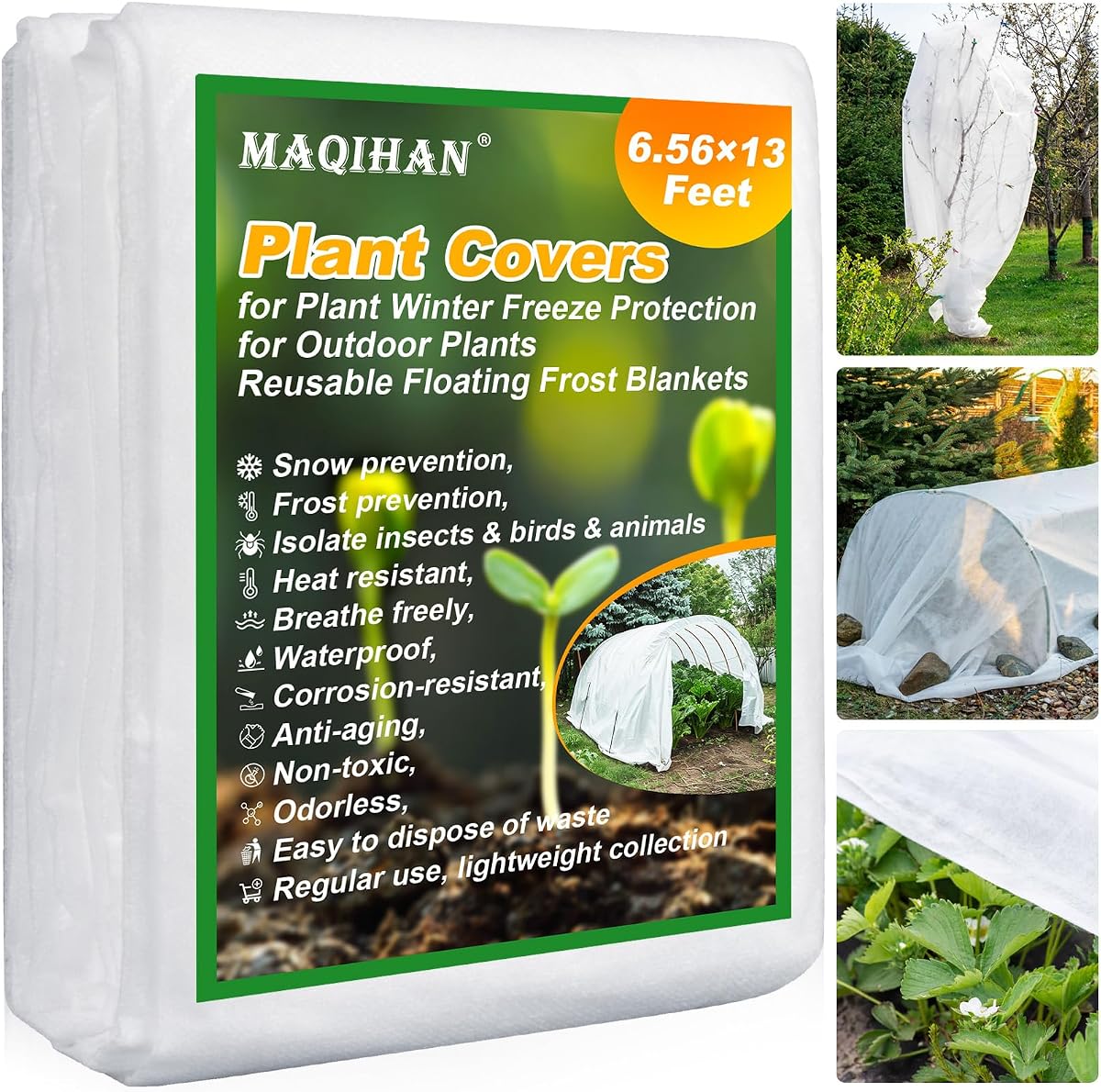
The MAQIHAN cover is the most flexible option for gardeners who need to size a protective piece around individual plants rather than cover a standard rectangular bed. It uses 1 oz non-woven fabric and carries a 4.5 rating, indicating a well-received balance of durability, breathability, and insulation.
We may earn a commission when you buy through this link, at no additional cost to you.
The frost cloth can be cut according to the size of the plant, then laid directly over the foliage, positioned loosely, or secured with hoops or frames. It is marketed for frost and snow protection, animal and insect barriers, and sun shielding. Its breathable construction is intended to support sunlight penetration while helping maintain stable soil temperatures.
Unlike many alternatives, the supplied information does not state a fixed length and width, so buyers should check the current listing carefully for its available dimensions. The product also relies on the gardener for support and fastening. Direct placement is convenient for small plants, but taller growth benefits from a hoop to maintain airflow and prevent the material from pressing down.
This cover is most appropriate for targeted protection around individual shrubs, flowers, potted plants, or small sections of a bed. Its instructions also emphasize deploying before sunset and removing or opening the cover after temperatures rise above freezing so plants can receive direct warming sunlight. Proper ventilation and drying are important parts of using it well.
Because the material can be cut to the required size, it is useful for protecting a single tender plant without covering an entire bed. Smaller sections are also easier to reposition as the plant grows or the weather changes.
The recommended sequence is to cover before sunset so residual soil warmth is retained, then remove the cover after temperatures rise above freezing. This routine helps balance frost shielding with the plants' need for sunlight and warming.
We may earn a commission when you buy through this link, at no additional cost to you.
This 10-by-50-foot frost cloth combines a large area with soft, moderate-thickness 1.2 oz non-woven fabric. Its 4.6 rating makes it one of the stronger customer-rated options, and the reusable material is described as strong, breathable, odorless, and flexible enough to handle multiple kinds of plants.
We may earn a commission when you buy through this link, at no additional cost to you.
The cover can be laid loosely over vegetation and secured with soil, stones, or nails, or it can be supported by a ring or hoop. It is described as windproof while still allowing light and water to reach the plants. Beyond frost, it can serve as a barrier against insects, pests, birds, and weeds, making it useful for pest management as well as cold protection.
One product claim of up to 30 degrees of surface warming should be treated cautiously and not interpreted as a universal temperature guarantee. Surface readings vary with wind, sunlight, moisture, crop, and the number of layers. The cover also does not include a support structure or fasteners, so a secure installation still depends on the gardener's setup.
This is a strong all-season option for strawberries, herbs, perennials, small fruits, evergreen shrubs, citrus, and greenhouse-adjacent plantings. It suits gardeners who want one fabric to use during cold nights, early spring, and periods when insect or bird pressure is elevated. Its large size and easy cutting also make it adaptable to separate beds and individual plants.
The stated uses range from strawberries and herbs to evergreen shrubs and citrus. That broad plant compatibility makes the cover useful for mixed gardens where different specimens may need frost, wind, bird, or insect protection at different times.
The fabric permits sunlight and water through while remaining flexible and reusable. A material that can handle both seasonal covers and warmer-month barriers is more likely to earn regular use than a product reserved only for emergency frost nights.
We may earn a commission when you buy through this link, at no additional cost to you.
This two-pack is the only cover in the guide designed around the dimensions and structure of a raised bed. Each cover measures 45 by 22 by 16 inches, and the set includes eight garden staple stakes. Its 4.3 rating reflects its specialized utility for compact beds and containers rather than large-scale row coverage.
We may earn a commission when you buy through this link, at no additional cost to you.
The construction combines PVC side panels with reinforced breathable mesh on the top. The mesh promotes ventilation, while the transparent PVC makes it easier to observe plant growth without opening the cover. Zippered sides allow controlled access, and the included stakes help stabilize each cover in windy conditions. This is a more structured option than loose floating fabric.
The obvious limitation is scale. At 45 by 22 by 16 inches, each cover is intended for a smaller raised bed, and two units will not cover a conventional long garden row. The mesh top also differs materially from a thick frost blanket, so buyers focused on maximum winter insulation should choose a fabric cover instead. The stated dimensions should be compared carefully with the bed's internal footprint and height.
This set is ideal for gardeners with small raised beds, patio planters, or a limited number of seedling boxes. The zippers, visible construction, and simple fastening make it convenient for checking and ventilating young plants. It is particularly attractive when the priority is a ready-made cold and pest barrier rather than a customizable roll of fabric.
The zippers give the gardener access without fully dismantling the cover. That makes it easier to inspect seedlings, adjust the interior, or admit air during warmer periods while preserving the overall protected structure.
Clear PVC sides allow plant condition to be observed, while the reinforced mesh top supports airflow. The combination reduces the need to open the cover merely to check growth and helps maintain a suitable environment for tender seedlings.
We may earn a commission when you buy through this link, at no additional cost to you.
The green frost blanket is the final recommendation and brings together a large 10-by-50-foot size, 1.23 oz polypropylene, and a stated cold-weather capability down to 23°F. Its 4.6 rating indicates broad customer approval, and the dark green color gives it a less utilitarian appearance than a white garden fabric.
We may earn a commission when you buy through this link, at no additional cost to you.
The cover is described as providing frost protection for outdoor plants, blocking harsh sunlight to prevent sunburn, and allowing 40 to 50% sunlight through for healthy growth. Its breathable construction supports air circulation, while the fabric can be cut to fit garden beds, long rows, individual plants, vegetables, shrubs, and flowers.
Because it allows only a portion of sunlight through, the cover should not be left in place indefinitely when plants need maximum light. It also has no bundled supports or stakes, so gardeners must provide a secure method of attachment. The 23°F figure is a stated product specification and should not be treated as a guarantee for every species or garden microclimate.
This blanket suits a large garden where appearance matters, such as a visible front yard, community plot, or landscaped area. It is also a flexible option for gardeners who want one material to address frost, snow, insects, and excessive sun. The broad dimension and cut-to-fit design let it serve both full rows and smaller protected groups.
The stated 23°F capability makes this cover relevant for regions that experience significant cold during autumn and winter. It can protect vegetables, flowers, and shrubs while also helping retain warmth around the soil and plants.
The dark green material blends more naturally into a landscaped setting than a conspicuous white cover. That makes it useful for gardens where the row cover will remain visible during the growing season or around a public-facing planted area.
We may earn a commission when you buy through this link, at no additional cost to you.
The right garden row cover depends on the size of the planting area, crop sensitivity, local weather, and preferred installation method. These factors help narrow a large catalog of floating fabric, hoop kits, and structured bed covers to the most practical option.
Begin by measuring the beds, rows, or individual plants that need protection. Large rolls offer the greatest flexibility because they can be cut into panels of different sizes, while a 10-by-30-foot sheet is easier to handle and usually sufficient for one standard bed. Compact covers with defined dimensions work best when the garden consists of small raised beds or planters. Consider the entire shape, not only the square footage, because a long narrow row may require a different sheet layout than a broad square bed.
Fabric weight provides a useful indication of thickness and durability, although it is not a complete measure of protection. The products here range from lightweight 0.9 oz material to a heavier 1.77 oz construction. Lightweight cloth is convenient for temporary frost protection and germination, while thicker fabric is better suited to repeated handling, stronger winds, and multiple layers. Crop sensitivity and local temperatures remain more important than a single weight figure, and the number of layers can influence performance substantially.
A breathable row cover should allow some air, moisture, and light to pass through instead of trapping condensation around foliage. Porous non-woven fabric is generally better suited to living plants than an impermeable plastic sheet. Some covers specify the amount of sunlight allowed, while others simply state that light passes through. Pay attention to ventilation needs and avoid leaving covers on during unusually warm periods unless the fabric is designed for that condition.
Loose fabric is economical and flexible, but it needs anchors and often benefits from hoops. Draping the material directly over short plants is simple, whereas hoops provide clearance for faster-growing crops and reduce direct contact with leaves. A kit that includes tubes, connectors, and clips saves separate shopping and makes tunnel construction more consistent. For small raised beds, a structured cover with zippers and stakes may be easier to access than a large loose sheet.
Frost cloth often does more than block cold. Look for products that also resist wind, snow, insects, birds, or excessive sun if those pressures occur in the garden. Breathable covers can support earlier planting and faster seedling growth during spring, while a sun-resistant fabric can provide shade during warmer months. Multi-season materials are more likely to remain useful throughout the year, particularly when stored dry between deployments.
A cover may remain exposed to strong sun for long stretches, so UV stabilization and tear resistance can affect useful life. Some fabrics include a UV-protective component, while others are described simply as durable or reusable. Heavier material generally resists tearing but is less convenient to move. For gardens with bright seasonal exposure, a stabilized fabric is more appropriate than a thin sheet intended only for brief nighttime use.
Reusable cloth should be allowed to dry before storage and kept away from prolonged light and moisture when not in use. Large wet sheets become heavy and difficult to handle, so a manageable cut or separate covers for individual beds can make seasonal changes easier. Fitted covers that fold compactly offer another storage advantage. Always check the material for tears after high winds and repair or replace damaged sections before the next season.
Prepare the bed before installing a cover by removing any fabric that is already wet, clearing damaged leaves, and confirming that the plants have enough room to grow. Cut the cover to the required size if necessary, then position it directly over short plants or build a hoop frame for taller growth. Secure the edges with soil, stones, staples, clips, or the supplied stakes.
For the strongest nighttime protection, install the cover before sunset so it can retain residual warmth from the soil. Keep the material taut enough to resist wind but not so tight that it presses against foliage. In warmer weather, open, raise, or remove the cover when appropriate so plants can receive direct sunlight and ventilation. Check the forecast regularly, because a cover that helps on a cold night can become overly warm on a sunny day.
After use, remove the cover and allow it to dry completely before folding or storing it. Brush away loose soil and plant debris, inspect for tears or UV-related deterioration, and keep the fabric away from moisture and prolonged light. Structured bed covers can be collapsed after their windows are dry, while hoop components should be stored separately so they remain easy to assemble for the next cold front.
Breathable non-woven polypropylene or spun polypropylene is a practical choice for most plants because it admits light, air, and moisture while creating a warmer microclimate. Lightweight fabric is convenient for temporary protection, while heavier cloth is better for exposed conditions and repeated use. The best material still depends on the crop, wind, and installation method.
They can rest over short, hardy plants, but taller or tender growth is usually better supported by hoops. A raised tunnel gives foliage space to grow, improves airflow, and reduces the chance of the material bruising leaves. Secure the outer edges so wind cannot pull the cover onto the plants.
Yes. Many of the listed covers are designed to function as barriers against insects, birds, and other animals in addition to frost and wind. The result depends on how completely the material encloses the plants and how securely its edges are anchored, because gaps can provide an entry route.
Remove or open the cover when daytime temperatures rise enough for the plants to benefit from direct sunlight and ventilation. The MAQIHAN guidance specifically recommends removal after morning temperatures move above freezing. In warmer weather, check the covered area rather than relying only on the outdoor temperature because sunlight beneath fabric can create additional heat.
Hoops are not required for every use, but they are valuable over tall vegetables, flowers, and seedlings. They create breathing room, support the material, and reduce damage from condensation or direct contact. A complete hoop kit is convenient, while a loose fabric roll can be paired with separately sourced hoops and clips.
Most of the large fabric products are described as cuttable with scissors, which allows one roll to cover beds, rows, shrubs, and individual plants. Cut along measured lines and leave enough material to secure the edges. If sections will serve different plants, keeping them separate makes daily ventilation and removal easier.
Let the fabric dry before folding it, then store it in a dry location away from prolonged light and moisture. Inspect it for tears and clean off loose soil before putting it away. Hoop components can be kept separately, and structured raised-bed covers should be fully dried before being collapsed for compact storage.
No single temperature specification applies to every crop, site, and setup. Wind, sunlight, moisture, plant species, support, and the number of layers all influence the result. Use the stated temperature figures as product guidance, add insulation when appropriate, and provide ventilation during mild or sunny periods.
The Plant Freeze Protection Cover 7 x 100 ft is the most flexible overall option because it combines a very large roll with light, breathable material. The 10 FT x 30 FT Frost Cloth Kit is the best convenience choice for gardeners who want thicker fabric and complete hoop hardware, while the 10-by-30-foot 0.9 oz cover provides a practical budget option for a standard bed.
Prioritize the protection your plants actually need, then match it to the space. Large gardens benefit from 50-foot rolls, smaller beds may suit the two-pack of fitted covers, and taller crops usually need hoop-supported clearance. Fabric weight, UV resistance, breathability, and secure anchoring should be considered together rather than relying on one specification.
Ratings, product details, and current prices can change, so check the latest listing before making a purchase. Comparing dimensions, included accessories, and local weather needs will lead to a garden row cover that is easier to install, maintain, and use throughout more than one season.