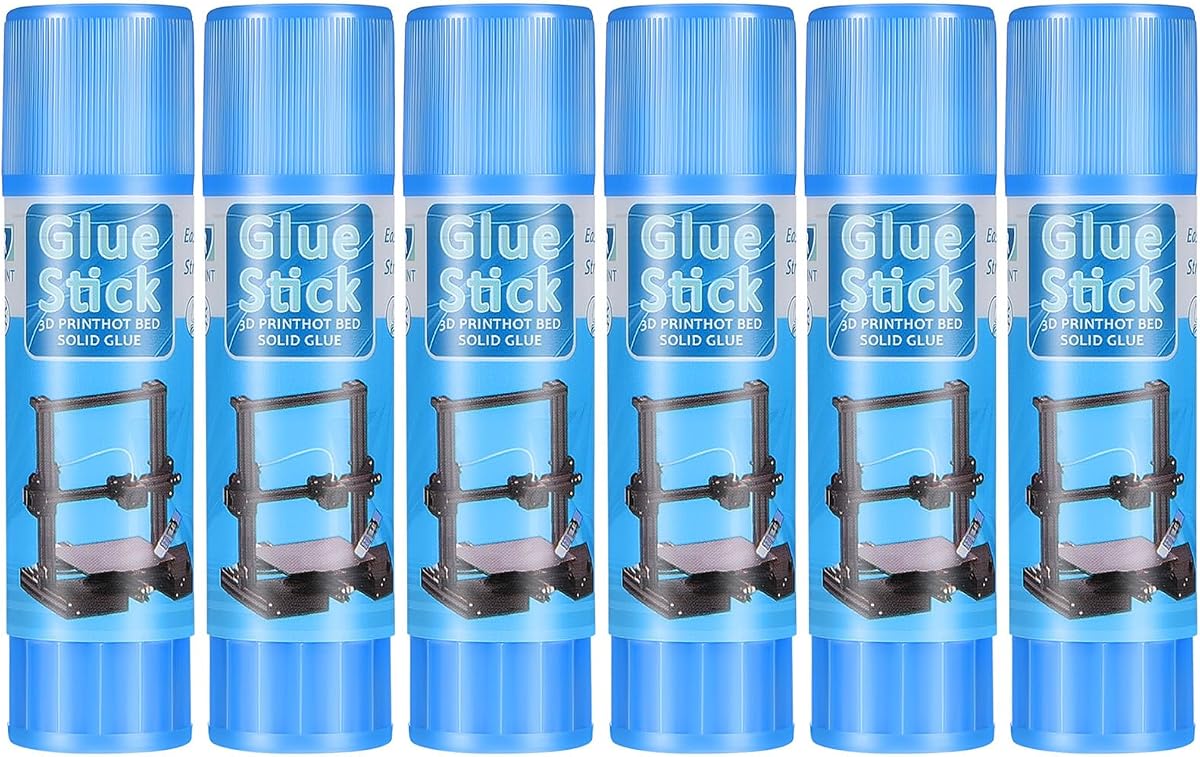
Outus 6 3D Printer Glue Stick
4.5Editor score
Water-soluble PVP formula
Supports heated build plates
Covers more than 100 prints
Explore the best glue stick for 3D printing bed options, comparing adhesion, material compatibility, cleanup, coverage, and ease of use.
A glue stick for 3D printing bed can improve first-layer contact, reduce warping, and make finished models easier to remove. The most useful formula spreads cleanly, grips effectively at printing temperatures, and washes away with water after the plate cools.
This guide compares ten solid adhesive options across build-plate compatibility, filament support, application method, cleanup, odor, and pack size. It includes both multipack glue sticks and liquid, foam-applied bed adhesives that offer an alternative approach to first-layer adhesion.
Each pick highlights a different practical advantage, from budget value and broad surface support to premium coverage for difficult materials. Ratings and specifications reflect the supplied product information, while prices and availability can change, so confirm current listings before buying.
4.5Editor score

4.7Editor score

4.5Editor score
The table below compares all ten options by format, capacity, build-surface support, filament compatibility, cleanup method, and practical standout feature, making it easier to match an adhesive to a particular printer and workflow.


The Outus 6 is a budget-oriented adhesive option for printers that struggle with first-layer adhesion. Its 4.5 rating reflects a well-rounded proposition built around a high-viscosity PVP formula, generous multipack format, and compatibility with common heated bed surfaces. It is especially relevant for makers who want an inexpensive way to improve corner and center adhesion without changing printer hardware.
We may earn a commission when you buy through this link, at no additional cost to you.
One of its strongest qualities is straightforward application. The solid stick can be rubbed over only the active printing region with a ruler, ID card, glass plate, or another flat object. The supplied information says each stick can support more than 100 average prints, which makes the six-piece package a practical choice for regular use. Compatibility extends to build-surface sheets, aluminum, glass, and other common heated-bed materials.
The trade-off is that this remains a manual glue-stick format rather than a precision applicator. Coverage and coating consistency depend partly on the technique and pressure used by the operator. Cleanup requires letting the plate cool and then washing away residue with water. Users should also replace the lid promptly because exposed PVP glue can otherwise dry out.
This product makes the most sense for beginners, classroom printers, and owners of glass or aluminum beds who need a straightforward adhesion aid. It offers a useful balance of capacity, low-odor PVP composition, and easy cleanup. For the best overall budget approach, it is a strong recommendation, particularly for those who value multipack storage over liquid applicators.
Six sticks and a stated lifespan of more than 100 average prints per stick provide a useful reserve for regular printing. The portable stick format also makes it simple to keep one near each printer.
The formula is described as suitable for build-surface sheets, aluminum, and glass. That makes it broadly useful for common FDM beds without requiring a special surface.
We may earn a commission when you buy through this link, at no additional cost to you.
The XZN six-pack is a versatile bed adhesive with a 4.6 rating and an emphasis on reliable first-layer contact. Each stick contains 36 grams, and the product information indicates that one stick is enough for more than 100 prints. That combination of capacity and performance makes the package suitable for frequent hobby printing or shared workspaces.
We may earn a commission when you buy through this link, at no additional cost to you.
Its defining benefit is broad compatibility. The sticks are listed for PEI sheets, aluminum plates, glass, and carbon crystal glass, while also supporting ABS, PLA, PETG, and TPU filaments. The adhesive is intended to limit warping, shifting, and bottom deformation without creating a difficult release layer. Once the bed and model cool, parts can peel away without scraping, and residue rinses away with water.
As with other solid glue sticks, consistent application depends on spreading a sufficiently thin and even layer. The formula glides over the bed, but a full application is not necessary because concentrating the coating in the active area reduces waste. Its PVP composition is described as low odor and suitable for homes, offices, and maker spaces, though sensible ventilation remains important whenever materials are heated.
Choose this option if you work with several filament families and change bed surfaces regularly. It combines a high capacity, a broad compatibility list, and uncomplicated cleaning in a familiar solid format. It is a particularly balanced choice for users who do not need a foam applicator but do want a dependable six-stick reserve.
Each 36-gram stick is stated to last for more than 100 prints. The six-pack reduces the inconvenience of frequently replacing a smaller adhesive supply.
Water-soluble residue is a major convenience benefit. Once the print has cooled, the model can be released without aggressive tool use and the plate can be rinsed.
We may earn a commission when you buy through this link, at no additional cost to you.
TEQStone JT16 is a six-pack glue stick designed to improve adhesion while preserving an easy-release experience. With a 4.6 rating, it combines stronger bed grip, water-soluble cleanup, and support for textured and smooth PEI, glass, aluminum, and flexible surfaces. It is a solid choice for printers that handle a mix of difficult materials and bed finishes.
We may earn a commission when you buy through this link, at no additional cost to you.
The formula is intended to reduce printing errors, deformation, and warping while also making completed parts easier to remove. Each 36-gram stick is described as supporting more than 100 prints, which gives the six-piece package considerable staying power. Its compatibility list includes ABS, PLA, and PETG, covering the most frequently used FDM filament categories.
One limitation is that the product does not provide a dedicated precision applicator. A thin coat can be applied to the active printing area, but consistent results still depend on how evenly the stick is distributed. Cleanup is simpler than with many permanent glues: the water-soluble layer can be wiped with a damp cloth or rinsed with water.
This pack is attractive for makers who alternate between PEI, glass, and aluminum surfaces or who print larger parts that need extra first-layer security. The stated 600-print potential across six sticks is particularly useful for busy hobbyists. It is a versatile all-rounder with particularly strong flexibility across build plates.
Support for smooth and textured PEI, glass, aluminum, and flexible surfaces makes this useful for mixed-printer households. A single bed-adhesive approach can simplify routine maintenance.
The stated capacity of more than 100 prints per stick adds up quickly across a six-pack. That makes the format well suited to consistent weekly or daily use.
We may earn a commission when you buy through this link, at no additional cost to you.
The Geeetech six-pack offers one of the broadest compatibility lists in this guide. Its 4.6 rating reflects a dependable combination of high-viscosity PVP adhesive, 36-gram sticks, and support for build-surface sheets, aluminum, glass, PEI, carbon crystal glass, printer stickers, Kapton, and Buildtak. That makes it relevant for users with more than one type of printer bed.
We may earn a commission when you buy through this link, at no additional cost to you.
The glue is intended to improve hot-bed adhesion and reduce warping or shifting. It is also listed for PLA, ABS, PETG, HIPS, and TPU, giving it a useful range of filament support. Each stick is described as lasting for more than 100 average prints, while the water-soluble formula allows the plate to be washed after cooling.
The main drawback is that it offers the same manual application limitations as other solid sticks. A thin coat is easier to clean and release than a heavy one, so users should resist the temptation to cover the entire plate indiscriminately. The lid should also be replaced after each use to prevent the exposed adhesive from drying.
This product is best for hobbyists, schools, and makers who work with several bed surfaces or filament types. It combines an unusually extensive compatibility list with a practical six-stick format. If surface versatility is the priority, the Geeetech pack is a particularly convincing choice.
The build-plate list extends from PEI, glass, and aluminum to Kapton and Buildtak. Matching filament support includes five major FDM families.
The adhesive is water-soluble, so it can be removed after cooling without solvents. A thin application also helps keep residue and release issues under control.
We may earn a commission when you buy through this link, at no additional cost to you.
The Black Magic Bed Adhesive Kit is the premium-oriented alternative to solid glue sticks. It provides 60ml of liquid adhesive and a precision foam applicator designed to create a thin, controlled layer where needed. Its 4.5 rating and multi-print coverage make it especially relevant to makers who want more uniform application than a hand-rubbed stick can provide.
We may earn a commission when you buy through this link, at no additional cost to you.
Its formula is described as reliable for PLA and PETG and engineered for tougher materials including ABS, ASA, TPU, nylon, and polycarbonate. The product information also states that it grips while hot and releases after cooling, a behavior that can simplify part removal. A single thin coating is intended to remain effective across several prints.
The foam applicator is the key differentiator. It avoids overspray, tape, and disposable paper towels while limiting adhesive to the intended region. Cleanup uses warm water, without a need for IPA, acetone, or scraping. Compatibility includes PEI, glass, and smooth surfaces associated with Bambu, Prusa, Creality, Elegoo, Flashforge, and Ender printers.
This kit is best for advanced-material printing, larger plates, and users who value repeatable coverage. It is not a traditional glue stick, but it directly addresses the uneven-application problem that many solid adhesives leave to the operator. For users ready to switch formats, it is the guide's most distinctive premium choice.
The foam tip spreads a thin, uniform layer in the active area. It reduces masking, overspray, and the waste associated with applying liquid adhesives by hand.
The formula targets difficult materials such as ABS, ASA, TPU, nylon, and polycarbonate. One thin coating is stated to work across several prints before reapplication.
We may earn a commission when you buy through this link, at no additional cost to you.
3D Printer Adhesive Glue Bed Weld uses a liquid coating with a built-in foam applicator, offering a practical middle ground between solid sticks and more complicated adhesive methods. Its 4.5 rating is supported by a feature set centered on controlled application, strong hot adhesion, and easier removal after the bed cools.
We may earn a commission when you buy through this link, at no additional cost to you.
The thermal-dynamic coating is described as sticking during printing and releasing as the part cools. Users can print several times on one coating and recharge it with a wet sponge, extending the working life of each application. Its quick-drying formula forms a thin film intended to provide grip without leaving a sticky residue.
The product is compatible with PLA, ABS, PETG, ASA, and CPE filaments. The built-in foam tip reduces the chance of spills and places the coating where it is needed. After the bed reaches room temperature, finished parts typically detach without tools, which reduces the risk of flexing or damaging a model.
Buyers should check the compatibility information for their exact surface type, as the product description specifically points to an image for this purpose. It is a good fit for users who favor a sponge-applied liquid and want to extend coverage between jobs. The main alternative to a glue stick is the foam applicator's more uniform distribution.
A wet sponge can refresh the existing layer, allowing several prints to share one application. This reduces the amount of adhesive needed for routine jobs.
Cooling allows the model to release more readily, often without scraping tools. Waiting until the bed reaches room temperature is important for clean separation.
We may earn a commission when you buy through this link, at no additional cost to you.
The Creality four-pack is the strongest all-around choice in this roundup, holding the highest supplied rating at 4.7. It combines official Creality branding, a safe PVP formula, targeted application, water cleanup, and compatibility with a notably broad range of filaments. That combination gives it broad appeal for both home printers and shared maker spaces.
We may earn a commission when you buy through this link, at no additional cost to you.
The sticks are listed for PLA, ABS, PETG, TPU, PC, PA, and other filament types, making them relevant to advanced materials as well as everyday PLA projects. The formula is intended to reduce model shedding, warping, and printing errors by improving first-layer adhesion. Only the effective printing area needs to be coated, which conserves material and limits unnecessary residue.
Cleanup is straightforward. After the bed cools, glue residue can be removed with water, and replacing the lid immediately helps prevent drying. As a solid adhesive, however, it does not offer the consistent controlled placement of a foam applicator. Users who print frequently may prefer to apply only a small, carefully spread layer before each job.
This is the best general recommendation for buyers who want a trusted-looking, broadly compatible glue stick without moving into liquid adhesives. It suits anyone balancing strong adhesion, low odor, easy cleaning, and simple storage. The four-stick package balances availability with convenience, while the range of supported filaments broadens its useful life.
Support spans PLA, ABS, PETG, TPU, PC, and PA. That makes the sticks useful when a printer is used for everything from prototypes to durable functional parts.
Applying the glue only within the active zone reduces waste and unnecessary full-bed coverage. A thin, even coat remains important for consistent release and cleanup.
We may earn a commission when you buy through this link, at no additional cost to you.
The Geeetech 36g six-pack centers on capacity and dependable first-layer grip. Its 4.6 rating reflects a high-usage formula, compatibility with five listed filament types, and support for common PEI, carbon-crystal glass, and aluminum surfaces. It is a practical choice for regular makers who want a substantial adhesive reserve in solid-stick form.
We may earn a commission when you buy through this link, at no additional cost to you.
Each stick is described as supporting more than 100 printing sessions while maintaining bonding force over time. The non-toxic, low-odor PVP composition is suitable for homes, schools, and workshops. Rather than coating the entire bed, users can spread a thin layer over the active printing zone, reducing waste and limiting residue outside the useful area.
The water-soluble formulation is another meaningful convenience. After the job is complete and the residue has dried, the plate can be rinsed with clean water, supporting easier model release and routine maintenance. A six-stick pack means replacements can remain available without frequent repurchasing, especially for busy printers.
This product is best for daily hobby printing, classroom activities, and users who favor the simplicity of a stick. It does not provide the precise placement of a foam applicator, so users should spread the material carefully. Its combination of longevity, washability, and broad surface support makes it a strong alternative to the other multipacks.
The stated longevity makes each 36-gram stick suitable for regular use. Six sticks create a useful reserve for active printers and shared workspaces.
The non-toxic, low-odor formula is suitable for home, school, and workshop environments. It also makes the sticks useful for crafts and STEM projects.
We may earn a commission when you buy through this link, at no additional cost to you.
The Creality two-pack is a compact option for printers that need a simple adhesion aid without a large multipack. Its 4.6 rating comes with a formaldehyde-free PVP formula, smooth thin-coat application, easy demolding, and water-washable maintenance. It is especially appealing to new makers who want to try bed glue without committing to a larger supply.
We may earn a commission when you buy through this link, at no additional cost to you.
The sticks are engineered to improve adhesion at high temperatures and help parts release after cooling. Their versatility extends across different build-plate surfaces, making them convenient for mixed printer setups. The product description also highlights their suitability for broader creative uses beyond printing, including crafts and other hands-on projects.
A two-piece format naturally offers less reserve than the four- and six-stick products. It is best suited to occasional printing or a single printer rather than a busy shared workshop. Manual application also means that a thin, even layer is still preferable to a heavy coat, both for adhesion consistency and easy removal.
Choose this option for occasional users, beginners, or anyone who wants a small official Creality supply on hand. It delivers the core benefits of a washable PVP glue stick without unnecessary bulk. For frequent use, one of the larger multipacks may offer better convenience, but for a straightforward two-stick trial this product is effective.
The sticks are made from PVP without added formaldehyde and are described as supporting a safer printing environment. They are positioned for both home and creative workspaces.
Smooth application supports a thin bond that grips during printing and becomes easier to demold after cooling. Avoid applying an unnecessarily thick layer.
We may earn a commission when you buy through this link, at no additional cost to you.
The Creality four-pack focuses on high-temperature bed adhesion and residue-free cleaning. Its 4.2 rating is the lowest in the supplied data, but the product still offers a useful combination of thin-layer application, water washability, and compatibility with numerous filaments and common bed surfaces.
We may earn a commission when you buy through this link, at no additional cost to you.
The formula is intended to prevent model edges from lifting or curling at printing temperatures. It supports PLA, ABS, PETG, PC, PA, TPU, and other materials, while also being listed for glass, PEI, PEO, textured plates, and low-temp plates. That broad list makes it suitable for many FDM printers, including common Creality systems.
Cleanup is one of its primary attractions. The sticks are water-washable, and the product information states that no sticky residue or scraping is required. As with other solid adhesives, a thin, even coat is important. A heavier application may complicate release even if the initial grip is strong.
This product is a reasonable option for users who value simple washable maintenance and a four-stick reserve. Its lower supplied rating gives it less of an evidence advantage than the other Creality four-pack, but the compatibility claims remain substantial. It works best for regular printers seeking straightforward bed care across several surfaces.
The adhesive is designed to keep edges from lifting or curling during a heated print. Stable contact during the first layer remains the central objective.
A water wash removes the adhesive after use, and the product is described as leaving no sticky residue. No solvent or scraping step is needed for routine cleaning.
We may earn a commission when you buy through this link, at no additional cost to you.
The right bed adhesive depends on your build surface, filament, printer activity, and tolerance for application and cleanup. Consider these factors before choosing between a solid glue stick, a multipack, or a precision-applied liquid coating.
Begin by confirming that the adhesive is approved for the exact surface on your printer. The products in this guide commonly list PEI, textured or smooth PEI, glass, aluminum, carbon crystal glass, Kapton, Buildtak, PEO, and other plates. Compatibility should be checked against both the plate material and any texture, because a smooth glass surface behaves differently from a textured PEI sheet.
Choose based on explicit compatibility, not just the word generic. If you own more than one printer, a broad-surface formula will reduce the need to keep separate adhesives. For any surface, confirm that the plate can tolerate warm or cool water during cleanup.
ABS, ASA, PC, nylon, and some other engineering materials are more demanding than standard PLA. Look for a product that explicitly supports the materials you print. PETG and TPU can also vary significantly by formulation, so a broad compatibility list is useful even when you mostly work with one type of filament.
Choose an adhesive proven for difficult materials if you regularly see corner lift. For PLA-only use, a simpler PVP glue stick may be enough, but matching the stated filament list remains the safest approach.
Solid sticks are portable and inexpensive but require manual spreading. A ruler, card, or flat applicator can help create a thin layer, whereas a foam applicator places liquid adhesive more precisely and with less overspray. Think about how often you print and whether consistency is worth using a liquid format.
For an even layer, select a precision applicator. For convenience and simple storage, select a solid stick. Whichever format you choose, a thin coat in the active printing area is usually more effective than a thick full-bed layer.
Water-soluble formulas are easier to maintain because the bed can be rinsed without strong solvents. The product should release the finished model after cooling so the print does not need to be levered off aggressively. Check whether cleanup is described as rinsing, wiping with a damp cloth, or using a sponge to recharge the coating.
Prioritize products that specify both easy removal and washable residue. If a plate is delicate or textured, a thin application and gentle washing are preferable to scraping or harsh chemical cleaning.
Two-stick packs suit occasional printing, while four- and six-stick bundles provide more reserve for frequent jobs. Several products state that one 36-gram stick can support more than 100 average prints, making multipacks practical for regular users. Consider your weekly print volume, how often the bed is cleaned, and whether multiple printers need adhesive.
Buy a small pack for occasional use or experimentation. Choose a multipack when you want fewer replacement interruptions and consistent access to a fresh stick.
PVP is the most common base listed among the solid sticks, and the products generally describe it as low odor, non-toxic, or acid-free. One option specifically emphasizes a formula without added formaldehyde. These claims are useful for homes, schools, and shared workspaces, but no adhesive should be deliberately inhaled or applied to skin.
Choose low-odor products and keep the container closed. Maintain reasonable ventilation when operating a printer because heating the bed and filament can release odors unrelated to the adhesive.
A coating that lasts across several prints can reduce maintenance, especially for liquid products. The Black Magic kit states that one thin layer can serve multiple prints, while Bed Weld can be refreshed with a wet sponge. Solid sticks also have long stated service lives, but they usually need a fresh spread for each application.
Consider reuse potential when calculating workflow time. Multi-print coating is convenient for repeatable production, while a fresh stick layer can offer simple control and predictable cleanup.
Value comes from reduced warping, easier part removal, less waste, and lower plate maintenance. A cheap adhesive that causes buildup or damages models may cost more in time than a better-applied product. Multipacks reduce replacement frequency, while precision applicators reduce masking materials and uneven coatings.
Evaluate the complete workflow rather than the number of sticks alone. The best option is the one that supports your materials, coats consistently, releases cleanly, and fits the way you actually maintain your printer.
Clean and cool the build plate before applying adhesive. Remove old loose residue, then spread a thin layer of the glue over the active printing area. For a solid stick, rub it across the surface using a flat card, ruler, or similar object; for a liquid product, use the supplied foam applicator and move in controlled overlapping passes.
Allow the coating to become an even, thin film before beginning the print. The exact wait depends on the product and printer, so follow its instructions and avoid heavy buildup. Place the lid on a solid glue stick immediately after use, and clean the foam applicator or sponge as directed so residue does not become a permanent part of the tool.
Let the finished print and build plate cool before attempting removal. This allows the adhesive layer to release more readily and reduces the chance of flexing a part, lifting corners, or scratching the surface. Afterward, rinse water-soluble residue with clean water or wipe it with a damp cloth, let the plate dry, and inspect it before applying the next coat.
Bed glue can improve first-layer adhesion, which often reduces corner lift and shifting caused by an unstable base. It cannot correct every source of warping, including unsuitable temperatures, enclosure drafts, material moisture, or poor filament conditioning. A thin adhesive layer, level bed, and appropriate material settings remain equally important.
No, most manufacturers recommend coating only the active printing area. Concentrating the adhesive where the model will sit conserves material and can make cleanup easier. Apply an even layer rather than leaving thick patches, especially around corners where lift is most visible.
Allow both the model and bed to cool fully before separating them. The adhesive should generally release more readily at room temperature, and using a spatula carefully at the edge can help initiate release. Avoid pulling upward on a delicate part, since flexible models can deform before the bond releases.
Yes, the solid sticks in this guide use water-soluble PVP formulas, and their supplied information states that residue can be removed with water after the plate cools. The liquid coatings also describe water-based cleanup, although the Black Magic kit specifically mentions warm water. Always confirm the current manufacturer instructions before wetting a plate.
No, although many products support PEI, glass, aluminum, carbon crystal glass, and other common surfaces. Compatibility can vary by texture and plate type, so check the product listing and compatibility image. This is especially important for specialty surfaces such as Kapton, Buildtak, PEO, and flexible plates.
A foam applicator can provide a more uniform and localized coating, which is useful for large plates or advanced materials. Glue sticks are simpler, portable, and easier to store, but their consistency depends on manual spreading. The better choice depends on how much control, capacity, and convenience you prioritize.
Apply a fresh thin layer whenever the previous coating is uneven, contaminated, or no longer provides reliable adhesion. Liquid products in this guide may last across several prints and can sometimes be refreshed, while solid sticks are normally spread before a print. Clean between uses so failed material does not contaminate the next coating.
Several options are specifically listed for ABS, ASA, PETG, TPU, PC, PA, nylon, or polycarbonate. Strong adhesion is only one part of successful printing; correct bed temperature, enclosure conditions, and filament preparation also influence warping. Check the exact filament list for your chosen product before use.
The Creality four-pack is the strongest overall balance in this guide, with the highest supplied rating, broad filament support, targeted application, and straightforward water cleanup. The Outus six-pack stands out for budget-conscious buyers, while the Black Magic kit offers the most distinctive premium approach through its precision foam applicator and multi-print liquid coating.
Prioritize confirmed compatibility with your build plate and filament, then consider application control and cleanup. A water-soluble solid stick is convenient for most makers, while a precision-applied liquid can be preferable for difficult materials, large plates, or repeatable production workflows. In either case, a thin and even layer remains more useful than a thick coating.
Ratings and specifications can change as manufacturers update listings, and current prices and availability are subject to change. Before purchasing, verify the latest product details, package contents, surface instructions, and seller information on the linked listing.