Uniden BCD436HP
4.2Editor score
Automatic zip-code programming
Advanced TrunkTracker V operation
GPS connectivity support
Detailed custom alert controls
A handheld scanner for monitoring frequencies can reveal nearby radio activity, help identify occupied spectrum, or keep you connected to aviation, marine, weather, public safety, and amateur transmissions. The right device depends on the systems you want to receive, the environments you visit, and whether you need a receiver or a full-spectrum analyzer.
We compared analog and digital scanners, trunked-system receivers, portable spectrum analyzers, and signal-generating instruments across supported frequency ranges, display capabilities, programming options, signal features, portability, and practical limitations. The list includes basic entry models, advanced digital scanners, and compact RF tools designed for more technical monitoring.
Each review explains the strongest use case, meaningful features, and important trade-offs. The top three selections highlight the best balance of capability, convenience, and specialized spectrum coverage. Product availability and pricing can change, so readers should confirm current specifications, system compatibility, and accessories before purchasing.
4.2Editor score

4.4Editor score

4.5Editor score
As an Amazon Associate we earn from qualifying purchases.
This side-by-side comparison separates conventional radio scanners from wideband spectrum analyzers, showing the supported systems, frequency coverage, programming approach, and portability of all ten products.


The Uniden SDS100 earns the Editor's Choice position because it combines a True I/Q receiver, digital TrunkTracker operation, and a rugged handheld design in one purpose-built radio scanner. Its 4.4 rating reflects a capable package for users who need dependable digital reception beyond the capabilities of simpler analog models.
We may earn a commission when you buy through this link, at no additional cost to you.
The defining feature is the True I/Q receiver, which captures a complete signal waveform in three dimensions. That approach supports improved error correction and signal recovery in difficult RF environments, particularly weak-signal locations and areas where simulcast systems overlap. The customizable color display also helps present useful information clearly, while the included HomePatrol database simplifies initial setup through location-based selection.
This is not an effortless entry-level scanner. Users who want effortless operation may find the SDS100's controls and configuration options more involved than a basic preset radio. GPS support can refine system selection while traveling, but the receiver is not included. The built-in USB battery charger is nevertheless a meaningful convenience for regular portable use.
The SDS100 is best suited to experienced listeners who monitor digital public safety, business, or other trunked communications and want stronger performance in challenging reception areas. It is the strongest all-around choice here for advanced digital monitoring without moving to a tabletop model. New users should budget time for setup and learn the menu structure before expecting effortless operation.
The True I/Q design is particularly valuable in weak-signal and simulcast areas. Its three-dimensional signal capture gives the digital receiver more information for error correction than a conventional architecture, improving the odds of recovering usable transmissions.
Entering a zip or postal code lets the scanner identify relevant nearby systems from the HomePatrol database. GPS support can further refine selection during travel, although users who want automatic location updates must supply a compatible external GPS receiver.
We may earn a commission when you buy through this link, at no additional cost to you.
The Uniden BCD436HP is the best premium option in this guide because it brings extensive digital monitoring features into a particularly approachable handheld format. Its 4.2 rating reflects a well-rounded receiver that combines automatic setup, trunk tracking, GPS support, detailed alerts, and a large display.
We may earn a commission when you buy through this link, at no additional cost to you.
The most persuasive feature is its simple location-based programming. After entering a zip code, TrunkTracker V uses the radio-system database to identify nearby communications in the United States and Canada. The scanner can cover public safety, aircraft, military, weather, and other categories, while a scan speed of 85 channels per second helps it keep pace with active systems.
The trade-off is that this convenience comes within a higher-end product category, and advanced users may eventually want to customize many of its scanning and alert settings. Instant replay can save up to 240 seconds of recent transmissions, which is useful for catching details missed the first time. Custom alerts can be tied to channel IDs, unit IDs, Close Call hits, emergency alerts, and tone-outs.
The BCD436HP is ideal for listeners who want broad digital coverage without manually building a complete programming list. It is especially attractive to travelers because GPS connectivity can help the scanner reselect systems as location changes. For anyone prioritizing simple setup alongside advanced digital tools, it is a premium recommendation that is easier to live with than a heavily menu-driven receiver.
The database-driven approach removes much of the initial programming burden. Users can begin with a zip code and then refine the resulting list as their monitoring interests become clearer.
Custom alerts can respond to particular identifiers, Close Call detections, emergency transmissions, and tone-outs. Tone, volume, color, and flash choices make it easier to notice important events without constantly watching the display.
We may earn a commission when you buy through this link, at no additional cost to you.
The SeeSii TinySA Ultra+ ZS406 takes the budget position by offering a different and unusually versatile approach to frequency monitoring. Its 4.5 rating reflects a capable portable spectrum analyzer with a wide measurement range, touchscreen display, data recording, and integrated signal generator.
We may earn a commission when you buy through this link, at no additional cost to you.
Coverage extends from 100kHz to 5.4GHz, with Ultra mode reaching as high as 6GHz. The 4-inch 480-by-320 screen visualizes up to 450 scan points, while switchable resolution bandwidth ranges from 200Hz to 850kHz. A built-in 32GB microSD card can store measurements, and USB connectivity allows control and data transfer through TinySA-APP on compatible computers.
Users should understand that this is not a replacement for a conventional police, fire, aviation, or marine voice scanner. It displays RF energy across a spectrum rather than automatically decoding conventional voice traffic, and advanced interpretation may require more technical familiarity. Signal-generator features make it especially useful for electronics testing rather than casual listening.
The ZS406 is a compelling choice for technicians, radio hobbyists, students, and technically curious users who want to see where signals are present across a broad range of frequencies. Its portability, long battery life, and recording support make field measurements practical. It is the top budget pick here for spectrum-wide awareness rather than straightforward voice monitoring.
A sweep across 100kHz to 5.4GHz makes the device useful for locating RF activity, identifying interference, and observing congestion. Adjustable resolution bandwidth helps balance broad scanning with the ability to distinguish nearby signals.
Measurements can be recorded to the included 32GB microSD card, while USB control permits transfer to a computer. These features make field observations easier to document and revisit without relying on a photograph of the display.
We may earn a commission when you buy through this link, at no additional cost to you.
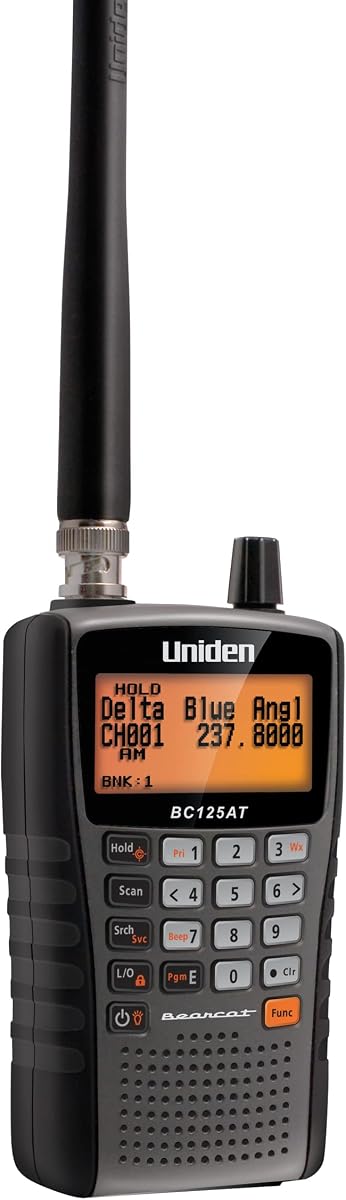
The Uniden Bearcat BC125AT is a feature-rich analog scanner that is immediately approachable for listeners interested in conventional radio services. Its 4.0 rating aligns with a capable preset scanner offering 500 channels, Close Call RF capture, ten memory banks, and a straightforward search-band system.
We may earn a commission when you buy through this link, at no additional cost to you.
Preset searches cover police, fire, emergency, ham, marine, railroad, civil aviation, military aviation, CB, FRS/GMRS/MURS, and racing. Users can begin exploring these services without researching individual frequencies, then organize programmed channels into ten banks and apply alpha tags. The compact housing, orange backlight, and portable format suit travel and outdoor use.
Its defining limitation appears in the product's name: analog only. It cannot receive digital radio systems such as Project 25, DMR, or NXDN, and it cannot follow digital trunking used by many public safety agencies. In areas where those systems dominate, a digital model would offer much more useful coverage.
The BC125AT is best for beginners and general listeners who want aviation, marine, weather-adjacent, amateur, racing, and other analog activity with minimal setup. It is less suitable for anyone primarily interested in modern digital public-safety networks. Buyers should first check which systems are active in the areas they expect to monitor.
The built-in service banks provide useful starting points across aviation, marine, rail, racing, ham, and other analog categories. They make the scanner approachable for listeners who do not yet know where to find particular frequencies.
Close Call can tune rapidly to nearby transmitters that fall outside the currently selected channel. It is useful for discovering local activity, although the scanner still cannot decode digital transmissions.
We may earn a commission when you buy through this link, at no additional cost to you.
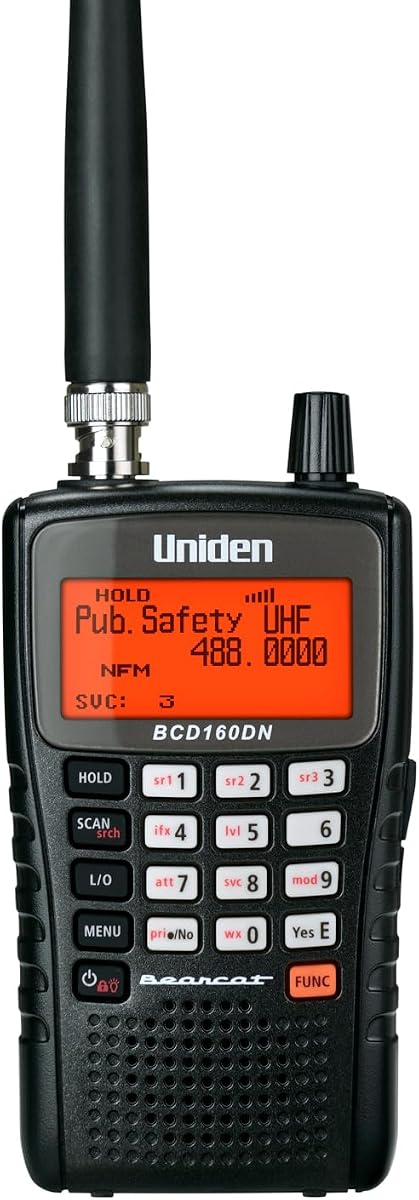
The Uniden BCD160DN offers modern digital reception in a compact handheld package. Its 3.2 rating is the lowest among the products reviewed, but its supported DMR and NXDN modes, preloaded profiles, 1,000-channel capacity, and search tools still make it a relevant option for specific digital monitoring needs.
We may earn a commission when you buy through this link, at no additional cost to you.
Rapid DCS and CTCSS decoding helps identify sub audible tones and system settings, while band scope and rapid system or channel number tagging assist with identifying elusive signals. Custom search can begin at the currently displayed frequency or begin from a frequency entered directly. Free Uniden software supports profile, favorites-list, database, and firmware management.
The most important boundary is the explicit lack of APCO P25 and trunking support. Users in regions dominated by Project 25 or trunked public safety systems should not mistake its general digital designation for complete compatibility. Its lower aggregate rating may also reflect a less mature ownership experience than the higher-rated Uniden models.
The BCD160DN makes sense for users who specifically need portable DMR or NXDN monitoring and do not need P25 trunking. Its rechargeable AA battery arrangement also helps maintain portability. For broader digital public-safety coverage or greater confidence in overall support, the SDS100 or BCD436HP would be stronger choices.
DMR and NXDN support comes preloaded, allowing the scanner to begin searching without first constructing every digital profile. Users can still customize and expand those configurations through PC software.
DCS and CTCSS rapid decode can reveal tones quickly, helping users identify the settings used by a system. This shortens the process of determining whether a detected signal is compatible with the scanner.
We may earn a commission when you buy through this link, at no additional cost to you.
The Uniden Bearcat SR30C is a compact entry-level scanner offering a practical set of analog features. Its 4.0 rating matches the BC125AT and reflects a reliable choice for listeners who want 500 channels, multiple preset service bands, Close Call detection, and PC programmability in a portable design.
We may earn a commission when you buy through this link, at no additional cost to you.
Ten service banks provide access to more than 32,000 preset frequencies across non-digital police, fire, emergency, NOAA weather, marine, racing, civil aviation, ham, railroad, CB, and other bands. Priority Scan gives selected channels preference, while the delay function reduces the chance of missing a reply during a conversation. A triple-conversion receiver supports signal reception across the included ranges.
Power can come from the supplied USB cable, two AA alkaline batteries, or two AA rechargeable NiMH batteries. Rechargeable cells can be charged in the scanner, but batteries are not included. Most importantly, the SR30C is analog only and cannot receive Project 25, DMR, NXDN, or digital trunked systems.
The SR30C is a sensible choice for beginners, travelers, and casual users who primarily want aviation, marine, weather, racing, or conventional local radio. It offers more features than a basic pocket radio while remaining approachable. Users in digitally dominated areas should choose a digital scanner instead.
The broad range of preconfigured bands allows a new owner to explore several kinds of analog communication immediately. This makes the scanner useful for aviation and marine listeners as well as general public-safety and weather monitoring.
Priority Scan keeps designated channels ahead of others in the rotation, while the delay function allows time for the end of one transmission and the beginning of a reply. Both features improve day-to-day monitoring without demanding constant manual control.
We may earn a commission when you buy through this link, at no additional cost to you.
The Whistler WS1040 is a programmable digital scanner aimed particularly at P25 Phase 1 and trunked-system monitoring. Its 4.1 rating reflects a capable alternative to Uniden's digital handhelds, with weather alerts, multi-system support, and helpful programming functions.
We may earn a commission when you buy through this link, at no additional cost to you.
Context-sensitive help places explanatory text within menu items, which can make the interface less intimidating while configuring systems. Free-form memory organization dynamically allocates capacity as needed rather than relying on rigid banks, reducing the chance that users will exhaust one area while another remains unused. A dedicated Skywarn Storm Spotter function provides quick access to storm spotter frequencies.
The central limitation is its focus on P25 Phase 1 rather than newer digital formats. Buyers with local systems using other digital protocols should verify compatibility before buying. Although the scanner is programmable, the PC interface and menu-driven operation may demand more work than a database-driven HomePatrol model.
The WS1040 is most appropriate for listeners who need P25 Phase 1, trunked communications, and weather information and who are comfortable learning a menu-based interface. It stands out for its dynamic memory design and contextual assistance. For simpler automatic setup, the BCD436HP may be easier, while broader advanced reception favors the SDS100.
Each relevant menu item can display short explanatory text, giving users immediate guidance without leaving the setup process. This is especially helpful for listeners building custom system lists rather than relying entirely on automatic database selection.
The scanner allocates memory according to actual needs instead of dividing it into fixed banks. That approach can accommodate changing programming needs more efficiently and reduce wasted capacity.
We may earn a commission when you buy through this link, at no additional cost to you.
The AURSINC TinySA Ultra+ ZS407 stands out for its broad 100kHz to 7.3GHz measurement range and modern handheld presentation. Its 4.4 rating reflects a capable spectrum analyzer with an IPS touchscreen, integrated low-noise amplifier, signal-generation functions, and a large internal battery.
We may earn a commission when you buy through this link, at no additional cost to you.
The display measures 4 inches diagonally at 480 by 320 pixels and can show up to 450 points per sweep. The built-in LNA provides as much as 20dB of gain across the stated range, improving the visibility of weak signals. Besides analysis, the device can produce sine waves, square waves, and RF test signals, making it a useful instrument for verification and troubleshooting workflows.
As with other spectrum analyzers, the ZS407 does not directly replace a programmable voice scanner. While it can reveal where RF energy exists, users still need compatible decoding knowledge and software if they want to identify particular transmission contents. The upper end of its range also places greater demands on correct input configuration, attenuation, and interpretation.
The ZS407 is best for RF technicians, advanced hobbyists, and field testers who need coverage beyond the 5.4GHz limit of the ZS406. Its 32GB card, PC control, wideband sweep, and signal output create a versatile portable test platform. Casual radio listeners should choose a conventional scanner instead.
Reaching 7.3GHz makes the ZS407 useful for Wi-Fi, drone-related frequencies, and other higher-band activity encountered in modern RF environments. Level calibration is also extended across the wider range.
The integrated LNA can add up to 20dB of gain, helping low-level signals stand out from the analyzer's noise floor. This is valuable when searching for intermittent or distant transmitters.
We may earn a commission when you buy through this link, at no additional cost to you.
The AURSINC Portable TinySA is a compact spectrum analyzer offering an approachable way to explore RF activity. Its 4.5 rating reflects a well-regarded tool with a color touchscreen, flexible signal inputs, a calibration generator, and PC connectivity within a portable enclosure.
We may earn a commission when you buy through this link, at no additional cost to you.
Its frequency coverage runs from 100kHz to 960MHz across two inputs. The higher-quality MF, HF, and VHF input covers 0.1MHz to 350MHz, while a separate UHF input handles 240MHz to 960MHz. Switchable resolution bandpass filters range from 2.6kHz to 640kHz, and the screen can present 290 scan points across a selected range.
The smaller 500mAh battery and 2.8-inch display make this a convenient tool for short field sessions, but it is less comfortable for prolonged continuous operation than the larger ZS406 and ZS407 models. Its software interface is less of a concern because USB CDC connectivity works with Windows and Linux, and TinySA-APP can capture the screen.
The Portable TinySA is a good fit for students, electronics hobbyists, and field users who want a lightweight spectrum viewer without carrying a larger analyzer. It can also act as a signal generator for calibration and basic tests. Users needing continuous operation, extensive storage, or multi-gigahertz coverage should consider one of the Ultra+ models.
A dedicated high-quality input handles MF, HF, and VHF frequencies, while a separate UHF input covers the 240MHz to 960MHz range. This lets the device adapt to more of the commonly encountered RF spectrum.
The built-in calibration generator enables automatic self-testing and low-input calibration. It also doubles as a source of sine or square-wave output for basic signal checks.
We may earn a commission when you buy through this link, at no additional cost to you.
The AURSINC TinySA Ultra+ ZS406 combines wideband spectrum analysis with a generous screen, strong documentation features, and a three-hour operating target. Its 4.5 rating places it among the strongest compact analyzers in the list, especially for users who need more detail than a simple signal-strength reader.
We may earn a commission when you buy through this link, at no additional cost to you.
The 4-inch 480-by-320 touchscreen displays up to 450 points, while the resolution bandwidth can be adjusted from 200Hz to 850kHz. The narrow 200Hz setting helps separate adjacent signals, and the input attenuator can be adjusted in 1dB steps. A 20dB LNA improves low-level reception below 3.5GHz, while the 32GB microSD card stores and shares measurement data.
The included 5000mAh rechargeable battery is designed for at least three hours of continuous operation. USB connectivity supports TinySA-APP control and data transfer through the Serial over USB protocol, with Windows drivers and Linux support. This makes the device easier to integrate into a computer-based measurement workflow than a display-only analyzer.
The ZS406 suits field technicians, students, and serious hobbyists who want a broad portable instrument with flexible resolution and signal output. It is not a conventional scanner for listening to police, aviation, or marine voice traffic. Buyers should choose it when seeing the spectrum, recording measurements, and testing RF signals are the main objectives.
The minimum 200Hz resolution bandwidth helps distinguish signals that would overlap at broader settings. This is useful for crowded bands, adjacent-channel behavior, and more detailed intermodulation checks.
USB control allows measurements to be transferred and managed through TinySA-APP. The integrated microSD card complements that workflow by retaining field data on the device itself.
We may earn a commission when you buy through this link, at no additional cost to you.
The most important choice depends on whether you want to listen to programmed voice services, follow trunked systems, or inspect broad sections of the RF spectrum. Compatibility, frequency range, receiver quality, setup method, and battery life should guide the decision.
Protocol compatibility is more important than a long feature list. Select a model that can actually decode the services you want to hear.
Match the upper frequency limit to the bands you need. Choose broader coverage for RF exploration and a radio scanner for voice monitoring.
Look beyond range alone. Receiver architecture and resolution often matter more when signals are weak or crowded.
Automatic database setup is ideal for beginners. Choose manual or PC programming when you need specialized control.
Compare real-world battery needs, not just capacity. Screen size, operating mode, and charging method influence total portability.
Prioritize alerts if you need to notice key activity while driving or working. Prioritize visual clarity for technical RF analysis.
Verify that the software and accessories are compatible with your computer. Direct data transfer and local storage can greatly improve workflow.
Choose a scanner for listening and a spectrum analyzer for RF measurement. Buying the wrong category can leave core needs unmet.
Begin by confirming the radio systems and frequency bands you intend to monitor. For a database-based scanner, enter the appropriate location and allow the software to identify nearby systems. For a manually programmed scanner, use verified frequencies and any required tones or identifiers. With a spectrum analyzer, start in a broad sweep and reduce the span and adjust resolution only after locating an area of interest.
Protect the receiver and user by using a suitable antenna for the selected range, checking the input path before attaching test equipment, and avoiding unnecessary high input levels. Create saved profiles or lists for regular locations, and use recording features on spectrum analyzers to preserve measurements. Keep the device disconnected from a PC when no transfer or update is required, especially during firmware operations.
Care for the device according to its display, battery, and connector instructions. Keep ports clean and dry, avoid charging non-rechargeable cells, and do not use a damaged cable or connector. Protect the screen from abrasive contact, remove batteries during long storage if the manufacturer permits it, and update the radio-system database or firmware regularly for digital scanners.
No. Devices differ sharply between conventional voice scanners and wideband spectrum analyzers. A scanner may tune specific radio bands but still lack the decoder required for a particular digital format, while an analyzer can show activity across a broad spectrum without directly decoding conversations. Compatibility depends on both frequency range and radio protocol.
An analog scanner receives conventional transmissions whose audio can be reproduced directly. A digital scanner must decode a digital format such as DMR, NXDN, or Project 25 and follow identifiers or trunking information. The BC125AT and SR30C are analog only, so users should verify local system types before choosing one of those models.
A spectrum analyzer is better suited to seeing signal energy, identifying interference, and measuring frequency activity. It does not automatically function like a programmed voice scanner and normally requires appropriate decoding software and technical knowledge. The WS1040, BCD436HP, and SDS100 are more direct choices for decoding supported public-safety systems.
True I/Q captures the complete signal waveform in three dimensions rather than relying on a simpler receiver structure. That gives the digital decoder additional information for error correction and signal recovery. The result can be particularly valuable in weak-signal areas and locations where multiple simulcast systems overlap.
No. Digital trunking support varies among models. The BCD436HP includes advanced TrunkTracker V operation, while the BCD160DN specifically does not support APCO P25 or trunking. The WS1040 supports P25 Phase 1 and trunking, so users should check the exact local system format before buying.
That depends on the activity you want to monitor. Conventional scanners concentrate on the bands used by voice services, while spectrum analyzers can inspect hundreds of megahertz or several gigahertz at once. A wide range is valuable for RF troubleshooting, but it does not replace a scanner when decoded voice reception is the priority.
No. The listed TinySA devices display measurements and can perform core functions independently. PC connectivity adds measurement control, screen capture, data transfer, configuration, and firmware access. Windows and Linux compatibility are described for the analyzers, but users should verify drivers and current software support before relying on a particular workflow.
The BC125AT is approachable for conventional analog services because it provides preset bands and straightforward channel organization. The BCD436HP is easier for many users who want digital systems because zip-code programming identifies nearby systems automatically. Between the two, the right choice depends on whether the local services are analog or digitally trunked.
The Uniden SDS100 is the strongest advanced choice because its True I/Q receiver targets difficult digital reception conditions, while location-based setup and a rugged build make it practical beyond the desk. The BCD436HP stands out for accessibility, combining broad database coverage, automatic programming, GPS support, replay, and detailed alerts. For broad RF exploration, the SeeSii TinySA Ultra+ ZS406 provides the best budget entry into wideband spectrum analysis.
Prioritize system compatibility before any other feature. Determine whether the activity in your area is analog, DMR, NXDN, Project 25, or trunked, then select a receiver that can decode it. If your goal is to visualize spectrum or test electronics, choose a wideband analyzer; if your goal is to listen to voice services, choose a radio scanner with the necessary formats and programming workflow.
Current prices and product configurations can change, so check the latest listing, warranty terms, included accessories, radio-system coverage, and firmware support before buying. The most capable device is only useful if it matches the systems and locations you need to monitor, while the most appropriate purchase is one that balances compatibility, reception, portability, and ease of use.