CENMATE Hybrid 2-Bay HDD and 3-Bay M.2 NVMe Enclosure
4.6Editor score
Combines two SATA drive bays
Adds three M.2 NVMe slots
Supports four RAID configurations
Uses USB 3.2 Gen 2
A JBOD enclosure combines multiple drives into one accessible storage pool without automatically distributing data across them. Choosing the right model requires balancing bay count, connection speed, cooling, drive support, and whether you need hot swapping, hardware RAID, or direct attached storage for expanding a NAS.
We compared the ten featured enclosures using the information in their product listings, focusing on capacity, interface speed, supported drive sizes, RAID or JBOD behavior, cooling, power delivery, and operating-system compatibility. The list includes desktop, high-capacity, hybrid NVMe, and rackmount models designed for different storage workflows.
Each review shows how the enclosure fits into a larger storage strategy, from consolidating media and managing backups to extending compatible NAS systems. Ratings and product details reflect the supplied listings, while availability and pricing can change, so readers should confirm the current configuration and terms before purchasing.
4.6Editor score
4.7Editor score
4.1Editor score
As an Amazon Associate we earn from qualifying purchases.
This side-by-side overview compares drive capacity, connection speed, RAID flexibility, cooling, and the most important physical and workflow differences among the ten featured JBOD and multi-bay enclosure options.


The TERRAMASTER D4-320 is a four-bay direct attached storage enclosure built around USB 3.2 Gen 2 connectivity and a rated customer score of 4.2. It is explicitly diskless and does not provide RAID, so its strongest appeal lies in giving a computer straightforward access to up to four independent SATA drives through one enclosure.
We may earn a commission when you buy through this link, at no additional cost to you.
Its headline transfer potential is 10Gbps, and the listing reports combined read and write performance of up to 1,016MB/s with four specified 8TB SATA III hard drives. A single SATA III 1TB SSD can reach a listed read speed of 510MB/s. The enclosure also accepts 2.5-inch hard drives and SATA SSDs, with support for one drive up to 30TB and a combined maximum of 120TB.
Operation is designed around convenience. The tool-free trays and push-lock mechanism secure each drive, while hot swapping permits replacement without powering down the enclosure. It works with Mac, Windows, and Linux without additional drivers, and USB Type-C connectivity supports current and older USB generations as well as Thunderbolt 3 and Thunderbolt 4 hosts. A temperature-controlled fan, sound-absorbing panels, and vibration damping help manage the heat and noise associated with multiple spinning drives.
This is a strong fit for users who want fast external access to several disks without learning complicated array controls. It is less appropriate for someone who specifically needs RAID striping, mirroring, or a NAS operating system. For photographers, editors, and backup specialists who frequently move large collections between a fast desktop and a notebook, the D4-320 offers an effective combination of capacity, responsiveness, and tool-free maintenance.
The 10Gbps interface gives the D4-320 ample bandwidth for individual SSDs and multi-drive workflows. Actual results depend on the host connection, installed drives, file sizes, and whether all bays are active.
Tool-free trays and hot swapping simplify drive replacement, while the controlled fan and vibration-reduction features help keep a four-drive setup practical in a shared workspace.
We may earn a commission when you buy through this link, at no additional cost to you.
The CENMATE 4-Bay Aluminum enclosure has a 4.3 rating and serves as a straightforward external storage system for both individual and business workflows. It holds four 2.5-inch or 3.5-inch SATA hard drives and SATA SSDs, supports up to 20TB per drive, and offers a listed combined capacity of 80TB. Like several products in this guide, it is a direct attached enclosure without RAID or NAS functions.
We may earn a commission when you buy through this link, at no additional cost to you.
Data transfers through USB 3.0 at up to 5Gbps under UASP control. The listing says a 1GB movie can move in three to five seconds when connected to a suitable USB 3.0 port, although actual performance also depends on the source drive, destination drive, host, and file workload. Both USB-A and USB-C 3.0 cables are included, and the enclosure is described as plug-and-play with Windows 7 and later, Mac 9.1 and later, and Linux.
The aluminum-alloy shell is paired with a 2-inch fan to remove heat from the drive bays. Hot-swappable, tool-free trays make installation and replacement straightforward. A dedicated 12-volt power adapter supports stable multi-disk operation. The important trade-off is acoustic: the manufacturer places fan noise around 40–50 decibels and does not recommend the enclosure for people who are especially sensitive to sound.
The CENMATE is a good choice when drive flexibility and easy maintenance matter more than a 10Gbps interface. It offers enough capacity for archival media, project files, and local backups, but it is not a unified RAID volume or a network appliance. Users who regularly move very large files should verify that their computer has a native USB 3.0 port rather than relying on a slower adapter.
Both 2.5-inch and 3.5-inch SATA devices fit the same four-bay layout, allowing users to combine high-capacity hard drives with smaller SATA SSDs without changing enclosures.
The aluminum body and active fan help manage heat, but the stated 40–50 decibel fan noise makes placement away from recording and quiet-office setups worth considering.
We may earn a commission when you buy through this link, at no additional cost to you.
The IO CREST 8-Bay USB enclosure is designed for users who need more drive positions than a typical four-bay desktop model. It carries a 4.0 rating and accepts 2.5-inch and 3.5-inch SATA hard drives from major brands, with support for capacities up to 24TB per drive. The enclosure does not create RAID arrays and does not operate as a NAS.
We may earn a commission when you buy through this link, at no additional cost to you.
Its USB 3.0 connection provides a listed maximum of 5Gbps and supports UASP. That makes it suitable for backups, media libraries, and general access to multiple disks, though the interface will not offer the theoretical headroom of a 10Gbps enclosure. The steel housing is designed for heat dissipation, and a built-in smart fan includes a thermal sensor with automatic and manual control across three speed levels.
One of the most useful details is the independent power switch for every drive. Users can turn off disks that are not being used instead of keeping every hard drive powered continuously. This is particularly relevant in an eight-bay configuration, where selective operation can reduce unnecessary activity and help manage the enclosure's overall heat output.
IO CREST serves users who prioritize bay count, per-drive control, and the option to expand capacity over time. It is a good match for offline archives or a collection of independent disks accessed through one USB port. Those who require automatic mirroring, RAID performance, or network sharing should choose an array-capable enclosure or a proper NAS instead.
Individual power switches are valuable in an eight-bay enclosure because inactive disks can be switched down without powering off unrelated drives or the entire unit.
A thermal sensor and three selectable fan levels give users both automatic cooling and manual control, allowing a balance between heat management and background noise.
We may earn a commission when you buy through this link, at no additional cost to you.
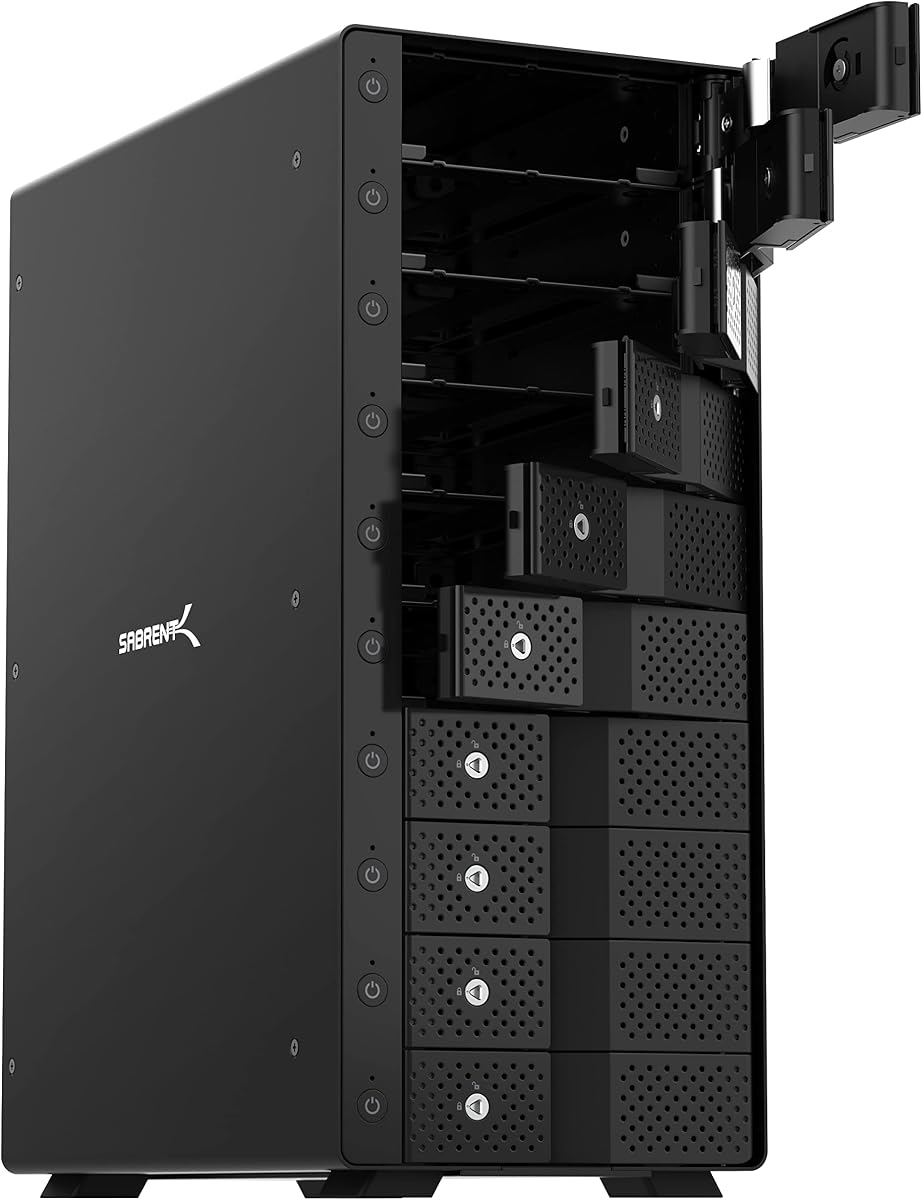
The SABRENT DS-UCTB is a ten-bay direct attached storage enclosure built for high-capacity backup, media, and IT workflows. It has a 4.1 rating and accepts up to ten 3.5-inch SATA hard drives, each listed at 20TB, for a maximum of 200TB. The model uses a dedicated ASMedia controller and does not offer RAID, meaning every drive mounts independently.
We may earn a commission when you buy through this link, at no additional cost to you.
Its USB 3.2 Gen 2 Type-C interface can transfer at up to 10Gbps and remains backward compatible with USB 3.0 and USB 2.0. To achieve the full listed interface rate, the host needs a USB 3.2 Gen 2 port. Both USB-C-to-C and USB-C-to-A cables are included, which is useful when a computer has only one convenient Type-A connection.
The enclosure emphasizes operational control. Each bay has a tray-less hot-swap design, its own on/off switch, and a status LED, while a master switch controls the unit. A locking key and Kensington slot improve physical security. The rigid aluminum body incorporates two 120mm fans to move air across all ten drives, an important feature in a high-density configuration.
This is the most premium-oriented pick here because of its bay count, 10Gbps connectivity, cooling, and per-drive controls. It is particularly suitable for IT departments, creative studios, and users managing many independent backup or media disks. It accepts 3.5-inch SATA drives directly; 2.5-inch SSD or HDD support requires the separately sold SABRENT BK-PCBS adapter, and drives are not included.
Each 3.5-inch drive mounts independently, making the enclosure useful for storage that must remain separate rather than being striped, mirrored, or combined through RAID.
Two 120mm fans move air across the ten-drive chassis, while individual switches and status lights make it easier to control which disks are active.
We may earn a commission when you buy through this link, at no additional cost to you.
The QNAP TR-004 combines four 3.5-inch SATA bays with USB Type-C direct attached storage and hardware RAID support. It has a 4.2 rating and is supplied diskless. Users can configure RAID 0, RAID 1, RAID 5, JBOD, or individual disks, making it more flexible than enclosures limited to a single operating mode.
We may earn a commission when you buy through this link, at no additional cost to you.
It supports Windows, macOS, and Linux as external storage and can also be used for NAS backup or to expand the capacity of a compatible QNAP NAS. The included USB Type-C-to-Type-A cable helps connect it to a wider range of hosts. Lockable drive bays add a useful physical protection layer in shared workspaces or installation areas.
There are important compatibility boundaries. The TR-004 cannot be used with several listed QNAP models, including the TS-128, TS-228, TS-131, TS-231, TS-431, and TS-431U, and a connected NAS must support QTS 4.3.6 or later. Its storage pool or volume cannot be combined with the connected NAS, and NAS applications cannot be installed on the enclosure itself.
The TR-004 is most attractive to QNAP owners who want hardware-managed arrays or a convenient migration path between compatible TR-004 units. Files moved from a NAS or another device to the enclosure may not be recognized, so migration planning is essential. For a general Windows, Mac, or Linux workstation, it is a capable four-bay option, but buyers should verify the hardware-RAID and NAS-integration workflow before committing.
Hardware support for RAID 0, RAID 1, RAID 5, JBOD, and individual disks lets users select performance, redundancy, combined capacity, or complete drive independence.
The TR-004 can back up or expand a compatible QNAP NAS, but its volume remains separate and cannot be merged into the NAS pool or used to run NAS applications.
We may earn a commission when you buy through this link, at no additional cost to you.
The QNAP TL-R1200C-RP is a 12-bay rackmount JBOD enclosure intended for storage expansion rather than a compact desktop setup. Its 4.1 rating reflects a specialized product for compatible QNAP NAS systems, Windows computers, and servers. The enclosure supports 3.5-inch SATA 6Gb/s drives and connects through USB 3.2 Gen 2 Type-C at up to 10Gbps.
We may earn a commission when you buy through this link, at no additional cost to you.
Its major strength is the redundant 250-watt power supply. In a rack environment where extended operation and serviceability are important, a redundant power option can improve resilience compared with relying on a single external adapter. The 12-bay layout also offers more expansion room than the four-, five-, and ten-bay models elsewhere in the guide.
As a JBOD device, its role is to expose the collective storage to a compatible host. It does not represent a small USB accessory and is not aimed at a single laptop user seeking an easy way to carry files. Buyers need to consider rack space, compatible QNAP hardware, the server environment, and the operating procedures required for an installed enclosure.
The TL-R1200C-RP is best suited to administrators, studios, and small businesses that need centralized storage expansion inside a rack. It offers an exceptional number of bays and a strong power design, but compatibility and physical installation should be confirmed before purchase. The key advantage is not portability or the lowest possible cost; it is the combination of high bay count, rackmount construction, and redundant power.
Twelve 3.5-inch SATA positions make the TL-R1200C-RP appropriate for organizations that need to grow beyond the capacity of a compact four-bay desktop enclosure.
The integrated redundant 250-watt power supply is a meaningful feature for rack-based systems where availability and service continuity matter more than minimal size.
We may earn a commission when you buy through this link, at no additional cost to you.
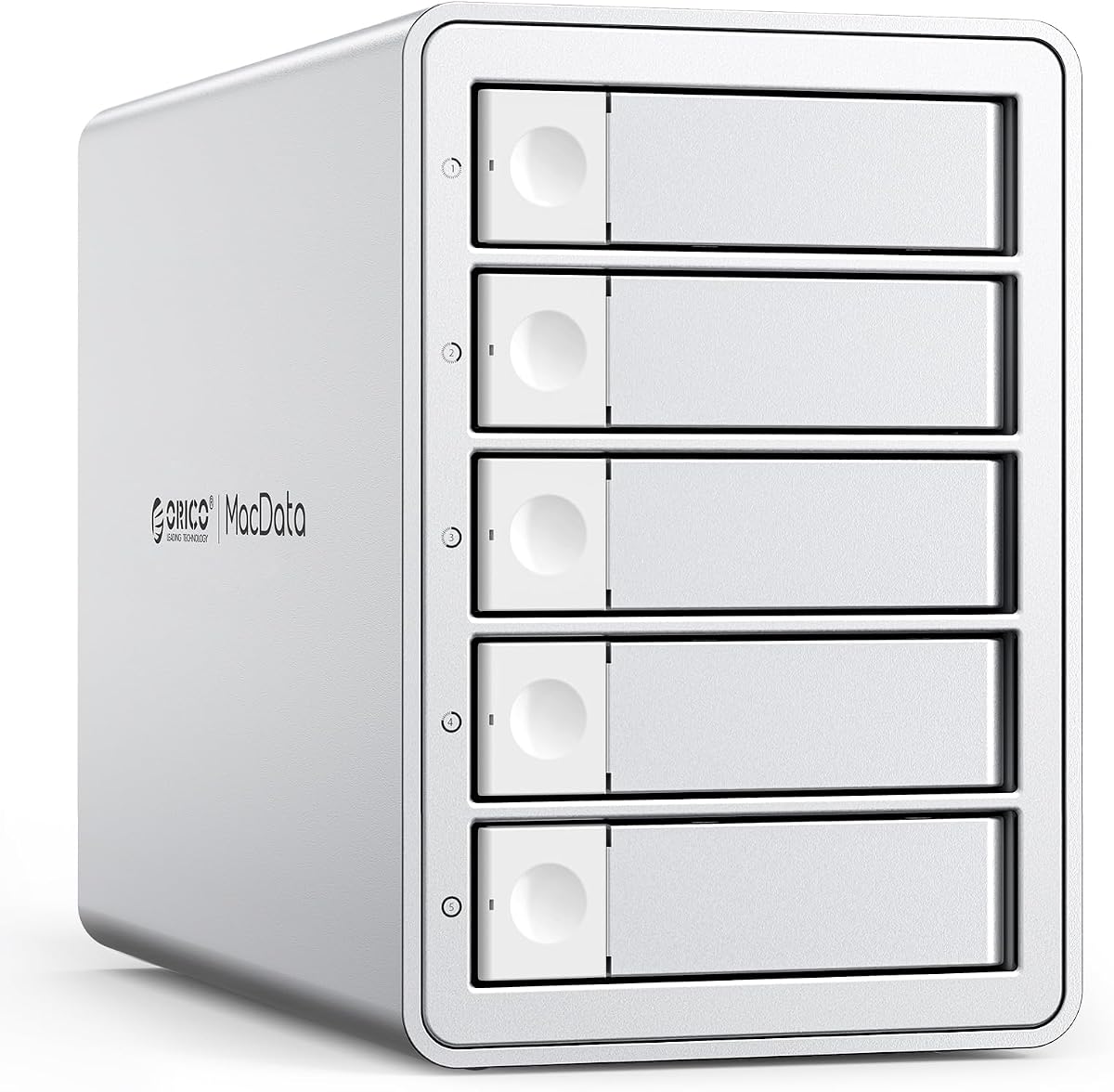
The ORICO 5-Bay RAID enclosure is the highest-rated product in this guide, with a 4.7 score and a particularly broad set of array options. Its hardware RAID controller supports RAID 0, RAID 1, RAID 3, RAID 5, RAID 10, JBOD, Clone, and Clear modes, allowing the storage arrangement to change with the user's priorities.
We may earn a commission when you buy through this link, at no additional cost to you.
The enclosure holds 2.5-inch and 3.5-inch SATA hard drives and SSDs. It supports drives up to 22TB each and a listed total of 110TB, while the product title identifies a 130TB maximum. The difference illustrates why buyers should examine the current listing carefully and verify how their chosen drive sizes and modes contribute to usable capacity.
A built-in 150-watt power supply is designed to keep all five high-consumption mechanical drives stable. The enclosure uses USB 3.0 Type-A and the listing states transfer rates up to 230MB/s. It works with Windows, Mac, and Linux without drivers, making cross-platform use straightforward as long as the host has a compatible USB 3.0 connection.
Cooling is handled by an aluminum alloy shell, an 80mm silent cooling fan, and front and rear honeycomb vents. The listing describes the design for long-term 24/7 operation, making this enclosure a strong fit for backup projects, video editing, and media libraries. It is the Editor's Choice because it combines the highest rating, five mixed-size bays, extensive RAID choices, and integrated power in one desktop package.
RAID modes for performance, redundancy, cloning, independent disks, and JBOD give users more control than a basic four-bay direct-attached enclosure.
The built-in 150-watt supply avoids a large external adapter and is intended to deliver stable power when several mechanical hard drives operate together.
We may earn a commission when you buy through this link, at no additional cost to you.
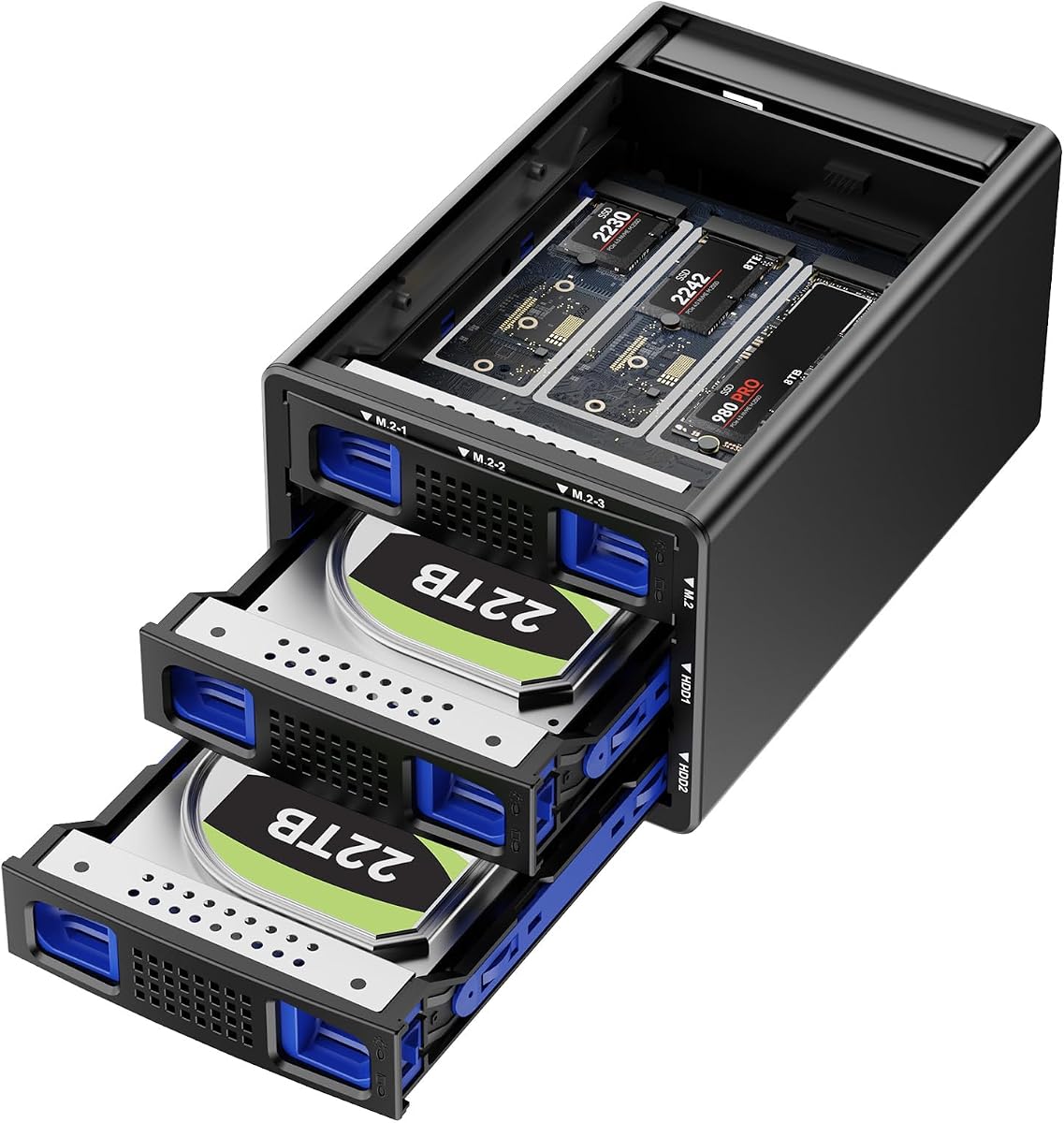
The CENMATE Hybrid NVMe enclosure combines two SATA drive positions with three M.2 NVMe slots, giving it a 4.6 rating and a distinctive place in this roundup. It supports RAID 0, RAID 1, Normal, and JBOD and offers a listed maximum capacity of 68TB based on two 22TB SATA drives and three 8TB M.2 SSDs.
We may earn a commission when you buy through this link, at no additional cost to you.
Its USB 3.2 Gen 2 interface supports up to 10Gbps, with a stated full-load read rate of 200–300MB/s except in RAID modes. The USB Type-C connection works with USB 3.0, USB 3.1, USB 3.2, Thunderbolt 3, and Thunderbolt 4 interfaces. Both USB-A and USB-C cables are included, and the enclosure supports Windows 7 and later, Mac 9.1 and later, and Linux.
The aluminum-alloy enclosure uses a 2.7-inch silent fan that runs continuously to cool the drives. This avoids the idea of a fan stopping during operation, but users sensitive to sound may find it less suitable for a quiet room. The listing also warns that RAID design can result in data loss, that the reset button must be held for five seconds after resetting an array, and that macOS does not include RAID software.
The hybrid design is the central appeal. Large SATA hard drives provide economical capacity, while NVMe SSDs can supply faster working data, but the enclosure is not simply a conventional SATA dock. It is an excellent budget choice for a user who wants both technologies in one enclosure and is comfortable with the operating-system and configuration limitations, especially before committing important data to a new array.
The combination of two SATA bays and three M.2 slots allows high-capacity archives and responsive SSD storage to coexist in a single USB-connected unit.
RAID 0, RAID 1, Normal, and JBOD provide useful choices, but the macOS software limitation and reset procedure mean users should maintain a separate backup before reorganizing an array.
We may earn a commission when you buy through this link, at no additional cost to you.
The ORICO 9848RU3 is a four-bay RAID enclosure with a 4.3 rating. It supports 3.5-inch SATA drives, including 22TB models, for a listed maximum of 88TB. Its eight configurations include RAID 0, RAID 1, RAID 3, RAID 5, RAID 10, JBOD, Clone, and Clear, giving users a choice of speed, redundancy, and independent access.
We may earn a commission when you buy through this link, at no additional cost to you.
The USB 3.0 interface is paired with SATA 6Gb/s support, and the listed transfer rate reaches up to 235MB/s. It works with Windows, Mac OS, and Linux. A built-in 150-watt power supply supplies multi-disk operation without requiring a large external power brick, which is useful for a unit intended to remain connected during intensive backup or transfer work.
Thermal management comes from an aluminum enclosure, an 80mm silent cooling fan, and front and rear vents that promote airflow through the drive area. The tray-less design allows drives to be removed and replaced quickly, while an independent safety lock helps prevent accidental ejection or loss of a disk. These physical protections add confidence in a setup where drives contain important files.
This ORICO model is a balanced four-bay option for users who want more configuration choices than a basic JBOD dock without moving to a five-bay chassis. It suits project archives, engineering collections, high-definition footage, and consolidated backups. Its limitations are the four-bay limit and USB 3.0 interface; workloads needing more positions or a faster host link should consider the other models in the comparison.
The mode selection covers striped performance, mirrored redundancy, JBOD capacity, cloning, and independent disk use without requiring a separate software-based controller.
A 150-watt internal supply, aluminum body, cooling fan, and front-to-rear vents support the demands of several large hard drives operating together.
We may earn a commission when you buy through this link, at no additional cost to you.
The OWC Mercury Elite Pro Quad is a four-bay USB-C storage enclosure with a 3.7 rating. Its universal drive bays accept both 2.5-inch and 3.5-inch drives, and the listed 0TB configuration indicates that it is presented as an empty enclosure rather than one populated with a specific storage set.
We may earn a commission when you buy through this link, at no additional cost to you.
The enclosure uses a USB 3.2 connection with 10Gb/s bandwidth and works with USB-C or Thunderbolt 3 equipped Mac and Windows computers. Its listed performance reaches up to 947MB/s, making it attractive for users who want a fast four-drive desktop array. A USB-C cable is included for connecting the unit to a suitable host.
An important consideration is that SoftRAID software is not included. The enclosure's RAID capability therefore needs to be evaluated in light of the software and operating-system workflow the buyer intends to use. Buyers should not assume that the hardware alone provides the full management experience they need, particularly if they expect graphical configuration or particular array types.
The Mercury Elite Pro Quad is a specialist option for a creator with four fast drives and a compatible high-speed host. Its strongest advantages are the 10Gb/s interface, universal bay sizing, and high listed performance. The lowest rating in the guide and the excluded SoftRAID software make it less certain for buyers who prioritize a fully bundled, straightforward configuration process.
The 10Gb/s interface and listed performance of up to 947MB/s suit fast SSDs and demanding transfer workflows when connected to a capable host.
Because SoftRAID is not included, users should confirm their preferred management method and operating system before treating the enclosure as a complete RAID solution.
We may earn a commission when you buy through this link, at no additional cost to you.
The right enclosure depends on how many drives you need, whether each disk should remain independent, how the array will be managed, and how much heat the chosen drive configuration will produce. These factors matter more than the number printed on the box alone.
These terms describe different ways a multi-drive enclosure presents storage. A JBOD device combines capacity while allowing the connected operating system to manage the individual disks. A direct attached storage product, or DAS, generally exposes each drive independently over a host connection. RAID adds controller-level arrangements such as mirroring, striping, or parity. The TERRAMASTER D4-320, CENMATE 4-Bay Aluminum, and IO CREST are explicitly described as non-RAID products, while QNAP, ORICO, and OWC offer RAID-oriented configurations.
Choose JBOD or independent disk access when files can be managed separately and you want simple expansion. Choose RAID only when you understand its redundancy, rebuild, and capacity implications.
Bay count determines how many physical devices can be installed and how much room the enclosure needs. Four-bay models suit typical workstations, while eight-, ten-, and twelve-bay products accommodate larger archives. Also verify whether the bays support 2.5-inch SATA SSDs and 3.5-inch hard drives. The OWC uses universal bays, the SABRENT primarily fits 3.5-inch SATA drives, and the hybrid CENMATE adds several M.2 NVMe positions to two SATA bays.
Match the chassis to your intended capacity and leave room for future expansion if your workflow changes.
A faster interface cannot help if the computer or hub provides a slower connection. USB 3.0 models are listed at up to 5Gbps, while USB 3.2 Gen 2 models offer up to 10Gbps. The OWC, TERRAMASTER, SABRENT, QNAP rackmount, and hybrid CENMATE occupy the higher-bandwidth group, while several 4.3, 4.7, and 4.6-rated products use USB 3.0. A full 10Gbps link also requires a host port capable of supplying it.
Check the port type and generation on your computer, and avoid introducing unnecessary hubs into a high-speed transfer path.
More modes can make one enclosure useful for several jobs, but they also create configuration decisions. The ORICO products offer eight listed modes, QNAP's TR-004 supports RAID 0, 1, 5, JBOD, and individual disks, and the hybrid CENMATE offers RAID 0, 1, Normal, and JBOD. Some modes prioritize capacity, while others improve redundancy or performance. RAID 0 increases speed but provides no redundancy, whereas RAID 1 duplicates data across drives.
Review each mode before use and keep an independent backup of irreplaceable data even when redundancy is enabled.
Mechanical hard drives generate heat, and tightly packed bays make airflow more important. The TERRAMASTER uses a temperature-controlled fan, sound-absorbing panels, and vibration damping. The SABRENT uses two 120mm fans, while the ORICO models use aluminum housings, vents, and an 80mm fan. The CENMATE models use active fans, but the listings warn that continuous or 40–50 decibel fan noise can be unsuitable for sound-sensitive users.
Consider both cooling capacity and acceptable background noise, especially if the enclosure will sit near a recording desk or home office.
Multiple spinning disks can demand more power than a single external drive. The ORICO 5-Bay and 4-Bay models include a 150-watt power supply, the CENMATE 4-Bay uses a 12-volt adapter, and the QNAP rackmount enclosure provides a redundant 250-watt power supply. Product design should match the workload, particularly when all bays contain high-consumption mechanical drives.
Integrated or properly rated power can reduce desktop clutter, but always use the supplied or specified power solution rather than an unverified substitute.
Hot-swappable bays let a user replace or reconnect a drive without shutting down the whole enclosure. The TERRAMASTER, CENMATE 4-Bay, SABRENT, and OWC support tool-free or tray-less maintenance, while physical locks and safety mechanisms can help prevent accidental removal. This is especially valuable for backup systems, media servers, and professional workflows in which uninterrupted access matters.
Confirm that the host supports safe removal, finish active transfers before changing a disk, and preserve the original data settings when rebuilding or replacing a member.
A enclosure that works as external storage may have limited functionality when attached to a NAS. The QNAP TR-004 can back up or expand compatible QNAP systems, but its volume cannot be combined with the NAS pool and NAS applications cannot be installed on it. Several older QNAP models are specifically excluded. Other products are advertised for Windows, Mac, and Linux use, although the hybrid CENMATE notes that macOS has no RAID software.
Verify both host compatibility and management software before purchasing for a network or mixed-platform environment.
Begin by checking the enclosure's drive requirements, supported interfaces, and host operating system. Install compatible SATA hard drives or SSDs according to the manual, secure any trays or locking mechanisms, and connect the enclosure with the appropriate USB or Type-C cable. For multi-disk systems, power the enclosure on before the computer so the host can recognize every installed device.
Format or initialize drives only after confirming which ones contain data. When creating a RAID, JBOD, Clone, or other array, follow the manufacturer's reset and configuration procedure exactly. The hybrid CENMATE specifically requires holding its reset button for five seconds after resetting an array. Wait for configuration and verification to finish before moving critical files, and maintain another backup of data that cannot be replaced.
For routine care, eject the enclosure through the operating system before removing it, and use safe removal before changing a hot-swappable drive. Keep intake and exhaust vents clear, avoid placing the unit on soft surfaces, and monitor temperatures during long transfers. If a fan becomes unusually loud or a drive behaves inconsistently, back up the data, power down safely, and investigate the affected bay.
A JBOD enclosure combines the usable capacities of multiple drives while generally leaving the host to manage the disks individually. A RAID enclosure uses a controller to arrange drives into modes such as mirroring, striping, or parity. JBOD prioritizes flexible capacity and independent access, while RAID can provide redundancy or performance when it is configured correctly. Neither should be treated as a substitute for an independent backup.
It depends on the enclosure and the connected host. Some JBOD devices present a single large volume, while others expose each drive separately through a controller or direct attached storage interface. Users who need individual disk visibility should look for explicit direct access or Normal mode, and they should confirm the behavior in the product documentation before adding data.
Usually, but the available transfer rate will be limited by the slower host connection. The SABRENT is backward compatible with USB 3.0 and USB 2.0, while other enclosures may also remain usable at lower speeds. A full 10Gbps connection requires a compatible USB 3.2 Gen 2 host port, and using an intermediate hub can reduce performance further.
No, not in every respect. A JBOD or DAS enclosure requires a connected computer to manage access, and it generally does not provide network sharing, user accounts, or dedicated NAS applications. Products such as the QNAP TR-004 have specific NAS-related limitations, including the inability to combine their storage with a connected NAS pool. A NAS is preferable when multiple users need simultaneous network access.
The right number depends on capacity, cooling, redundancy, and workflow. Fewer drives can reduce heat and power demand, while a full enclosure can provide more throughput in suitable workloads. RAID configurations may require matching drive sizes or capacities, and any redundant mode still needs a separate backup. Begin with the number of drives required for current capacity rather than filling every bay automatically.
Only if the product specifically supports hot swapping and the procedure is followed correctly. The TERRAMASTER, CENMATE 4-Bay, SABRENT, and OWC describe hot-swappable or tray-less access. Even then, finish active transfers, eject the individual drive if the host permits it, and preserve the original array configuration when inserting a replacement.
RAID 0 increases performance by distributing data across drives, but a single failed member can make the array unavailable. RAID 1 mirrors data and can improve availability, yet it is not a complete backup because accidental deletion, corruption, or device failure can affect both copies. Important data should also be copied to a separate system or medium.
Active cooling is highly useful when several hard drives operate in a compact chassis because their combined heat can increase. The enclosure should have unobstructed airflow, and the selected drive workload should match the cooling design. Users who are sensitive to noise should compare fan specifications, such as the CENMATE's stated 40–50 decibel range, before choosing a model for a quiet room.
The strongest general-purpose pick here is the TERRAMASTER D4-320 because it combines four hot-swappable bays, a 10Gbps interface, broad host compatibility, and thoughtful noise reduction. The ORICO 5-Bay RAID is the Editor's Choice for users who prioritize its 4.7 rating, extensive mode selection, mixed drive sizes, and integrated power, while the SABRENT DS-UCTB stands out as the premium option for ten independent high-capacity bays.
Prioritize the workflow before the bay count. Choose independent access for separate media disks, JBOD for host-managed capacity, and RAID only when you need its particular performance or redundancy characteristics. Cooling, power delivery, host-interface speed, and drive compatibility are equally important because they determine whether the enclosure remains dependable under sustained use.
Finally, verify the current listing, supported host, drive requirements, and software terms before ordering. Product configurations, firmware, bundles, and prices can change, and a model that appears ideal on paper may have compatibility limits that matter in your particular setup. Use the comparison to narrow the field, then check the latest manufacturer and retailer information for the exact enclosure.