
1KW AC Brushless Low RPM Alternator
5.0Editor score
Brushless 1000W design
Integrated voltage regulator
Portable dual-wheel structure
Our guide compares the 10 best low RPM alternators for wind turbines, highlighting power output, voltage options, construction, mounting, and suitability for
A low RPM alternator is the heart of many small wind-energy projects, converting slow turbine rotation into usable electrical power. The right unit must match your rotor speed, electrical system, mounting plan, and output needs while operating efficiently without excessive maintenance.
We compared the ten permanent magnet alternators in this guide using their published power ratings, speed figures, phase configuration, voltage options, construction, mounting details, voltage regulation, and intended wind or hydro applications. The list covers compact single-phase charging units and larger three-phase turbine generators.
Each review identifies the product's most useful qualities and any limitations visible in its specifications. The numbered rankings reflect suitability for the stated use case, while ratings reflect customer feedback where available. Product prices and availability can change, so check the current listing before purchasing.
5.0Editor score

4.3Editor score

5.0Editor score
This side-by-side comparison highlights the most important differences among the ten alternators, including output, electrical configuration, speed, mounting provisions, and the wind or hydro applications each model is designed to support.


The VQP Permanent Magnet Alternator Generator combines a 1200W rating, a 12V-to-14V output range, and a built-in voltage stabilizer. It holds a 4.3 customer rating, and its most appealing qualities are practical charging support, lighting capability, and a compact permanent-magnet design intended for low-speed use and common 12V electrical systems.
We may earn a commission when you buy through this link, at no additional cost to you.
Its strongest feature is the integrated voltage stabilizer, which helps provide more consistent output while protecting connected equipment from voltage fluctuations. Pure copper winding and an aluminum shell provide a balance of electrical conduction, impact resistance, and low weight. The described wiring process is also approachable: connect the battery positive terminal to the generator positive terminal through a button-controlled live wire, then ground the negative terminal for charging and lighting.
One qualification is the stated maximum operating speed of 4500 RPM. Although the listing describes the unit as suitable for low-RPM applications and names wind turbines among its uses, that speed figure should be checked carefully against the operating range of your particular rotor. It is also configured around 12V charging and lighting rather than a larger three-phase turbine system, so buyers seeking high-capacity AC output may need a different design.
This is the strongest general-purpose recommendation for a DIY wind-turbine charging project involving a modest battery bank, 12V lighting, or small appliance loads. It is particularly appealing when voltage regulation, straightforward wiring, compact construction, and dual charging-and-lighting support matter more than three-phase scalability.
The built-in voltage stabilizer is a meaningful advantage for battery charging because it helps reduce the effect of output fluctuations. This makes the alternator especially relevant to projects where the generator will feed a lead-acid battery or run 12V lighting alongside other modest loads.
Pure copper windings support efficient energy conversion, while the aluminum shell keeps the unit relatively light and able to withstand impact. The listed terminals and simple connection procedure also make this less intimidating for first-time turbine builders.
We may earn a commission when you buy through this link, at no additional cost to you.
This 8000W permanent magnet generator is explicitly positioned around 600 RPM operation for DIY horizontal wind turbines. It uses rare-earth NdFeB magnets, pure copper windings, and a three-phase gearless design, making it more specialized than compact battery-charging alternators and more appropriate for builders designing a substantial AC generation stage.
We may earn a commission when you buy through this link, at no additional cost to you.
The generator and turbine are described as having favorable matching characteristics, stable performance, and direct-drive simplicity. Its aluminum-alloy cover receives anti-corrosion treatment and is designed to resist harsh environmental influences, including acid, alkali, and salt exposure. Special stator and rotor arrangements support heat dissipation and reduce starting resistance torque, important characteristics for continuous mechanical input.
Because no customer rating is shown for this listing, the published specifications are the main basis for evaluating it. The broad output options—12V, 110V, and 220V—also need careful interpretation: a three-phase generator does not automatically provide a ready-made output for every controller or battery arrangement. A suitable rectifier, inverter, charge controller, and protection system may be required depending on the intended loads.
Choose this model when the goal is a high-output, low-speed, direct-coupled wind turbine rather than a small 12V lighting system. Its gearless structure and 600 RPM orientation align well with a properly sized horizontal rotor, although technical planning around power electronics remains essential.
A 600 RPM specification and gearless construction reduce the need for a complex speed-increasing transmission. That mechanical simplicity can make the turbine-generator pairing easier to balance and maintain.
The NdFeB rotor and pure copper windings are intended to improve efficiency and provide stable output as wind conditions vary. The described stator and rotor design also promotes heat dissipation during sustained operation.
We may earn a commission when you buy through this link, at no additional cost to you.
This low-RPM permanent magnet alternator is listed with output configurations from 1000W through 10000W, three voltage choices, and operation at 500 RPM. It is designed for both wind turbines and hydro generators, giving DIY builders a flexible platform for projects using moving water or variable wind.
We may earn a commission when you buy through this link, at no additional cost to you.
The gearless design eliminates conventional gearing and is intended to improve reliability by reducing the number of mechanical components. Its iron shaft is described as durable enough for the rigors of turbine operation, and the mounting arrangement can be installed without the base when a custom setup requires more flexibility.
The title emphasizes low noise, although the listing does not provide a numerical sound measurement or detailed acoustic test results. That makes the claim something to investigate through customer feedback and fitment information rather than a measured performance guarantee. Buyers should also confirm the selected voltage and power configuration directly, since the broad range may represent different variants.
This alternator makes sense for a builder who wants one product family to cover either wind or hydro generation and values voltage selection. It is a strong candidate for 24V or 48V systems where a standard 12V charging generator would not be the right fit.
Selectable 12V, 24V, and 48V configurations provide a useful path for scaling a project. The correct voltage should match the battery bank, inverter, controller, and every connected load.
Compatibility with both wind and hydro generators provides flexibility for experimental or mixed renewable installations. The durable iron shaft and gearless layout support projects where simplicity and dependable rotation are priorities.
We may earn a commission when you buy through this link, at no additional cost to you.
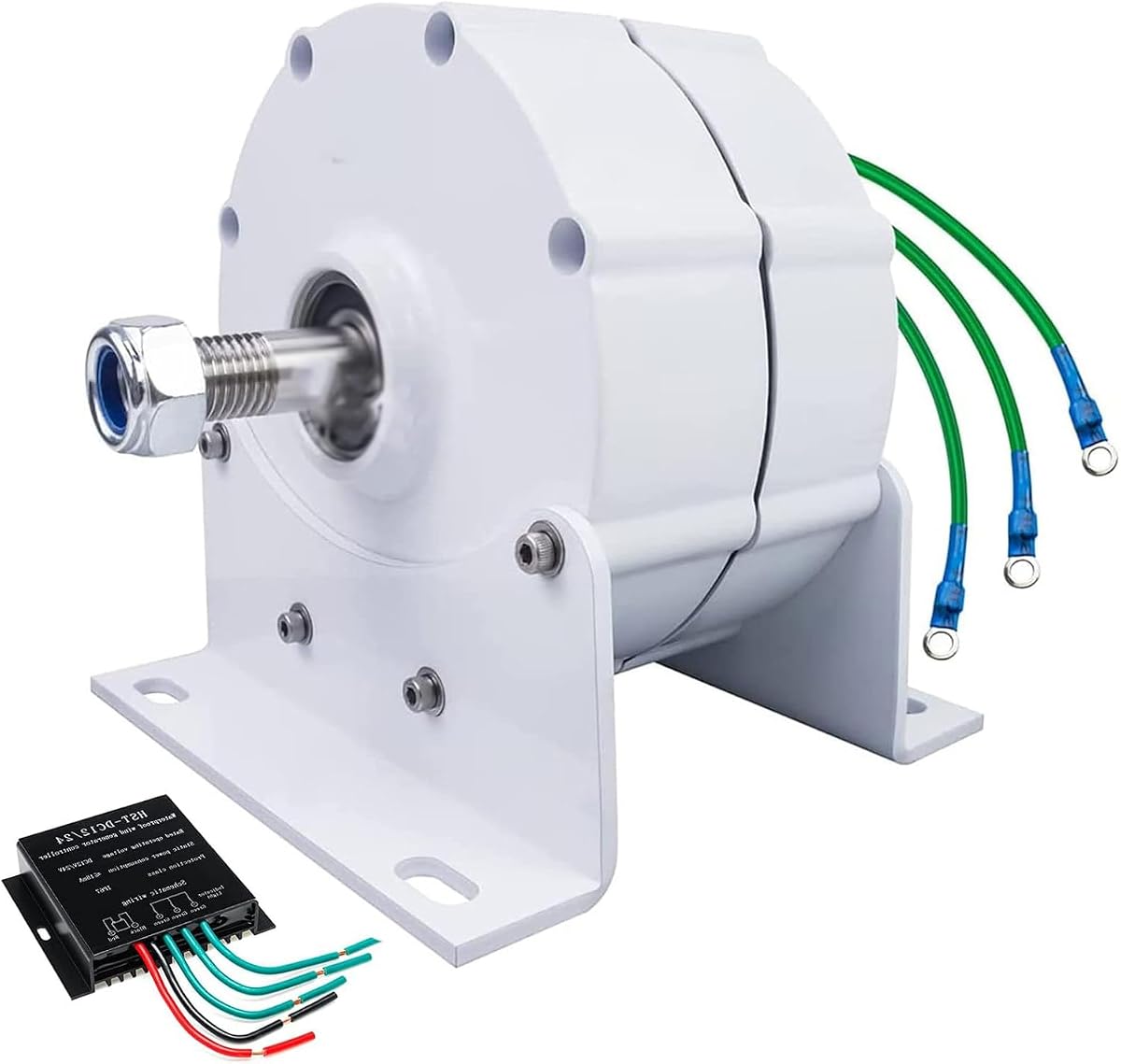
The 1KW AC Brushless Low RPM Alternator offers a 1000W output, brushless permanent-magnet construction, and a 5.0 customer rating. Its assembled aluminum-and-copper body, integrated regulator, and double-ended wheel arrangement make it an approachable option for portable, outdoor, emergency, or small renewable-energy applications.
We may earn a commission when you buy through this link, at no additional cost to you.
The double-ended structure supports power generation and lighting while allowing the unit to be mounted at the bottom of a water tank or fan blade for cooling. An internal voltage regulator is designed to maintain stable output and protect connected equipment. The listing also emphasizes that the one-piece structure arrives ready for use, reducing assembly work for builders who want a straightforward starting point.
Its stated rotational speed of 4500 RPM means buyers should not automatically equate the low-RPM label with operation at the much slower speeds characteristic of dedicated 500 or 600 RPM turbine generators. The available 1000W rating also sets a realistic ceiling for connected loads. Despite those limitations, the absence of a separate gearbox in the described brushless design can simplify mechanical integration.
This is the best budget-oriented pick for a compact charging, lighting, or portable power project. It is most suitable for builders who prioritize ready-to-use construction, stable regulation, and a straightforward double-wheel format over very large output or the ability to run at only a few hundred RPM.
The integrated one-piece assembly removes much of the setup work normally associated with a custom generator. Preassembled construction is helpful for portable installations and projects intended to move between locations.
The internal voltage regulator helps protect connected devices, while the double-ended mounting arrangement can support cooling-fan use. These features make the generator adaptable to both stationary and mobile applications.
We may earn a commission when you buy through this link, at no additional cost to you.
This 1200W permanent magnetic generator combines AC and DC capability with battery charging, LED lighting support, and a built-in voltage regulator. Its magnetic-strip rotor and self-rectifying generator design make it relevant to both turbine projects and mobile equipment applications.
We may earn a commission when you buy through this link, at no additional cost to you.
The double-wheel construction and compact aluminum-and-copper body support portability. According to the product information, the unit can charge 12V lead-acid batteries and work with general-purpose LED lights from 12V through 80V. It can also accept a water-tank cooling fan blade, although that blade is not included, giving installers an additional way to manage heat.
As with other units labeled for low RPM use, the stated 4500 RPM figure should be reconciled with the intended rotor speed. A generator optimized for a higher rotational speed may require a carefully matched turbine rather than a very slow, large-diameter rotor. The listing also provides no customer rating, so its published attributes should be compared carefully with those of rated alternatives.
This generator is best for a portable 12V charging or lighting build that benefits from both AC and DC outputs. It may also serve agricultural or mobile-power experiments where a compact double-wheel format and optional fan cooling are valuable.
Supporting both output types lets the unit serve charging and lighting duties without forcing one fixed electrical use. That versatility is useful in experimental systems where loads may evolve during the build.
The compact double-wheel body is easy to transport and suitable for outdoor use. An optional cooling-fan arrangement adds another installation option for projects requiring better heat management.
We may earn a commission when you buy through this link, at no additional cost to you.
The 400W PMG alternator is explicitly designed for low-speed wind and hydro turbine systems, with low startup torque and a gearless three-phase configuration. It includes a mounting base and single shaft, providing several essential installation elements in one package for small renewable-energy projects.
We may earn a commission when you buy through this link, at no additional cost to you.
The rotor uses a patented alternator arrangement with a specially designed stator to reduce resistance torque and improve matching between the generator and a turbine. A new ring-style power-output device is described as overcoming cable-winding limitations associated with traditional generators. Human-centered installation and maintenance considerations make the unit approachable for DIY builders.
The 400W output is modest, so this is better suited to lighting, controls, small electronics, or a limited battery-charging circuit than to household-scale loads. Since the product has three-phase output and no customer rating is listed, buyers should verify the terminal configuration, rectifier requirements, and expected voltage behavior before finalizing the installation.
This model is a logical choice for a compact wind or micro-hydro system that prioritizes genuine low-speed operation and includes the basic mounting hardware. It offers a more turbine-focused package than the double-wheel charging generators without reaching the capacity of the larger three-phase units.
Low startup torque is valuable in wind generation because it lets the turbine begin producing from modest airflow. The gearless arrangement also removes the need to maintain conventional transmission components.
The included base and single shaft simplify initial assembly and make the package more practical for a first turbine project. Additional electrical conditioning may still be required depending on the intended load.
We may earn a commission when you buy through this link, at no additional cost to you.
This multi-power generator is available in 8000W, 9000W, 10000W, and 12000W configurations and is designed for DIY horizontal wind turbines operating around 600 RPM. Its rare-earth NdFeB magnets, pure copper windings, and three-phase gearless architecture target projects requiring substantially more generating capacity than compact battery units.
We may earn a commission when you buy through this link, at no additional cost to you.
The product information highlights favorable generator-to-turbine matching, stable output, and a die-cast aluminum shell with anti-corrosion treatment. The housing is described as resistant to strong wind and to acid, alkali, and salt exposure, all useful characteristics for an exposed installation. Special rotor and stator design support low starting resistance torque and effective heat dissipation.
An automatic protection function is another notable feature. When excessive thermal load, external force, or another abnormal condition occurs, the described system disconnects the permanent-magnet core's flux linkage and stops the rotor urgently. That protective behavior is intended to reduce equipment damage. As no customer rating is provided, the technical description and system compatibility should take precedence over social proof.
This generator suits experienced DIY builders designing a powerful horizontal rotor with a dedicated three-phase conditioning stage. Choose it over smaller PMAs when output capacity, direct 600 RPM coupling, and abnormal-condition protection are central project requirements.
Four listed power configurations allow the builder to align generator capacity with rotor size and expected resource conditions. This makes the family more adaptable than a single fixed-output design.
The automatic shutdown response is intended to limit damage during thermal overload, mechanical interference, or other abnormal conditions. It adds reassurance for unattended installations where prompt fault response matters.
We may earn a commission when you buy through this link, at no additional cost to you.
This compact 1200W permanent magnet synchronous generator has a 4.5 customer rating and supports 12V AC and DC output. Pure copper windings, a lightweight aluminum housing, pre-drilled mounting holes, and ready-to-wire terminals give it an appealing mix of electrical and installation features.
We may earn a commission when you buy through this link, at no additional cost to you.
The generator is described as capable of starting at minimal rotational speeds and connecting directly to single-wheel drives without complex gearing. That makes it interesting for small experimental turbines where simplicity is more valuable than three-phase scalability. It can charge 12V batteries and power LED lighting, while the copper winding and aluminum casing support durability and manageable weight.
The stated 4500 RPM output speed remains the key specification to check against a planned rotor. A turbine may need a larger diameter, appropriate gearing, or a different generator if it turns much more slowly. The unit is also single-phase, limiting scalability compared with the three-phase models in this guide. Its 4.5 rating provides useful customer validation, although it does not replace checking electrical compatibility.
This is a strong pick for a compact single-phase wind or mobile charging project, especially when quick mounting and minimal mechanical complexity are priorities. It is a better fit for 12V lighting and battery charging than for larger appliances or an expandable three-phase installation.
The ability to connect to a single-wheel drive without complicated gearing simplifies turbine layout. It is especially useful for small experimental rotors and portable generator arrangements.
Pre-drilled holes and ready-to-wire terminals reduce setup time, while the compact aluminum body is easy to move. These details suit builders who want a practical unit rather than a custom-wound assembly.
We may earn a commission when you buy through this link, at no additional cost to you.
The 400W Rare Earth Alternator is a low-speed, gearless three-phase generator with 42NSH magnetic steel and a mounting base. It is intended for both wind turbine and water turbine applications, making it a practical choice for small micro-renewable installations.
We may earn a commission when you buy through this link, at no additional cost to you.
The rotor and stator arrangement is designed to reduce resistance torque and improve matching with a turbine. Its 42NSH magnetic steel provides stronger magnetism and higher temperature resistance, while F-class enameled wire is rated to withstand operating temperatures up to 150 degrees according to the product information. The shell uses dacromet coating and two anti-corrosion paint layers for extended outdoor protection.
As with the other 400W three-phase PMA in this guide, the output is suitable primarily for small systems. Lights, instrumentation, controls, communications equipment, or a modest battery bank are more realistic applications than household-scale power. The absence of a customer rating means buyers should confirm wiring, voltage behavior, and controller requirements directly from the listing.
This model is a good option for builders who value thermal resistance and corrosion protection alongside genuine low-speed operation. The included base and wind-and-water compatibility make it a versatile starting point for small experimental renewable systems.
Higher-temperature magnetic steel and F-class enameled wire support operation in a thermally demanding environment. The multi-layer shell finish adds protection for installations exposed to moisture and weather.
Low startup torque and reduced resistance torque help a small rotor begin rotating and sustain generation. These characteristics are especially valuable in micro-wind and micro-water projects.
We may earn a commission when you buy through this link, at no additional cost to you.
The 12000W three-phase permanent magnet generator is the highest-output model in this guide and carries a 5.0 customer rating. It is a gearless wind and water turbine generator supplied with a rectifier and a stated 120-volt output, positioning it as a premium option for ambitious direct-drive renewable-energy systems.
We may earn a commission when you buy through this link, at no additional cost to you.
Rare-earth NdFeB magnets and copper windings are used to improve working efficiency and matching characteristics with turbines or other rotating sources. A die-cast aluminum shell strengthens the unit against strong wind, while corrosion-resistant treatment helps protect it from acid, alkali, and salt exposure. The fixed rotor design is also described as supporting effective heat dissipation and low starting resistance torque.
The included rectifier simplifies the conversion of the generator's AC output, but a complete installation will still require proper protection, distribution, and possibly inversion or battery charging controls. Its 12000W rating also demands a turbine capable of delivering meaningful mechanical power; pairing it with a small rotor would prevent the generator from reaching its rated output.
This is the best premium choice for a builder seeking high capacity, direct-drive operation, and a more complete power-conditioning package. It is appropriate for a properly sized horizontal wind or water turbine project rather than a small battery-charging demonstration.
A 12000W rating provides the headroom needed for larger loads and a suitably powerful rotor. Direct-drive operation removes gears, reducing mechanical complexity while retaining efficient conversion.
The supplied rectifier streamlines the path from three-phase AC generation toward a usable rectified output. It is a meaningful convenience, although system designers must still add compatible protection and control equipment.
We may earn a commission when you buy through this link, at no additional cost to you.
Choosing a wind-turbine alternator means matching electrical output to rotor speed, while also considering phase configuration, voltage, thermal resistance, mounting, and the controls required for safe operation.
The most important starting point is the generator's stated operating speed. Models explicitly described for 500 or 600 RPM are naturally suited to slow direct-drive rotors, while compact charging units with a 4500 RPM figure may need a faster rotor, a larger turbine, or a suitable transmission. Check both the maximum rated speed and whether the seller identifies a minimum efficient operating range. A generator that can technically spin at the intended speed is not necessarily efficient there, so rotor diameter, blade design, and expected wind conditions matter just as much as the motor label.
Rated power indicates the maximum electrical output under appropriate operating conditions, not a constant amount of energy available throughout the day. A 400W generator may suit lighting, controls, or a small battery bank, while 8000W to 12000W models require a substantially larger turbine and can serve more demanding loads. Estimate the connected load, desired battery-charging rate, and expected wind resource. Remember that low winds and turbulence mean the system may operate well below its nameplate output for long periods.
Single-phase alternators are easier to integrate with modest 12V charging, lighting, and small appliance systems. Three-phase output is more relevant to larger turbine installations and provides a path to more capable power conversion, but it usually requires a rectifier, inverter, charge controller, or other equipment designed for three-phase input. Confirm phase count, terminal arrangement, rectification, voltage regulation, and grounding before connecting any controller or battery.
Generator voltage must agree with the battery bank, charge controller, inverter, switches, and loads. Options such as 12V, 24V, 48V, 110V, 120V, and 220V support different system architectures, but a nominal generator output does not automatically make it safe for every attached device. Look for voltage-regulation details and confirm whether the stated voltage applies to raw AC, rectified DC, or a regulated output. A built-in regulator is valuable for charging and lighting, while larger AC systems may require dedicated power electronics.
Gearless direct-drive generators eliminate conventional speed-increasing transmissions, reducing friction, maintenance, noise, and potential failure points. Their low startup torque and reduced resistance torque can help a turbine begin turning under modest wind or water flow. The trade-off is that rotor speed and load must be matched directly. Confirm shaft dimensions, base or mounting hardware, bearing support, rotor balance, and whether the generator is intended to sit in the nacelle or elsewhere in the drivetrain.
Wind generators can become hot during prolonged operation and may face moisture, salt, dust, and wide temperature changes. Aluminum housings provide a useful balance of strength and weight, while copper windings support electrical and thermal performance. The two 400W models mention F-class wire rated for temperatures up to 150 degrees, and several larger units use multi-layer anti-corrosion finishes. Consider the local climate, enclosure or airflow requirements, and whether a cooling fan can be incorporated without affecting rotor balance.
A base and single shaft can materially simplify the build, as shown by the 400W PMG. Double-wheel units are portable and offer alternative mounting positions, including bottom-mounted cooling applications. Pre-drilled holes and ready-to-wire terminals save setup time, but they do not guarantee compatibility with every turbine design. Measure shaft diameter, available space, pulley or hub dimensions, and fastener spacing. Confirm whether the base, shaft, rectifier, controller, and cooling fan are included rather than assuming every accessory arrives in the box.
A voltage regulator helps connected equipment receive consistent power, while overload or abnormal-operation protection can limit damage. Some models describe automatic rotor stopping when excessive thermal load or external force occurs, while others emphasize internal regulation. Add appropriate fuses, breakers, disconnect switches, grounding, surge protection, and charge control as required by the system design. Customer ratings can help identify recurring concerns, but ratings should complement—not replace—checking the technical specifications and available documentation.
Begin by confirming that the alternator's rated speed, voltage, phase, and power match your turbine and electrical system. Secure the shaft or wheel to the rotor using the specified fasteners, maintain balanced alignment, and position the generator where airflow can remove heat. Mount the included base where appropriate, but never force a shaft or pulley to fit a mismatched hub.
Install the required rectifier, voltage regulator, charge controller, inverter, fuse, disconnect, and grounding components according to the wiring diagram for your selected model. Connect the battery only after confirming polarity and voltage, and keep the load disconnected during the first test. Raise the turbine into a safe operating position gradually while monitoring output, temperature, vibration, and unusual sounds.
For routine care, inspect the mounting hardware, wiring insulation, shaft, and connectors at regular intervals. Keep cooling paths clear and remove accumulated dirt or moisture without immersing electrical components. Disconnect power before making adjustments, and investigate persistent voltage changes, excessive heat, noise, or vibration rather than treating them as normal. Follow the seller's instructions for service and replacement parts.
A 500 RPM model is specifically oriented toward slower rotor rotation and can often be direct-coupled to a large, low-speed wind turbine. A 4500 RPM model may still be marketed as low RPM relative to conventional vehicle alternators, but it requires a faster rotor or a speed-increasing arrangement. Buyers should compare actual rotor speed rather than relying only on the low-RPM label.
Several models in this guide are designed for 12V battery charging, including the VQP 1200W unit and the double-wheel copper-wound generator. They should be paired with a proper charge controller and have the correct polarity and grounding. Confirm whether the alternator includes rectification and voltage regulation before connecting it directly to a battery.
It depends on what the system requires. Raw three-phase AC cannot simply be connected to a battery, and a rectifier or inverter is generally needed to create usable DC or controlled AC. The 12000W premium model includes a rectifier, while other three-phase listings should be checked carefully for the exact output package and compatible controller requirements.
A gearless design has fewer moving parts, which can reduce maintenance, friction, and mechanical complexity. It also tends to provide low startup torque, making it useful for slow rotors. The trade-off is that the rotor must turn within the generator's efficient speed range, so direct coupling requires careful turbine matching.
Its maximum rated output is 400W under suitable conditions, but real average output will be lower and depend on rotor size, wind speed, and system losses. It is more appropriate for lights, controls, electronics, or a small battery-charging setup than for major household loads. A large turbine or multiple generators would be needed for greater collection capacity.
Several permanent magnet models are explicitly designed for both wind and hydro applications, particularly the 500 RPM unit, the 400W PMG, the 400W Rare Earth Alternator, and the 12000W premium generator. The rotor, speed, and coupling must be suited to flowing water, and appropriate water resistance and electrical protection should be used.
Wind speed and turbine load change continuously, so the induced voltage can vary with rotational speed. A built-in regulator, such as those described in the VQP and 1KW brushless models, can help produce a steadier output. Batteries, charge controllers, inverters, and correctly rated loads still need appropriate protection against remaining fluctuations.
Most routine maintenance involves checking the mounting fasteners, shaft alignment, wiring, connectors, cooling airflow, and signs of moisture or corrosion. Keep the generator's ventilation paths open and verify that the rotor and housing are not vibrating excessively. Electrical service should be performed while the system is disconnected and in accordance with the manufacturer's instructions.
The best budget choice is the 1KW brushless double-wheel alternator because it combines an assembled design, integrated voltage regulation, and a 5.0 customer rating. The VQP 1200W PMA is the best overall pick for typical 12V charging and lighting, while the 12000W three-phase generator represents the best premium choice for a properly sized wind or water turbine project.
Prioritize realistic rotor speed first, then confirm phase, voltage, power, and required rectification. Low startup torque, gearless construction, thermal resistance, corrosion protection, and included mounting hardware matter, but none can compensate for a generator that is mismatched to the turbine. For smaller installations, the 400W three-phase PMAs may fit; for larger horizontal turbines, the 600 RPM families provide more headroom.
Finally, check the current listing, included accessories, customer feedback, and electrical documentation before buying. Product availability and prices change, and those changes can affect which option is most practical. Use the published specifications to plan the complete system rather than selecting only by rated wattage.