
Rechargeable Telescopic Camping Light
4.6Editor score
Extends to 37.8 inches
12000mAh battery capacity
RGB and color temperature modes
Our Rechargeable Camping Lantern guide compares 10 models for brightness, runtime, charging, durability, portability, modes, and emergency features to help you
A rechargeable camping lantern can transform a dark tent, campsite, vehicle, or emergency zone into a safer and more functional space. The right model balances usable brightness, long runtime, durable construction, portable dimensions, intuitive controls, and dependable charging options for the places where you actually need light.
We compared these ten rechargeable camping lanterns using the specifications and features supplied for each product. The list covers compact tent lights, high-output area lanterns, collapsible designs, power-bank models, dual-charging options, color modes, and rugged emergency lights for camping, hiking, travel, and power outages.
Each pick highlights a different practical advantage, from broad campsite coverage to low-cost backup lighting and flexible placement. Product ratings, features, and availability can change over time, and prices also fluctuate, so readers should confirm the current listing and specifications before making a final purchase.
4.6Editor score

4.7Editor score

4.8Editor score
This side-by-side overview compares brightness, battery capacity, placement options, water resistance, and emergency functions so you can identify the lantern that best matches your camping site, vehicle kit, or home-preparedness needs.




The Coleman Classic Rechargeable LED Lantern combines a familiar camping-oriented design with a versatile set of outputs, earning a 4.7 rating. It provides up to 800 lumens, but more importantly gives campers useful control through 100-, 300-, and 800-lumen settings rather than forcing a single fixed brightness.
We may earn a commission when you buy through this link, at no additional cost to you.
Its built-in 4800mAh lithium-ion battery supports up to five hours on high and as much as 45 hours on low or flashing operation. The level indicators make remaining power easier to monitor, while the USB charging station can charge personal devices even while the lantern is operating. A large bail handle and integrated carabiner simplify placement on a tent, branch, hook, or nearby camping accessory.
The lantern is rated IPX4 for water resistance and is described as impact-resistant up to one meter. That combination is sensible for ordinary rain, splashes, and campsite handling. The unscrewable base also permits convenient cord storage, while the three brightness levels cover ambient, task, and broader area lighting. There is no listed red mode, so it is less specialized for preserving night vision than some alternatives.
This is the strongest general recommendation for campers who want one lantern to handle the tent, picnic table, vehicle, and short emergency. Its modest high-mode runtime means it is not the option for continuous all-night maximum-brightness work, but the lower settings provide better endurance. It is especially attractive for buyers who value a straightforward, established-style design with both lighting and device-charging functions.
The three brightness settings make it practical to move from soft low light to a much brighter campsite flood without carrying another lamp. The flashing option adds another layer of usefulness during nighttime movement or signaling.
A lantern that can charge a phone can be valuable during outages, although the charging port should be treated as a convenience rather than a substitute for a dedicated power bank. The bail handle and carabiner provide secure, hands-free hanging options.
We may earn a commission when you buy through this link, at no additional cost to you.
The Glocusent 135-LED Camping Lantern delivers 360-degree illumination across roughly 201 square feet and carries a 4.6 rating. Its five dimmable levels and three color temperatures give it more control than a standard single-color lantern, making it useful for reading, general hiking, family activities, and detailed campsite tasks.
We may earn a commission when you buy through this link, at no additional cost to you.
The 5000mAh battery can run for up to 200 hours on low, 12 hours at maximum brightness, and fully recharge in about 3.5 hours. A separate 1500-lumen super-bright mode supplies a short burst of wider coverage for emergencies. Red SOS signaling and a Type-C phone-charging port reinforce its value as more than a basic tent lamp.
Its 3000K warm light works well for fog or relaxed evenings, 4500K neutral output suits reading and walking, and 6000K cool white offers a crisper task light. The IP45 rating covers rain and dust protection, while the stated 1.5-ounce weight keeps the lantern easy to carry. Large sunken buttons can be located in darkness, and memory recalls the previous setting.
This model is well suited to campers who change activities often or want control over light color. It also makes sense for households preparing a versatile emergency lamp because it can provide ambient light, signaling, boost output, and device charging. The main limitations are the absence of a charging adapter and the brief duration of the highest-output mode.
Color temperature can have a practical impact on comfort and visibility. Warm output is gentler around a campsite table, while neutral and cool settings are more useful for reading, navigation, and tasks requiring crisp detail.
The super-bright burst and SOS red strobe give the lantern functions beyond ordinary ambience. These modes are most valuable when a short, attention-grabbing output is more appropriate than conserving every bit of battery capacity.
We may earn a commission when you buy through this link, at no additional cost to you.
The XTAUTO Collapsible Solar Lantern is a four-pack centered on portability, backup placement, and simple charging. It uses six high-intensity LED chips with 360-degree coverage, and its collapsible design can create a concentrated lantern beam or a broader flashlight-style pool of light.
We may earn a commission when you buy through this link, at no additional cost to you.
Each unit includes a built-in 1600mAh rechargeable battery and supports both solar and USB charging. Automatic power-off protection is included, and the stated runtime exceeds 25 hours when fully charged. The folding handle allows it to hang inside a tent, from a branch, or elsewhere, while the compact collapsed form is easy to place in a day pack.
The product is described as water-resistant, heat-resistant, and freeze-resistant, making it appropriate for a range of outdoor conditions. However, its battery capacity is lower than many competitors, and it does not offer the detailed color-temperature selection or long low-light runtime found among the Glocusent models. Its strength comes from deploying several lights rather than maximizing one unit's specifications.
This four-pack is a compelling choice for families, group campers, or emergency preparers who want one lantern in the tent, one near the cooking area, one in the vehicle, and another as a spare. It is less suitable for someone seeking one exceptionally bright lantern with sophisticated controls, but its portability and dual charging methods remain useful for widely distributed emergency lighting.
A four-pack is more useful when a campsite needs illumination in several places. Distributing smaller lights can reduce the need to carry a single high-output unit everywhere, especially around tents, picnic tables, and parked vehicles.
USB charging handles routine top-ups, while solar charging offers another option when sunlight is available. Users should still plan around realistic charging conditions and verify battery status before an extended trip.
We may earn a commission when you buy through this link, at no additional cost to you.
The Blukar 116-LED Camping Lantern combines a 360-degree 3000K light with four side panels that can unfold at 90 degrees. It carries a 4.6 rating and stands out for giving users both concentrated and wide-area illumination from a single unit.
We may earn a commission when you buy through this link, at no additional cost to you.
Seven modes include high and low side light, high and low bottom light, full high, full strobe, and red SOS. One-button operation keeps the controls simple, while automatic shutoff after a period of inactivity reduces the chance of leaving the lantern on. The warm white output is designed to be uniform and soft rather than harsh.
A 4800mAh integrated USB battery provides between 10 and 48 hours of illumination, with an LED indicator for remaining consumption and USB-C recharging. The non-removable battery simplifies construction but means the lantern must be recharged in place. Its ABS body, hook, and included climbing buckle offer straightforward hanging options.
Campers who need a lantern that can change from focused task lighting to broader overhead-style coverage should find this design useful. It is especially attractive for tent interiors, picnic tables, and vehicle organization. The absence of adjustable color temperature or a phone-charging function narrows its appeal, but its seven modes and adjustable panels make it highly versatile for normal campsite use.
Unfolding the side lights broadens the illuminated area, while keeping the lantern closed creates more concentrated light. This makes it easier to tune the output to a work surface, tent interior, or general campsite space.
The mix of directional, full-output, strobe, and red SOS modes allows the lantern to handle ordinary illumination and signaling. A memory of familiar controls is especially helpful in the dark, where cycling through every option is inconvenient.
We may earn a commission when you buy through this link, at no additional cost to you.
The Two-Pack COB Camping Lanterns hold the highest rating in this group at 4.8, offering two complete lights with 360-degree COB illumination. Their four modes cover standard lantern output, flashlight use, and red warning functions including strobe and SOS signaling.
We may earn a commission when you buy through this link, at no additional cost to you.
Each lantern can be recharged by USB or powered with three AA batteries, although the batteries are not included. That dual-power approach is unusual and useful for campers who want a backup when a cable or power source is unavailable. The collapsible metal design allows the light to operate in different positions and includes three strong magnets in the base.
The ABS body is described as water-resistant, which is appropriate for ordinary rain and storm exposure. Its lightweight, compact construction makes it easy to place one lantern in each pack, hang both around a campsite, or keep one as a dedicated vehicle and emergency light. The red warning mode is useful for signaling and less disruptive nighttime use.
This set is the strongest budget-oriented choice for families or groups because it supplies two units instead of a single lantern. It also offers uncommon resilience through the AA battery option. While it lacks the color temperatures, large boost ratings, and phone-charging functions of some competitors, its simplicity, magnetic placement, and dual-power design make it an excellent multipurpose backup.
USB recharging is convenient at home or before a trip, while AA batteries provide a fallback when charging access is limited. The fallback batteries should be packed separately and treated as emergency capacity rather than the primary operating method.
The magnetic base can attach the lantern to suitable metal surfaces, creating additional placement options around a vehicle or campsite. Campers should confirm that the surface is secure and appropriate for the attachment.
We may earn a commission when you buy through this link, at no additional cost to you.
The Glocusent 1200-Lumen Lantern is designed around smooth dimming, multiple color temperatures, and exceptional low-output endurance. It has a 4.5 rating and combines a reflective optical design with a frosted diffuser to create softer, more even 360-degree illumination across a stated 15-percent-larger lighting area.
We may earn a commission when you buy through this link, at no additional cost to you.
Five brightness levels range from 5 to 340 lumens, with a separate 1200-lumen boost mode for three minutes. The 5000mAh battery is rated from 14 to 130 hours at standard output and up to 400 hours in one-lumen night-light mode. Four indicators display battery and charging status, helping users avoid being surprised by a depleted lantern.
Seven modes cover 1800K warm light, 3000K warm white, 4500K combined light, 6000K cool white, a low night-light mode, red light, and SOS flashing. Three independent buttons, memory recall, a top handle, a hidden bottom hook, and a detachable lampshade make the lantern easy to tailor to different placements.
This is an excellent choice for households seeking backup light that can remain on for many hours, particularly when a very dim night-light setting is acceptable. It can also charge phones, GPS devices, and other USB-C gadgets through its 10W reverse charging function. The boost mode is intentionally brief, and travelers who want fewer controls may find other models simpler.
Continuous brightness adjustment allows the user to find a comfortable level without jumping between a few fixed steps. This is particularly useful in a tent, where a harsh maximum setting can be distracting and a minimum setting may be too dim for ordinary tasks.
The ability to recharge a phone, GPS unit, or another USB-C device makes the lantern useful during outages and remote travel. As with any shared power source, it is best to conserve battery capacity for lighting when possible.
We may earn a commission when you buy through this link, at no additional cost to you.
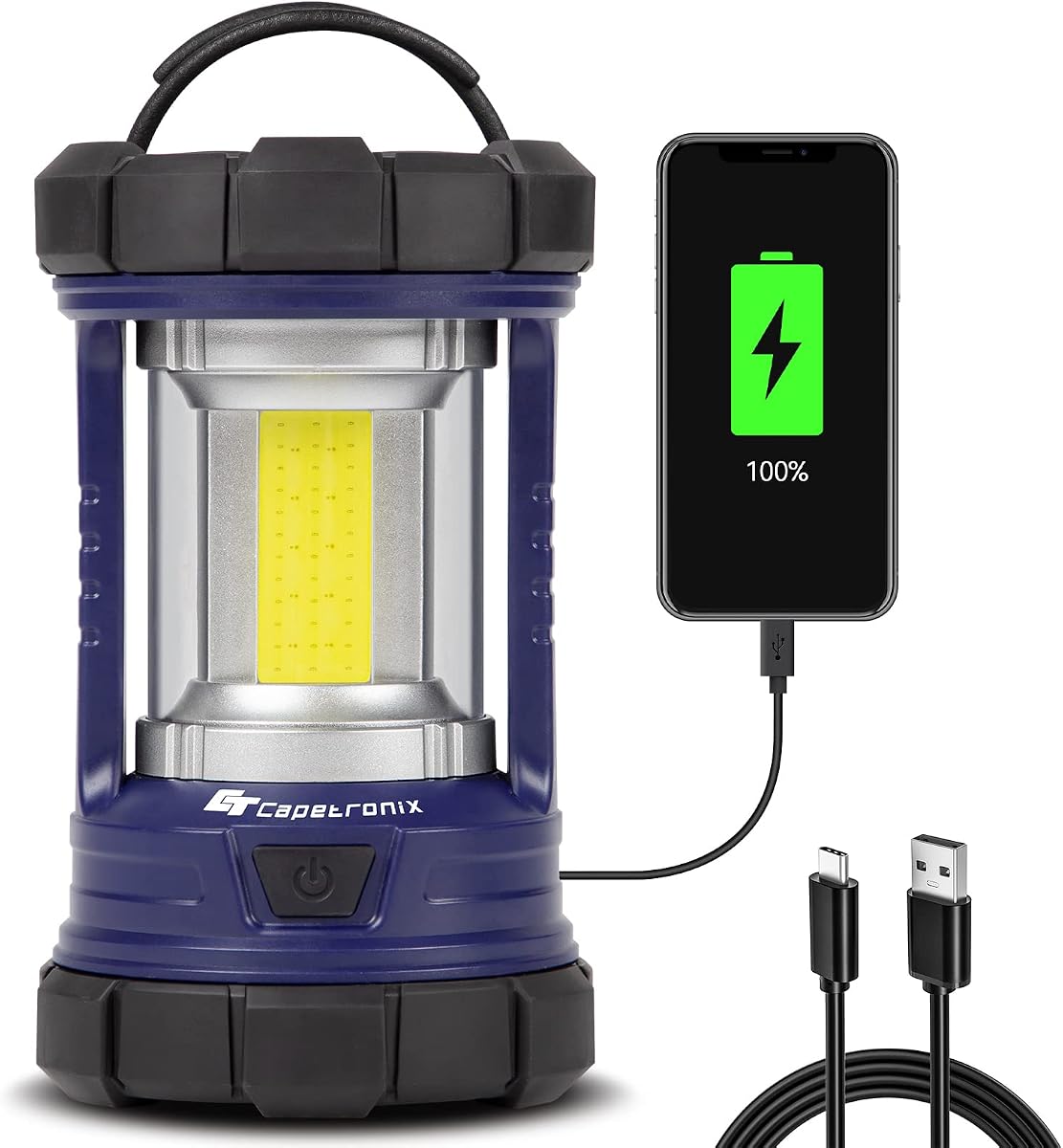
The CT CAPETRONIX 3200-Lumen Lantern leads this group in stated maximum brightness and carries a 4.6 rating. Its double COB light panels are designed to flood a campsite or vehicle with strong light, making the model appealing when fast, high-output illumination matters more than minimal weight.
We may earn a commission when you buy through this link, at no additional cost to you.
The rechargeable 4600mAh battery can also operate as a phone charger through its USB output. Included Type-C cables support recharging, and the lantern is positioned for camping, automobile use, and emergency preparation. High, medium, and low brightness settings allow some control, while steady red and red-strobe modes cover night observation and signaling.
Its IPX4 rating provides resistance to rain and splashing, and the impact-resistant rubber top and bottom protect areas often exposed to drops. A steady rubber base helps prevent sliding on slippery or uneven surfaces. The body is described as military-grade ABS, and collapsible hooks allow hanging from a tree limb, camping rack, or tent structure.
At approximately 7 by 4 inches and 1.2 pounds, this is a substantial lantern rather than a lightweight pack accessory. That bulk is a reasonable trade-off for the 3200-lumen maximum and larger battery, but it may be less appealing to hikers focused on carrying less gear. It is best for vehicle-based camping, larger tents, and emergency kits needing a powerful light source.
The double-panel configuration provides the strongest maximum output in the list. That brightness is valuable for a large pitch, an outdoor work area, or a vehicle scene where a dimmer lantern would require repositioning.
The rubberized top and bottom add impact protection, while the broad base helps resist slipping. Those details make the lantern more practical for active campsites where tables and ground surfaces may not be perfectly level.
We may earn a commission when you buy through this link, at no additional cost to you.
The Glocusent 135-LED IP44 Lantern is a compact 360-degree light with a 4.6 rating. It illuminates approximately 200 square feet using 135 upgraded LEDs and offers five dimmable levels, three color temperatures, and a 1500-lumen emergency boost mode.
We may earn a commission when you buy through this link, at no additional cost to you.
A 5000mAh battery provides up to 200 hours on low and 12 hours at maximum brightness, with a full charge taking about 3.5 hours. The three-minute boost is intended for wide-area emergencies rather than continuous maximum output. A Type-C port also supports phone charging, and the included USB-C-to-C cable facilitates recharging.
Warm 3000K, neutral 4500K, and cool 6000K modes cover atmosphere, reading, hiking, and clear task illumination. The IP44 rating supports use in rainy or dusty environments, while the stated weight of 1.5 ounces keeps it easy to carry. Large recessed buttons, a memory function, a top handle, and a bottom hook improve operation and placement.
This model is well suited to backpackers and campers who want very little weight without giving up emergency functions. It also works well as a household outage light because of its long low-level runtime and phone-charging capability. Its IP44 rating is less substantial than the IP68 design of another model in the list, so buyers needing greater submersion protection should choose accordingly.
At a stated 1.5 ounces, the lantern is easy to justify adding to a hiking kit. Its small footprint and low weight make it suitable for carrying to a remote campsite, a nighttime fishing spot, or a vehicle emergency bag.
The mix of color temperatures, dimming, boost output, and SOS signaling covers both routine tasks and unexpected situations. Memory recall reduces repeated button pressing after the user has established preferred settings.
We may earn a commission when you buy through this link, at no additional cost to you.
The Rechargeable Telescopic Camping Light stands apart with a foldable body, seven-stage extension, magnetic tripod, and a stated height of up to 37.8 inches. It carries a 4.6 rating and can function as a flashlight, tripod lamp, table lamp, backpack light, or traditional lantern.
We may earn a commission when you buy through this link, at no additional cost to you.
Its 12000mAh rechargeable lithium battery offers 24 to 78 hours of light and recharges in approximately six to seven hours through a 5V/2A Type-C port. USB output allows the unit to charge a smartphone, tablet, or other device. This large capacity makes it a convincing premium choice for vehicle-based camping, family sites, and power outages.
The side light adjusts through 160 degrees, three color temperatures span 1500K to 8000K, and stepless dimming provides precise control. Two RGB modes add four fixed colors—yellow, blue, green, and red—plus a gradient. These features are useful for campsite atmosphere, task lighting, or entertainment, although some buyers may never need the full color range.
An IPX5 rating, ABS, polycarbonate, and aluminum construction support use in rainy or humid environments. The built-in magnet allows attachment to vehicles, boats, and motorcycles, while the tripod design provides stability on grass and sand. This is the most adaptable physical design in the group, and it is the top choice for users who prioritize placement flexibility and battery capacity over pocket-sized simplicity.
The telescoping extension, magnetic tripod, and vehicle-ready magnet allow the light to adapt to a table, ground, branch, car, boat, or motorcycle. This reduces the need to carry separate stand hardware for several camping tasks.
The 12000mAh capacity supports lighting and device charging over longer periods than smaller models. It is a strong option for group camps and outages, provided the added size and weight still suit the user's packing priorities.
We may earn a commission when you buy through this link, at no additional cost to you.
The Glocusent 106-LED Camping Lantern is the most ruggedly protected model in the list, with a stated IP68 waterproof rating and resistance to drops from 40 inches. It carries a 4.5 rating and is aimed at campers, travelers, and emergency users who may encounter rain, river crossings, or demanding outdoor conditions.
We may earn a commission when you buy through this link, at no additional cost to you.
The 106 LEDs are distributed around the body for even 360-degree coverage. Five dimmable brightness levels and a 1200-lumen boost mode provide flexibility, although the boost is designed to last only three minutes. An anti-fog mode improves visibility in heavy fog, and an integrated SOS mode provides an emergency signaling option.
Its dimensions are listed as 2.2 by 2.2 by 5.6 inches, with a weight of 8.5 ounces, making it compact enough for a hiking backpack. The 5000mAh rechargeable battery runs for up to 80 hours at the lowest brightness. USB-C charging can be completed with a portable power bank or small solar setup when conventional power is unavailable.
This lantern is a compelling choice for wet environments, fishing trips, and preppers who prioritize water resistance over device charging. Its 3000K setting is intended for fog, 4000K for walking, 6000K for repair or broader campsite tasks, and SOS for signaling. Compared with most rivals, its strongest advantage is environmental durability rather than extra charging versatility.
The stated IP68 rating and drop-resistance make this lantern a practical choice around water, rain, and rough terrain. It is still wise to protect charging ports and follow the manufacturer's care instructions.
The three color temperatures are tied to practical conditions, from fog and walking to broader task lighting. This makes mode selection more purposeful than simply cycling through decorative brightness levels.
We may earn a commission when you buy through this link, at no additional cost to you.
The most useful lantern is one whose brightness, runtime, charging method, protection, and placement features match your environment. Review these factors before comparing models or deciding which emergency functions are genuinely necessary.
Maximum lumen figures are most useful when comparing the scale of each lantern's output, but they should not be treated as the only measure of quality. A tent lamp may need soft 360-degree coverage, while a large campsite or roadside situation may call for a powerful directional beam. Some models use broad diffuser panels, some concentrate light through COB arrays, and others combine a lantern body with a separate flashlight function.
Battery capacity influences expected runtime, but the brighter mode usually consumes power much faster than the lowest setting. Look for a range of runtimes rather than a single maximum claim. A lantern intended for weekend camping may prioritize 100 or more hours at a low level, while a high-output emergency light can be more useful with a shorter, rechargeable runtime.
USB-C is common among newer models and works with a broad range of power banks and adapters. Solar charging can provide a useful backup in prolonged daylight, although it should not be assumed to match wall charging speed. A phone-charging output is helpful during outages, but it also shares the lantern's battery with the light. Check included cables and whether a wall adapter is supplied.
An IPX4 rating is designed for splashes and light rain, while IP44 adds protection against dust and more solid water ingress. IP65 offers stronger water-jet protection, and IP68 indicates a higher level of submersion resistance according to the stated specification. Impact resistance and reinforced ends are also useful for lights that will be dropped during packing or used around children and busy campsites.
Useful modes may include low, medium, high, warm, neutral, cool, red, strobe, and SOS. The best interface is not necessarily the one with the most modes; large buttons, clearly separated functions, memory recall, and a simple power control matter in darkness. Red light can support night visibility, while strobe and SOS modes help make a campsite or vehicle more noticeable.
A top handle, carabiner, folding hook, telescoping shaft, magnetic base, or integrated tripod determines how easily the lantern can be hung or elevated. Stable bases help on uneven ground, and a downward-facing diffuser can reduce dark areas when a lantern is suspended. Consider whether you will mainly place it on a table, hang it inside a tent, attach it to a vehicle, or elevate it over a group.
Compact lanterns are easier to carry and can be distributed around a campsite, while larger models generally offer bigger batteries, more output, or more elaborate stands. Compare packed dimensions and listed weight against the space available in your bag. A two-pack can be more useful than one premium model for a family because each person can keep a light close at hand.
SOS signaling, red strobe, and super-bright bursts are meaningful emergency additions, but they should complement rather than replace planning and backup power. A USB output can keep a phone connected during an outage, yet charging a device reduces the capacity available for illumination. Choose the functions you are likely to use and avoid paying for complexity that adds little to your routine.
Before every trip, fully charge the lantern using the recommended cable and adapter, then confirm that the battery indicator matches the expected state. Test the brightness controls, red mode, SOS or strobe, device-charging output if applicable, and every hook, handle, magnet, or telescoping section. Packing a small power bank provides a useful backup when the lantern cannot be recharged on site.
At the campsite, place the lantern where it is stable and where the light can reach the area you need without shining directly into nearby tents. Hang it high enough to reduce shadows when broad coverage is the goal, or lower it and aim it toward a task surface when focused light is more useful. Turn the output down when possible because a lower setting is usually gentler on the eyes and more efficient on the battery.
Keep charging ports dry and clean, avoid exposing the lantern to extreme heat or punishing impacts, and follow the stated water-resistance limits. Do not assume a water-resistant model can remain submerged unless its specification explicitly permits that. If the battery no longer holds a useful charge, the light becomes sluggish, or the housing is damaged, stop relying on it for safety-critical lighting and replace or service it.
Runtime depends heavily on brightness, color mode, battery capacity, and how recently the lantern was charged. The models here range from approximately 10 hours at demanding outputs to as much as 400 hours in a very low night-light mode. For most weekend trips, choose a model that remains usable for many hours on its lower and middle settings.
Several models in this guide provide a USB output that can charge a phone, GPS device, or other compatible USB-C equipment. The feature is useful during outages, but charging a device also reduces the battery available for lighting. Keep a dedicated power bank for critical electronics whenever possible.
Use a low or warm setting for relaxing inside a tent because it is easier on the eyes and generally extends runtime. A neutral setting works well for reading and walking, while a higher or boost mode is most appropriate for detailed tasks, broad campsite coverage, or short emergency situations.
No. Higher output can illuminate a larger area or make details easier to see, but it usually consumes more power and may be unnecessarily bright inside a tent. Consider coverage, diffusion, runtime, controls, and placement alongside maximum lumens when deciding whether a brighter model is actually more suitable.
These ratings indicate different levels of protection against water and solids. IPX4 is generally associated with resistance to splashing water, while IP44 adds dust protection and a higher degree of water protection. Neither rating should automatically be interpreted as permission for prolonged submersion.
A collapsible lantern is convenient for small tents, backpacks, and emergency kits because it packs down compactly. A telescopic model offers more height, placement flexibility, and often larger battery capacity, making it better for campsites, vehicles, and group use. Choose based on where you need light rather than on shape alone.
Solar charging is best viewed as a supplemental option because charging speed depends on sunlight, angle, weather, and the panel's exposure. Recharging by wall, vehicle, or power bank before departure remains the more dependable approach, especially before a storm or multiday trip.
One lantern is enough for a solo camper who keeps it in the tent or pack. Families and groups may benefit from two or more units placed in different areas, reducing the need to carry one lantern everywhere. A multipack can also make emergency preparation easier by allowing lights in the home, vehicle, and travel bag.
The Coleman Classic Rechargeable LED Lantern is the most balanced overall recommendation because it combines three brightness levels, a 4800mAh battery, useful runtime, device charging, and straightforward hanging features. The Rechargeable Telescopic Camping Light takes the premium position with its 12000mAh battery, extendable stand, magnetic mounting, and broad lighting controls, while the Two-Pack COB Camping Lanterns offer the strongest value-oriented option.
Prioritize the conditions you will actually encounter. Lightweight campers should weigh a compact model such as the Glocusent 135-LED or 106-LED lantern, while large camps and vehicle kits may benefit from the 3200-lumen CAPETRONIX or telescopic model. Wet environments call for stronger water protection, and multi-day users should examine low-setting runtime, charging access, and whether a separate power bank is needed.
Before buying, confirm the current product listing, included accessories, charging requirements, dimensions, and protection rating. Ratings and availability can change, and prices fluctuate, so the current listing remains the best source for up-to-date information. With those checks in mind, you can select a rechargeable camping lantern that matches your runtime, brightness, placement, and emergency requirements.