
Aston Microphones Halo
4.6Editor score
360-degree acoustic filtering
Lightweight portable construction
Expanded surface area
Linear sound absorption
Reflection filters for microphones create a controlled acoustic zone around a microphone, helping reduce the sound of nearby room reflections, reverberation, and environmental interference. A useful filter should improve clarity without adding obvious coloration, while fitting the microphone, stand, recording space, and portability needs of its owner.
The products in this guide span compact wraparound foam shields, folding panel designs, portable vocal booths, and more specialized multi-layer systems. We compared their stated acoustic construction, isolation approach, adjustment options, stand compatibility, storage requirements, and intended recording applications to help distinguish practical differences.
Each review explains the product's strongest qualities, limitations, and most suitable user, while the comparison table highlights the major differences across the full field. Ratings and product details can change over time, and current prices vary, so readers should confirm the latest listing information before purchasing.
4.6Editor score
5.0Editor score

4.4Editor score
As an Amazon Associate we earn from qualifying purchases.
The comparison below places all ten filters side by side, focusing on physical design, acoustic construction, adjustment hardware, portability, and practical compatibility rather than treating every reflection filter as the same type of accessory.
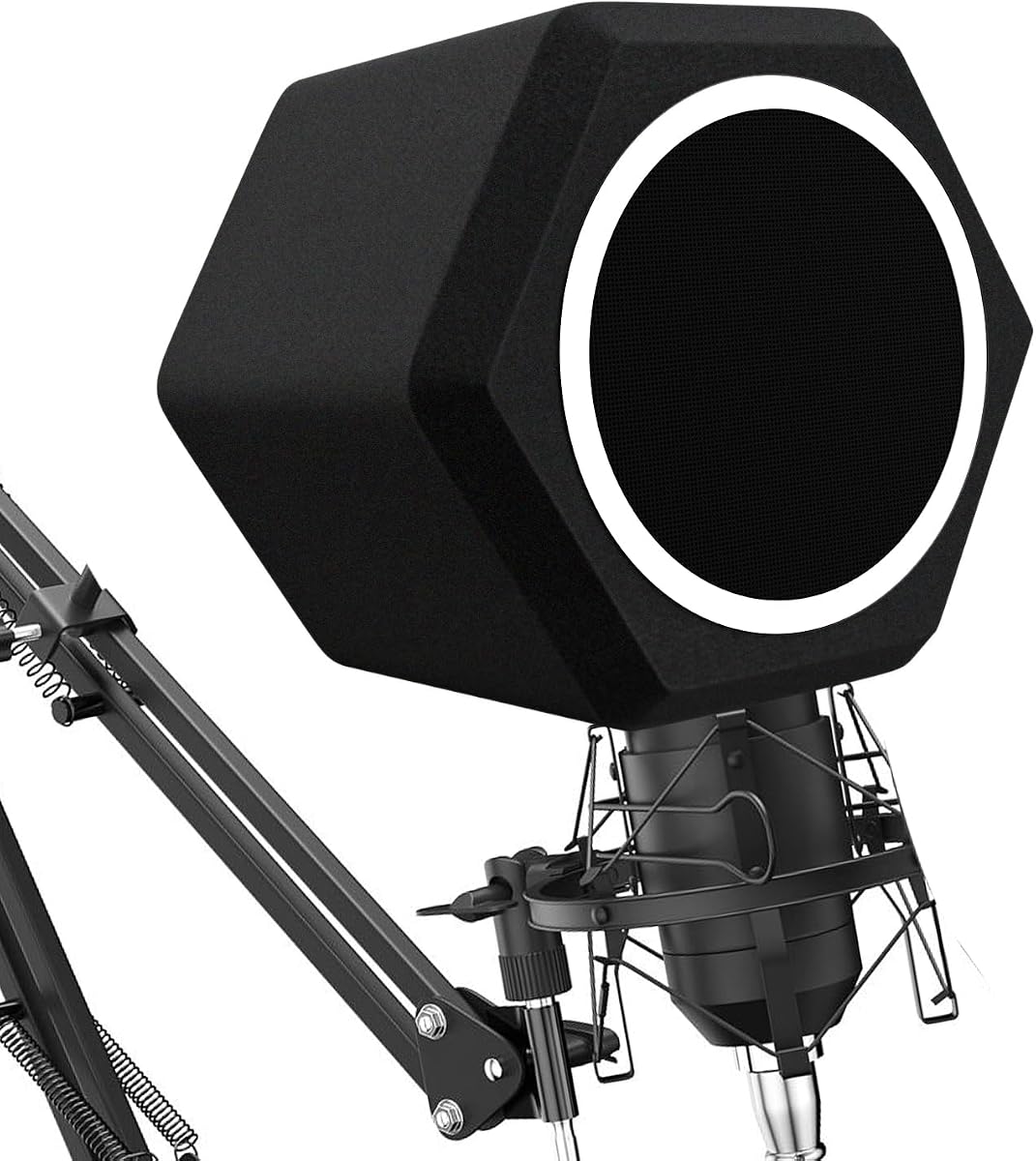


The Penypeal Wind Shield Pop Filter is a compact enclosure-style reflection filter rated 4.5 out of 5. Its defining feature is a five-sided foam design that surrounds much of the microphone while leaving a controlled opening for sound entry. A double-layer pop filter on that side adds protection against plosives, making the product useful for voice recording, streaming, radio, and studio sessions.
We may earn a commission when you buy through this link, at no additional cost to you.
The stated acoustic strategy combines reflection control, sound filtering, and absorption. The five-sided seal is intended to reduce interference arriving from several directions, while the double-layer screen helps prevent strongly voiced consonants from creating distracting bursts. Its holder is designed for most XLR or USB condenser microphones with a removable-jacket diameter between 50 and 75 millimeters, and the supplied holder accommodates different microphone sizes.
The main compromise is coverage. Unlike a broad folding panel that can form a wall behind the performer, this model wraps around the microphone more closely, making it compact but less capable of shielding the full rear hemisphere. Compatibility also depends on the shape and dimensions of the microphone, particularly when a removable outer jacket is involved. The product is best treated as a close-range accessory rather than a complete room-treatment solution.
This is a compelling choice for someone who wants a lightweight pop filter and reflection-control enclosure in one accessory. It should suit home-studio vocalists, podcasters, and mobile recorders who value portability more than maximum physical coverage. For a large-diaphragm condenser, users should verify the stated dimensional range and inspect the included holder before committing.
Combining the enclosure with a double-layer pop filter gives vocalists a practical two-function accessory. That arrangement is especially helpful in untreated rooms where harsh plosives and nearby reflections can otherwise require separate remedies and additional mounting hardware.
At a stated 120g, the filter is light enough to move between a desktop stand, tripod, cantilever arm, or floor stand with little effort. Its compact form is particularly attractive for creators who switch locations rather than maintaining a permanent studio.
We may earn a commission when you buy through this link, at no additional cost to you.
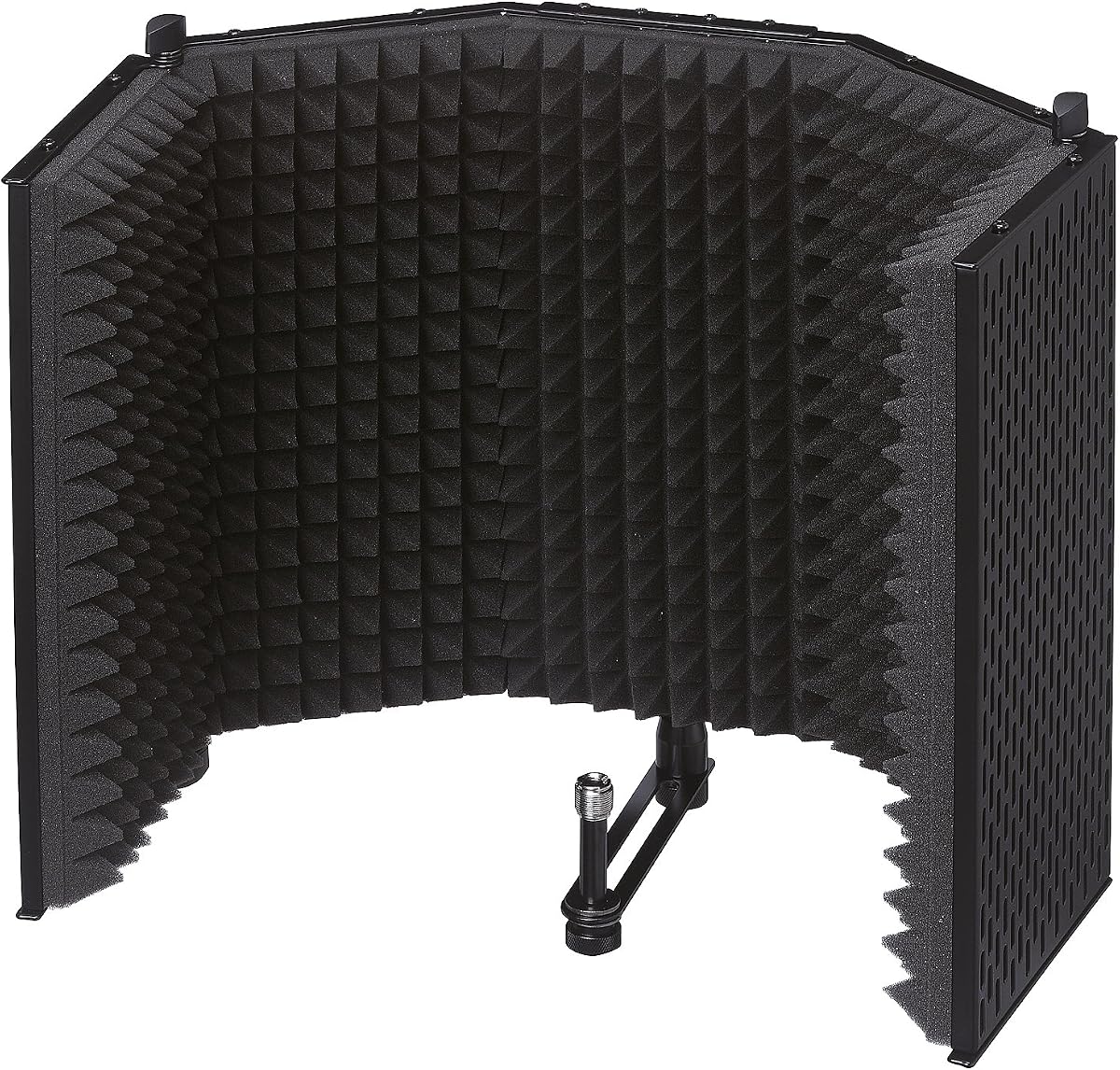
The Moukey Three-Panel Shield is a folding reflection filter rated 4.4 out of 5. Built around three acoustic panels, it offers a larger rear barrier than a close-fitting pop enclosure while remaining more compact than many five-panel designs. Its reflective, filter, and absorbing layers are intended to reduce sound bouncing back into the microphone.
We may earn a commission when you buy through this link, at no additional cost to you.
High-density acoustic foam forms the inner treatment, while the back panel uses ABS material for support. The panels fold for storage and can be adjusted to change the angle around the microphone. Included metal conversion nuts support 3/8-inch and 5/8-inch threaded fittings, allowing the shield to be used with a broad selection of microphone stands and shock mounts.
Its main limitation is that three panels cannot enclose as much space as a five-panel shield, so the performer may still hear or record more sound from the open side. The foam-lined interior also needs protection from impacts, moisture, and dust. A table stand can be used for broadcast setups, but a separate microphone position within the arch must be established carefully.
The Moukey is a solid middle-ground option for podcasters, home vocalists, and mobile creators who want a folding barrier and broad stand compatibility without a larger five-panel footprint. It works best when the treated side is placed behind the main reflection source and the open side faces away from the loudest room activity.
The reflective, filtering, and absorbing layers address reflected energy and incoming interference in different ways. This multi-material construction makes the shield more versatile than a simple piece of foam and gives it a more substantial barrier around the microphone.
The hinged design allows the shield to collapse for transport and reopen into a working arch. Angle adjustment also helps users match the barrier to the microphone and performer rather than forcing the microphone into one fixed position.
We may earn a commission when you buy through this link, at no additional cost to you.
The Aston Microphones Halo is a portable reflection filter rated 4.6 out of 5. Its compact shape makes it one of the most approachable options in this guide, while its treatment extends through 360 degrees rather than being limited to a conventional horizontal plane. The product is designed for users who want to improve isolation without carrying a large vocal booth.
We may earn a commission when you buy through this link, at no additional cost to you.
Key advantages include a surface area described as approximately 40 percent larger than the main competitor cited by the manufacturer and more linear absorption. Vertical coverage is particularly important because sound reflections and interference can arrive above, behind, and below the microphone, not merely from directly behind it. The Halo also remains incredibly lightweight, reinforcing its suitability for mobile sessions and less permanent studio arrangements.
The trade-off is adjustment. Unlike a folding panel shield with several hinged surfaces, the Halo presents a more defined portable form. Buyers who need a wide range of angles, a large separation area, or a close visual barrier for strong performers may prefer a panel-based design. It also does not include a pop filter in the supplied feature description, so it should not automatically be treated as a complete vocal accessory package.
For podcasters, voice-over artists, and musicians who want an established portable filter at a relatively accessible tier, the Halo remains a strong recommendation. Its strong rating, broad directional treatment, larger surface area, and low weight make it a particularly balanced choice for improving an untreated recording space.
A filter that only protects the horizontal rear plane can leave the microphone vulnerable to reflections arriving from above or below. The Halo's 360-degree approach addresses those directions, which is useful when the room ceiling, desk, and nearby walls all contribute to a reverberant recording environment.
The stated increase in surface area shows that portability does not require a tiny acoustic shell. A larger treated region can improve the microphone's environmental conditions while the lightweight construction keeps the unit practical to move between sessions.
We may earn a commission when you buy through this link, at no additional cost to you.
The Five-Sided Foam Isolation Ball is an enclosure-style filter rated 4.4 out of 5. Like other close-fitting designs, it reduces reflected and ambient sound by surrounding the microphone with high-density acoustic foam. It also includes a dual-layer pop filter designed to soften harsh sibilance, plosives, and related vocal artifacts.
We may earn a commission when you buy through this link, at no additional cost to you.
Its five-sided construction offers more directional coverage than a basic flat pop filter, while the foam is designed to absorb unwanted noise and reflections. The stated microphone compatibility range is 50 to 68 millimeters, making it relevant to many condenser microphones, though less broad than the 50 to 75 millimeter range offered by the first product.
The microphone and holder are explicitly not included, which is an important distinction when comparing complete kits. Its 200g weight remains portable, and it can mount on desktop stands, mic arms, floor stands, or shock mounts. However, the compact enclosure still leaves one primary side open, and effectiveness depends on aligning that opening away from the strongest source of room reflection.
This filter is a good match for home-studio vocalists, streamers, dubbing users, and podcasters who want pop protection in the same accessory as acoustic isolation. It is especially useful when a full folding shield would be inconvenient, provided the buyer confirms microphone dimensions and already has an appropriate holder.
The included pop filter targets harsh consonants that many vocalists encounter even when a microphone is positioned correctly. Combining that function with an acoustic enclosure can produce a cleaner source capture with fewer separate attachments.
The stated high-density foam is intended to absorb rather than simply block sound. That distinction matters in close-mounted accessories, where softer treatment can reduce the harsh edge associated with a hard reflective shell.
We may earn a commission when you buy through this link, at no additional cost to you.
The Moukey Five-Panel Shield is rated 4.4 out of 5 and represents a larger version of the company's folding isolation concept. Five panels form a broader enclosure around the microphone, increasing the treated area and making it better suited to users who need more separation from the room.
We may earn a commission when you buy through this link, at no additional cost to you.
The shield combines reflective, filtering, and absorbing layers, with high-density acoustic foam inside. The back panel is made from ABS for structural support, and non-slip support points help the unit remain stable on a desk. Foldable panels allow the barrier to be adjusted, unfolded for recording, and collapsed for storage or transport.
Metal adapters allow connection to 3/8-inch and 5/8-inch hardware, supporting most microphone stands and shock mounts. The trade-off is bulk. Compared with the three-panel Moukey, this version takes up more desk space and needs more deliberate positioning. If the panels are not adjusted evenly, the microphone may not be centered in the most useful section of the enclosure.
The product is a strong option for home studios, radio workflows, personal recording, and professional environments where a larger folding shield is acceptable. It offers a compelling balance of coverage, portability, and stand compatibility for users who want a traditional panel-style reflection filter.
Five panels create a more complete barrier than the three-panel Moukey design. That additional coverage is useful in rooms with pronounced wall reflections, because the microphone can be placed deeper within the treated region.
The unit can sit on a tabletop for live broadcast work or attach to a microphone stand for a more permanent studio arrangement. The included adapter hardware broadens compatibility with common stand and shock-mount fittings.
We may earn a commission when you buy through this link, at no additional cost to you.
The sE Electronics RF Space is a large portable vocal booth rated 4.5 out of 5. Rather than relying on a single foam shell, it uses a patented multi-layer construction with a larger surface area and deeper air gaps. The stated goal is greater isolation and control across the recording environment around the microphone.
We may earn a commission when you buy through this link, at no additional cost to you.
The design combines layered materials to reduce reflections and create a controlled sound space for vocals, instruments, drums, and amplifiers. Unlike products built around a flexible metal frame and foam panels, the RF Space is described as using robust metal components without plastic or low-cost foam. Specialized mounting hardware provides lockable adjustment for height, distance, and angle.
Its size and construction are the main trade-offs. A deeper, more elaborate vocal booth demands more desk or stand space and can be less convenient for constant transport than a compact Halo or folding enclosure. It also does not promise the elimination of every room sound; even a well-designed reflection filter works within the limits of the room and the placement of both performer and microphone.
The RF Space is best suited to serious home studios, professional facilities, mobile vocalists, and anyone willing to devote a meaningful setup area to acoustic control. Its robust construction, advanced layer system, and precise mounting make it a compelling choice when isolation quality and repeatable positioning outweigh simplicity.
The deeper air gaps separate the microphone from the reflective and absorbing layers. That separation can make the acoustic enclosure behave more like a controlled vocal booth than a single flat screen placed close to the microphone.
A metal-based structure is easier to maintain than a frame dominated by inexpensive plastic and loose foam. Combined with hand assembly and durable finishes, the design is oriented toward regular studio use and long-term reliability.
We may earn a commission when you buy through this link, at no additional cost to you.
The Foldable Two-Panel Isolation Shield is a compact freestanding filter rated 4.2 out of 5. It is designed for voice-over, podcasting, demo recording, and other situations where a small acoustic barrier is more convenient than a large vocal booth.
We may earn a commission when you buy through this link, at no additional cost to you.
Its treatment includes an absorbing layer, a filter layer, a reflective layer, and a vented metal backplate. The two hinged panels can be angled to suit the microphone position, while the freestanding steel base allows the shield to be positioned without relying entirely on a microphone arm. It can also work with most microphone stands.
The central trade-off is the relatively limited physical coverage. Two panels cannot create the same rear and side barrier as three- or five-panel products, and the shield's effectiveness will depend on where the most disruptive reflective surface sits relative to the microphone. The vented metal backplate also adds structural reinforcement while leaving a small amount of open space that should be oriented away from problematic noise sources.
This product is most appropriate for creators with limited space, a need for quick setup, and a recording room where moderate reflection control is sufficient. It is less compelling for powerful singers who need a large acoustic void or for users whose recording environment contains sustained ambient noise outside the shield's direct line of fire.
A weighted or stable freestanding structure can simplify desktop recording by removing the need to build a large support arrangement around the microphone. It also makes it easier to experiment with the shield's position relative to the room's reflective surfaces.
The two folding panels collapse flat for storage and transport. That makes the shield practical for people who record in temporary spaces or cannot leave a large acoustic unit assembled beside the desk.
We may earn a commission when you buy through this link, at no additional cost to you.
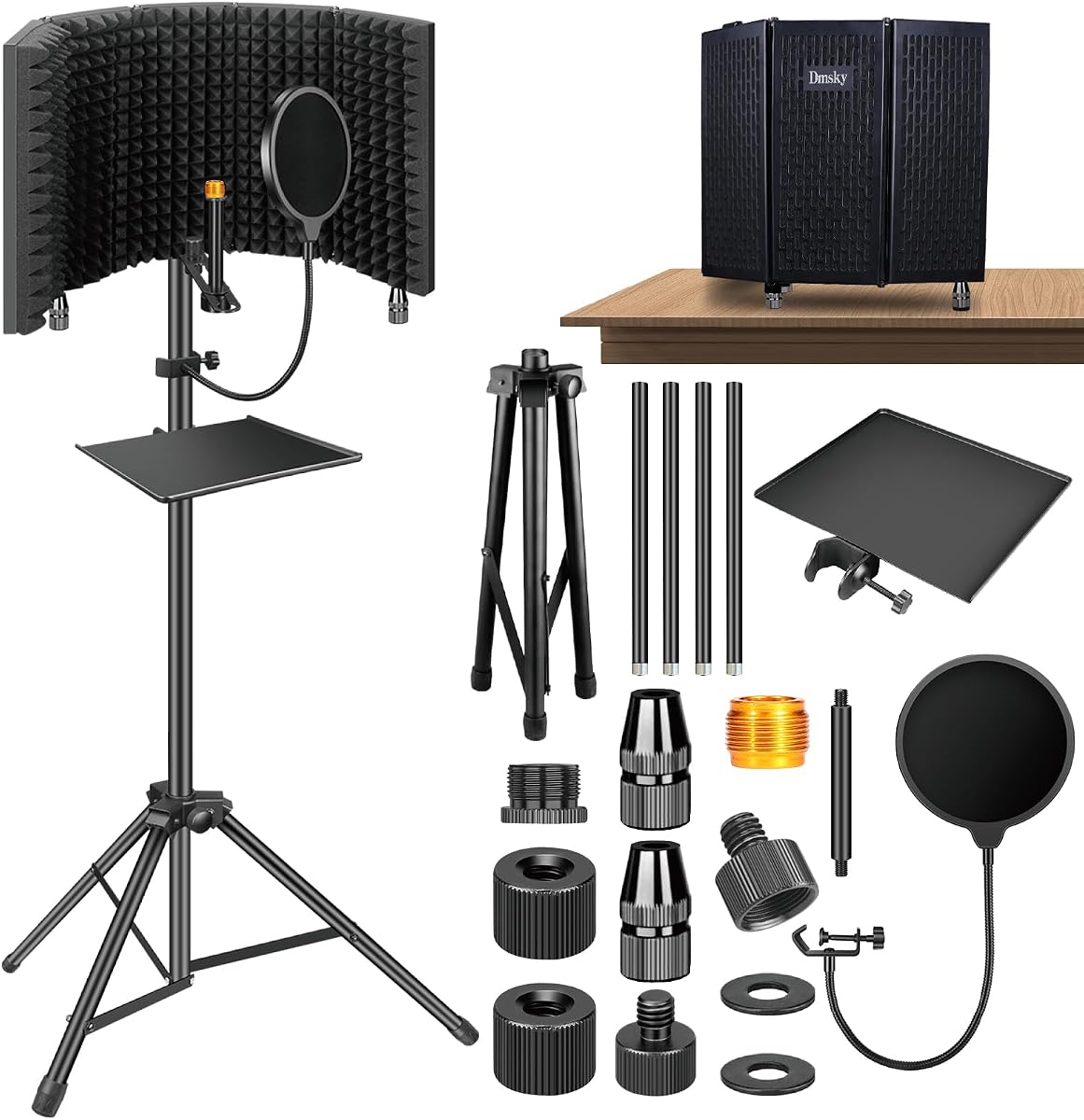
The Dmsky Shield and Stand is a complete microphone isolation package rated 4.6 out of 5. It combines a five-panel folding shield, high-density acoustic foam, a pop filter, a steel tripod, mounting adapters, and a storage tray. Its appeal comes from offering a full support system rather than requiring users to assemble several accessories separately.
We may earn a commission when you buy through this link, at no additional cost to you.
The shield uses reflective, filtering, and absorbing layers to reduce audio-wave bounce and external interference. Its five panels adjust at 180 degrees, allowing the barrier to be shaped around the microphone. The included stand reaches 78.7 inches overall, while the shield position adjusts from 42 to 71.5 inches, supporting both seated recordings and standing performances.
The heavy-duty tripod, steel screws, metal back panel, and anti-slip support points are intended to improve stability. A shelf or tray can hold an external sound card or mobile phone. The disadvantage is size: the stand, panels, and accessories create a larger footprint than a simple desktop filter, and the full assembly is more involved to transport than a compact wraparound model.
This package is best for podcasters, streamers, singers, and small recording spaces that need a complete microphone and isolation setup at an accessible level. Buyers who already own a reliable stand may find the included support unnecessary, but for a new setup, the coordinated height adjustment, broad panel positioning, and included pop filter provide considerable convenience.
The included pop filter, adapters, stand, and tray reduce the number of separate purchases required for a functional vocal recording arrangement. This convenience is especially valuable for creators assembling a first home studio.
The two levels of height adjustment let the user alter both the shield and microphone position. A broad range can improve consistency across different performers without replacing the entire stand for each setup.
We may earn a commission when you buy through this link, at no additional cost to you.
The Tascam TM-AR1 is a portable microphone reflection filter with a 5.0 rating, the highest listed score among these products. Its central purpose is straightforward: minimize reflections and unwanted room ambience while giving the performer a more controlled microphone environment. The result is a focused option for users who value simple, dependable equipment.
We may earn a commission when you buy through this link, at no additional cost to you.
The TM-AR1 is lightweight and adjustable, allowing it to mount to virtually any standard microphone stand. A unique folding design supports fast microphone placement changes and easier storage. These attributes make it well suited to podcasting, voice-over, home-studio vocals, and mobile sessions where equipment must be moved without taking over the workspace.
The supplied product information is concise and does not describe a complex multi-layer material system, an included pop filter, or specialized conversion hardware. As a result, buyers seeking a detailed breakdown of acoustic layers may find more explicit specifications in the higher-end sE products. The design also remains an open reflection filter rather than a sealed booth, so placement remains important.
The TM-AR1 is an excellent general recommendation for anyone who wants a straightforward filter with strong ratings, fast adjustment, and uncomplicated storage. It combines a familiar mounting approach with a compact folding design, making it particularly persuasive for podcasters and mobile voice professionals who need repeatable reflection control without a complex multi-panel system.
Quick placement changes are valuable when moving between speakers, different microphone positions, or sessions with varying room conditions. The adjustable mounting and folding structure support that flexibility without requiring a complicated assembly process.
Because the filter folds, it can be stored away when it is not needed and brought back into use for a recording session. That is a practical advantage over permanent booth-style systems in shared or compact workspaces.
We may earn a commission when you buy through this link, at no additional cost to you.
The sE Electronics RF Pro is the premium option in this guide, with a 4.4 rating and a patented nine-layer acoustic design. Introduced as an industry-standard portable vocal booth, it is designed to reduce room reflections and ambient noise in studios, home setups, and mobile recording environments.
We may earn a commission when you buy through this link, at no additional cost to you.
Its nine carefully engineered layers are intended to work across different parts of the frequency spectrum, combining balanced absorption and diffusion for a natural, uncolored result. The robust construction uses metal components without plastic or low-cost foam, while the mounting system provides control over height, distance, and angle. That positional control is more comprehensive than the basic adjustment offered by many compact filters.
The cost of that sophistication is size and commitment. The RF Pro is a substantial vocal-booth solution rather than a lightweight desktop accessory, and it demands sufficient space around the microphone. Like every reflection filter, it addresses the immediate acoustic environment rather than controlling noise transmitted through walls, distant traffic, or other sources outside its treatment area.
This is the recommendation for professional vocalists, serious home-studio owners, podcasters, voice-over artists, and users recording acoustic instruments who want a refined balance of isolation and natural sound. The RF Pro's durable materials, multi-frequency design, and precise adjustment justify consideration when the goal is dependable, repeatable acoustic control rather than the lowest commitment.
Different acoustic problems occur at different frequencies, so the RF Pro uses a layered design rather than one uniform material. The stated combination of absorption and diffusion is intended to control reflections while avoiding an obviously colored result.
Height, distance, and angle controls make it easier to reproduce a useful microphone position. Repeatability is particularly valuable in professional sessions, where small placement changes can otherwise create inconsistent results between takes.
We may earn a commission when you buy through this link, at no additional cost to you.
Choosing a reflection filter involves balancing acoustic coverage, construction, adjustability, portability, and compatibility. The right choice depends on the room, recording style, microphone, and whether the shield must remain permanently installed or travel frequently.
Coverage is one of the most important distinctions among reflection filters. Compact wraparound models can reduce interference from several immediate directions, but a folding design with more panels can create a deeper barrier behind the microphone. The three-panel Moukey provides a middle ground, while the five-panel Moukey and Dmsky designs cover more of the rear hemisphere. Larger barriers are useful in rooms with pronounced wall reflections, though they require more desk space and careful adjustment. The open side should face away from the loudest reflective surface, and the microphone should sit within the most useful part of the enclosure rather than directly against a panel.
A filter can reduce unwanted sound by absorbing energy, reflecting it away, or diffusing it into a less concentrated pattern. The products here use different combinations, with the sE models emphasizing multi-layer balance and several foam-based options relying on dense acoustic foam. A properly selected system should lower obvious room reflections without making the voice sound unnaturally dull or creating a new audible boundary. A filter placed too close to the source can also change tone, so microphone distance and the filter's internal geometry matter as much as the number of materials.
Compatibility should be checked before purchase. Wraparound models often specify a microphone diameter range, such as 50 to 75 millimeters or 50 to 68 millimeters, and may include a holder or explicitly exclude one. Panel-style shields commonly need a 3/8-inch or 5/8-inch threaded connection, with adapters sometimes included. The microphone should also have enough clearance from the panels and pop filter to avoid accidental contact. Users should confirm both the physical dimensions of the microphone and the type of stand or shock mount they already own.
A filter can only deliver its intended benefit if the microphone is placed correctly. Adjustable panels, rotating mounts, and controls for height, distance, and angle provide greater flexibility than a fixed compact shell. These features are particularly useful when a single room serves several recording tasks or performers. The Dmsky package offers extensive stand and shield height adjustment, while both Moukey panel designs allow their hinged sections to be repositioned. The sE RF Pro includes especially comprehensive mounting controls, and the Tascam prioritizes fast placement changes through its adjustable, folding design.
Portability depends on more than weight. A lightweight filter can still be awkward if it uses several large hinged panels, while a larger system may fold into a self-contained unit. The Aston Halo is exceptionally light and purpose-built for portable use. Moukey and Tascam designs fold for transport, and the Dmsky package disassembles into a larger group of stand and shield components. The sE RF Space and RF Pro provide deeper acoustic structures but demand more space. Consider the bag, vehicle, and storage area where the product will remain between sessions rather than looking only at its listed weight.
Durability matters most for equipment used repeatedly in studios, mobile racks, and live rooms. The sE RF Space and RF Pro use robust metal components and finished construction intended for long-term use. The Dmsky package uses a steel stand, metal back panel, and steel fasteners, while the Moukey products use an ABS back panel for support. Foam and fabric surfaces require more careful storage because compression, tears, and moisture can affect their performance. A filter with replaceable or serviceable panels may be easier to maintain, but the supplied information does not specify replacement-part availability for every model.
The meaning of a complete package varies across the list. The Dmsky option includes a pop filter, tripod, adapters, and a storage tray. The Penypeal and five-sided foam models integrate or include pop-filter functionality, while the Tascam does not list one among its stated features. Several wraparound products do not include the microphone or holder, so accessory assumptions can lead to disappointment. Before buying, compare not only the shield but also the number of mounts, adapters, pop-filter pieces, and support pieces that must be sourced separately.
The best filter depends on the source and the problem being solved. Vocals benefit from close reflection control and may also need pop protection. Acoustic instruments, drums, and amplifiers can produce broader sound fields, making a deeper multi-panel or multi-layer system more appropriate. For voice-over, a compact foldable filter may be sufficient when the booth is already well controlled. For live streaming in a shared office, the main issue may be nearby voices rather than wall reflections, and no reflection filter can fully solve noise arriving from outside its acoustic boundary.
Begin by identifying the primary reflective surfaces in the room. Position the rear or curved portion of the filter toward the nearest wall, window, or other hard surface, and orient its open side away from the loudest activity. Mount the microphone so that the capsule is centered within the most protected area without touching the foam, panels, or pop filter. For a stand-mounted product, tighten the threaded connection and locking controls gradually, then confirm that the assembly remains stable.
Set the microphone distance and angle before beginning a serious take. Speak or perform at a consistent position and make small adjustments while listening for changes in brightness, proximity, reflections, and room tone. Pop filters should sit close enough to interrupt strong bursts of air without touching the microphone capsule. For a multi-panel shield, open or close the wings to balance coverage against a comfortable performer position rather than maximizing enclosure size without considering distance.
Care for the filter according to its materials. Dust the surfaces gently, keep microphones and cables away from the foam, and avoid compressed air or harsh chemicals that could damage acoustic fabric. Store folded panels in a dry location and do not place heavy objects on them. Allow enclosed equipment to ventilate after use in humid conditions, inspect threaded fittings periodically, and follow the manufacturer's instructions for cleaning any removable or replaceable components.
No. A reflection filter mainly reduces reflections and interference in the immediate area around the microphone. It cannot control noise that enters from outside the treated zone, such as traffic, a neighboring room, or an air-conditioning system. Complete room control generally requires absorption, bass traps, and isolation in addition to a reflection filter.
A pop filter primarily reduces bursts of air caused by letters such as P and B. A reflection filter is designed to create a broader controlled acoustic environment around the microphone. Some products in this guide combine both functions, while others focus only on reflections and require a separate pop filter.
More panels can create a larger barrier and provide greater rear-side coverage, but they do not automatically guarantee better recordings. Panel angle, microphone distance, room acoustics, and performer position all matter. A well-adjusted smaller shield may work more effectively than a large one positioned poorly.
A treated studio may still benefit from a portable reflection filter, particularly for close-miked vocals, isolation between performers, or mobile recording. It is less essential when the room already has sufficient treatment and the recording requires the natural ambience of that space. Its purpose should match the desired sound rather than being added automatically.
Many filters can be used with USB microphones because the acoustic treatment operates independently of the microphone's connection type. The important checks are physical fit, capsule clearance, and whether the product includes a suitable holder. Some enclosure-style models specify a microphone diameter range or require a removable outer jacket, so compatibility should be confirmed first.
There is no single correct distance for every product and room. The microphone should be centered within the protected area and far enough away to avoid contacting foam or panels. Start with a natural vocal position, listen for changes in tone, and make small adjustments rather than placing the microphone hard against the acoustic surface.
Yes, provided the filter is large enough and positioned to control the sound field reaching the microphone. A multi-panel or deeper multi-layer system generally offers more coverage for instruments than a compact pop-filter-style enclosure. Close-miked guitar may still benefit from a small shield, while drums and amplifiers often need a broader acoustic space.
Fold or disassemble it according to its design, loosen unnecessary tension, and store it in a dry, clean location away from heavy objects. Avoid compressing the acoustic foam for long periods, because folding and compression can damage the material or distort the panel shape. A padded bag or case is useful for transport, especially for mobile sessions.
The Aston Microphones Halo stands out as the best budget selection because it combines a 4.6 rating, 360-degree vertical filtering, a relatively large treated area, and very low weight. The Tascam TM-AR1 earns the editor's choice for its 5.0 rating, quick adjustments, standard stand compatibility, and convenient folding design. For users seeking a premium, professionally engineered solution, the sE Electronics RF Pro provides nine layers, refined mounting control, and durable metal construction.
The right choice ultimately depends on the recording problem. A compact wraparound filter is convenient for pop control and close vocal work, while a three- or five-panel shield offers more rear coverage. Deep multi-layer systems suit users who require more precise control and have sufficient desk space. Always verify microphone dimensions, included accessories, and threaded adapters before ordering.
Product ratings, features, availability, and prices can change, and the current cost of each option may differ from earlier listings. Check the latest Amazon page and current technical details at the time of purchase so that the selected reflection filter matches your microphone, stand, room, and recording goals.