
TEKTON Reversible Ratcheting Combination Wrench Set
4.6Editor score
Fourteen metric wrench sizes
Modular organizer system
Offset twelve-point box ends
Reversible ratcheting wrenches are compared by tooth count, size range, offset, gearing, and build quality to help you choose the right set for tight-space
Reversible ratcheting wrenches combine a box-end fastener grip with a compact ratcheting mechanism, allowing work without repeatedly removing and repositioning the tool. The best choices balance tooth count, offset geometry, size coverage, durability, markings, and convenient storage, especially when repairs happen in confined or awkward spaces.
This guide compares ten reversible ratcheting wrench sets based on their listed tooth counts, size ranges, offset designs, reversing mechanisms, materials, organization features, and stated construction details. It covers SAE, metric, and mixed sets, with particular attention to useful working clearance, fastener protection, and the number of individual tools needed.
Each product section explains who benefits most from that particular design and where its trade-offs may matter. Ratings and product information reflect the supplied listings, while prices can change frequently, so readers should confirm the current listing, included sizes, dimensions, warranty terms, and availability before purchasing.
4.6Editor score

5.0Editor score

4.1Editor score
The comparison below highlights the most important practical differences among the ten sets: standard system, number of sizes, ratcheting tooth count, offset geometry, and included organization. These factors help distinguish a compact multi-size tool from a conventional full assortment of individual combination wrenches.


The Klein Tools 68216 combines four SAE socket sizes in each of two ratcheting box wrenches, giving it an unusual balance of coverage and portability. Its 4.4 rating is supported by several practical details, including a 90-tooth mechanism, a pass-through design, color-coded markings, and recessed handle areas intended to reduce fatigue during repetitive work.
We may earn a commission when you buy through this link, at no additional cost to you.
The set covers 1/4, 5/16, 3/8, 7/16, 1/2, 9/16, 5/8, and 3/4 inch, spanning fasteners that are common across automotive, construction, and general maintenance work. A 90-tooth ratchet reduces the movement required to engage the next tooth, while the extended pass-through architecture can leave room for a longer threaded rod or bolt to project beyond the ratcheting head.
The main limitation is measurement focus. This is an SAE-only set, so metric fasteners would require separate tools. It also offers fewer physical handles than a standard assortment because multiple sizes share each wrench. That compactness can be an advantage in a small toolbox, but users who prefer one dedicated handle per size may find a conventional combination set more familiar.
This is a strong option for technicians, do-it-yourself users, and mobile repair professionals who want broad SAE coverage without carrying eight separate box wrenches. It is particularly attractive when the fastener stems extend beyond the wrench head or when a short ratcheting swing is important. For those needs, the 4-in-1 format adds meaningful versatility.
The quad-wrench design consolidates common SAE sizes into only two handles. That makes the set easier to organize, carry, and retrieve than an equivalent collection of individual wrenches while preserving the same nominal size coverage.
The extended pass-through design is valuable on protruding studs and long bolts. It allows the wrench body to remain farther from the fastener's working surface, which can improve hand clearance and reduce the need to reposition the tool.
We may earn a commission when you buy through this link, at no additional cost to you.
The ironcube set is a conventional 12-piece metric assortment spanning 8 through 19 millimeters, with every integer size represented. Its 4.5 rating reflects a well-rounded feature set: chrome vanadium construction, a 72-tooth two-way ratchet, a 12-point box end, a black matte finish, and a wax canvas pouch for storage.
We may earn a commission when you buy through this link, at no additional cost to you.
The most important advantage is straightforward size coverage. Mechanics working on cars, motorcycles, bicycles, and compact machinery often encounter metric hardware in the 8- to 19-millimeter range. Keeping each size on an individual wrench makes selection fast, while the reversible mechanism avoids lifting the tool from the fastener during repetitive loosening and tightening.
The 72-tooth mechanism needs more movement between strokes than a 90-tooth design, but the difference is most noticeable in especially confined work areas. A pouch also takes up more room than a small retention rail, although the wax canvas treatment is specifically described as resisting cracking under intense sunlight. The stated ASME-standard construction and 24-month support add reassurance, but buyers should still verify the complete specifications relevant to their intended use.
This set is best suited to owners of metric-focused vehicles, motorcycles, or workshop equipment who want a conventional wrench-per-size layout. It is a practical pick for general repair and maintenance rather than a minimalist mobile kit. Users who regularly work in SAE sizes or extreme tight quarters may prefer a higher-tooth or multi-size alternative.
Covering every whole millimeter from 8 through 19 millimeters is useful for frequently changing hardware sizes. The traditional one-size-per-wrench layout also makes it straightforward to select the correct tool without decoding a multi-size head.
The included wax canvas pouch gives the set a defined place in a tool bag and can be folded or arranged to keep the wrenches together. Its construction is intended to tolerate storage conditions that may cause less robust materials to deteriorate.
We may earn a commission when you buy through this link, at no additional cost to you.
Jaeger's 16-piece set is designed for users who need a broader metric assortment than the standard 8- through 19-millimeter range. It includes 8, 9, 10, 11, 12, 13, 14, 15, 16, 17, 18, 19, 21, 22, 24, and 25 millimeter sizes, accompanied by a lock-in rack and a 4.5 listing rating.
We may earn a commission when you buy through this link, at no additional cost to you.
A 90-tooth ratcheting box end allows relatively little movement between strokes, making the set suitable for repair work where access is limited. The reversible box end is described as able to tilt up to 180 degrees with its directional arrow, improving the approach angle in confined spaces. Its 12-point geometry gives the tool a multi-sided profile intended to fit common fastener shapes without requiring a perfectly square approach.
The trade-off is physical size. Sixteen individual wrenches take more room than a consolidated 4-in-1 or multi-size design, and the set is metric-only. Buyers should also carefully evaluate the listed corrosion-resistance description and the product's steel construction in relation to their own storage environment. The lifetime return policy is an unusual added assurance, although eligibility and process should be confirmed with the seller.
The Jaeger set makes the most sense for a technician, restoration hobbyist, or serious home mechanic who regularly encounters metric fasteners from 8 through 25 millimeters. Its high tooth count, tilting access, and dedicated rack are particularly useful when the work area is deep, obstructed, or shared with many other tools. For compactness, it is not the leading option.
The inclusion of 21, 22, 24, and 25 millimeter wrenches extends beyond the sizes found in many entry-level metric sets. Larger hardware can appear on brackets, machinery, drivetrain components, and structural assemblies, making the wider range useful for serious repair work.
The included lock-in rack helps keep sizes organized and reduces the chance of grabbing the wrong wrench. A fixed rack is especially useful in a workshop where the set has a dedicated location, provided the surrounding tool storage leaves enough room for the complete assembly.
We may earn a commission when you buy through this link, at no additional cost to you.
The GEARWRENCH 86658 stands out for its 90-tooth ratcheting mechanism, which is listed as requiring only a 4-degree arc to turn a fastener. That is the smallest movement angle among the sets featured here. Paired with a 4.5-to-5.0-style professional presentation and a 5.0 listing rating, it is well suited to technicians who routinely work around obstructions.
We may earn a commission when you buy through this link, at no additional cost to you.
The 15-degree offset box end improves clearance and is also intended to reduce injury potential by changing the alignment between the wrench and the user's hand. Off-corner loading on both the open and closed ends is designed to distribute contact differently and lower the risk of rounding a fastener. High-visibility ink in the size stamp further improves tool selection in a busy workshop or under poor lighting.
The main drawback is that the supplied information does not enumerate the ten SAE sizes, so buyers should verify the size chart before ordering. The set is also limited to SAE fasteners, and its professional geometry does not compensate for lacking metric coverage in a mixed workshop. Buyers who require a specific metric size should choose a metric set instead of assuming interchangeable dimensions.
This is the leading recommendation for SAE-focused users who put maximum emphasis on tight-space access and fastener protection. It is also a strong choice for automotive repair, equipment maintenance, and assembly work where a 4-degree swing can eliminate much of the frustration caused by blocked handles. The set is best purchased after confirming that its ten sizes match the fasteners used most often.
The listed 4-degree arc is the defining feature of this set. A short stroke is valuable where adjacent parts, tubing, or structural members prevent the handle from sweeping through a broad arc.
Off-corner loading is intended to reduce rounding compared with a conventional box end. This makes the wrench appealing for older, plated, or already-marked fasteners that may be more vulnerable to damage.
We may earn a commission when you buy through this link, at no additional cost to you.
The DISEN set is unusual because it combines metric and SAE coverage in one 10-piece package. It includes five metric pairings—6 by 8, 10 by 12, 13 by 14, 15 by 17, and 19 by 21 millimeters—and five SAE pairings from 1/4 by 5/16 inch through 3/4 by 7/8 inch. Its 4.8 rating reflects a versatile, feature-focused design.
We may earn a commission when you buy through this link, at no additional cost to you.
Each wrench uses a 25-degree offset at both ends, providing more clearance than conventional straight or lightly offset designs. A reversing lever at each end lets the user change direction without removing the tool. The 12-point box-end profile is described as re-engaging after a 30-degree swing, and the handle is reinforced with four rivets to resist separation.
The paired-size layout is the main compromise. It can keep the number of physical tools low, but it offers fewer immediately available size combinations than a set containing one wrench per size. The black electrophoresis treatment is intended to resist rust, while the listed clear size markings make selection easier. Users who need one specific intermediate size may have to confirm that it appears in a paired head rather than assuming full coverage.
This set is a strong middle ground for mixed-system toolboxes, hobby mechanics, and general maintenance users. It is especially useful when both inch and metric hardware appear in the same project and the double offset can keep the handle clear of nearby components. It is less suitable for a specialist who requires every common size on a separate wrench or an extremely low tooth count.
Many household and hobby projects mix inch and metric fasteners. Including both systems avoids carrying separate sets and makes this configuration convenient for general repair kits, automotive work, and imported components.
The 25-degree angle and paired reversing levers make the wrench adaptable from either side. That flexibility is particularly helpful when the accessible side of a fastener is determined by the vehicle, machine, or surrounding assembly rather than the technician.
We may earn a commission when you buy through this link, at no additional cost to you.
The GEARWRENCH 9509N is a 13-piece SAE combination wrench set built around a 72-tooth ratcheting box end. Its 4.7 rating indicates strong customer reception, while the product's defining details are a flush-mounted reversing lever and off-corner box-end loading designed to improve grip and reduce fastener rounding.
We may earn a commission when you buy through this link, at no additional cost to you.
Combination wrenches offer an open end for many familiar fastening tasks and a ratcheting box end for the restricted-access situations where a standard combination wrench is less convenient. The low-profile lever makes changing direction easier without removing the wrench. Compared with the other GEARWRENCH set in this guide, this model offers more individual wrenches, making it a more conventional full-size assortment.
Its 72-tooth mechanism requires more movement than the 90-tooth GEARWRENCH 86658, so it is less suited to extremely confined spaces where even a small handle swing is impossible. The supplied information also does not list the 13 individual SAE sizes. Buyers should therefore confirm the size chart, especially if the set must cover a particular range of vehicle or equipment fasteners.
This set is a good choice for a professional SAE workshop that wants a broader traditional assortment and the convenience of combination ends. It is well suited to technicians who regularly work on American-pattern fasteners and value a protected, low-profile reversing control. For metric work, the absence of metric sizes means another set would be needed.
A combination format can serve more than one access situation in the same job. The ratcheting box end helps in restricted locations, while the open end remains useful for familiar fasteners and quick orientation.
A flush-mounted lever reduces the chance of snagging the wrench on nearby parts. It can also feel more integrated than a protruding switch when the tool is used in a crowded engine bay or around closely mounted hardware.
We may earn a commission when you buy through this link, at no additional cost to you.
The Der Erwachte set uses two four-in-one wrenches to cover eight SAE sizes: 5/16 and 3/8 inch, 7/16 and 1/2 inch, 9/16 and 5/8 inch, and 11/16 and 3/4 inch. Its 4.1 rating is the lowest in this comparison, but the design directly addresses a common complaint about wrench sets: the amount of space they occupy in a tool bag.
We may earn a commission when you buy through this link, at no additional cost to you.
Each tool is forged from high-strength CR-V steel with a polished anti-corrosion finish. The reversible ratcheting box ends allow direction changes without removing the wrench, while the included pouch keeps the compact set together. This makes it appealing for mobile repair, emergency kits, small workbenches, and anyone who wants useful SAE coverage without carrying eight separate handles.
The principal trade-offs are system coverage and flexibility. The set is SAE-only, and each head carries two rather than four sizes. Users must choose the correct pair and orient it properly, which may take slightly longer than selecting a dedicated wrench. The 4.1 rating also suggests that buyers should examine current customer feedback and verify the fit of each listed size before purchase.
This is the practical budget and portability choice among the featured products. It is best for common household fasteners, light automotive maintenance, and compact emergency kits where eight common SAE sizes matter more than exhaustive coverage. It is less appropriate for professional shops needing larger SAE sizes, metric hardware, or separate high-torque tools.
The four-in-one arrangement covers frequently used fractions of an inch while keeping the physical count unusually low. It is a practical way to build a small service kit without sacrificing access to several common fastener sizes.
The included portable pouch makes the two tools easier to carry between jobs. Keeping the set together also reduces the chance of leaving a loose wrench behind or misplacing a less common size.
We may earn a commission when you buy through this link, at no additional cost to you.
The TEKTON WRC94302 combines 14 individual metric combination wrenches with a substantial organizer system. The wrenches cover every integer size from 6 through 19 millimeters, while the package includes four three-tab organizers, three one-tab organizers, and a label sheet for sizes ranging from 1/4 inch to 2-5/8 inches and 6 to 50 millimeters.
We may earn a commission when you buy through this link, at no additional cost to you.
The ratcheting box end is offset by 15 degrees to create finger clearance and improve access around obstructions. Its 12-point profile is described as fitting 6-point, 12-point, and square fasteners, and the drive switch permits rapid direction changes. Permanently stamped size markings on both sides improve identification, while the abrasive-blasted texture and trivalent-chrome plating are intended to provide a smooth, durable finish.
Its value is strongest for organized metric work, but the package is more elaborate than a basic wrench set. The modular organizers take dedicated space and may be more than a casual user needs. The set is also SAE-un-equipped despite the included label sheet accommodating fractional-inch sizes, so buyers should not interpret that label range as evidence that inch wrenches are supplied.
This is the premium recommendation for a technician who wants a complete 6- through 19-millimeter assortment, polished construction, and a serious storage system. It is particularly well suited to dedicated workbenches and professional tool collections where consistent organization is as important as the wrench itself. Its 4.6 rating and thoughtful finishing make it a compelling all-around metric package.
The modular organizer arrangement lets the owner add compatible wrenches over time instead of replacing an entire fixed rack. The included labels support that broader system, making the set easier to integrate into a growing professional tool inventory.
The abrasive-blasted surface and trivalent-chrome process are intended to provide a refined texture and protective finish. Stamped markings are a further practical advantage because they are less likely to disappear from wear than loosely printed markings.
We may earn a commission when you buy through this link, at no additional cost to you.
This three-piece metric set covers 8 through 19 millimeters by assigning four sizes to each wrench. Its 4.4 rating reflects a useful compromise: twelve commonly needed metric sizes are available in only three handles, supported by a 72-tooth ratchet that is listed as needing approximately 5 degrees of movement.
We may earn a commission when you buy through this link, at no additional cost to you.
The design includes a reversing lever at both ends, so users can change direction from either working position. Off-corner loading is intended to strengthen engagement and reduce the risk of rounding fasteners. The tools are described as chrome vanadium steel made through drop forging and heat treatment, with chrome plating added to improve rust resistance and clear markings for rapid size selection.
The compact multi-size layout is the defining benefit and the central compromise. It can save substantial space in a mobile tool bag, but users must inspect which sizes are paired on each head and orient the correct end. A 72-tooth mechanism is not the finest tooth count in the comparison, although the listed 5-degree movement remains useful in tight locations. No SAE sizes are included.
This set is a good match for metric-focused technicians, motorcyclists, and DIY users who want the full 8- through 19-millimeter range without a dozen individual tools. It is also a sensible emergency-kit addition. Those who prefer a dedicated handle for every size or routinely work in inches should choose a conventional or mixed-system alternative instead.
The three-wrench layout provides every whole millimeter from 8 through 19 millimeters while limiting the amount of hardware in a bag. It is particularly useful for mobile mechanics who carry tools between vehicles or job locations.
Putting a direction lever on both ends reduces the need to turn the wrench over when the fastener approach changes. The feature adds convenience in assemblies where one side is fixed by nearby components or limited access.
We may earn a commission when you buy through this link, at no additional cost to you.
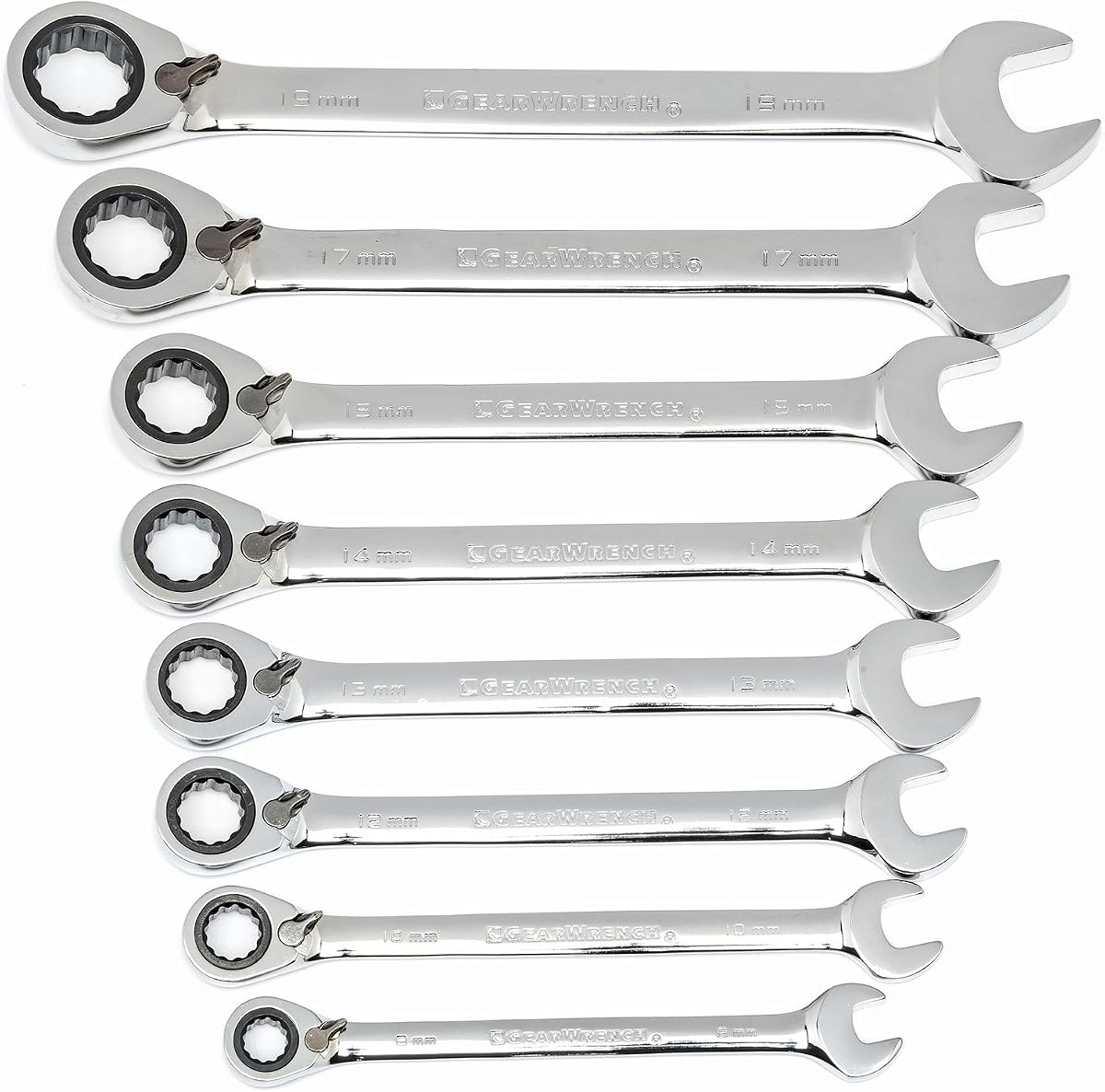
The GEARWRENCH 9543 is an eight-piece metric combination set with a 72-tooth ratcheting box end. Its 4.7 rating places it among the stronger-rated products in this guide, and its listed five-degree movement arc, 15-degree offset, flush-mounted reversing lever, and off-corner loading design all target professional repetitive repair work.
We may earn a commission when you buy through this link, at no additional cost to you.
The compact eight-piece format makes the set easier to transport than a large 14- or 16-piece assortment while still providing dedicated combination wrenches. The ratcheting arc is listed as substantially shorter than the 30-degree movement of a standard box end, which can be useful when a handle cannot swing freely. The offset adds working clearance, and the low-profile reversing lever keeps the control close to the tool.
The supplied data does not list the eight metric sizes, so buyers must check the current size chart and confirm that it covers their most common hardware. Because the set is metric-only, it will not replace an SAE assortment. The 72-tooth design also gives a slightly longer movement arc than the 90-tooth GEARWRENCH 86658, a difference that matters most in especially restricted spaces.
This is a balanced metric option for technicians who want individual combination wrenches without carrying a large full-set arrangement. It is suited to general automotive, equipment, and workshop maintenance, especially where the 15-degree offset and compact reversing control are useful. Buyers focused on maximum tightness should consider the 90-tooth option, while those wanting a broader range should examine the 14- and 16-piece sets.
The set applies a 15-degree offset, off-corner loading, and a flush lever to a relatively compact assortment. These features make it more suitable for regular service work than a basic reversible box wrench.
A five-degree ratcheting arc is short enough to help in many awkward positions, even though it is longer than the four-degree arc of the 90-tooth SAE set. The improvement over a standard thirty-degree box-end stroke remains meaningful during repetitive work.
We may earn a commission when you buy through this link, at no additional cost to you.
The most useful set depends on fastener standards, available space, working clearance, and how often the tools will be carried. Comparing tooth count and offset is important, but size coverage, organization, markings, and serviceability should also influence the final choice.
Metric and SAE fasteners are not interchangeable, and the most common purchasing mistake is selecting a set by piece count without checking its measurement standard. The featured options include SAE-only, metric-only, and mixed systems. SAE sets use fractional-inch sizes, while metric sets use millimeter markings. The mixed DISEN set includes both, but it provides fewer sizes in each system than a dedicated set.
Identify the hardware you encounter most often before choosing. American-pattern vehicles, many tools, and older domestic equipment often call for SAE sizes, while imported machinery, motorcycles, and newer compact equipment may rely on metric hardware. A comprehensive workshop may eventually need both standards, but two focused sets can still be more useful than one oversized mixed set with gaps in the sizes used daily.
More teeth generally mean a shorter arc between successive ratcheting strokes, which is valuable when a fastener is surrounded by pipes, body panels, or structural members. The listed comparisons range from a 4-degree arc for the 90-tooth GEARWRENCH set to a 30-degree re-engagement movement for the DISEN set's 12-point design. Tooth count alone is not the only consideration, but it gives a useful indication of access efficiency.
Choose a high-tooth mechanism for engines, wheel assemblies, frames, and confined machinery. A 72-tooth design can still be highly effective and may offer a more balanced construction for general work. Buyers should also consider whether reversing controls remain easy to reach when the wrench is positioned at an angle.
Offset box ends move the wrench handle away from the fastener and the user's knuckles. A 15-degree offset, as offered by the TEKTON, Jaeger, and GEARWRENCH sets, can create useful clearance in normal service work. The DISEN set uses a 25-degree double offset for more pronounced repositioning, while the Klein set emphasizes a pass-through design for longer protruding fasteners.
The best angle depends on the working environment. A modest offset supports balanced handling, while a larger double offset can help when the fastener sits close to a wall or another component. Check that the offset does not force an awkward wrist position. Clearance is valuable only when the wrench can still be held comfortably and controlled through the tightening stroke.
Individual wrenches make size selection quick and reduce the chance of choosing the wrong end, but they occupy more space. Multi-size tools consolidate two or four sizes into each wrench, which is ideal for mobile kits, emergency bags, and tightly packed toolboxes. The Klein, Der Erwachte, and three-piece set in this guide use the compact approach, while the ironcube, Jaeger, and GEARWRENCH sets provide one wrench per size.
Consider how quickly the tool must be selected during a repair. A one-size-per-wrench layout is often easier to use under time pressure, while a multi-size design offers excellent portability. Whichever format you choose, inspect the printed or stamped markings in adequate light. Clear, permanent identification is a small feature that can prevent repeated searching and incorrect selection.
Several sets specify chrome vanadium steel, including the ironcube, Der Erwachte, and three-piece metric set. Other options identify forged steel or describe specialized finishes without providing the same material detail. Chrome vanadium is a common wrench material because it balances strength, toughness, and manufacturability, although the final tool also depends on heat treatment, machining, and ratcheting components.
Surface finish affects long-term appearance and resistance to dirt and corrosion. The ironcube uses a black matte finish, DISEN uses black electrophoresis, TEKTON uses an abrasive-blasted surface with trivalent-chrome plating, and the Der Erwachte set uses a polished anti-corrosion finish. Choose a finish that suits storage conditions, and wipe tools dry after use to slow surface deterioration.
Storage can determine whether a good set remains usable. The ironcube set includes a wax canvas pouch, the Jaeger set uses a lock-in rack, and the TEKTON package includes modular organizers plus labels. The Der Erwachte set also includes a portable pouch. These features help prevent missing a size, reduce selection time, and make the set easier to move between locations.
A rack is valuable for a fixed workstation, while a pouch is often better for mobile work. Modular storage can accommodate future expansion but may require more room than a simple tray. Compare the included storage with the space available in your toolbox, wall rack, vehicle bag, or drawer before deciding that a particular set is the better fit.
A reversible ratchet is useful only if the box end engages the fastener securely. Many products use 12-point geometry, and some add off-corner loading intended to reduce rounding. These features can be valuable on damaged, plated, or previously marked fasteners. The Jaeger set additionally allows its reversible box end to tilt, while the Klein and Der Erwachte sets consolidate several sizes on each head.
Before purchasing, verify the listed size range and the way paired sizes are arranged. A multi-size wrench may fit the fastener but still require more care in selecting the correct end. For demanding work, confirm the product's stated application, material, and warranty terms, and avoid using any wrench beyond the capacity appropriate for its size and construction.
Select the wrench size that matches the fastener and confirm that the correct end of a multi-size tool is engaged. Seat the ratcheting box end fully before applying torque. Move the handle in the permitted direction, then reverse the drive switch only when needed; reversing is normally unnecessary because the ratcheting action can drive the handle back over the fastener.
Use the offset and pass-through geometry to improve hand clearance, but keep the wrench aligned with the fastener and avoid striking the tool. Do not use a ratcheting wrench as a pry bar, hammer, or breaker. If a fastener is seized, diagnose the cause and use the appropriate removal method instead of forcing the wrench beyond its intended purpose.
After use, wipe oil, dirt, and moisture from the wrenches, especially the ratcheting head and reversing mechanism. Keep the tools dry, lightly oil moving components when appropriate, and store them in their pouch, rack, or organizer. Periodically check that the size markings remain legible and that each wrench operates smoothly without binding or excessive play.
A reversible ratcheting wrench can tighten or loosen a fastener without removing the tool after every stroke. The ratcheting mechanism lets the user move the handle through a short arc and then reposition it without lifting the wrench off the fastener. This is especially useful in confined areas where a full handle swing is difficult. A direction switch also allows both tightening and loosening with the same tool.
A higher tooth count usually means less movement is needed between strokes, which can improve access in tight spaces. However, tooth count is only one part of overall performance. Offset geometry, box-end fit, reversing control, strength, and build quality also influence how a wrench feels and works. A well-designed 72-tooth wrench may be more suitable for general use than an otherwise compromised high-tooth option.
They are available in SAE, metric, and mixed configurations, but a wrench can only fit the size and system it was designed for. SAE tools use fractional-inch markings, while metric tools use millimeter markings. The ironcube, Jaeger, TEKTON, and three-piece metric options are metric-only, the Klein, GEARWRENCH SAE, and Der Erwachte options are SAE-focused, and DISEN includes both systems.
They require the user to identify the correct end of the tool and orient it properly, which can take a little more thought than grabbing a dedicated size. In return, they can cover several common sizes while taking up less toolbox space. They are especially convenient for mobile repair, emergency kits, and users who want broad coverage without carrying many individual handles.
An offset box end places the handle at an angle to the fastener rather than directly in line with it. This can improve finger clearance, reduce the need to reposition the wrench, and make the handle less likely to contact nearby components. The sets in this guide use offsets ranging from 15 to 25 degrees, and Klein's pass-through design provides added clearance for protruding threaded fasteners.
No. A reversible set may use only box ends, while a traditional combination wrench includes a box end and an open end. Open ends remain useful for certain quick adjustments and familiar fasteners, while dedicated combination wrenches can offer a different feel and faster size selection. Many technicians keep a reversible set alongside a conventional combination assortment for that reason.
Wipe away moisture, oil, and road salt after use, then store the tools in a dry environment. A light film of appropriate oil on the ratcheting components can help protect internal surfaces, but excess oil may attract dust. Do not leave damp tools inside a closed pouch, and follow any manufacturer-specific cleaning and storage instructions included with the product.
Choose a conventional set when fast size selection, broad dedicated coverage, and the availability of open ends are priorities. Choose a multi-size reversible set when portability, low tool count, and access around obstructions matter most. Technicians often compare the two approaches by considering their most frequently used sizes, the amount of available storage, and whether they work in SAE, metric, or both systems.
The GEARWRENCH 10-piece 90T SAE set is the strongest all-around choice when minimal swing, a 15-degree offset, and fastener protection are the priority. The TEKTON 14-piece metric set stands out for complete 6- through 19-millimeter coverage, polished finishing, and a flexible modular organizer system, while the Der Erwachte two-piece set offers the most compact way to carry eight common SAE sizes.
Whichever option you choose, prioritize the measurement system and fastener sizes you use most often, then consider offset, tooth count, and reversing accessibility. A very compact set is valuable for mobile work, a conventional individual-wrench assortment is easier to navigate in a busy shop, and a mixed configuration can be useful when one project regularly combines inch and metric hardware.
Product listings and prices can change, and the information in this guide reflects the supplied product data rather than a personal test session. Before ordering, verify the current size chart, exact set contents, material details, warranty terms, and seller information. Checking those details will help ensure that the selected reversible ratcheting wrench set matches both your fasteners and your working environment.