
GOSKY Spotting Scope Phone Adapter
4.0Editor score
Simple three-step setup
Eyepieces from 28–47 millimeters
Zinc alloy and plastic build
Works with most smartphones
A spotting scope phone adapter connects a smartphone to the eyepiece of a spotting scope, telescope, monocular, binocular, or microscope. The best models provide accurate camera alignment, dependable phone support, broad eyepiece compatibility, and enough adjustment to reduce dark edges while preserving a stable view.
This guide compares ten adapters based on the supplied specifications, including supported phone widths, eyepiece diameters, adjustment mechanisms, construction, mounting methods, remote-control features, and intended optical equipment. The list covers universal clamps, three-axis mounts, magnetic systems, and a model designed for selected premium spotting scopes.
Each review explains the strongest reasons to consider a particular adapter while noting meaningful limitations. The top picks highlight a general-purpose Celestron mount, a budget-friendly GOSKY option, and a specialized OLLIN system. Product availability, configurations, ratings, and prices can change, so confirm current details before purchasing.
4.0Editor score

4.2Editor score

4.8Editor score
As an Amazon Associate we earn from qualifying purchases.
The comparison covers alignment systems, supported eyepiece and phone sizes, mounting styles, construction, and field-oriented features. It is designed to help narrow the field before checking the latest listing details and fit.




The tridaptor Universal Phone Scope Digiscoping Adapter is a rigid, fully adjustable mount designed to connect compatible smartphones to spotting scopes, telescopes, monoculars, binoculars, and microscopes. Its 4.4 rating reflects a strong balance of construction, flexibility, and useful field features, with the three-axis adjustment system standing out as the central advantage.
We may earn a commission when you buy through this link, at no additional cost to you.
The X-, Y-, and Z-axis controls let a user align the phone camera horizontally, vertically, and in relation to eye relief. That third-axis movement is especially useful for reducing vignetting or dark edges around captured images. An all-metal body helps resist flexing, while rubber pads protect both the phone and eyepiece. The included Bluetooth remote also reduces shake by allowing shutter activation without touching the phone.
Compatibility is broad but not unlimited. The listed phone range is 60–87.5 millimeters wide, and the eyepiece range is 22–61 millimeters in outer diameter. The manufacturer notes compatibility with many eyepieces from Vortex, Swarovski, Celestron, Nikon, Zeiss, Kowa, and Leupold, but also warns that shorter eyepiece models may not work. Buyers should therefore measure before ordering.
This is a strong choice for a serious birdwatcher, amateur astronomer, or nature observer who wants precise control without relying on a fixed-position magnetic mount. It is less suitable for someone with a very narrow or unusually wide phone, or for an eyepiece outside the stated dimensions. For users within those parameters, the adjustment range and stable metal platform make it one of the most versatile options in this guide.
Independent movement along three axes makes it easier to place the camera directly over the eyepiece and find proper eye relief. That control is valuable when a fixed clip leaves the phone slightly tilted or produces dark borders around the frame.
The aluminum construction is intended to limit flex and sagging, while rubber contact points help prevent scratches. A rigid platform is especially helpful for long wildlife sessions, astronomy sessions, and magnified microscope views.
We may earn a commission when you buy through this link, at no additional cost to you.
The tridaptor Universal Digiscoping Adapter offers a three-axis metal mounting platform for smartphones and a wide range of optical devices. Its 4.2 rating places it among the stronger choices in the guide, particularly for users who value alignment control and a rigid frame over the fastest possible installation.
We may earn a commission when you buy through this link, at no additional cost to you.
Adjustment across three axes allows the phone camera to be centered over the eyepiece more precisely. Forward and backward movement helps establish the correct distance and eye relief, which can reduce dark edges and vignetting. The rigid aluminum construction is designed to keep the phone level, and rubber pads help protect the phone and optic from scratches during repeated use.
The adapter supports phones approximately 60–87.5 millimeters wide and eyepieces measuring 22–61 millimeters across the outside. It can be used with most spotting scopes, telescopes, monoculars, and microscopes. As with other universal mounts, the listed range does not guarantee that every eyepiece shape will work, so checking the maximum eyepiece diameter is important.
This model suits observers who already own a compatible phone and optical equipment but want a stable, reusable adapter that is not tied to a particular device. It may be less compelling for buyers seeking a lightweight, tool-free travel setup, since the metal construction and multiple adjustment controls add complexity. Within its stated dimensions, however, it provides a practical balance of rigidity and precise positioning.
The mounting platform is not limited to spotting scopes. Its stated compatibility extends to telescopes, monoculars, and microscopes, giving users with different instruments a single adapter that can serve several image-recording needs.
Moving the phone along the optical axis makes it easier to reach proper eye relief. This is important because even a small separation error can create a dark circle, blurred edge, or incomplete circular image.
We may earn a commission when you buy through this link, at no additional cost to you.
The GOSKY Spotting Scope Phone Adapter is a practical, uncomplicated option for connecting a smartphone to an optical eyepiece. Its 4.0 rating and simple three-step process make it appealing to beginners who want to capture birds, wildlife, distant scenes, or microscope images without learning a complex mounting system.
We may earn a commission when you buy through this link, at no additional cost to you.
The adapter's main body uses zinc alloy, while the phone clip uses high-strength PA plastic. This combination provides a durable structure for field use without requiring the entire mount to be metal. Its grooved metal housing is designed to grip the eyepiece, and the phone clamp is tightened with a knob after the camera has been aligned.
Its eyepiece compatibility runs from 28 to 47 millimeters in diameter, which covers many ordinary eyepieces but is less generous than several three-axis or magnetic products in the guide. The listed smartphone range of 54–90 millimeters is broad and includes numerous iPhone, Samsung, and other Android models. The mount should still be checked against the dimensions of the specific device.
Choose the GOSKY if straightforward operation and a compact general-purpose adapter matter more than sophisticated alignment. Users with very large or unusually small eyepieces should verify fit first. For compatible equipment, its easy setup, durable body, and broad phone support make it a sensible entry point into digiscoping.
The process is straightforward: place the phone in the clip, align the camera with the eyepiece, and tighten the knob. That limited adjustment process avoids counterweights and multi-axis calibration.
A zinc alloy housing provides rigidity where it is most useful, while the PA plastic phone clip keeps the weight manageable. Rubber or grooved contact areas help secure the setup during outdoor use.
We may earn a commission when you buy through this link, at no additional cost to you.
The CELTICBIRD Precision Metal Telescope Phone Mount is a universal adapter centered on easier camera alignment and adjustable distance. Its 3.8 rating places it behind the higher-scoring options, but its practical scale design and wide stated compatibility make it worth considering for users with varied optics.
We may earn a commission when you buy through this link, at no additional cost to you.
The highlighted feature is an adjustable distance between the eyepiece and phone lens. Changing that spacing helps position the camera more effectively and can improve the clarity of the captured image. A centering-oriented design also simplifies the initial setup compared with an entirely fixed clip, while the aluminum body and high-strength plastic clamp provide a solid combination for field use.
The eyepiece range is 34–62 millimeters in outer diameter, and the phone clamp supports widths from 54–90 millimeters. The product is listed for binoculars, monoculars, telescopes, spotting scopes, and microscopes. Although the broad dimensions suggest good coverage, exact fit still depends on the shape and dimensions of the eyepiece.
This adapter makes sense for users who want more camera-spacing control than a basic knob-mounted model without carrying a full three-axis mechanism. Its lower rating and lack of a specified remote control are drawbacks for buyers who prioritize wireless shutter activation. For compatible eyepieces and phones, though, the adjustable spacing is a meaningful advantage.
The phone and eyepiece are not locked at a single fixed separation. Adjusting that distance gives users another way to improve framing and reduce the chance of an incomplete or darkened image.
Compatibility with binoculars, monoculars, telescopes, spotting scopes, and microscopes makes this a useful shared accessory for observers who switch between different optical equipment.
We may earn a commission when you buy through this link, at no additional cost to you.
The Magsafe Digiscoping Adapter is a machined magnetic mount designed primarily for recent iPhone models and MagSafe-compatible cases. Its 3.7 rating is the second-lowest in the guide, but the strong magnetic connection, wide eyepiece range, and durable 6061-T6 aluminum construction give it a clear specialized purpose.
We may earn a commission when you buy through this link, at no additional cost to you.
The adapter offers movement up and down and forward and backward, allowing the camera to be aligned with the eyepiece and brought to the appropriate eye relief. Built-in N52 neodymium magnet rings secure the phone to the mount, reducing the need for a conventional clamp. The aluminum body is anodized, beveled, and specified at 123 grams, combining substantial construction with a manageable field weight.
It supports eyepieces measuring 28–64 millimeters in outer diameter and works with telescopes, spotting scopes, monoculars, binoculars, and microscopes. Compatible iPhone 12 through 17 Pro Max models and MagSafe cases can attach directly. Older iPhones and Android devices can use the included metal ring, which must be allowed to set for 24 hours before mounting.
This is a compelling option for an iPhone user who prioritizes rapid magnetic attachment and a compact, robust design. It is less suitable if MagSafe charging is required, and users with a different phone ecosystem may find the added ring step less convenient. Buyers should also measure microscope eyepieces carefully, as the manufacturer specifically recommends doing so.
The magnetic interface allows a compatible phone to be added or removed quickly. That convenience is useful when switching between casual viewing and a planned digiscoping session without repeatedly operating a mechanical clamp.
The 6061-T6 aluminum block is precision machined and anodized for durability, while beveled edges are intended to reduce snagging. Its stated weight remains portable for a scope, binocular case, or hiking pack.
We may earn a commission when you buy through this link, at no additional cost to you.
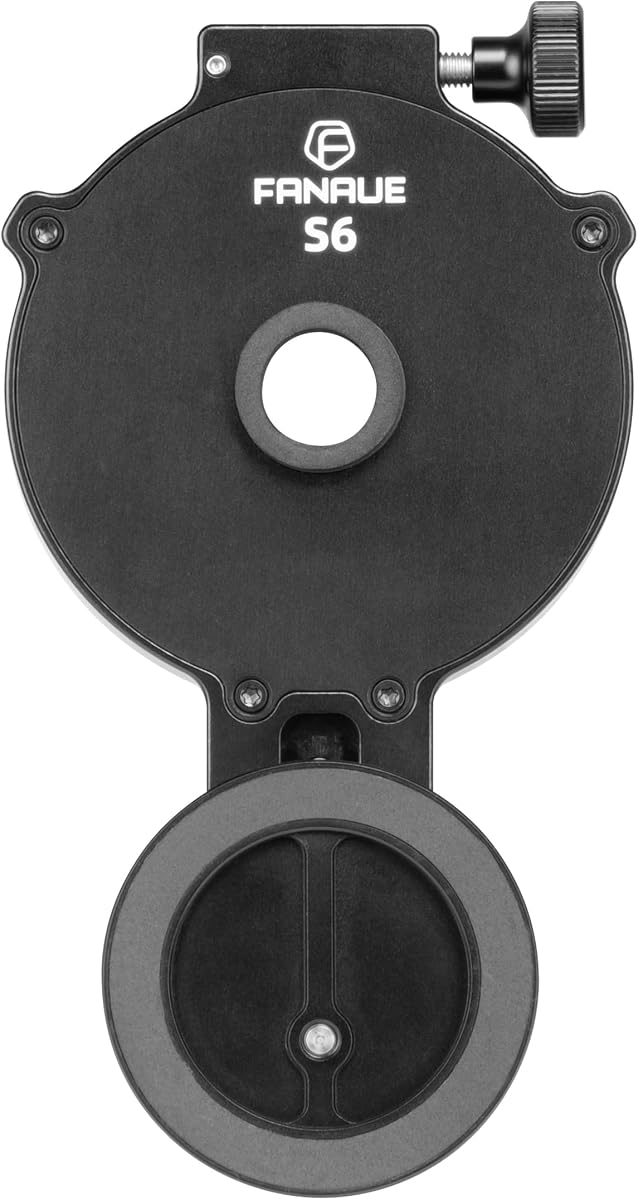
The FANAUE Telescope Phone Adapter combines magnetic phone attachment with an adjustable rotating mechanism. Its 4.0 rating reflects a solid general-purpose design for wildlife photography, birdwatching, stargazing, and microscopy, with portability and quick setup as its main strengths.
We may earn a commission when you buy through this link, at no additional cost to you.
A user places the phone in the adapter, centers the camera over the eyepiece, and uses the knobs to secure the device. The rotating mechanism allows the viewing angle to be adjusted after attachment, while the magnets help maintain a stable connection. The frame is made from machined aluminum, giving the mount a solid structure without relying entirely on plastic components.
The listed eyepiece range is 30–60 millimeters, covering many standard spotting scopes, monoculars, binoculars, and astronomical telescopes. Most smartphones are supported, though the product does not provide a specific width range in the supplied information. The manufacturer recommends measuring a microscope eyepiece before ordering because specialized instruments may present fit differences.
Choose this adapter if quick magnetic mounting, portability, and rotational flexibility are priorities. It may be less attractive than a three-axis model for users who need very fine control of camera position and eye relief. For most standard applications, however, the FANAUE offers a straightforward way to record magnified views with a broad range of phones and optical equipment.
The rotating platform changes the angle of the mounted phone, which can make it easier to compose a horizontal scene, portrait image, or vertically oriented video without changing the eyepiece position.
The lightweight aluminum frame is described as portable enough to carry on hikes and field sessions. That makes it easier to keep an adapter available when wildlife or celestial subjects may appear unexpectedly.
We may earn a commission when you buy through this link, at no additional cost to you.
The New Universal Binocular Phone Adapter is a tool-free, lightweight mount designed for quick field use. Its 3.5 rating is the lowest listed here, and its single-window design has a clear limitation, but the 360-degree rotation and dual-lock mechanism still make it worth considering for portable digiscoping.
We may earn a commission when you buy through this link, at no additional cost to you.
A wide clamp accommodates many iPhone, Samsung, and Android phones, including many slim-to-medium cases. The phone can slide along the rail until the main wide camera is centered over the eyepiece, while smooth 360-degree rotation permits different shooting orientations. A dual-lock system secures the phone and eyepiece, and non-slip rubber pads add protection and grip.
The eyepiece compatibility range of 16–50 millimeters is among the broadest in the guide and includes scopes, telescopes, binoculars, and microscopes. However, the adapter uses a single alignment window. On multi-camera phones, the main wide lens can be centered, but ultra-wide and telephoto secondary lenses will not align through that same opening.
This product is best for users who value portability, quick installation, and freedom of rotation more than sophisticated three-axis control. It is less suitable for someone who expects every rear camera to work or wants precise forward-and-back eye-relief adjustment. For compatible devices, its no-tool design and broad eyepiece range remain useful advantages.
The quick-release design requires no screws or separate counterweight assembly. Users can attach the adapter to a compatible eyepiece and position the phone with minimal setup, which is useful when the scene does not wait.
The alignment window is optimized for a phone's main wide camera. Secondary ultra-wide and telephoto lenses will not line up with the eyepiece, so users should select the main camera in the phone's camera application.
We may earn a commission when you buy through this link, at no additional cost to you.
The OLLIN Snapshot Spotter Adapter is a specialized digiscoping system for users of selected Athron, Argos, Leupold, and Swarovski scopes. It carries the highest rating in this guide at 4.8 and offers a different approach from universal clamps: the eyepiece adapter uses magnetic technology to connect to a separately sold Snapcase.
We may earn a commission when you buy through this link, at no additional cost to you.
The low-profile compression fit is designed to remain on the spotting scope eyepiece while still allowing normal viewing. Its purpose-built magnetic connection is intended to reduce missed shots associated with alignment and complex mounting. A protective cap helps keep the spotter clean outdoors, while an adjustable tether keeps the cap attached to the scope during extended observations.
This is a premium, model-specific option rather than a universal adapter. Size 01 compatibility is listed for the Athlon Ares G2 UHD 20-60X85, Argos HD 20-60×85, Leupold SX2 Alpine HD, and Swarovski ATX/STX and ATC/STC models. The separate Snapcase requirement also means this listing is not a complete standalone solution for every buyer.
Choose the OLLIN if you own one of the specified scopes and value a purpose-built magnetic workflow over universal compatibility. It is a poor fit for a mixed collection of eyepieces, microscope use, or a simple spot-and-clamp setup. For owners of compatible premium scopes, the field-ready fit, high rating, and streamlined connection make it a distinctive choice.
The adapter is engineered around specific spotting-scope models rather than a generic size range. That focused design can make attachment and field readiness more cohesive for owners of a listed scope.
The low-profile eyepiece profile allows the adapter to remain installed while the scope is used normally. A protective cap and adjustable tether help protect the connection from dirt and prevent the cap from being lost.
We may earn a commission when you buy through this link, at no additional cost to you.
The Celestron NexYZ 3-Axis Phone Adapter is a well-rounded precision mount for telescopes, spotting scopes, binoculars, monoculars, and microscopes. Its 4.2 rating, three-axis control, broad phone support, two-year US warranty, and included microscope adapters make it a strong all-around recommendation.
We may earn a commission when you buy through this link, at no additional cost to you.
The patented X-, Y-, and Z-axis controls center the phone camera and adjust its relationship to the eyepiece. Z-axis movement is particularly important for reaching proper eye relief and obtaining a well-framed image. A spring-loaded slider makes phone changes convenient, while a durable metal frame and polymer body balance rigidity with portability.
The NexYZ supports almost any eyepiece from 35–60 millimeters in diameter and works with common 1.25-inch and 2-inch telescope eyepieces. Two microscope adapters are included, adding versatility beyond astronomy and birding. It also fits a wide range of iPhone, Samsung Galaxy, and Google Pixel models, generally even when most cases are installed.
This is an excellent choice for a user who wants fine alignment without a specialized magnetic case or a scope-specific system. The 35–60 millimeter eyepiece range is less expansive than that of several universal competitors, and the metal-and-polymer frame is bulkier than ultra-light plastic designs. For compatible equipment, however, its adjustment, support, warranty, and versatility make it a particularly complete package.
Three independent adjustments make the NexYZ easier to align than a basic fixed clip. Users can center the camera, fine-tune the angle, and establish the right spacing to the eyepiece.
The spring-loaded slider allows the phone to be inserted or removed without repeatedly loosening a fixed clamp. That makes the adapter more convenient for sharing a telescope or spotting scope between users.
We may earn a commission when you buy through this link, at no additional cost to you.
The APEXEL 360° Universal Digiscoping Phone Adapter is an unusually light, screw-free design that includes a Bluetooth remote. Its 5.0 rating is the highest numerical rating in the supplied product data, and its emphasis on quick installation makes it appealing for casual birders, families, hikers, and backyard astronomers.
We may earn a commission when you buy through this link, at no additional cost to you.
The adapter snaps onto a compatible eyepiece and is designed to be ready in about ten seconds. A 360-degree rotation collar allows users to move between landscape and portrait framing without removing the phone. At approximately 0.22 pounds, it is substantially lighter than a bulky all-metal unit, making it easier to carry during long hikes or birding excursions.
Compatibility covers 23–50 millimeter eyepieces and most iPhone and Android phones. The instructions recommend zooming the phone camera to 2x to reduce black edges, selecting the main rather than ultra-wide lens on applicable iPhone Pro and Samsung S-series devices, and turning off Macro and Auto-Switch modes. Phone optics vary, so some dark corners may remain even after careful alignment.
This adapter is a strong option for anyone who values a quick workflow, a remote shutter, and low carrying weight over three-axis fine adjustment. The 23–50 millimeter eyepiece range excludes larger and smaller optics, and camera-control behavior differs among phone brands. For compatible devices, its simplicity, rating, and remote make it one of the most approachable choices.
The included remote separates shutter activation from direct phone contact. That helps prevent movement from tapping the screen, which can be particularly noticeable at high magnification.
The rotating collar changes the phone's orientation while it remains attached. This is useful for switching between wide scenery, vertical video, and different framing preferences in the field.
We may earn a commission when you buy through this link, at no additional cost to you.
The right spotting scope phone adapter depends on optical compatibility, camera placement, and the kind of fieldwork you expect. Measure both devices first, then compare the mounting method, adjustment range, materials, and phone features that matter most to you.
Start with the outside diameter of the eyepiece barrel, not the advertised magnification or nominal eyepiece size. Compatible ranges vary considerably: the APEXEL supports 23–50 millimeters, the GOSKY supports 28–47 millimeters, the tridaptor mounts extend to 22–61 millimeters, and the Magsafe model reaches 28–64 millimeters. A mount that merely falls within the numerical range can still fail if its collar or clamp cannot physically clear the eyepiece or its larger housing.
Phone width matters because an adapter must hold the device without blocking the selected camera. Several models list exact supported widths, while others simply state that most smartphones are compatible. Products that fit the bare device may not also fit a thick case, so the complete assembly should be considered. Camera location is equally important because multi-camera phones have wide, ultra-wide, telephoto, and periscope lenses positioned differently.
Basic knob adapters are sufficient when the phone can sit directly over the eyepiece and the optical view naturally forms a centered circle. Three-axis mounts are more forgiving because they adjust left, right, up, down, and optical-axis distance. Two-direction and rotating magnetic designs provide useful flexibility but may not offer the same fine eye-relief control. Buyers struggling with dark edges or partial frames should prioritize X-, Y-, and Z-axis positioning.
A digiscoping adapter does not contain the viewing optics; it merely positions a phone camera over an existing eyepiece. Most adapters work best with the main wide camera, and some explicitly note that secondary lenses will not align. To reduce dark edges, select the correct lens, turn off automatic camera switching where needed, center the lens carefully, and adjust the phone-to-eyepiece distance rather than relying on digital cropping alone.
A rigid frame is valuable when a long lens magnifies tiny movements. All-metal models, such as the tridaptor and FANAUE options, resist flexing, while mixed-material designs can remain durable with less weight. The GOSKY uses a zinc alloy body with a plastic phone clip, and the APEXEL prioritizes a lightweight ABS construction. Magnification, tripod use, wind, and long observation sessions all increase the value of a secure eyepiece clamp and well-supported phone.
Universal mechanical clamps are broadly reusable across phone brands. Magnetic adapters are exceptionally convenient with compatible iPhones and magnetic cases, but non-MagSafe phones may require an included ring. The Magsafe Digiscoping Adapter allows a ring to be added to iPhone 11 and earlier models and Android devices, with a 24-hour setting period. The OLLIN Snapshot Spotter goes further by requiring a separate Snapcase and fitting specified scope models.
The simplest workflow is place, align, and tighten. The APEXEL emphasizes a screw-free ten-second setup, while the GOSKY uses three straightforward steps. A Bluetooth remote can prevent shake by moving the shutter action away from the phone. Other practical extras include rubber scratch protection, protective caps, included microscope adapters, carrying profiles, and a spring-loaded phone slider that speeds up device changes.
Birding and wildlife observation benefit from stable alignment and rapid phone changes. Astronomy may favor a long-duration mount that can remain attached to an eyepiece. Microscopy requires careful measurement because specialized oculars can vary in diameter. The OLLIN system is tailored to selected scopes, while the Celestron NexYZ supports astronomy, birding, general optics, and microscopy through included adapters.
Before attaching the adapter, measure the eyepiece's outer diameter and the width of your phone with its intended case. Confirm that the phone's selected camera can be centered over the eyepiece. Clean both the adapter and optical lens with a soft, lint-free cloth, and avoid placing fingers on exposed optical surfaces.
Secure the adapter to the eyepiece using the stated eyepiece clamp, compression fit, magnetic interface, or phone rail. Place the phone on the mount, select the main wide camera, and adjust the camera position. If the frame is dark or circular, move the phone along the optical axis, center the lens precisely, and use the recommended camera zoom or disable automatic lens switching where supported.
Support the optic and adapter without applying force to the eyepiece barrel. Use a tripod or another stable platform for long sessions and high magnification, and use the included Bluetooth remote or timer to avoid shaking the phone. After use, disconnect the phone gently, remove the adapter, clean away dirt, and store the components in a dry protective case. Do not leave a magnetic ring adhesive setting prematurely or expose the setup to moisture.
A spotting scope phone adapter is a mount that holds a smartphone over the eyepiece of an optical instrument. It allows the phone camera to capture the magnified view for wildlife, birding, astronomy, distant scenery, or microscopy. The adapter does not provide magnification itself; that comes from the spotting scope or other optical device.
Measure the outside diameter of the eyepiece barrel and compare it with the adapter's supported range. Also consider the shape of the eyepiece housing, not just diameter, because some clamps require extra clearance. A product that lists a compatible diameter can still fail if the eyepiece has a wider shoulder or unusual design.
Most of the universal models support both iPhone and Android devices, often with specific width ranges. The Magsafe Digiscoping Adapter is optimized for magnetic iPhone models and cases, although its included ring can be used with older iPhones and Android devices. Always verify the phone width, case thickness, and camera position before purchasing.
Black edges usually indicate imperfect camera-to-eyepiece alignment, insufficient eye relief, the wrong camera, or a combination of these issues. Center the main wide camera over the eyepiece, adjust the phone distance, and follow the camera-app instructions supplied with the adapter. Some residual dark corners may remain because every phone has a different lens position and field of view.
A remote is helpful but not absolutely required. It reduces shake because the phone is not touched when the shutter is activated. The TRIDAPTOR model with the Bluetooth remote and the APEXEL 360° Universal Adapter include this feature. Alternatively, a timer can provide similar separation between the camera and your hand.
A phone may fit physically while only one rear camera aligns correctly. The 360° Clip Lock Adapter explicitly states that its single alignment window is intended for the main wide camera, while ultra-wide and telephoto lenses will not align. Other universal mounts can also be designed around one camera position, so review the instructions before recording.
Yes, but the eyepiece must fall within the stated diameter range and fit the adapter's physical shape. Most products in this guide support binocular, monocular, telescope, or microscope eyepieces to varying degrees. Measure microscope oculars especially carefully, and check whether an included microscope adapter is needed.
Remove the phone gently, loosen or detach the eyepiece clamp as appropriate, and wipe the mount with a soft, lint-free cloth. Keep dirt and moisture away from moving parts, magnetic surfaces, and optical glass. Store the adapter and phone rail together in a dry case so that small adjustment pieces do not become lost.
The Celestron NexYZ stands out as the most balanced general recommendation, with three-axis alignment, broad phone support, microscope adapters, and a two-year US warranty. The GOSKY is the straightforward budget selection for compatible standard eyepieces, while the OLLIN Snapshot Spotter is the premium choice for owners of its specifically supported scopes and the separate Snapcase.
For every other buyer, prioritize the measurements before features. Confirm the eyepiece diameter, phone width, case clearance, and camera position. Then choose the amount of adjustment you need, whether a rigid metal frame is worthwhile for your typical magnification, and whether quick magnetic attachment or a manual clamp better fits your routine.
Ratings, product configurations, and prices can change, and a successful purchase ultimately depends on compatibility with the exact equipment in your hands. Check the latest listing, measurements, included components, and return terms before ordering, particularly for magnetic rings, separate cases, and model-specific spotting-scope systems.