
8pcs Aluminum Glue Pull Tabs
4.5Editor score
Eight aluminum tab sizes
Works with common PDR tools
Reusable dent pulling design
Suitable for multiple vehicle types
Tape for Removing Dents guide compares ten paintless dent repair kits and pullers, covering suction, glue tabs, leverage, materials, applications, and
Tape for removing dents can refer to adhesive pull tabs, suction-based dent pullers, and larger paintless dent repair systems. A useful product should restore shallow body damage without disturbing factory paint, while matching the size and shape of the dent to the correct pulling method.
We compared all ten products by repair method, included components, material construction, surface limitations, and ease of use. The list covers glue-tab systems, three-piece suction pullers, multi-tool kits, a slide hammer set, a dent lifter with repair tabs, and a specialized decal eraser wheel.
Each pick reveals what it does best, along with practical restrictions that affect the result. Product ratings and configurations can change over time, and prices change frequently, so shoppers should confirm current availability, included accessories, and the latest listing details before buying.
4.5Editor score

5.0Editor score

3.4Editor score
The comparison below organizes each option by its core repair method, included accessories, material, and best use. Although several listings use the broad search phrase tape for removing dents, pull tabs, suction cups, and mechanical levers work through different mechanisms and suit different kinds of shallow damage.
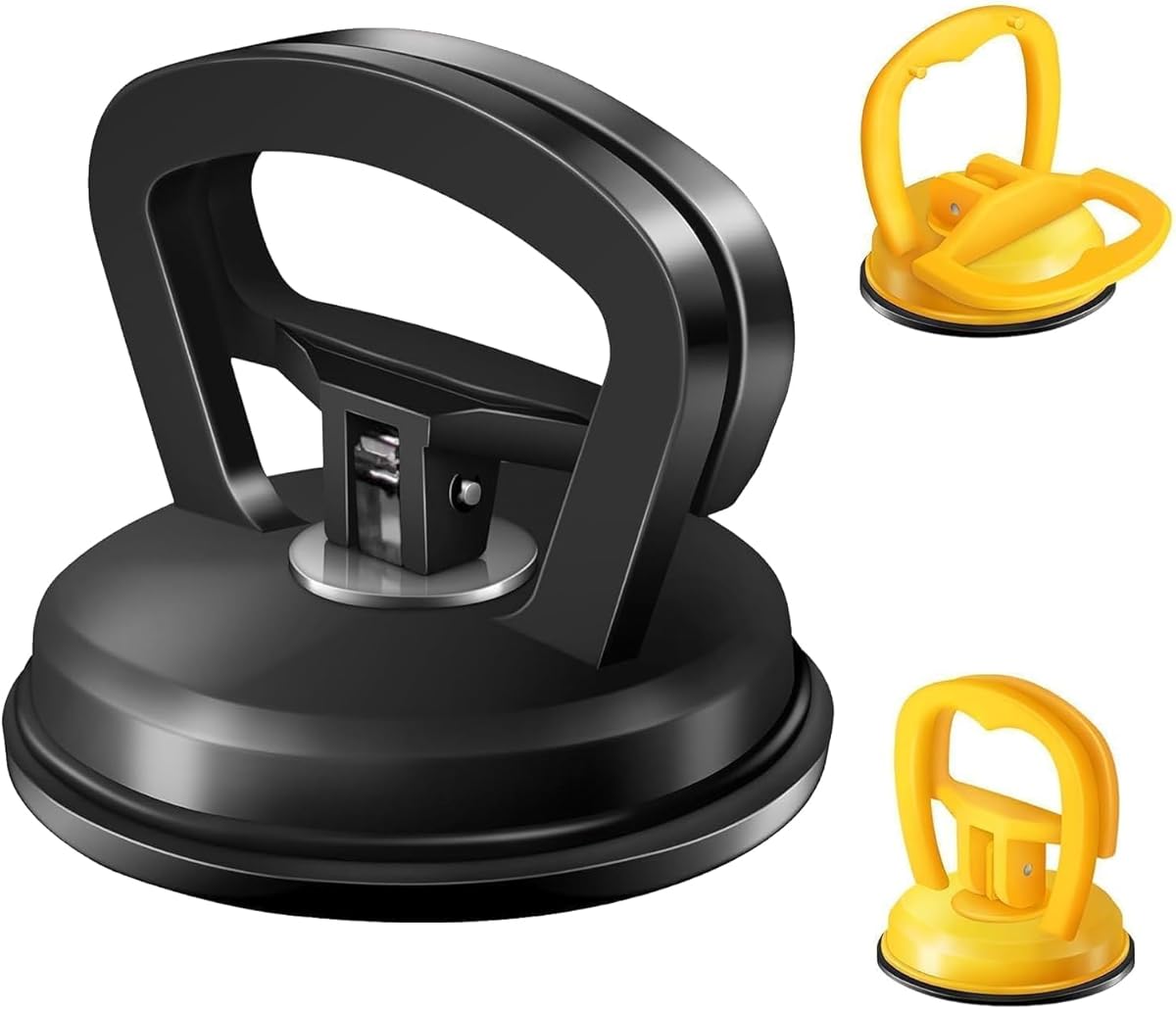


This three-piece handheld puller holds a 4.4 rating and stands out for its straightforward suction-based approach. It includes one large puller and two smaller versions, allowing users to address broad, shallow depressions and tighter areas without assembling a multi-component PDR system.
We may earn a commission when you buy through this link, at no additional cost to you.
The listed construction combines durable natural rubber with a solid metal core, while the spring-lock handle is designed to maintain tension. The large tool is rated by its manufacturer for up to 110 pounds of horizontal suction and 77 pounds of vertical suction, although actual performance depends on surface cleanliness, seal quality, and dent geometry.
Its most attractive benefit is the lack of adhesive. There are no pull tabs to heat, attach, or clean from the paint, making this a convenient choice for quick touch-ups. The tradeoff is that suction works best on relatively broad, shallow damage and clean, smooth, dry surfaces; sharp creases, corners, and deeply pinched metal are poor candidates.
This is our best overall selection because it balances three useful cup sizes, straightforward operation, and versatility beyond automotive work. Choose it for minor parking-lot dings, shallow hail marks, and smooth-panel repairs, particularly if you want a reusable tool without hot glue.
The large cup covers more surface area, while the two smaller cups can reach tighter and more curved sections. Matching the cup diameter to the depression helps create a dependable seal, and the manufacturer recommends ensuring the indentation is larger than the cup.
Because the repair method uses vacuum rather than adhesive tabs, there is no curing cycle or glue residue to remove. Wipe the rubber cup and the panel clean, allow the surface to dry, and the tool can be stored for the next repair.
We may earn a commission when you buy through this link, at no additional cost to you.
The GLISTON 45-piece kit carries a 4.0 rating and offers a more complete paintless dent repair setup than a simple suction tool. It combines a plastic bridge puller, golden dent lifter, five pry tools, a hot glue gun, and ten glue sticks with a varied collection of pull tabs.
We may earn a commission when you buy through this link, at no additional cost to you.
The upgraded lifter adjusts in both height and width, which helps it fit a wider range of dent profiles. Five tab sizes provide 16 stated size combinations, while the arched bridge geometry is designed to reduce the chance of adding damage during a pull.
This is a flexible kit for users who expect to handle different dent sizes rather than one specific type of mark. Its limitations are practical: a glue gun and adhesive tabs are part of the workflow, corners and creases are explicitly unsuitable, and the number of components can feel more involved than a three-piece suction set.
The kit is best for a garage or enthusiast who wants a dedicated glue-based PDR system and has several metal panels to address. It is less appealing for a single tiny ding because the extra tools and preparation may exceed the scope of the repair.
Height and width adjustment allow the bridge to accommodate different panel shapes. This flexibility is useful when a single rigid puller would either miss a shallow depression or concentrate force in the wrong area.
The pullers use padded rubber feet intended to protect original paint. Correct placement still matters, since leverage near a crease or unsupported edge can still create damage or produce an uneven result.
We may earn a commission when you buy through this link, at no additional cost to you.
The Dent Fix DENDF-705D is an offset-style decal eraser wheel with a 4.6 rating. Unlike the other selections, it is a focused accessory rather than a multi-piece dent pulling system, which makes it worth considering for users whose specific concern is lifting old adhesive or decal residue.
We may earn a commission when you buy through this link, at no additional cost to you.
The offset configuration can make the wheel easier to roll while keeping the user's hand away from the working surface. It has a universal fit designation, a package weight of 0.272 kilograms, and package dimensions of 17.272 by 11.938 by 3.81 centimeters.
Because the supplied product information is limited, it would be misleading to claim that it can pull out body dents or include tab adhesive. It should be judged as a specialized surface-cleaning tool, and buyers should verify the wheel's intended use and compatibility before ordering.
This product is best for detailers or body-shop workers who need a dedicated decal eraser alongside larger PDR equipment. It is not the leading choice for someone seeking a complete tape-based or suction-based dent removal solution, but its specialty role and strong rating make it a useful complementary tool.
The offset shape places the rolling surface away from the user's direct hand position. That arrangement can improve control when working across broad decals or adhesive layers.
This wheel is more relevant as a cleanup accessory than as a standalone dent repair solution. Painters and repair technicians may use it alongside broader tools for removing decals and adhesive before refinishing.
We may earn a commission when you buy through this link, at no additional cost to you.
This golden dent puller kit has a 5.0 rating and provides a focused combination of a lever-style puller and 18 pulling tabs. Its arch-shaped body, adjustable height, and rotating knob are designed to adapt the pull angle and force to different dent contours.
We may earn a commission when you buy through this link, at no additional cost to you.
The base is wrapped in soft rubber to protect factory paint, while the reinforced pivot and nonslip handle support controlled leverage. The tabs are made from engineering plastic and can work with the included puller as well as standard T-bars and slide hammers.
Compared with an oversized kit, this set offers a cleaner and more focused selection of essential tools. The trade-off is that a hot glue gun and glue sticks must be supplied separately, and the product should not be used on plastic bumpers or trim.
This is our best premium choice for a serious DIY user who wants precise, controlled pulls on metal body panels. It suits shallow to moderate dents, including hail marks and small impacts, and offers enough tab variety for careful selection without taking on the complexity of a 140-piece system.
The arched bridge provides a stable pulling point while the rotating knob adjusts the tool to the panel. This helps users vary the direction of force rather than relying on one fixed angle for every dent.
Using a tab that follows the dent's contour improves the contact area and gives the puller a cleaner lifting direction. The range of sizes helps accommodate narrow dimples and broader shallow depressions.
We may earn a commission when you buy through this link, at no additional cost to you.
This pack of 10 yellow glue sticks has a 4.4 rating and provides the adhesive needed for tab-based paintless dent repair. Each stick measures 11 millimeters and is described as a standard size suitable for standard hot glue guns.
We may earn a commission when you buy through this link, at no additional cost to you.
The manufacturer identifies yellow glue as having stronger viscosity than typical general-purpose glue sticks, making it intended for relatively harder parts of a car. The listed guidance gives a five-to-eight-minute melt time for a 100-watt glue gun and approximately two minutes of adhesive cooling time as the best working window.
These sticks are an excellent refill for owners of a compatible pull-tab kit, but they do not include tabs, a puller, or a glue gun. The timing guidance also matters because handling adhesive before it has properly bonded can weaken the repair or create a mess.
Buy this product if you already own a PDR kit and want a specialized ten-pack of yellow sticks. It is a supporting supply rather than a stand-alone solution, making it most economical for regular DIY use or for keeping a multi-tool dent repair setup ready.
The sticks are formulated for the kind of firm, temporary bond needed when a tab is used to pull metal. They are better suited to this purpose than assuming that any general-purpose glue stick will offer comparable holding strength.
Allow the adhesive to melt fully, then let it cool for approximately two minutes before attaching the tab. Working within the stated window helps establish a stable bond without prematurely handling a cooling tab.
We may earn a commission when you buy through this link, at no additional cost to you.
The 140-piece paintless dent removal kit has a 3.4 rating, but its accessory breadth is unmatched in this list. It includes a two-in-one slide hammer T-bar, a bridge puller, a dent lifter, three suction cups, a hot-melt glue gun, a rubber hammer, tap-down pen, ten glue sticks, and 100 pull tabs.
We may earn a commission when you buy through this link, at no additional cost to you.
Its T-bar is intended for large dents, the bridge puller addresses medium dents, and the lifter is assigned to smaller dents. A selection of tab sizes and shapes expands the range of contact geometries, while the suction cups offer an alternative method when a panel is clean, flat, and the dent is sufficiently broad.
The lower rating is worth considering, although the supplied information does not specify a particular defect. The kit is also physically complex, and its broad instruction and safety guidance is sensible given the slide hammer, pinch points, hot glue, and numerous accessories involved.
This bundle is best for a serious hobbyist, rental operator, or professional technician who expects repeated use. For a single shallow ding, a smaller kit is easier to learn and store, but for a varied repair workload, having a T-bar, bridge, lifter, suction, and abundant tabs in one package can be advantageous.
The slide hammer supplies a stronger, more direct pulling action, while the bridge and lifter offer more controlled leverage. Matching the tool to the dent's depth and surface contour is essential for avoiding additional distortion.
A comprehensive kit gives users time to select the correct tab, puller, and preparation tools. Its scale is an advantage for frequent work but can feel excessive for a quick, isolated repair.
We may earn a commission when you buy through this link, at no additional cost to you.
The black three-piece suction kit has a 5.0 rating and offers the simplest route into paintless dent repair. It includes a 4.5-inch large puller, two 2.2-inch small pullers, and a compact storage box measuring 4.9 by 4.7 by 4.3 inches.
We may earn a commission when you buy through this link, at no additional cost to you.
Its construction combines an ABS housing, natural rubber pad, and metal core, with a smooth spring-lock handle intended to create consistent tension. The large tool covers broad damage, while the two smaller tools are better suited to tight, curved sections and smaller depressions.
The standout convenience is that no glue, chemicals, or professional skills are required. Users separate the handle, press the cup onto a clean, flat surface, lock the handle, and pull. That makes the kit highly portable, although deep or sharp creases remain outside its stated range.
This is an excellent pick for beginners, roadside users, and anyone who wants a compact repair option with no consumables. It is less suitable than a tab system for deep or irregular damage, but for broad shallow dents, its three cup sizes and simple operation are hard to beat.
The included box keeps the three pullers together and small enough to fit in a vehicle storage area. That makes the set practical for someone who wants immediate access to a basic dent repair option.
The large suction face addresses wider shallow distortions, and the smaller cups reach confined areas. Selecting the smallest practical cup gives the user more control around curved panels and tight body lines.
We may earn a commission when you buy through this link, at no additional cost to you.
This eight-piece aluminum pull tab set has a 4.5 rating and offers a focused upgrade for anyone who already owns a compatible PDR tool. The tabs come in eight sizes so users can match different contact shapes to shallow dents on cars, SUVs, trucks, and four-wheel-drive vehicles.
We may earn a commission when you buy through this link, at no additional cost to you.
The aluminum construction is designed for durability and reuse, while the varied geometry allows tabs to sit more naturally against different dent contours. The set is compatible with most glue puller systems, including slide hammers, dent lifters, and other PDR hand tools.
Its appeal lies in being a compact, specialized accessory rather than a large kit. The limitation is equally clear: no puller, glue gun, or adhesive is mentioned as included, so buyers need compatible equipment and must select an appropriate tab adhesive separately.
This is the best budget option for an existing DIY setup or a technician who wants to add more pull-tab sizes without buying a complete kit. It is not ready for immediate use as a standalone system, but for a compatible tool owner it is a practical and economical way to broaden the repair options.
A tab that follows the shape of a depression can distribute adhesive contact more evenly than a poorly matched tab. The eight sizes make it easier to experiment with different contours before committing to a pull.
The listed aluminum material is intended to resist breakage and support repeated use. Removing adhesive cleanly and inspecting each tab after use helps preserve that durability.
We may earn a commission when you buy through this link, at no additional cost to you.
The Small Paintless Auto Body Puller Kit has a 3.7 rating and emphasizes a streamlined alternative to bulky sets with more than 100 pieces. Its 28-piece configuration includes a T-bar puller, 18 tabs, a small hot-melt glue gun, five glue sticks, plastic shovels, an empty bottle, and a cleaning cloth.
We may earn a commission when you buy through this link, at no additional cost to you.
Its core process is straightforward: clean the dent, melt adhesive onto a tab, attach the tab, wait about two minutes, and pull with the T-bar. The kit is intended for metal surfaces on car doors, refrigerators, motorcycles, and washing machines, giving it broader household utility.
Compared with the 140-piece system, this package is easier to organize and carries a less intimidating number of accessories. Its lower rating and single style of puller mean it may be less flexible for varying dent sizes, and the reliance on adhesive introduces heating, cooling, and residue-removal steps.
This kit is best for a beginner who wants a complete but less overwhelming setup for common shallow dings and hail dents. It is particularly suitable when a T-bar puller is the preferred method and the user values included cleanup supplies over having every conceivable lever tool.
A focused list of 28 components is easier for a new user to understand than a very large assortment. It supports a complete workflow while limiting the number of puller styles that must be learned.
The inclusion of shovels, a bottle, and a cloth supports the full tab-based repair cycle. Alcohol and a suitable scraper are recommended for lifting remaining adhesive without disturbing factory paint.
We may earn a commission when you buy through this link, at no additional cost to you.
The black and orange suction set has a 5.0 rating and combines one large 4.5-inch disc with two smaller 2-inch discs. The large face is intended for broad panel distortions on flat or slightly curved sections, while the small rims provide focused access around handles, mirrors, and character lines.
We may earn a commission when you buy through this link, at no additional cost to you.
Its push-and-pull operation requires no heat, glue, drilling, air compressor, or electrical outlet. A storage bag makes the lightweight set convenient for a vehicle trunk, backpack, or glove compartment, supporting quick use in parking areas or at the roadside.
The soft rubber rims are designed to conform to contours without leaving glue residue or swirl marks. That claim still depends on a clean, dry surface, and the method remains most effective for shallow, broad damage rather than deep creases or sharply pinched edges.
This is a strong pick for travelers, car owners, and detail-oriented users who want a quick, reusable repair option without consumables. Its three-disc format provides more size selection than a single-cup tool, while the bag adds convenient portability.
The two-inch rims can reach small depressions where a larger cup cannot create a full seal. Focused traction is especially useful around narrow gaps and raised body details.
Wiping the rubber edges with a damp cloth after use removes dust and surface debris that could weaken the seal. Keeping the rims flexible and the sealing faces clean helps maintain consistent performance over repeated repairs.
We may earn a commission when you buy through this link, at no additional cost to you.
The most useful dent-removal system depends on the damage, the available tools, and how much control you need. Consider pull method, dent geometry, material compatibility, and cleanup before choosing a kit or individual tape accessory.
Glue-tab systems use an adhesive tab as an intermediary between the puller and the panel. They offer precise control and work well on shallow metal dents, but they require a glue gun, curing time, and careful removal of residue. Suction pullers create a vacuum seal directly against the panel and require no consumables, making them faster for broad, shallow dents that present a flat enough surface.
In short, choose tabs for finer control and suction for quick, adhesive-free repairs.
A tab should fit within the depression without extending too far onto an unsupported edge. A suction cup needs enough contact area to seal, while its diameter should remain smaller than the visible dent. Large cups suit broad distortions, and small cups work better around tight curves, body lines, handles, and character lines.
Select multiple sizes when possible so each repair can use the most appropriate contact area.
Most listed systems target smooth metal surfaces such as car doors, roofs, hoods, motorcycles, and appliance panels. Several explicitly warn against corners, creases, and plastic trim. These limitations matter because leverage can worsen a sharp crease, and adhesive may bond differently to textured plastic or powder-coated surfaces.
Verify that the product is approved for your exact panel material before beginning.
A T-bar or slide hammer can deliver greater force, which may help with stubborn or deeper shallow metal damage, but it also requires more care around pinch points. Lever-style pullers offer more controlled movement, while suction tools are generally best for the lightest applications. Adjustable bridges and rotating mechanisms can help align the pull with the dent's contour.
Prioritize control over maximum force for a first-time repair.
Some kits include a hot glue gun, glue sticks, and pull tabs, while others require separate purchases. Even when a gun is included, buyers should confirm its size and whether suitable PDR adhesive is supplied. Specialized glue sticks may have different melt and cooling behavior from ordinary craft glue, affecting the strength of the temporary bond.
Choose a system with a complete, clearly stated accessory list if you want to begin immediately.
A compact suction set can live in a glove compartment and be deployed without heat or cleanup. Large kits take more space but keep specialized pullers, tabs, and tools together. Portability is valuable for roadside assistance, while organized storage is more useful for a professional workshop or frequent home garage work.
Choose the amount of equipment that matches your repair frequency and available space.
Clean and dry the panel before either suction or adhesive work. For tab systems, protect surrounding paint, allow the adhesive to cool as directed, and pull steadily. After removing a tab, use the recommended alcohol and scraper process to lift residue. A clean surface also helps users judge whether a pull improved the panel.
Preparation improves the seal and reduces the chance of lifting paint unnecessarily.
A complete system may include pry bars, a rubber hammer, tap-down pen, suction cups, glue gun, glue sticks, pull tabs, and multiple pullers. More components are not automatically better, but they can make a kit adaptable to different dent sizes. Focus on whether the supplied tools correspond to the damage you realistically expect to repair.
Buy for actual repair scenarios rather than the largest advertised component count.
Start by identifying the dent and the panel material. Inspect the damage from several angles, clean the surface, and dry it thoroughly. For a suction puller, select a cup smaller than the dent and press it firmly into a flat area within the depression. For a tab system, warm the correct PDR glue in a compatible glue gun and apply a controlled layer to the chosen tab.
Allow tab adhesive to cool and bond before pulling. Follow the product's stated working time, use a tab that matches the dent's contour, and attach the puller according to its instructions. Apply steady, controlled force rather than a sharp sideways movement. A suction puller is worked in short, even attempts, while a T-bar or bridge puller is operated along the intended lift direction.
After a successful pull, stop if the panel is not improving. Remove tabs carefully, lift residual adhesive with the recommended cleaner and a plastic scraper, and wipe the rubber cups clean before storage. Inspect tabs, glue gun components, puller edges, and suction rims for damage, and never use cracked or sharp components.
The best adhesive choice is a PDR pull tab sized to fit inside the dent, paired with a compatible lever, lifter, or slide hammer. The tab should follow the dent's contour and sit on sound paint rather than spanning a crease. Quality dent-specific glue and careful preparation are essential for a strong temporary bond.
A properly sized tab and a controlled pull can remove shallow dents without disturbing original paint. Risk increases when adhesive is too hot, the tab is pulled at the wrong angle, or the tool is used on plastic trim, textured surfaces, sharp creases, and unsupported edges. Work on clean paint and avoid pulling when the panel is not improving.
Suction pullers are cleaner and faster for broad, shallow dents because they require no heat, adhesive, or residue removal. Glue tabs generally provide better control and are more adaptable to different dent contours. The better option depends on the panel shape, depth, and whether the dent provides a large enough area for a clean suction seal.
Most of the listed products are best suited to shallow dents and explicitly caution against corners or creases. A sharp crease is already a permanent change in the metal's shape, and aggressive pulling can stretch it further. Paintless dent repair tools are most effective before a panel has split, cracked, or become severely distorted.
The supplied instructions for the three-piece handheld puller recommend pouring hot water over the dent before placing the suction cup and pulling. This may help relax a shallow depression. Users should avoid an open flame and should not pour very hot water over glass, electronic parts, trim, or painted surfaces that could be damaged.
The listed yellow glue sticks recommend approximately two minutes of cooling as the best working time after melting, with a stated melt time of five to eight minutes for a 100-watt glue gun. Actual behavior depends on the glue, gun, tab, and panel temperature, so users should allow a firm bond without touching the tab.
The product instructions recommend spraying alcohol onto the remaining glue and using a plastic shovel or scraper to lift it. Work gently and avoid dragging hard tools across the paint. If residue persists, consult the adhesive manufacturer's guidance and confirm that the cleaner is suitable for the vehicle's finish before use.
Several listed systems identify refrigerators, motorcycles, and washing machines as suitable metal surfaces. The same basic rules apply: use the tool on a smooth clean panel, select a tab or suction size that matches the depression, and avoid vents, seams, edges, and coated or plastic parts. Appliance panels can be thin, so control is especially important.
The Golden Dent Puller PDR Kit is the strongest all-around choice for controlled tab-based repairs, while the 140-piece system offers the most complete collection of pullers and accessories. For the simplest high-rated suction option, the Black Three-Piece Suction Kit stands out, and the eight-piece aluminum tab set is a cost-conscious upgrade for an existing compatible tool.
Prioritize the repair method that matches the damage rather than choosing by component count. Broad shallow dents favor a large suction cup, smaller or more irregular shallow depressions benefit from correctly sized adhesive tabs, and forceful tools should be reserved for metal panels with sound paint and enough room to pull. Accessories such as a specialized glue gun, tabs, and cleanup tools must match the chosen system.
Before ordering, confirm the latest product configuration, compatibility, included accessories, and current listing details. Ratings, package contents, and prices can change, and an inexpensive but incompatible tool is less useful than a complete setup suited to the panels you actually want to repair.
