
Light Up Bricks Accessories Kits
4.4Editor score
Fourteen illuminated brick styles
Seven assorted light colors
Standard-size block compatibility
LED Light Kit for Legos guide comparing 10 options for brightness, compatibility, power, installation, colors, modes, and display ideas for creative builds.
LED light kits can transform a static brick-built landscape into a detailed display, adding depth to buildings, character to vehicles, and atmosphere to nighttime scenes. A useful kit should combine manageable wiring, dependable power, and lights that fit securely without interrupting the appearance of the model.
The products in this guide were compared using the information provided about their light formats, compatibility, power systems, control options, installation requirements, and intended uses. The list covers dot lights, light bars, classic illuminated bricks, spotlights, multicolor strips, and a purpose-built Power Functions light.
Each review explains the product's strongest benefits, practical limitations, and ideal buyer, helping you choose lighting that fits a particular collection or creative project. Product availability and pricing can change over time, so confirm the current listing details before making a purchase.
4.4Editor score

4.9Editor score

4.7Editor score
The table below compares the ten lighting options by light type, power method, control features, and best-fit applications, making it easier to identify the right kit for a specific brick model or display project.



The JMBricklayer LED Lighting Kit is an eight-cord lighting system designed for buildings, houses, floral displays, and other standard-size brick models. Its 4.3 rating reflects a practical feature-led package, with automatic light sensing standing out from kits that require continuous manual control.
We may earn a commission when you buy through this link, at no additional cost to you.
The kit includes eight LED light cords, one 2-by-6 building brick containing a nine-port hub, a 50-centimeter cable, and a user manual. The ultra-thin 0.38-millimeter wires are intended to disappear within seams, while the hub is shaped like a standard building brick so it can blend into a display. Compatibility with standard-sized bricks and major brick brands also gives it broad appeal.
Two operating modes provide useful flexibility. Always-on mode keeps the display illuminated consistently, while light-sensing mode switches the lights on in darker surroundings and off in brighter environments. That automatic behavior is particularly appealing for a shelf or display cabinet where manually changing the model is inconvenient. The trade-off is that the sensor reduces direct control over exactly when the display activates.
This is a strong choice for builders who want a polished nighttime presentation with minimal daily intervention. It is less suitable for anyone seeking remote color selection, highly visible spot beams, or a large collection of independent illuminated elements. For those priorities, a multicolor or spotlight kit would offer more artistic control.
Light-sensing mode is the kit's defining advantage, allowing the model to respond to ambient conditions. The always-on option remains available when a consistent illuminated look is preferred.
The 0.38-millimeter cords are slim enough to run between pieces or inside walls. Placing the brick-style hub within the structure can reduce the visual impact of the lighting hardware.
We may earn a commission when you buy through this link, at no additional cost to you.
The Light Up Bricks Accessories Kits pack provides 14 classic 2-by-2 LED blocks and carries a 4.4 rating. It is an approachable way to add color to cars, architectural buildings, collections, and other standard-size brick creations without installing a complicated wiring network.
We may earn a commission when you buy through this link, at no additional cost to you.
The assortment includes two red, two yellow, two green, two blue, two white, two alternating red-and-blue, and two multicolored light bricks. That variety makes it possible to suggest traffic signals, illuminated signs, glowing windows, decorative effects, or mixed-color scenes simply by choosing where each brick is placed.
Because the lights function as bricks rather than cables and hubs, installation is one of the easiest in this guide. Builders can swap them into ordinary positions, allowing illuminated pieces to remain integrated with the structure. The listed specifications emphasize smooth surfaces, moderate tightness, and child-friendly ABS plastic, and the product is described as complying with US toy-safety standards and being free of lead, cadmium, and phthalates.
The main limitation is limited control. These illuminated blocks do not offer the sensor, remote, timer, or programmable effects found in more elaborate kits. Even so, the pack provides an inexpensive and colorful way to test the concept, decorate a smaller display, or create a playful gift without assembling a custom electrical system.
Seven lighting styles support basic storytelling, including solid colors and two mixed or changing effects. They are especially useful for signs, vehicles, street details, and festive displays.
Each unit occupies a standard 2-by-2 position, so it can be added wherever an ordinary brick fits. That simplicity makes the pack approachable for new lighting projects.
We may earn a commission when you buy through this link, at no additional cost to you.
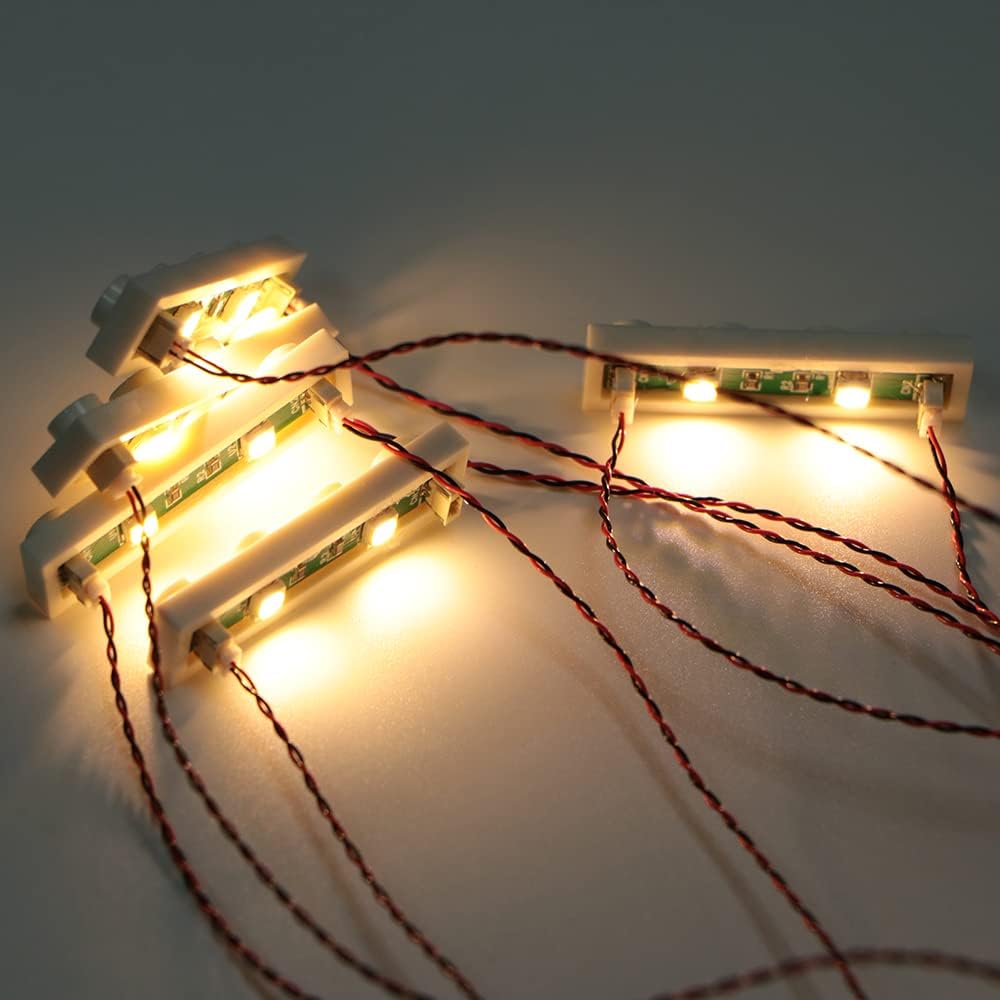
The 20-piece 1-by-4 LED Building Block Lighting Kit is a warm-white system for ceiling, wall, stair, table, balcony, and interior lighting. Its 4.6 rating places it among the strongest general-purpose kits here, particularly for builders seeking a large number of consistently warm light points.
We may earn a commission when you buy through this link, at no additional cost to you.
The package contains 20 individual LED bars, each occupying a 1-by-4 brick space and using two warm-white LEDs, along with 20 wires and three USB power units. Connecting the lights in series allows the total illuminated length to expand or contract according to the model, giving the builder more freedom than a fixed-size light string.
Each lead is approximately 5.9 inches long, while each USB unit is about 20 inches. Installation is based on contact strips at the wire ends connecting with a housing in each brick. The extra-thin wires are designed to be hidden without changing the overall visual appearance, which is valuable for detailed architectural builds and models intended for close viewing.
This kit is best for warm interior ambience rather than colorful effects or focused exterior beams. It requires more deliberate cable routing than illuminated bricks, but the payoff is a much more integrated look. Builders creating a large house, multilevel structure, or illuminated streetscape will likely appreciate the combination of light quantity and flexible series layout.
Because the bars and connectors are supplied individually, the builder can determine the final length. This makes the system practical for both compact rooms and large multi-level displays.
Warm-white illumination works well for interior ceilings, stairs, counters, and balconies. It creates a consistent atmosphere without the visual complexity of multicolored lighting effects.
We may earn a commission when you buy through this link, at no additional cost to you.
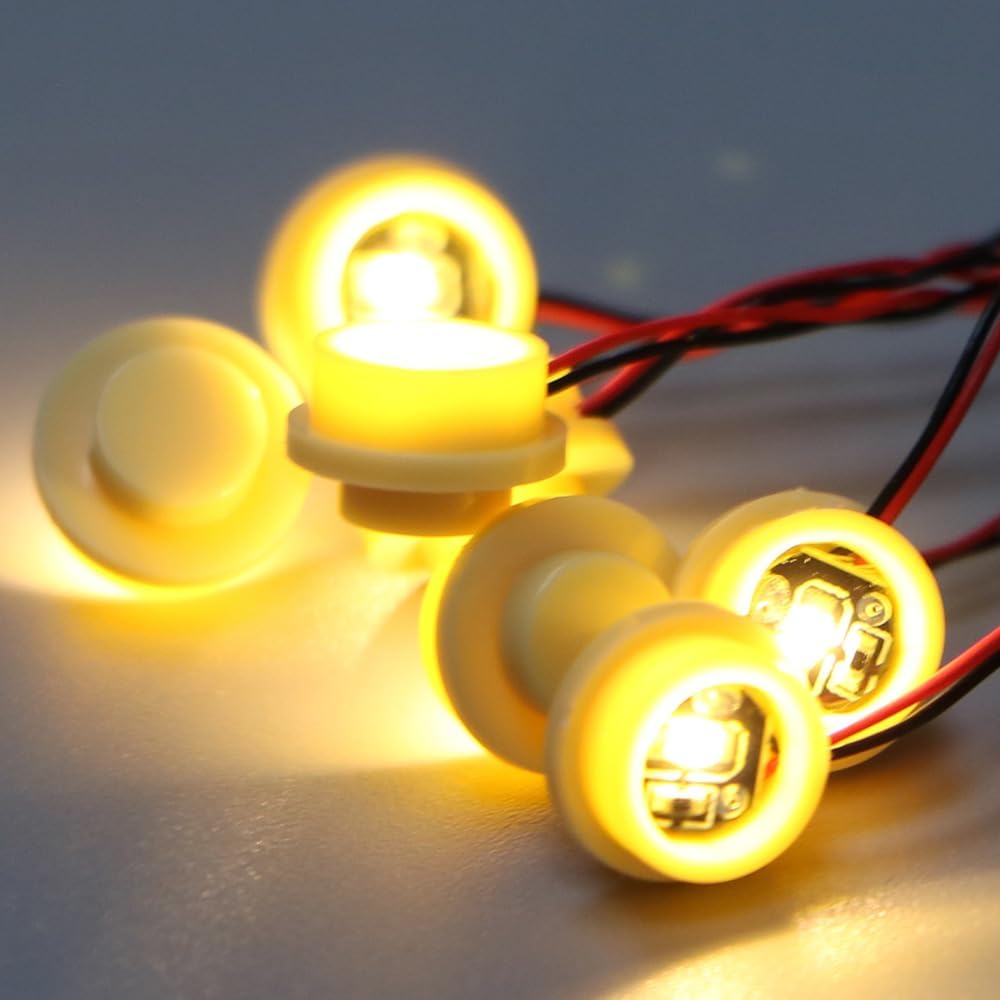
The 14-piece Circular Dot Lighting Kit uses small 1-by-1 warm lights to illuminate cities, houses, and other building-block scenes. Its 4.7 rating reflects a well-rounded feature set, with constant illumination, an intelligent timer, and two practical power options.
We may earn a commission when you buy through this link, at no additional cost to you.
The lights connect through a 0.38-millimeter power cord designed for effective concealment. The kit can draw power from a 5-volt, 2-amp USB plug, a computer USB interface, or the included battery box. The battery box also contains a timer function, allowing the lights to remain on for six hours and switch off for 18 hours.
Dot lights occupy less visual space than larger bars, making them useful for compact buildings, narrow corridors, street details, and display niches. Low-power LEDs provide a softer look intended to reveal models in dark conditions without overwhelming their shape. Compatibility with LEGO and other mainstream brick brands broadens the possible applications.
The most notable caveat is that batteries are not included, so buyers using the battery route must supply compatible cells. The timer follows a fixed six-on, 18-off cycle rather than allowing an arbitrary schedule. Even so, the compact footprint, 4.7 rating, and automatic behavior make this an attractive choice for a display intended to run unattended for part of the day.
The timer mode illuminates the scene for six hours before switching off for 18. This predictable cycle is helpful for showcases where brief nighttime viewing is the goal.
USB power suits permanent displays, while the included battery box offers a simpler alternative for temporary setups. A compatible button cell is required for battery operation.
We may earn a commission when you buy through this link, at no additional cost to you.
The Sawaruita 16-piece light brick set combines five colorful flashing lights with three each of white, yellow, and blue flashing versions. Its 4.4 rating makes it a colorful counterpart to the more technically involved hub-and-wire kits, and it is suited to cities, towns, castles, and larger classic brick collections.
We may earn a commission when you buy through this link, at no additional cost to you.
Each light is built like a standard block, so the lights can be inserted directly into compatible models. Transparent shells allow the LEDs to diffuse visibly through the pieces, helping illuminated windows, signs, and decorative surfaces read clearly from different angles. The product is described as using durable, odorless ABS plastic intended for safe use by children.
A built-in button cell and power switch keep operation self-contained. The stated cell type is LR 41 at 1.5 volts, and replacing the cell allows continued use without replacing the entire set. This approach is convenient for temporary exhibits, gift displays, and models that move around, although there is no USB connection or remote control.
This package prioritizes immediate visual fun over precise control. Individual lights retain their own color or flashing behavior, but they cannot be dimmed or coordinated through a central controller. It is a strong option for adding a playful illuminated look to several locations, particularly for builders who value easy placement and replaceable power.
The assortment includes both steady white and yellow options alongside flashing blue and multicolor versions. This allows a model to mix ordinary illumination with more attention-grabbing animated effects.
The integrated switch and replaceable LR 41 cell remove the need for external wiring. The approach is especially convenient for displays that are moved or powered only occasionally.
We may earn a commission when you buy through this link, at no additional cost to you.
The 20PCS White 1-by-4 Lighting Kit is a complete white-light upgrade for cityscapes, houses, custom creations, and other major building-block brands. Its 4.5 rating reflects a generous package that supplies not only 20 light bars but also the hubs, expansion boards, and cables needed to organize them.
We may earn a commission when you buy through this link, at no additional cost to you.
Two USB hubs, one six-port and one eight-port expansion board, and three 30-centimeter cables are included. Ultra-thin flexible cables are designed to tuck into gaps between pieces, helping preserve the appearance of a finished model. The lights can be positioned around ceilings, walls, stairs, tables, and balconies.
Compatibility with mainstream building-block brands makes the kit suitable for different collections rather than one specific model format. The product information also presents the setup as suitable for different skill levels and highlights multiple colors, lighting modes, and effects, although the listed version is identified as white. Buyers should therefore judge the package based on the white configuration shown.
With 20 units, the system is well suited to a large display that needs distributed illumination rather than a single focal point. Its trade-off is physical complexity: multiple hubs and cables require more planning than self-contained light bricks. The package is best for a builder committed to creating a clean, fully integrated nighttime scene across a substantial model.
Two hubs and two expansion boards provide several connection points for a large installation. The included cables reduce the need to source compatible lengths separately.
Twenty light bars can illuminate several rooms or levels rather than concentrating on one area. Their standard footprint makes them useful for houses, commercial buildings, streets, and other detailed scenes.
We may earn a commission when you buy through this link, at no additional cost to you.
The 10-Pack Mini LED Dot Lights combines a 4.9 rating with a compact, integrated design, making it the strongest all-around recommendation in this guide. The kit is intended for building-block models, MOC projects, buildings, vehicles, and minifigure scenes that benefit from small pools of even light.
We may earn a commission when you buy through this link, at no additional cost to you.
The package contains 10 dot lights, one USB hub, one 30-centimeter extension cable, and two expansion boards. Each compact LED produces soft, even illumination without the harsh glare associated with a concentrated visible light source. Its small size allows it to fit between blocks without protruding from the model or distracting from the original silhouette.
High-grade ABS material is specified for the components, while the hub and expansion boards provide organized control points for the lights. The result is a system that appears purpose-built for builders who value presentation. Lights can define windows, highlight miniature characters, outline vehicles, or create subtle atmosphere in compact buildings.
Ten lights may not be enough for a very large display, and the listed lights are white, so it is less suitable for colorful effects. Even with those limits, the combination of the guide's highest rating, discreet footprint, soft output, and included connection hardware makes this kit the most balanced choice for many individual projects.
The mini dot-light format is designed to integrate into tight spaces. It can highlight small details without adding a conspicuous lamp or bulky cable to the model.
Even light distribution helps reveal edges, windows, and minifigure areas without producing distracting glare. The result can look more integrated than a visible spotlight.
We may earn a commission when you buy through this link, at no additional cost to you.
The 16-Color Building Block Light Kit is built for creative effects rather than subtle static illumination. Its 4.2 rating is the lowest among the ten products, but the kit offers a distinctive combination of ten LED strips, 16 colors, and an infrared remote that many lighting-focused systems do not provide.
We may earn a commission when you buy through this link, at no additional cost to you.
A 15-centimeter terminal connection line and a 50-centimeter USB main control line are included for installation. The supplied 20 building blocks can be mixed into an existing collection, while the strips provide flexible illuminated elements for city or street scenes. Compatibility with LEGO models expands the range of structures that can be customized.
The infrared remote gives the user direct control over lighting patterns and colors without reaching into the model. That makes the system useful for demonstrations, temporary displays, holiday scenes, and projects where changing the visual mood is part of the experience. Sixteen colors also allow coordinated themes rather than tying every scene to a single fixed appearance.
Cable management requires attention because the strips use external terminal wiring. The remote also introduces another control element that must remain accessible after installation. Despite these trade-offs, this is the most flexible choice for builders who prioritize color variety and interactive effects over a completely concealed, fixed lighting system.
Color selection allows the same display to shift between warm, cool, festive, or dramatic presentations. It is particularly valuable for city entertainment districts and seasonal scenes.
The infrared remote lets the builder alter colors and patterns without handling the model. It is convenient for demonstrations and for displays where frequent visual changes are desired.
We may earn a commission when you buy through this link, at no additional cost to you.
The Four-Light Spotlight Kit is designed for large models and exterior illumination, with a listed 160mA output and four lights. Its 4.3 rating reflects a specialized package that offers more dramatic, directed lighting than the low-profile dot systems.
We may earn a commission when you buy through this link, at no additional cost to you.
The set includes contour, search, and environment light options, allowing the builder to create different atmospheric effects. Each spotlight is paired with a 19.7-inch USB cable, and a four-port USB connector supplies power. This arrangement provides enough reach to position lights outside a building or direct them toward a feature of the model.
The slim design is intended to integrate with building-block projects while still producing visible beams. Search lights can emphasize a particular focal point, contour lights can define an edge or architectural outline, and environment lights can spread illumination around an exterior scene. The multiple styles offer more direction than standard ceiling bars.
Only four lights are included, so this kit is less appropriate for filling every room in a large building. Spotlights also need careful placement to avoid harsh hotspots or visible source glare. Even so, it is a compelling choice for dramatic façades, landscape features, cinematic builds, and models that benefit from a visible pool of light.
Contour, search, and environment styles give the builder distinct ways to shape the scene. These options are useful for façades, terrain, entrances, and other exterior features.
A single four-port connector supports the complete set and keeps the power arrangement organized. The long attached cables allow the spotlights to be positioned outside the model.
We may earn a commission when you buy through this link, at no additional cost to you.
LEGO Functions Power Functions Light 8870 is a single, purpose-built lighting accessory rated 4.7 by customers. Rather than supplying a general lighting kit, it focuses on one highly specific job: adding a compact glow to a model that uses the Power Functions system.
We may earn a commission when you buy through this link, at no additional cost to you.
The listed uses include glowing eyes, headlights, and other small details. Its compact format makes it well suited to vehicles, robots, creatures, architectural features, and character models where only a small illuminated element is needed. Because it is designed as a supplement to the Power Functions model collection, it fits naturally into compatible powered creations.
Installation is simple because the builder is adding one standardized component rather than assembling hubs, expansion boards, wires, and multiple lamps. The single-piece package also keeps the purchase focused. This makes it useful for finishing an existing project with a small point of light instead of reworking an entire room or streetscape.
The trade-off is limited quantity and narrower compatibility than the other options in the guide. It requires a compatible Power Functions arrangement and does not provide a broad set of colors, timers, sensors, or remote effects. For a model already using that ecosystem, however, it delivers an elegant, targeted solution with an excellent 4.7 rating.
Glowing eyes, headlights, and indicator lights can make compact models feel more animated. One standardized accessory is often enough to add that emphasis without overwhelming the build.
The light is intended to supplement a Power Functions collection. Builders already using compatible hubs and cables can integrate it more directly than a standalone wired kit.
We may earn a commission when you buy through this link, at no additional cost to you.
The right lighting kit depends on the scale of the model, the visual effect you want, and how much wiring and control you are comfortable adding. Consider light placement, power, compatibility, and installation method before choosing.
Light bricks resemble ordinary building pieces and are the simplest way to add illumination. Dot lights are smaller and better for windows, figures, vehicles, and compact details. Light bars cover wider architectural surfaces such as ceilings, walls, floors, and balconies, while spotlights create directed beams for dramatic exterior effects. Multi-light systems are better for large models that need several distinct sources rather than one central glow.
Most kits are designed to work with standard-size building blocks and major brick brands, but the exact footprint still matters. A 1-by-1 dot light fits a different area from a 2-by-2 illuminated brick or a 1-by-4 light bar. If you already own a large collection, consider purchasing different formats rather than forcing one fixture into an unsuitable position. Compact, close-fitting parts are especially useful for detailed models where the original silhouette should remain intact.
USB power is convenient for permanent displays because it connects to a wall adapter or computer interface. Battery boxes can be better for portable exhibits, although the required cells may not be included. Self-contained light bricks are the least demanding because each light uses its own replaceable button cell. Whichever system you choose, check connector type, cable reach, and whether the included power components meet your setup needs.
A lighting kit can look impressive during installation but disappointing if cables remain visible across the model's exterior. Kits with ultra-thin wires are easier to run through gaps, walls, floors, and under staircases. A brick-shaped hub may also blend more effectively than a separate exposed component. Plan the path from each light to its controller before inserting parts, and avoid stretching wires sharply or leaving loops that interfere with moving sections.
A fixed light kit is sufficient for many displays, while a light sensor can switch illumination on in darkness and off in brighter conditions. A timer offers unattended operation on a fixed cycle, while an infrared remote enables live color and pattern changes. These conveniences add control but may require additional components, more settings, or a clearer view of the remote sensor. Choose features that match how the model will actually be used.
Warm white tends to feel inviting and works well for interiors. Bright white can provide a cleaner technical appearance, while multicolor systems support signs, festive themes, and entertainment districts. Static light is understated, flashing light adds animation, and spotlights create visible directional beams. Consider how the colors will relate to the model's existing palette, and remember that a colorful fixture may look less integrated in an otherwise monochromatic display.
Self-contained light bricks need little more than careful placement, while hub-based systems require cable planning and multiple connections. Read the included instructions, identify where the controller will be hidden, and confirm that the model can remain open during installation. Larger kits may be easier to distribute across rooms or levels, but they also create more opportunities for a loose connection or awkwardly routed cable.
A short-term party display may be best served by replaceable-cell light bricks, while a permanent shelf exhibit benefits from USB power and a discreet hub. Unattended installations can benefit from light sensing or a timer, reducing the need to remember when to switch the model on. Frequent color changes or live demonstrations call for remote control. Choose the operating pattern that matches the display's location, schedule, and maintenance routine.
Before installing any lights, build and stabilize the main model. Identify a suitable location for the controller, map the intended lighting positions, and confirm that every cord can reach without crossing an articulated hinge or preventing a section from being removed. A mock layout with the lights beside the model helps determine spacing before anything is fixed in place.
Install the least visible wiring first. Route ultra-thin leads through gaps, beneath floors, behind walls, or under stairs, and position hubs where they will not interfere with minifigures or moving features. Connect each light according to its instructions, keep power components dry, and avoid pinching cables when closing the model. For USB-powered systems, use a suitable connection and avoid forcing a connector into a mismatched port.
Turn the system on at low intensity or in a dim room to evaluate the result, then adjust the placement rather than moving an entire installed cable run. Clean exterior pieces with a soft, dry cloth and keep moisture away from hubs, contacts, battery boxes, and the power source. Before storing the display, disconnect USB power, remove replaceable cells if desired, and pack the cables without sharp bends.
Many kits in this guide are explicitly designed for standard-size building bricks and major brick brands. Compatibility still depends on the dimensions of the light and the intended installation position. Check whether a fixture occupies a 1-by-1, 1-by-4, or 2-by-2 space, and confirm that the model can accommodate its connector and wiring. A close-fitting fixture generally preserves the model's appearance better than a bulky alternative.
Light bars are well suited to larger interior areas such as ceilings, walls, floors, and balconies. Mini dot lights are better for individual windows, small figures, vehicles, and tight rooms where a low-profile source is desirable. Many builders combine both formats so broad rooms have soft coverage while important details receive focused highlights. The best choice depends on whether the model prioritizes even room illumination or distinct glowing points.
It depends on the kit. Self-contained illuminated bricks may use replaceable button cells, while many wired systems include a battery box as an alternative to USB power. Some kits do not include the required cells, so the product listing and manual should be checked before purchase. USB power is convenient for permanent displays because it avoids recurring battery replacement.
Plan the route before installing the lights and use the thinnest available cables. Run them through gaps between pieces, beneath floors, behind walls, or under stairs, and place the hub in a concealed location. Avoid sharp bends, stretched leads, and routes that cross moving sections. Leaving access to the connections can also make future troubleshooting easier.
Yes, provided the lights and cables were installed with flexibility in mind. Dot lights, bars, and spotlights can often be repositioned if they are not permanently glued. If a display uses a remote, sensor, or timer, changing the arrangement may require reconnecting the controller. Keeping a little spare cable near expansion boards can make later adjustments less disruptive.
The product information for the classic illuminated brick pack states that its products comply with US toy-safety standards and are free of lead, cadmium, and phthalates. For any kit, responsible use still matters: do not let children handle exposed electrical parts, damaged cables, or battery compartments without adult supervision, and keep power components away from moisture.
Warm white usually creates a comfortable, cohesive interior effect and works well with natural brick colors. Multicolored lighting is better for signs, holiday scenes, entertainment districts, and displays where different effects are desired. Spotlights can add contrast and drama, but the most satisfying result usually comes from combining a neutral base light with a limited set of accent colors.
No. A light-sensing kit responds to ambient brightness, switching on in darker conditions and off in brighter ones. A timer follows a preset cycle; in the 14-piece circular dot kit, that cycle is six hours on and 18 hours off. Sensors are useful for displays that should react to the room, while timers are better when you want a predictable, unattended schedule.
The Mini LED Dot Lights stand out as the strongest overall option because of their 4.9 rating, compact footprint, soft output, and included connection hardware. The Light Up Bricks Accessories Kits provide the most approachable multicolor entry point, while the Power Functions Light 8870 is ideal for adding a small glow to a model already built around that system.
For larger displays, prioritize the number of fixtures, cable reach, controller placement, and the type of atmosphere you want. Warm-white bars suit broad architectural interiors, dot lights fit detailed spaces, spotlights create dramatic exteriors, and remote-controlled multicolor strips offer the most dynamic effects. The best installation is the one that feels integrated with the model rather than added on top of it.
Check the current listing, included components, compatibility information, and operating requirements before ordering. Product contents and availability can change, and the current cost should be confirmed on the linked page. Whichever kit you choose, plan the wiring and power source first to achieve the cleanest final display.
