
Thermaltake Toughpower GT 850W
4.5Editor score
Up to 90% efficiency
Native 450W GPU connector
Smart Zero Fan operation
Fully modular flat cables
Discover the best 80 Plus Gold power supplies for gaming PCs, comparing efficiency, wattage, modularity, connectors, noise, and build compatibility.
An 80 Plus Gold power supply converts wall electricity into usable DC power more efficiently than lower-rated alternatives, helping reduce waste heat while supporting modern processors and graphics cards. The right unit also depends on capacity, connector standards, cable design, acoustic behavior, case dimensions, and the demands of your particular build.
This guide compares ten Gold-certified units ranging from a compact 600W model to several 850W options for powerful gaming systems. We examined efficiency claims, ATX and PCIe standards, modularity, rail design, fan behavior, transient-power support, protection features, warranty coverage, and practical cable-management considerations using the supplied product information.
Each review identifies the qualities that distinguish one supply from another and shows where it fits best, from a value-oriented traditional gaming PC to a quiet, future-ready enthusiast system. Ratings and product details reflect the available listings, while prices and availability can change, so readers should confirm current specifications and offers before purchasing.
4.5Editor score

4.7Editor score

4.6Editor score
The comparison below highlights the major differences among the ten Gold-certified power supplies, including capacity, efficiency, connector support, modularity, cooling, and warranty coverage. It is designed to make it easier to match a supply to a particular PC build without overlooking important compatibility details.
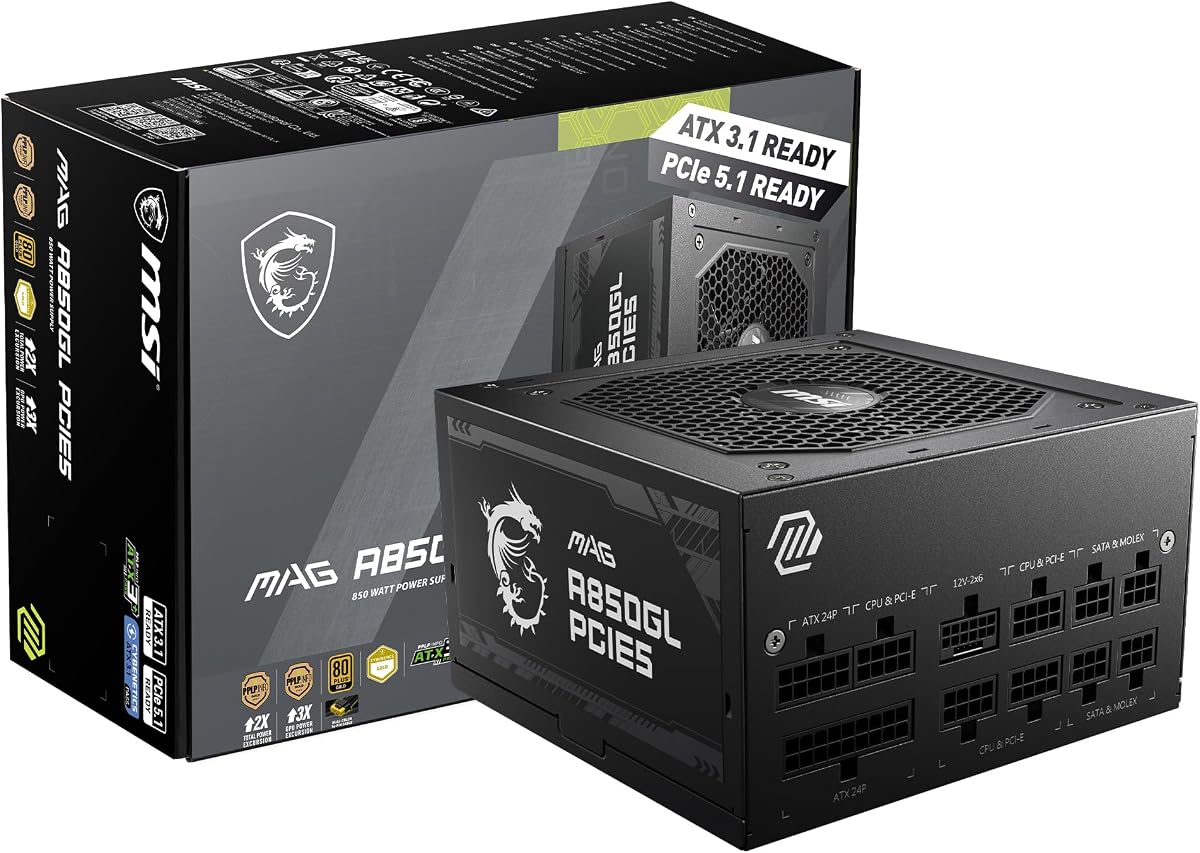


The MSI MAG A850GL PCIE5 is an 850W gaming power supply with an 80 Plus Gold certification and a 4.5 rating. Its most distinctive combination is ATX 3.1 and PCIe 5.1 readiness, a native dual-color 12V-2×6 cable, full modularity, and a compact design intended to make installation and cable routing easier.
We may earn a commission when you buy through this link, at no additional cost to you.
The native 12V-2×6 connection is particularly relevant for current high-end graphics cards, reducing the need for bulky adapters and helping preserve a clean interior. Full modularity means unused cables can remain out of the case, improving airflow and visual presentation. The ten-year warranty also provides useful long-term coverage for a component expected to remain in a build for years.
Its main compromise is that the supplied information does not describe the fan size or bearing type, nor does it provide a specific maximum-efficiency figure beyond Gold certification. Buyers who place acoustics above every other consideration may prefer the be quiet! Pure Power 13 M, while those prioritizing a modern connector, compact layout, and long warranty will find this MSI attractive.
This is a strong general recommendation for a modern 850W gaming PC, particularly one using a current GPU with a 12V-2×6 connection. It balances capacity, modern standards, modularity, and warranty coverage without requiring buyers to choose a specialized acoustic design.
ATX 3.1 and PCIe 5.1 support allow the native dual-color 12V-2×6 cable to connect directly to compatible hardware. That simplifies high-end builds and avoids the cable bulk associated with multi-adapter solutions.
The fully modular design lets builders connect only the leads their components require. This reduces clutter inside the chassis and can make airflow easier to maintain.
We may earn a commission when you buy through this link, at no additional cost to you.
The Thermaltake Toughpower GT provides 850 watts of capacity, Gold efficiency, and modern ATX 3.1 support at a practical entry point for modern gaming systems. It carries a 4.5 rating and stands out through its native PCIe 12V-2×6 connector, fully modular construction, and Smart Zero Fan control.
We may earn a commission when you buy through this link, at no additional cost to you.
Its single high-amperage 12V rail is designed to deliver stable power to demanding components, while the native 450W PCIe 5.1 connector supports compatible graphics cards without an adapter. Low-profile flat black cables make routing easier and improve the appearance of the finished system. The fan automatically adjusts to the load, helping minimize noise during lighter workloads.
The main limitation is its five-year warranty, which is shorter than the ten-year coverage offered by the MSI MAG A850GL PCIE5. The available specifications also do not identify the fan bearing. Nevertheless, the core combination of capacity, modularity, Gold efficiency, and current GPU connectivity is unusually well rounded for value-focused buyers.
The Toughpower GT is a strong recommendation for a gaming PC that needs 850 watts and a modern GPU connection but does not require premium acoustic engineering or the longest warranty. It is particularly useful for builders who want direct GPU power and clean cable management without moving to the top tier.
The native PCIe 12V-2×6 lead supports modern graphics hardware without requiring a multi-adapter arrangement. Its rated 450W delivery also aligns with current high-end GPU connector requirements.
Smart Zero Fan behavior adjusts cooling to the operating load. This can keep the supply quieter during ordinary desktop tasks while preserving airflow when the system demands more power.
We may earn a commission when you buy through this link, at no additional cost to you.
The CORSAIR RM850e (2025) is one of the strongest all-around options in this guide, earning a 4.7 rating for its mix of modern electrical standards, quiet cooling, modular cabling, and strong component specification. Its 850W capacity suits demanding gaming and workstation configurations without moving beyond the widely available ATX power class.
We may earn a commission when you buy through this link, at no additional cost to you.
Intel ATX 3.1 certification is the defining feature, including support for PCIe 5.1 platforms and resistance to twice the expected GPU transient power excursions. A 120mm rifle bearing fan follows a specially calculated fan curve, while 105°C-rated capacitors and Modern Standby support strengthen the case for a dependable everyday platform.
Fully modular cabling keeps unused leads outside the chassis, improving airflow and simplifying installation. One limitation is that the supplied listing does not explicitly identify a native 12V-2×6 cable or give a maximum efficiency number. Buyers whose GPU requires that connector should verify the exact cable configuration, while those prioritizing efficiency can consult the published certification details.
This RM850e is best for builders who want a quiet, modern, dependable power supply without paying for the most specialized premium option. It is a particularly strong choice for a high-performance PC where transient handling, modularity, and dependable component quality matter more than specialty cable aesthetics.
ATX 3.1 certification means the platform is designed to withstand transient excursions from a compatible GPU. This is valuable for modern systems that can draw sharp, short power spikes under demanding workloads.
The 120mm rifle bearing fan uses a calculated curve to manage noise, while 105°C-rated capacitors support steady operation. Together, these details support a stable and acoustically considerate build.
We may earn a commission when you buy through this link, at no additional cost to you.
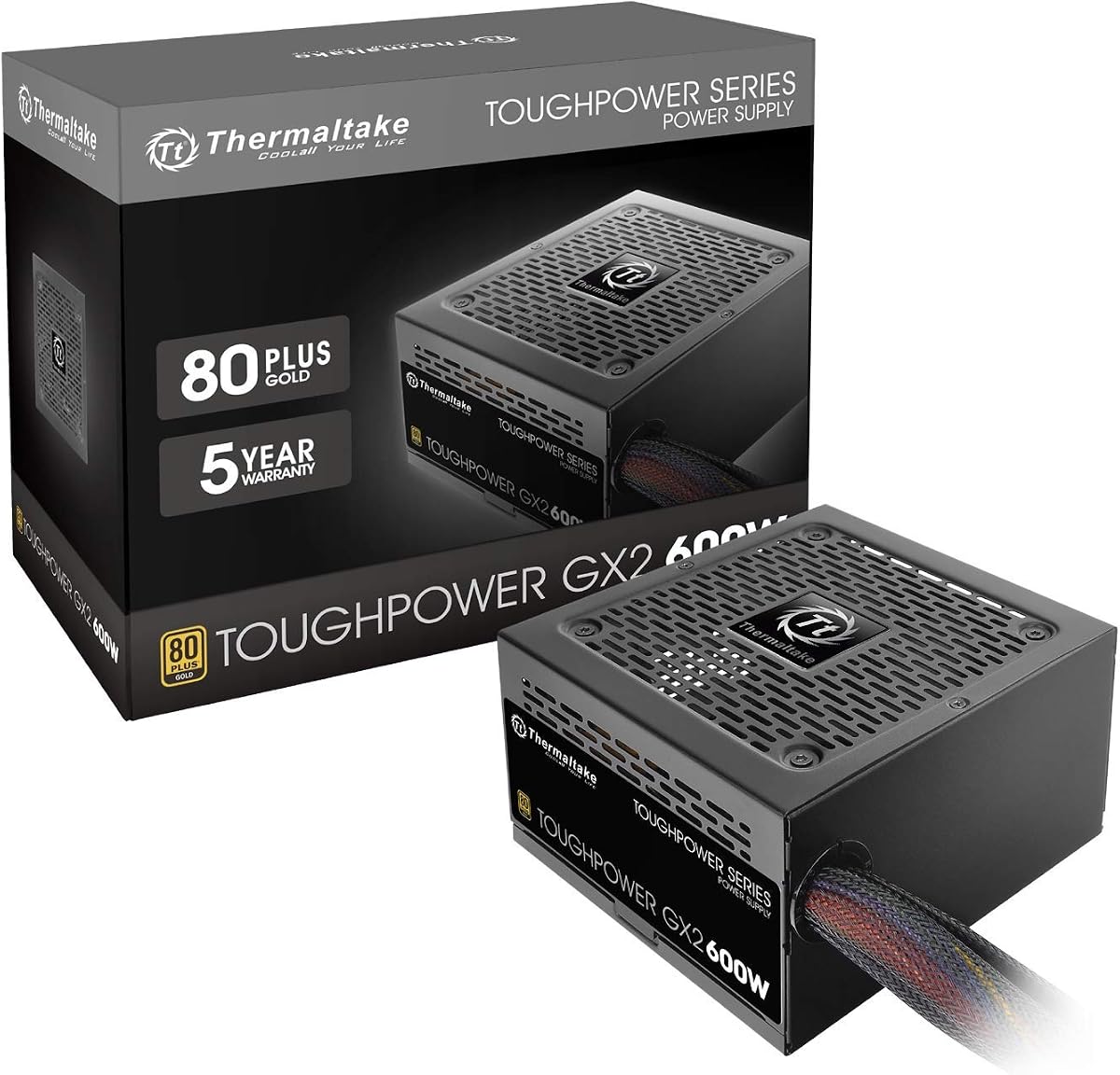
The Thermaltake Toughpower GX2 is a 600W Gold-certified supply for traditional gaming and general-purpose systems that do not require the newest connector standard. It carries a 4.6 rating and supports up to 90% efficiency, C6 and C7 states, SLI and Crossfire configurations, and a single high-amperage 12V rail.
We may earn a commission when you buy through this link, at no additional cost to you.
Its non-modular design includes a 24-pin main power connector, EPS 4+4 connector, six SATA leads, two PCI-E 6+2 connectors, three peripheral connectors, and one floppy connector. A dynamic-bearing 120mm fan is promoted for cooling and quiet operation, while high-quality capacitors and low-ripple output support stable performance.
The fixed cable arrangement is the principal drawback. Unused leads must remain in the case and can interfere with airflow, while the ATX 12V V2.4 and EPS V2.92 designation places it behind newer ATX 3.1 units. Its 600W rating also leaves less headroom for exceptionally power-hungry components than the 750W and 850W alternatives here.
The GX2 remains a sensible choice for a midrange gaming PC, an existing system upgrade, or a multi-drive workstation that benefits from numerous SATA and peripheral connectors. It is best for builders who value simplicity and adequate capacity over a native modern GPU connector and fully modular wiring.
The single 12V rail uses a DC-to-DC design to support contemporary GPU loads. This makes the 600W unit relevant for established gaming configurations that do not yet require ATX 3.1.
Six SATA connectors and three peripheral leads provide useful flexibility for storage-heavy systems. This can simplify builds that require more legacy connections than modern modular units emphasize.
We may earn a commission when you buy through this link, at no additional cost to you.
The be quiet! Pure Power 13 M is the premium choice for builders who want excellent efficiency, near-silent operation, and comprehensive modern GPU support. It has a 4.6 rating, an 80 Plus Gold certification, and a stated maximum efficiency of up to 94.4%, placing it above the standard Gold threshold when operating in favorable conditions.
We may earn a commission when you buy through this link, at no additional cost to you.
Its ATX 3.1 design includes a native 12V-2×6 connector for PCIe 5.1 graphics cards and four PCIe 6+2-pin connectors for current-generation GPUs. The 850W unit provides one massive 12V rail and is specified to handle power excursions up to twice its rated power, a useful characteristic for future processors and graphics hardware.
Semi-passive cooling stops the fan completely under low load, and optimized fan blades support quiet operation at higher loads. LLC topology is used for voltage regulation, while full modularity makes cable management straightforward. The only practical disadvantage is its premium positioning relative to other 850W Gold units, and the inclusion of four older-style connectors may be unnecessary for some builds.
This power supply is ideal for a quiet workstation, a refined gaming system, or a high-end build where efficiency, transient response, and direct modern GPU power take priority. Buyers who value acoustic comfort and headroom will find the Pure Power 13 M particularly well suited to the role.
A stated maximum efficiency of up to 94.4% can reduce power consumption and heat compared with a unit operating near the conventional Gold baseline. Lower heat also supports the objective of a quiet, thermally comfortable system.
Native 12V-2×6 and four PCIe 6+2-pin connectors provide flexible support for both current and newer graphics cards. The unit is also designed to absorb excursions up to twice its rated power.
We may earn a commission when you buy through this link, at no additional cost to you.
The Thermaltake GF1 combines 850 watts of capacity, 80 Plus Gold efficiency, full modularity, and a large cooling fan. Its 4.4 rating makes it the lowest-rated product in this group, but the core design remains capable for standard gaming builds that do not specifically require ATX 3.1.
We may earn a commission when you buy through this link, at no additional cost to you.
A 140mm fluid-bearing fan moves a substantial amount of air through the chassis, while Smart Zero Fan behavior minimizes noise when cooling demand is low. The high-amperage single 12V rail uses DC-to-DC conversion and supports Intel C6 and C7 states, along with ErP readiness.
Its main drawback is the absence of an ATX 3.1 or native 12V-2×6 claim in the supplied specifications. That makes it less compelling for a new build centered on the newest graphics cards, particularly if those cards require a direct 12V-2×6 connection. The 4.4 rating is also the lowest here, although it remains a favorable customer score.
The GF1 is a reasonable choice for a high-power traditional gaming PC where full modularity, a large fan, and sufficient capacity matter more than the newest interface standard. Buyers should confirm the included cable set against their graphics card before committing.
The 140mm fluid-bearing fan provides generous airflow for an 850W unit. Its larger dimensions can also move a given volume of air at comparatively lower rotational speed.
The design covers 80 Plus Gold, Intel C6 and C7 states, and ErP readiness. It remains relevant for conventional builds even though it does not advertise ATX 3.1 compliance.
We may earn a commission when you buy through this link, at no additional cost to you.
The CORSAIR RM850x is a polished enthusiast option with a 4.7 rating, full modularity, ATX 3.1 compliance, and a native 12V-2×6 connection. Its Cybenetics Gold rating reaches up to 91% efficiency, providing a useful independent efficiency designation alongside the Gold positioning reflected in its broader product category.
We may earn a commission when you buy through this link, at no additional cost to you.
ATX 3.1 compliance means the unit supports PCIe 5.1 hardware and is designed to resist transient power spikes. The native connector enables a direct GPU-to-PSU link without an adapter. Low-profile cable combs and embossed, flexible cables make the system look neat and make installation more manageable.
The unit is more expensive than several other 850W alternatives, which is the primary consideration for value-oriented buyers. It is also certified under the Cybenetics program rather than being described here as an 80 Plus Gold model, so buyers should distinguish between the two certification frameworks. Its high rating and refined cabling nevertheless make it a well-regarded choice.
The RM850x suits a premium gaming build that uses a modern graphics card and values aesthetics as well as electrical standards. It is particularly attractive when native GPU power, flexible cables, and low visual clutter are priorities.
Embossed cables and low-profile combs improve both flexibility and appearance. This makes the RM850x especially suitable for builds with a visible glass side panel.
The 12V-2×6 connector provides a direct path to compatible graphics cards. ATX 3.1 compliance also adds transient-spike handling for demanding modern platforms.
We may earn a commission when you buy through this link, at no additional cost to you.
The Cooler Master MWE Gold 750 V3 delivers 750 watts, 90% Gold-level efficiency, and ATX 3.1 support. Its 4.6 rating and emphasis on durable cabling make it a practical middle ground for high-end gaming PCs that do not require the full 850W class.
We may earn a commission when you buy through this link, at no additional cost to you.
The 90-degree 12V-2×6 PCIe 5.1 connector is designed to improve electrical durability and safety while reducing cable strain near the graphics-card connection. It can deliver up to 450W to a compatible GPU. The power supply also uses a hexagonal fan cover, an 80% airflow intake, and a dedicated heat sink to support cooling performance.
Capacity is the main tradeoff. While 750 watts may be sufficient for many systems, it provides less headroom than the 850W options in this guide. The supplied data also does not state whether the cable system is modular, so cable-management expectations should be verified in the final listing. Despite these limitations, Gold efficiency at 90% is a solid baseline.
The MWE Gold 750 V3 is best for a modern gaming build with a power-hungry graphics card but without an extreme processor and GPU combination. It is a sensible choice for builders who want ATX 3.1 connectivity and durable cables at a midrange capacity.
The 90-degree 12V-2×6 plug positions the cable more neatly and places less strain on the connection. Its design specifically emphasizes electrical durability for demanding graphics hardware.
An 80% airflow intake and dedicated heat sink work with the hexagonal fan cover to improve cooling. This supports stable operation and can help maintain low temperatures.
We may earn a commission when you buy through this link, at no additional cost to you.
The EVGA SuperNOVA 850 G+ is a traditional high-capacity Gold supply with a 4.8 rating, the highest customer score among these products. It combines 850 watts, full modularity, a 135mm fluid dynamic bearing fan, extensive electrical protections, and a ten-year warranty.
We may earn a commission when you buy through this link, at no additional cost to you.
Its 80 Plus Gold certification promises 90% efficiency at 115V and 92% at 220V to 240V under typical loads. The protections cover over-voltage, under-voltage, over-current, over-power, short-circuit, and over-temperature conditions, providing a broad safety foundation. A power-on self tester is a small convenience for initial setup.
As an older model, the SuperNOVA 850 G+ does not advertise ATX 3.1 or PCIe 5.1 support, and the supplied title does not mention a native 12V-2×6 cable. That may require an adapter with some current graphics cards. Its higher market positioning also makes it less economical than several newer alternatives, despite the long warranty and strong rating.
This unit is best for an established gaming PC, a builder seeking long-term warranty coverage, or someone who values proven protection features over the newest connector standard. For a completely new high-end build, a modern ATX 3.1 model may be easier to integrate.
Protection against over-voltage, under-voltage, over-current, over-power, short circuits, and excessive temperature covers several common failure conditions. This broad coverage is a major part of the unit's appeal.
The ten-year warranty makes the supply attractive for builders expecting a long upgrade cycle. It offers meaningful reassurance for a high-power component that may remain in service for years.
We may earn a commission when you buy through this link, at no additional cost to you.
The CORSAIR RM850e (2023) delivers 850 watts with 80 Plus Gold efficiency, full modularity, and ATX 3.1 compliance. Its 4.6 rating reflects a well-rounded unit that combines a low-noise 120mm rifle bearing fan, 105°C-rated capacitors, and Modern Standby support.
We may earn a commission when you buy through this link, at no additional cost to you.
ATX 3.1 compliance brings PCIe 5.1 platform support and transient-spike resistance, helping the unit meet the needs of current and emerging hardware. The calculated fan curve is designed to reduce noise even under load, and improved low-load efficiency supports more efficient behavior during routine desktop operation.
The supplied specifications do not explicitly confirm a native 12V-2×6 cable, so buyers with compatible current graphics cards should verify the package contents. It is also an earlier RM850e version, meaning the 2025 RM850e offers a newer platform designation. Even so, the established modular design and strong feature set remain convincing for compatible builds.
The 2023 RM850e is a good choice for gamers seeking an established 850W design with modern transient support and effective cable management. It is especially suitable when the build needs more than 750 watts but does not require the premium efficiency or finish of the highest-end alternatives.
Full modularity reduces unnecessary cables and improves airflow. Gold efficiency and improved low-load behavior complement that practical layout by reducing waste and improving system comfort.
ATX 3.1 compliance allows the unit to support PCIe 5.1 platforms and resist transient spikes. This makes the 850W capacity more appropriate for contemporary demanding graphics hardware.
We may earn a commission when you buy through this link, at no additional cost to you.
A Gold power supply should be selected by considering more than certification alone. Capacity, connector standards, transient handling, acoustic behavior, modularity, physical dimensions, protection, and warranty coverage all influence whether a unit will work well in your specific system.
Start with the combined power demands of the processor, graphics card, memory, drives, fans, and expansion devices, then leave reasonable headroom for short-term peaks and future upgrades. A 600W supply may suit a mainstream gaming configuration, while 750W offers more flexibility and 850W is preferable for power-hungry graphics hardware, high-end processors, or multiple expansion cards.
Choose enough continuous capacity for the build, but avoid oversizing without a clear purpose. A larger unit can remain efficient at low loads, yet its physical size, fan behavior, and cost should still be appropriate for the case.
80 Plus Gold indicates a supply is designed to meet defined efficiency thresholds under tested loads. Higher efficiency generally means less energy is lost as heat, which can support cooler and quieter operation. Some units in this guide advertise specific maximum figures, while others are identified only as Gold-certified, so exact comparisons require checking the current certification details.
Prioritize an authentic Gold certification and reputable efficiency testing. Also consider how the system is used: a workstation running near full capacity may realize different acoustic and thermal benefits than a mostly idle gaming PC.
ATX 3.1 support is particularly relevant for modern graphics cards because the standard addresses transient power excursions and includes guidelines for the 12V-2×6 connection. A compliant unit can be better suited to components that briefly demand more power than their steady-state consumption suggests. Native connector support can also simplify installation and avoid bulky adapters.
Check whether your graphics card specifies a 12V-2×6 requirement or supports standard PCIe 6+2-pin connectors. Modern standards offer useful headroom, but a system with older hardware does not automatically need the newest PSU platform.
Fully modular units include detachable cables so builders can route only what the system needs. Non-modular supplies use fixed leads, which can simplify the PSU itself but leave unused cables in the chassis. In tight cases or systems viewed through a glass panel, modularity usually produces a cleaner result and can make airflow easier to manage.
Consider connector angles, cable thickness, and available space behind the motherboard tray. Fully modular does not mean every cable is thin or easy to bend, so check the physical dimensions and routing path before finalizing a purchase.
Quiet operation depends on fan size, bearing type, fan curve, and the load placed on the supply. Semi-passive or Smart Zero Fan modes can stop or reduce fan activity during light loads, while a larger fan may move more air at lower speed. Systems intended for media playback, office work, or quiet living spaces benefit from careful attention to low-load behavior.
Look for a stated fan curve or zero-RPM mode when silence is important. Also consider the size and quality of the surrounding case ventilation because a quiet PSU still needs enough airflow to dissipate heat.
A dependable power supply should include protection against common electrical faults such as over-voltage, under-voltage, over-current, over-power, short circuits, and excessive temperature. High-temperature-rated capacitors are another useful indicator because they are central to long-term reliability and steady voltage regulation. These features help protect both the PSU and the connected computer components.
Review the protection list and component specifications rather than assuming every similarly named model is identical. When comparing generations, prioritize modern electrical standards, documented protections, and clear manufacturer support.
A power supply is expected to remain in a system for many years, so warranty coverage is a meaningful purchasing criterion. The products here include five-year and ten-year options, with the longest coverage appearing on the MSI MAG A850GL PCIE5 and EVGA SuperNOVA 850 G+. Warranty length should be weighed alongside efficiency, connectors, acoustics, and build fit.
Check what the warranty covers, whether it requires proof of purchase or an online registration, and whether support is available in your region. A long warranty is most valuable when it accompanies a design otherwise suited to your system.
Power supplies come in standard and compact sizes, and the listed product descriptions do not provide every physical dimension. Before ordering, compare the unit's length and mounting pattern with the case's power bay and available clearance for modular cables. Also verify the CPU motherboard connector, PCIe connections, SATA requirements, and the graphics-card power method.
Use the supplied images and current manufacturer documentation to confirm fit. Planning the installation path for both fixed and detachable cables can prevent a powerful unit from becoming difficult to install or maintain.
Before installation, disconnect the computer from wall power, switch off the PSU, and verify that the chosen wattage matches the system's estimated demand. Select the appropriate motherboard, CPU, graphics-card, SATA, and peripheral cables, and consult the supply's documentation for correct connector and orientation guidance. Never force a connector or use an incompatible adapter.
Route fixed and modular cables behind the motherboard tray where possible, keeping the power supply fan unobstructed and leaving enough space for its intake. Arrange the cables so they do not press against sharp case edges or block airflow. Confirm that every modular connector is fully seated and that no unused cable is routed where it can contact hot components.
After assembling the system, check the PSU fan and system airflow, then confirm that the computer starts normally and that the graphics card receives the number and type of power connections its manufacturer specifies. Keep the supply dry, avoid stacking objects above it, and provide the case with adequate ventilation. Periodically inspect cables for damage and arrange service or replacement if protection faults, unusual noise, or unstable operation appear.
Yes, 80 Plus Gold is an appropriate efficiency target for many modern gaming computers because it reduces waste heat while providing ample power for mainstream components. For a high-end processor and graphics card, capacity and transient-power handling matter more than certification alone. An ATX 3.1 unit with 850 watts is often a prudent choice for such builds.
Fully modular cabling makes installation cleaner and allows unused leads to remain outside the case. It can improve airflow and make a glass-sided build look better. A non-modular unit can still work perfectly well, but its unused fixed cables may require more space and careful bundling.
ATX 3.1 is a broader power-supply and platform standard that includes provisions for transient loads from modern graphics cards. PCIe 5.1 describes a generation of PCI Express connectivity, and compatible power supplies may provide a native 12V-2×6 cable for relevant graphics cards. Buyers should check both the PSU standard and the exact connector required by the GPU.
An 850W supply can be enough for many high-end systems when the components are selected with their power requirements in mind. The GPU is usually the largest factor, followed by the processor and expansion hardware. Choosing 850W rather than a smaller unit provides more transient and upgrade headroom without requiring an oversized modularity level.
No. Semi-passive and Smart Zero Fan modes usually keep the fan stopped only during low-load conditions. Once heat or power demand rises beyond a defined threshold, the fan begins spinning to maintain safe operating temperatures. Full-speed fan activity during gaming or heavy computing is therefore expected and normal.
Gold efficiency can help reduce heat, which contributes to quieter cooling, but efficiency alone does not guarantee silence. Look for a semi-passive mode, a carefully calculated fan curve, a fluid or rifle bearing fan, and a suitable case-airflow plan. The be quiet! Pure Power 13 M is particularly relevant for buyers who prioritize low noise and high efficiency.
The required number depends on the graphics card's power rating, connector design, and manufacturer guidance. Some cards use one native 12V-2×6 connection, while others use multiple 6+2-pin connectors. Never combine connector types unless the graphics-card manufacturer explicitly instructs you to do so, and avoid daisy-chaining cables when a direct connection is available.
They can reduce the amount of energy lost as heat compared with less efficient alternatives. The actual saving depends on the system's load, the PSU's efficiency curve, local electricity conditions, and how long the computer is used. The benefit is often most noticeable in systems that spend substantial time at moderate or high load.
The CORSAIR RM850e (2025) stands out as the most balanced modern choice, combining ATX 3.1 certification, modular cabling, quiet cooling, strong component specifications, and a 4.7 rating. The Thermaltake Toughpower GT offers an accessible route to 850 watts and native 12V-2×6 power, while the be quiet! Pure Power 13 M leads the premium group with exceptional stated efficiency and refined acoustic design.
Prioritize capacity that leaves genuine upgrade headroom, modern transient support for a demanding GPU, and a connector layout that matches the exact hardware. Modularity, fan behavior, protection features, physical fit, and warranty can then determine which of the shortlisted models is most suitable. A smaller 600W or 750W unit can be sensible when the installed components do not justify more capacity.
Ratings, efficiency claims, bundle contents, and compatibility details should be confirmed on the current listing before ordering. Prices and promotions also change over time, so compare the final cost alongside the technical fit rather than relying on a temporarily favorable offer alone. The most reliable choice is the supply whose standards, capacity, cables, and service coverage align with the planned system.