
Baofeng UV-5R
4.5Editor score
Dual-band analog transmission
Selectable high and low power
CHIRP programming support
Compact familiar handheld design
Ham Radio for Backpacking guide comparing 10 top radios for range, battery life, weather alerts, portability, features, and outdoor reliability today.
Ham Radio for Backpacking equipment must balance communication range, battery endurance, weight, and resistance to the unpredictable realities of wilderness travel. A capable radio can connect separated members of a group, provide weather alerts when cellular service disappears, and serve as a dependable emergency link when hiking routes separate a party.
The radios in this guide were compared using published specifications and customer ratings, with particular attention to transmit bands, output power, battery capacity, charging options, programming methods, weather reception, navigation functions, and packability. The list includes conventional handheld transceivers, upgraded analog models, a digital multimode radio, and a compact QRP transceiver.
Each review explains the role the radio can play on the trail and identifies the compromises that matter most for backpackers. The top three highlight the strongest combinations of value, versatility, and specialized capability, while the remaining reviews cover practical alternatives for different operating styles. Prices and availability can change at any time.
4.5Editor score

4.8Editor score

4.3Editor score
The comparison below organizes all ten radios by the capabilities most relevant to backpackers, including supported operating modes, output power, charging flexibility, memory capacity, emergency functions, and portability. It makes clear that the most appropriate choice depends on whether the priority is simple analog communication, digital connectivity, weather awareness, or ultralight operation.


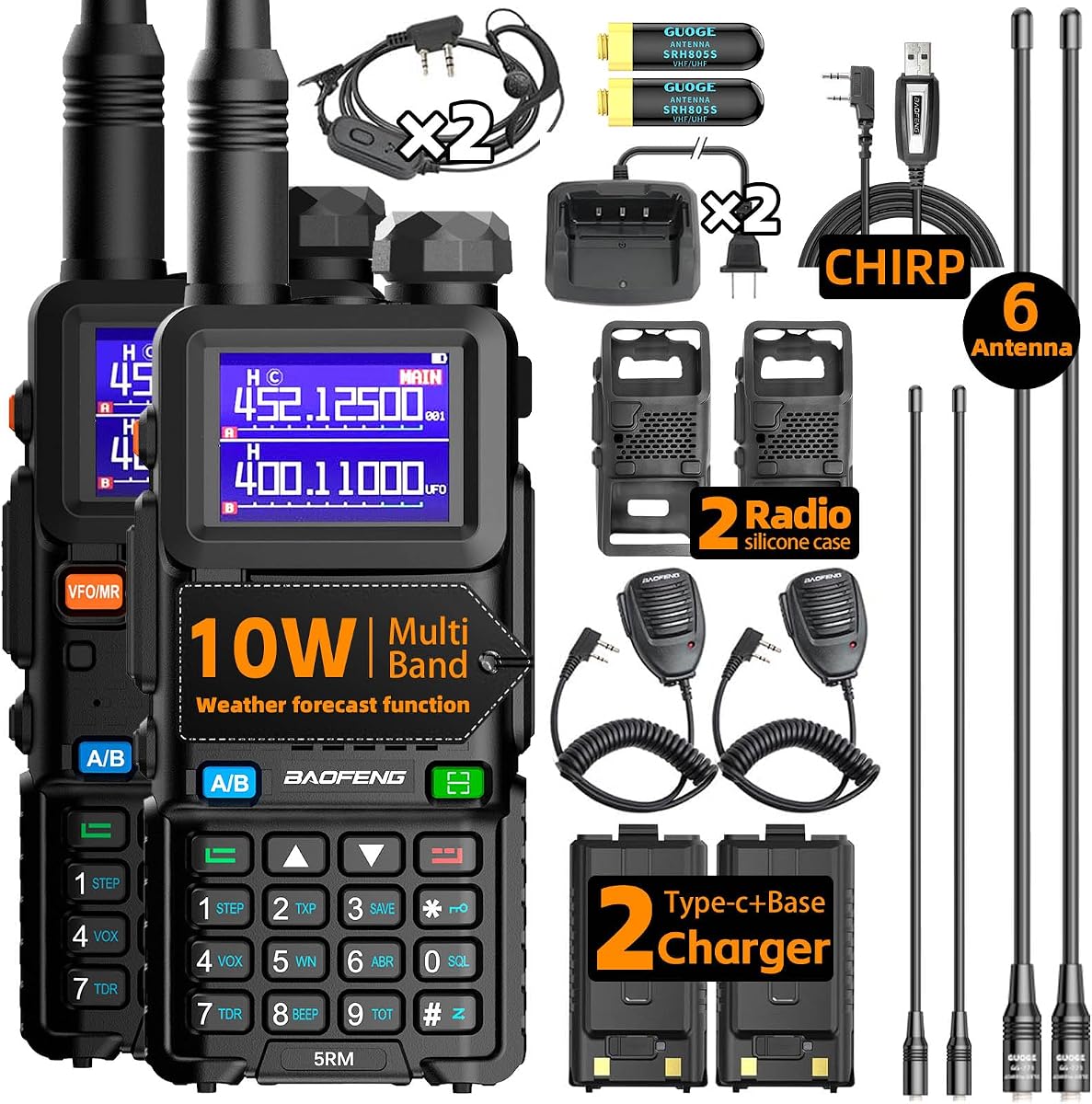

The Baofeng UV-5RM ranks first because it combines a wide range of amateur-radio functions with the practical charging and emergency features backpackers need. Its 4.8 customer rating is the strongest in this group, and the two-pack format makes it straightforward to keep one radio in the pack and another with a partner. The radio is designed for conventional analog amateur operation while adding expanded reception beyond the basic dual-band handheld format.
We may earn a commission when you buy through this link, at no additional cost to you.
Its listed receiving coverage spans 108–136MHz, 136–174MHz, 220–260MHz, 350–390MHz, and 400–520MHz, while transmission is specified for the 144–148MHz and 420–450MHz amateur bands. With up to 10 watts of available output, the UV-5RM gives trail groups a useful combination of reach and power control. The 2500mAh rechargeable battery, USB charging, and desktop base charging make it easier to replenish power from a wall, vehicle, laptop, or power bank.
NOAA reception is a particularly valuable feature for backpacking because official weather alerts can provide information when mobile data is unavailable. The 1.77-inch color screen, CTCSS and DCS functions, VOX, DTMF, alarm, LED flashlight, time-out timer, and one-touch frequency copying improve daily usability. CHIRP support is useful for preparing channel lists, but the need to understand programming terminology and local amateur-band rules can be a barrier for a first-time operator.
This is the strongest general recommendation for backpackers who want more capability than a basic UV-5R without moving into digital or specialized QRP equipment. It is particularly suitable for hiking groups, hunting parties, and campers operating on conventional repeaters or programmed simplex channels. Those who need automatic location reporting, continuous tracking, or modern digital voice should consider the DM-32UV instead, while minimalist operators may prefer the lighter trusdx.
NOAA alerts, an emergency alarm, and an LED flashlight add value after the basic radio conversation. These features do not replace a satellite messenger, first-aid kit, navigation equipment, or sound trip planning, but they make the handheld more useful when conditions deteriorate.
The 2500mAh battery, selectable power levels, and two charging methods provide a useful foundation for longer trips. Carry a compact power bank and reduce transmit power when nearby teammates are within easy reach to conserve energy.
We may earn a commission when you buy through this link, at no additional cost to you.
The original Baofeng UV-5R remains one of the most approachable conventional handheld radios for backpackers. Its 4.5 rating reflects a strong combination of familiar controls, dual-band transmission, and programmable memory. It is a sensible choice for new operators who need reliable local communication without navigating the larger feature sets found in newer models.
We may earn a commission when you buy through this link, at no additional cost to you.
The radio transmits within 144–148MHz and 420–450MHz, allowing operation on the amateur VHF and UHF bands permitted by the user's authorization. Its 128 channels, 50 CTCSS tones, 104 DCS codes, dual-frequency display, and dual-standby function cover the core needs of a hiking group. High and low transmit power let users trade range for battery life, while busy-channel lockout and keypad lock improve operation during movement.
Programming can be handled through a computer with CHIRP, making it possible to prepare a local repeater or simplex list before leaving home. A large LCD, selectable tri-color backlight, VOX, a 12.5kHz step option, and an LED flashlight add conveniences that are helpful in a tent, at night, or during a group movement. Compared with the newer UV-5RM, however, it has fewer memory locations and no listed NOAA receiver.
Choose the UV-5R when the budget matters and your group only needs conventional analog communications on a few familiar channels. It is less attractive for travelers who require detailed weather alerts, extensive channel storage, or digital features. For most basic backpacking communication, its straightforward design and easy programming support make it a practical first radio.
The UV-5R is easier to introduce than a full-featured digital transceiver. New users can begin with a small set of prepared channels, learn the essential controls, and gradually add repeaters or tactical CTCSS and DCS settings as their experience develops.
Dual watch, VOX, selectable backlight, and a built-in flashlight support the repeated, short-duration communications typical of a hiking group. These conveniences matter more in practice than having many rarely used functions.
We may earn a commission when you buy through this link, at no additional cost to you.
The BF-F8HP PRO is the premium choice in this roundup because it focuses on organization, flexible information display, and more specialized amateur-radio features. Its 4.3 rating is slightly below the leaders, but the radio offers a sophisticated feature set for backpackers who manage multiple groups, routes, repeaters, or recurring events.
We may earn a commission when you buy through this link, at no additional cost to you.
Clear English menus, a full keypad, 1,000 memories, and ten named zones allow operators to separate home, travel, club, event, simplex, and receive channels. Users can select which zones participate in scanning and temporarily skip a busy channel without changing the saved scan list. The display can show names, frequencies, zones, and approximate signal strength, while Dual Watch alternates one receiver between two channels and Single Watch creates a full-screen view of one channel.
Tri-band amateur transmission is the central differentiator, although valid amateur authorization remains necessary and operators must stay within their privileges. Airband AM, NOAA weather reception, and broadcast FM are receive-only. Direct radio-to-radio location sharing can exchange position with another compatible BF-F8HP PRO on the same channel, although it does not provide map display, continuous tracking, APRS, repeater passage, or emergency-location services.
The radio is best suited to an operator who values organized memory and tri-band access more than the lowest possible purchase cost. Common changes can be made from the keypad, while larger programming projects require BTECH CPS or supported CHIRP-next software and a separately sold PC03. Firmware updates likewise require that cable, software, and model-specific instructions. For uncomplicated dual-band use, the UV-5R remains less demanding, but the BF-F8HP PRO offers the most refined conventional control experience here.
Named zones make it possible to isolate everyday channels from trip-specific repeaters and event frequencies. The feature is especially useful for expedition leaders or radio volunteers who need several channel lists without rebuilding them for every outing.
Compatible radios can exchange a location directly on the same channel, which may help a group confirm a meeting point. It should not be mistaken for continuous position tracking, because the listed capability does not include maps, APRS, or movement history.
We may earn a commission when you buy through this link, at no additional cost to you.
The two-pack UV-5RM setup is a convenient option for pairs, families, and small hiking teams that want matching conventional radios with the necessary accessories already included. Its 4.5 rating and extensive package make it easier to build a complete communication kit without separately matching handheld bodies, batteries, charging bases, and microphones.
We may earn a commission when you buy through this link, at no additional cost to you.
Each radio offers the same broad receiving coverage and licensed amateur-band transmission ranges as the UV-5RM family, along with a 1.77-inch color screen and storage for as many as 999 channels. Each unit includes a 2500mAh rechargeable battery, USB-C cable, and US desktop charger. The package also includes a programming cable, two speaker microphones, two AR-771 earpieces, two AR-805S accessories, two belts, and two hand straps.
The included speaker microphones are particularly relevant to outdoor use because they allow a backpacker to transmit without repeatedly handling the radio. This is useful while wearing gloves, moving across uneven terrain, or communicating during a group task. NOAA reception provides emergency weather updates, while frequency copy reduces setup friction when both radios need the same conventional channel.
The trade-off is pack volume and weight. Two complete handheld systems take more space than one radio, and accessories that are unnecessary for a specific trip can be left behind. Still, for two people who need independent spare power and matching equipment, this package is more coherent than assembling a pair from mismatched components. It is a strong choice for a couple or a two-person expedition team.
Identical radios make channel programming and daily operation easier for a pair. Each person also receives an independent battery, charging base, earpiece, hand strap, and speaker microphone, reducing dependence on shared components.
The external speaker microphones can be clipped near the shoulder or attached to a pack strap. This keeps the antenna and controls accessible while allowing a backpacker to keep both hands on trekking poles, map, or trail equipment.
We may earn a commission when you buy through this link, at no additional cost to you.
The Baofeng UV-32 is a feature-rich two-pack radio that brings GPS, selectable high power, and an extended high-gain antenna to the conventional handheld format. Its 4.4 rating makes it a strong choice for backpackers who want navigation awareness around their communications equipment, although the listed GPS function should not automatically be treated as a full mapping solution.
We may earn a commission when you buy through this link, at no additional cost to you.
The radio can be upgraded from the UV-5RM platform and includes high, medium, and low power settings, frequency duplication, AM reception, a stopwatch, FM radio, LED flashlight, alarm, DTMF, VOX, NOAA weather reception, and a 2500mAh lithium-ion battery. Frequencies can be copied through the side keys or written through an app, providing more than one method for adjusting channels during a trip.
The included 18.89-inch antenna is designed to improve signal strength and extend practical communication distance, but its length creates a noticeable pack-management issue. Backpackers need to route it carefully so it does not snag on vegetation, catch pack straps, or become a burden in dense brush. The radio also includes a base charger and USB-C cable, with USB and desktop charging options.
This model suits a two-person group that values conventional voice communication, built-in GPS, weather alerts, and a long antenna. It is less suitable for ultralight hikers or those who already carry a dedicated GPS device and prefer a smaller antenna. Its combination of emergency tools and selectable output power makes it particularly compelling for hunting, search-oriented activities, and extended backcountry travel.
The built-in GPS adds another way to understand position, but backpackers should still carry a dedicated navigation tool, paper backup, and the skills to use them. Technology can fail, run out of power, or become difficult to operate in poor weather.
The 18.89-inch antenna favors signal performance over compactness. Measure it against the rest of your pack and secure it securely before entering dense vegetation or moving rapidly beneath trees.
We may earn a commission when you buy through this link, at no additional cost to you.
The Malahit trusdx is the specialist ultralight option in this guide. Unlike the handheld transceivers, it is a low-power radio designed around five HF bands and multimode QRP operation. Its 4.5 rating reflects an enthusiastic niche audience, and the assembled 3D-printed enclosure makes it directly relevant to backpackers who want to reduce the bulk of traditional amateur-radio equipment.
We may earn a commission when you buy through this link, at no additional cost to you.
The listed operating bands are 80, 60, 40, 30, and 20 meters. The mainboard is version 1.2 and the RF board is version 1.0. The unit arrives assembled in an army-green 3D-printed case with raised lettering, and the bootloader has already been installed with the firmware programmed. Its serial number is attached inside the package rather than shown on the OLED.
Programmers must follow the included instructions to configure a call sign. The official firmware omits the spectrum display, while the beta programming firmware adds one but has slightly fewer other menu functions. The radio uses a 3.5mm by 1.35mm power jack, and the external battery case is sold separately. Those details make the trusdx less convenient as a first radio, even though it is compelling for an experienced operator making a deliberate weight reduction.
For backpackers with relevant licenses, long experience with radio programming, and a comfort with HF operation, the trusdx offers a specialized way to stay in contact beyond local handheld range. It is not suitable for someone expecting a ready-to-use NOAA alert device, simple channel scanning, or a complete charging kit. Its strongest case is as a lightweight station paired with a properly selected antenna system.
The trusdx exchanges the familiar handheld form factor for a compact five-band QRP transceiver. That makes it attractive to experienced operators who understand antenna selection, power budgets, and the relationship between frequency and propagation.
Because the bootloader is already installed, the serial number is not displayed on the OLED. It is supplied on a bag label, and the instructions also explain a recovery method using a sequence of zeros if the label is lost.
We may earn a commission when you buy through this link, at no additional cost to you.
The Baofeng K5PLUS delivers a capable 10-watt conventional handheld in a configuration that suits individual backpackers. It has a 4.5 rating and includes a long, flexible high-gain antenna, 999 memory channels, NOAA weather reception, and one-touch frequency copying. The combination makes it a solid companion for a solo traveler who wants local repeater access and a conventional radio that can also serve a nearby group.
We may earn a commission when you buy through this link, at no additional cost to you.
The radio can be charged through its US desktop charger or by USB-C from a compatible power source. Its additional 15.35-inch antenna is flexible and intended to enhance signal strength and communication distance. One-touch copying uses the BAND control to duplicate a compatible radio's frequency without computer programming, which can simplify setup when every member carries a similar unit.
Other listed features include Airband reception, an FM radio, LED flashlight, stopwatch, DTMF, VOX, alarm, CTCSS, DCS, and time-out timer. These turn the handheld into a broader outdoor tool rather than a voice-only radio. NOAA reception is especially relevant for weather awareness, while the flashlight can provide a small convenience in camp or on an early start.
The K5PLUS is best for a backpacker who wants more transmit power and channel capacity than a basic UV-5R but does not require GPS or digital voice. The long antenna is the most important packing consideration, and users should become familiar with the controls before leaving home. Those who prioritize the smallest possible equipment will find the UV-5R easier to carry.
The K5PLUS provides a 10-watt option and substantial channel memory while remaining a conventional analog radio. This makes it a practical middle ground for operators who want straightforward voice communication without configuring a DMR network.
Frequency copying is useful when a trail partner uses a compatible handheld and the group wants to align quickly. A computer and programming cable are still more flexible for planning repeaters, tones, and multiple channel groups.
We may earn a commission when you buy through this link, at no additional cost to you.
The Baofeng DM-32UV is the most advanced communications platform in this guide and the only listed model centered on digital voice. Its 4.3 rating reflects a capable feature set that includes DMR, analog fallback, GPS, APRS, text messaging, and a large channel database. It is a strong option for organized groups that can coordinate digital talk groups and color codes before the trip.
We may earn a commission when you buy through this link, at no additional cost to you.
The radio supports up to 4,000 channels, TDMA dual-time-slot operation, switchable high, medium, and low power, and a 2.0-inch screen with a full keypad. It can operate in DMR digital mode and traditional analog mode, allowing a compatible digital group to communicate while still supporting conventional channels. The listed digital tools include 128-character Chinese or English text messaging, call recording, remote monitoring, and ARC4, AES128, or AES256 encryption options.
Built-in GPS and APRS provide location reporting capabilities that most handheld radios in this roundup do not offer. FM, AM, and NOAA reception add listening and weather functions, while the emergency alarm can provide an alert. A Type-C port handles charging, frequency writing, and firmware updates, reducing the need to carry separate cable types once the correct software is configured.
A DM-32UV makes the most sense for a backpacker or club whose members are already using this digital ecosystem. Digital voice will not work with an unrelated conventional radio unless the group agrees on compatible settings and communication modes. For a mixed group, the UV-5RM or UV-32 may be easier to coordinate. The DM-32UV earns its place for users who value text messaging, detailed location reporting, and large programmable channel sets.
DMR can carry more organized traffic on available spectrum than an entirely analog setup, while the radio retains analog compatibility. Talk groups, color codes, and user identifiers must be agreed upon before the group relies on digital communication.
GPS and APRS make the DM-32UV more useful for group location awareness than basic handhelds. Position reports still depend on programming, compatible software or services, correct intervals, and the availability of a suitable data connection through the local network.
We may earn a commission when you buy through this link, at no additional cost to you.
The Baofeng AR-5RM combines a strong 4.6 rating with a large color display, expanded reception, and a 2500mAh rechargeable battery. It is a well-rounded handheld for backpackers who want familiar dual-band amateur transmission, substantial memory, and a more detailed screen than the basic UV-5R provides.
We may earn a commission when you buy through this link, at no additional cost to you.
The radio receives across 108–136MHz, 136–174MHz, 220–260MHz, 350–390MHz, and 400–520MHz. It transmits on 144–148MHz and 420–450MHz, subject to appropriate amateur authorization. A 1.77-inch color display and up to 999 memory channels simplify navigation and organization, while the FCC identification listed as 2AJGM-5RH provides a specific model reference for programming.
Charging flexibility is a major backpacking benefit. Each unit includes a 2500mAh rechargeable battery, a USB-C cable, and a desktop charging base. The radio can be replenished from a wall outlet, power bank, laptop, car adapter, or another USB port, making it easier to maintain power during a multi-day trip. NOAA reception provides severe-weather alerts, and the LED flashlight and alarm functions add emergency utility.
The AR-5RM also includes a high-quality speaker microphone, allowing backpackers to communicate without holding the radio. Frequency cloning through one-touch copying is convenient for matching compatible devices, and CHIRP compatibility supports more deliberate programming. This model is a good middle-to-upper choice for hikers who prioritize NOAA information and a large display. The UV-5RM two-pack is more immediately complete, while the original UV-5R remains less expensive and simpler.
With as many as 999 memory locations, the color display can make channel organization easier than on a small monochrome screen. Named or frequently used channels should still be arranged before the trip to avoid scrolling in poor light.
USB-C and desktop charging make it possible to fill batteries at a vehicle, campsite, lodge, or from a power bank. A protected battery and disciplined power management remain important because charging opportunities may be unpredictable.
We may earn a commission when you buy through this link, at no additional cost to you.
The Baofeng BF-F8HP is a full-kit conventional handheld that combines an 8-watt maximum output with three selectable power levels and a 2100mAh battery. Its 4.5 rating makes it a dependable alternative to the UV-5R family, particularly for a backpacker who values a complete accessory bundle and a more gradual choice of transmit power.
We may earn a commission when you buy through this link, at no additional cost to you.
The radio supports 136–174MHz VHF and 400–520MHz UHF operation, with wide or narrowband selection. High, medium, and low settings provide 8, 4, and 1 watt of output, allowing users to preserve battery life when nearby or seek greater range when necessary. A V-85 high-gain antenna is included, along with the radio, battery, CH-5 desktop charger, wall adapter, earpiece kit, wrist strap, belt clip, and user manual.
This accessory package makes the BF-F8HP straightforward to prepare for a trip. The in-depth guide and support are designed to help users who are not already radio experts, while the three power levels make it easy to adapt the radio to group size and terrain. The hardened shell is another useful feature for equipment that will be carried through rocks, wet vegetation, and repeated packing cycles.
A PC03 FTDI programming cable is recommended for easier computer programming but is not included, which is the main inconvenience for users who want a completely ready-to-program package. The BF-F8HP is less advanced than the UV-5RM, BF-F8HP PRO, or DM-32UV, but it remains a practical full-kit option. It is especially attractive for a group that wants a straightforward dual-band radio with multiple power choices and a larger battery.
Using 1 watt around camp can extend operating time, while 4 or 8 watts becomes more useful when the group is spread along a trail or blocked by terrain. A disciplined power plan often matters more than beginning every contact at maximum output.
The included battery, high-gain antenna, charger, wall adapter, earpiece, strap, clip, and manual reduce the need to assemble a starter kit. Only the optional programming cable remains outside the listed bundle.
We may earn a commission when you buy through this link, at no additional cost to you.
The right backpacking radio depends on local coverage, group coordination, licensing, antenna strategy, and the number of days you may spend away from reliable charging. Weight and battery endurance matter, but operating features should be evaluated only after confirming that they solve a problem you will actually encounter.
Choose a model that matches your license and the repeaters or simplex channels available along your route. A wider transmitter is not automatically better if you lack the relevant authorization or local infrastructure to use it.
Prioritize a comfortable charging setup and carry a protected power reserve for extended travel. Use lower power whenever the group is nearby to preserve capacity for the stretches where distance matters.
Measure the entire radio-and-antenna package before purchasing. Choose the shortest practical antenna that suits your operating style and route, and secure it against brush and straps.
Choose analog for simple group contact, dual-mode for greater flexibility, and digital when your group already uses a common network. Do not select a digital radio solely for its longer feature list.
Choose a weather receiver if your route crosses exposed or remote terrain, but verify local service availability. Treat the radio as one layer of emergency preparation rather than the only one.
Match the location feature to your actual need. A dedicated GPS, phone, paper map, and compass may still be required even when the radio can report a position.
Program at home, print a compact reference card, and carry backup channels. Make sure every group member understands which channels are primary, secondary, and emergency options.
Inspect the housing, antenna, battery door, and charging port before each trip. Use a waterproof pouch for storage while retaining access to controls and audio.
Begin by learning the radio indoors before leaving home. Learn how to select channels, adjust volume, scan, change power, open the accessory connector, activate emergency functions, and identify battery status. Program the planned channels, repeater offsets, tones, and backup frequencies. Write down essential information on paper and ensure every member can reach the group on more than one channel without relying on a device screen.
During a hike, conserve battery and attention. Use a low power setting when teammates are nearby, avoid unnecessary transmissions, and keep the radio accessible rather than buried in a side pocket. A high-gain antenna may improve reach, but long antennas need careful routing around pack straps and vegetation. A one-touch copy is helpful for matching a nearby compatible radio, yet it should not replace a prearranged channel plan.
Care for the radio by keeping the battery contacts clean, using compatible chargers, and protecting the radio from moisture and impact. Check the battery for swelling or damage, inspect the antenna connector, and carry a spare charged battery or power source when the route extends beyond dependable charging. Before every trip, verify that the radio transmits on authorized frequencies, receives the planned group channels, produces clear audio, and remains reachable even if a cell phone is offline.
If you intend to transmit on amateur frequencies, you generally need the appropriate amateur authorization for your country. Receiving weather broadcasts, broadcast radio, or other public frequencies may not require an amateur license, but operating rules vary. Confirm your local regulations and any licensing requirements for repeaters before your trip.
A basic dual-band handheld such as the UV-5R is often sufficient when the group stays within a few miles or uses nearby repeaters. A radio with NOAA reception, more memory, or a larger battery becomes more valuable if the route extends farther or weather information is important. Local terrain and repeater coverage can matter more than maximum advertised power.
Yes, conventional and digital amateur radios do not depend on cellular networks for local communication. They can connect directly with compatible radios or through reachable amateur repeaters. Their usefulness beyond local coverage depends on band propagation, repeater infrastructure, antenna height, terrain, and the other party’s equipment.
No. Higher power can improve communication over difficult terrain, but it also consumes more battery and does not overcome every obstruction. Use a low setting when group members are close, then increase power when the group is separated. A good antenna and careful placement can also produce meaningful gains.
It is highly useful in areas covered by NOAA transmissions, particularly when cellular weather alerts are unavailable. A dedicated receiver can provide forecasts and emergency notices, but it should supplement—not replace—a reliable forecast, paper map, weather-appropriate clothing, and an evacuation plan. Availability outside the United States is a separate consideration.
A two-pack is convenient when each traveler needs a complete matched kit with separate batteries, chargers, and accessories. Individual purchases may be better if members already own compatible radios or want different models. Confirm that every radio supports the same frequencies, tones, and operating mode before relying on the group.
A digital radio can improve efficiency, support text messaging, and provide advanced location features when the whole group is properly coordinated. It is unnecessary when members only need basic analog voice contact. Digital and analog models can be useful together, but the team must agree on talk groups, identifiers, and compatible channels in advance.
At minimum, carry a charged spare battery or suitable power reserve, a way to keep the radio protected and accessible, and a printed channel plan. A compatible programming cable and compact antenna may be useful depending on the model. A weather radio, satellite communicator, map, compass, and emergency beacon can provide additional layers of protection.
The Baofeng UV-5RM is the strongest all-around recommendation because it combines a highly rated feature set, expanded reception, flexible charging, NOAA alerts, and ample channel memory. The original UV-5R is the economical choice for simple dual-band voice contact, while the BF-F8HP PRO stands out for organized channel management, tri-band transmission, and more refined controls.
Backpackers should prioritize legal band coverage, local repeater compatibility, battery endurance, charging access, and the size of the complete radio-and-antenna package. Digital radios, GPS, APRS, and automatic frequency copying are valuable only when the group can configure and use them effectively. Simplicity often produces better communication in the field than a long list of unused features.
Finally, check the current specifications, included accessories, seller information, and price before ordering, because product bundles and commercial details can change. Buy from a source you trust, test the radio before the trip, and keep the final decision centered on reliable communication for the route and group you actually have.