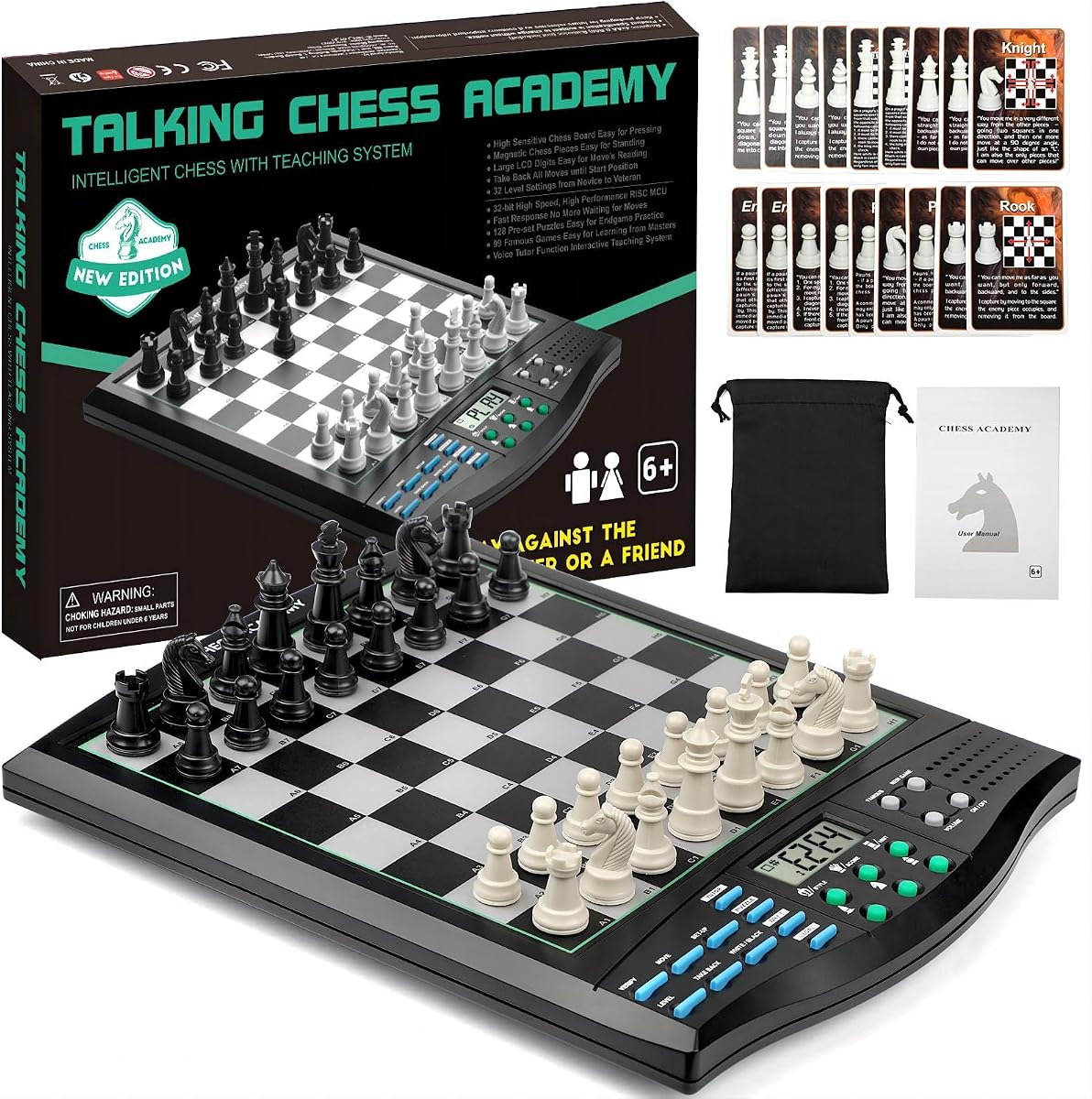
Talking Chess ACADEMY
4.3Editor score
Voice-guided teaching system
128 preset chess puzzles
Multiple difficulty levels
Our AI Chess Board guide compares 10 smart boards for coaching, automation, online play, learning features, portability, build quality, and overall value.
An AI chess board combines a physical playing surface with software, sensors, and a chess engine, creating a more interactive way to learn, practice, and play. The best models offer useful coaching, responsive piece recognition, online connectivity, and clear feedback without making the experience feel overly complicated.
We compared ten boards based on the features stated in their product information, including AI strength, coaching tools, online-platform support, piece recognition, automation, portability, display design, and included learning content. The guide covers traditional electronic sets, connected boards, themed editions, and systems capable of moving pieces automatically.
Each pick highlights a different path for chess players, from inexpensive learning computers to sophisticated connected boards. Ratings reflect the supplied customer feedback, while feature priorities and practical trade-offs help explain why each model may suit a different household. Prices and availability can change, so check current listings before buying.
4.3Editor score

4.4Editor score

4.3Editor score
The table below compares all ten boards across their most important characteristics, including AI capability, coaching, connectivity, recognition, and physical design. It provides a quick way to narrow the field before reading the detailed reviews.





ChessUp 2 is the strongest all-around choice in this guide because it combines a physical board, a built-in chess engine, piece-aware coaching, and standalone Wi-Fi in one coordinated system. Its 4.4 rating reflects generally favorable customer sentiment, while the listed functionality gives it exceptional range for learners, families, and experienced players who want both practice and organized study.
We may earn a commission when you buy through this link, at no additional cost to you.
The board's TouchSense pieces are central to the experience. Moving a piece can reveal potential moves, mistakes, and blunders, while the lighting system provides guidance without requiring the player to interpret a small display. Each participant can choose a different level of AI help, allowing a child or beginner to receive light-up square prompts while a stronger player chooses a more challenging game. That flexibility makes mixed-level family play especially practical.
Built-in Wi-Fi is a major advantage over electronic computers that rely entirely on local controls. The product connects to Chess.com and Lichess for real-time online matches without requiring a phone or laptop. Its companion app adds game review, progress tracking, and expert-led lessons, while the physical board displays lesson content at the same time. Players can also set up arbitrary positions, recreate famous games, and experiment with openings, tactics, and endgames.
The main trade-off is complexity. A system with customizable hints, position study, lessons, online accounts, and an app may feel like more than a simple opponent to someone whose primary goal is a traditional electronic chess game. The information also does not specify every detail of setup, account requirements, or supported lesson languages, so buyers should confirm compatibility before committing. For a buyer who wants one board to cover coaching, online play, and serious study, however, ChessUp 2 is the most complete package in the list.
ChessUp 2 is particularly well suited to households where players have different skill levels. Guidance can be adjusted for each side, turning the board into a teacher for a novice and a serious opponent for an experienced player without requiring two separate products.
Built-in Wi-Fi removes the need to keep a phone beside the board during online games, while the ability to study any position expands its value beyond casual matches. Together, these features support both live competition and deliberate training.
We may earn a commission when you buy through this link, at no additional cost to you.
Chessnut Air combines traditional appearance with modern chess technology, earning a 4.4 rating and a place near the front of this ranking. Its full piece recognition, embedded LED indicators, adaptive AI, online play, and game recording create a balanced feature set for players who want a board that does not look like a bulky classroom appliance.
We may earn a commission when you buy through this link, at no additional cost to you.
Recognition is the model at the center of the experience. The board uses sensor-chip plastic pieces, allowing it to identify the complete position rather than merely detecting that a square changed. This reduces the need for manual position correction and makes recorded games, LED move indications, and online synchronization more convenient. The included set contains 34 sensor-chip pieces, two extra queens, a USB-C charging cable, and a quick-start guide.
The Chessnut App supports AI practice with adjustable difficulty, position review, and analysis of completed games. Compatible integrations also allow play through supported services such as Chess.com and Lichess, with incoming moves shown by the board's LED system. For ordinary home play, up to 20 over-the-board games can be stored for later review or export, which is a meaningful advantage over basic electronic boards with little or no history.
Its 13-by-13-by-0.7-inch wooden-look board and 2.7-inch king produce a more traditional profile than many screen-led alternatives, although the pieces are plastic. App-dependent features may also feel less fluid than the fully standalone approach of ChessUp 2. Chessnut Air is an excellent fit for players who value accurate recognition, a natural-looking board, app-assisted study, and online connectivity without requiring a premium robotic mechanism.
Full piece recognition gives Chessnut Air an advantage when a game is recorded, resumed, or transferred to an online platform. Players can spend more time thinking about the position and less time correcting the board.
The wood-look board and concealed LEDs are useful for homes where a large electronic display would dominate the room. Online capabilities and recorded-game storage preserve the feel of a conventional set while adding digital convenience.
We may earn a commission when you buy through this link, at no additional cost to you.
GoChess Mini is a portable smart board that combines an advanced AI opponent, real-time light coaching, online play, and different assistance settings for each player. Its 4.4 rating and extensive skill range make it a practical option for beginners who want guidance as well as stronger players who want a meaningful challenge.
We may earn a commission when you buy through this link, at no additional cost to you.
The board provides 32 AI difficulty levels, allowing users to move gradually from introductory games to demanding contests. Colored lights give immediate feedback and guidance, which can help beginners understand legal movement, evaluate a move, or learn from a mistake. The same flexibility extends to playing together: each participant can select an assistance level, so two people of different abilities can compete without the stronger player dominating the entire session.
Online support for Lichess and Chess.com expands the options beyond local play. Players can challenge friends or new opponents while retaining the physical experience of moving real pieces. The Mini's stated 35-by-35-millimeter square design and light weight are particularly convenient for offices, classrooms, travel, or compact home spaces, where a full-size display-based board would occupy too much room.
The board is less suited to intensive study than ChessUp 2, Chessnut Air, or Chessnut Evo because the supplied information emphasizes coaching, difficulty, and online matches rather than game libraries or arbitrary-position tools. Its compact footprint may also require a stable table with enough clearance. Even so, GoChess Mini is a strong choice for anyone seeking an approachable, portable AI opponent with unusually broad difficulty and assistance controls.
GoChess Mini is easy to recommend to families because each player can receive a different amount of assistance. The compact size also makes it practical for taking on a trip without giving up an electronic opponent.
Colorful move indications can make abstract ideas more understandable for new players. Rather than limiting the board to win-loss play, the lighting system turns mistakes and suggested directions into visible cues during the game.
We may earn a commission when you buy through this link, at no additional cost to you.
Talking Chess ACADEMY delivers the core benefits of an electronic chess computer without requiring an app, online account, or connected display. Its 4.3 rating reflects a favorable reception, and the combination of a voice tutor, multiple difficulty levels, practice puzzles, famous games, and a simple press-to-move board makes it a sensible entry point for children and budget-conscious adults.
We may earn a commission when you buy through this link, at no additional cost to you.
The interactive teaching system is the model's defining feature. Voice messages warn about poor moves, mistakes, and threats, announce whether a move is legal, and speak during setup or position verification. A dedicated hint function can suggest a move, while five novice levels and mini-chess games help players learn how each piece operates. The board uses a sensitive surface that responds when a square is pressed, and the large LCD digits make coordinates easy to read.
The educational library is unusually substantial for a basic system. It includes 128 preset puzzles for endgame practice, 99 famous games for studying master-level examples, and five mini-chess variations. The computer also offers side swapping, move takeback before the starting position, computer-move chasing, volume adjustment, auto power-off, and a saving function for longer sessions.
It is not a connected board, and the supplied information does not mention online opponents, full piece recognition, or app-based analysis. Players who want those features should look toward Chessnut Air or the top-ranked ChessUp 2. Even so, Talking Chess ACADEMY focuses on the most important elements of learning chess through a tangible board. It is a strong choice when the goal is accessible instruction, voice guidance, and a substantial practice library in a portable electronic set.
Spoken feedback can reveal an error immediately, which is especially helpful for younger players or anyone still learning board coordinates. The teaching function makes the system feel more like a tutor than a silent opponent.
Puzzles, famous games, hints, and mini-chess modes make this board useful without internet access. The combination supports both structured practice and casual learning whenever a phone is unavailable.
We may earn a commission when you buy through this link, at no additional cost to you.
Chessnut Move is one of the most technologically ambitious boards in this guide, using motorized piece bases to move chessmen automatically. Its 4.1 rating is lower than those of the leading conventional smart boards, but no casual feature in the comparison matches the visual drama and convenience of pieces repositioning themselves after games, during study setups, or in response to online moves.
We may earn a commission when you buy through this link, at no additional cost to you.
The system claims one-millimeter full piece recognition, a 10 Hz refresh rate, and a 0.1-second response time, with automated movements averaging under three seconds. Multiple pieces can move at the same time, allowing fast resets and efficient construction of study positions. A built-in Stockfish engine supports direct play with adjustable Elo difficulty, so a phone, computer, or app is not required for an engine match.
The Chessnut App adds position and video import, allowing tutorial or tournament moves to appear on the physical board. It also connects to Chess.com, Lichess, and other supported services, where an opponent's reply is automatically played. Voice commands provide a hands-free way to issue controls, making the board especially interesting for demonstrations, streamed games, and study sessions.
Its robotic mechanism introduces practical considerations that conventional boards do not have. The pieces use self-moving bases that require charging, and the package includes a charging pad, two cables, and spare bases. Reliability across many automated moves, charging routines, and setup procedures may also explain why its rating trails the more conventional connected options. Chessnut Move is ideal for a buyer who values visible automation enough to accept greater complexity in exchange for a board that visibly plays itself.
Self-moving pieces turn ordinary move playback into a physical demonstration. This is especially useful for recreating games, showing a study line, or letting a remote opponent's reply appear without manual piece placement.
Stockfish is built into the board for direct practice, while the app expands the experience through imported content and online play. The combination serves users who want the board to function independently during a match.
We may earn a commission when you buy through this link, at no additional cost to you.
P6 Electronic Chess Board is a compact learning computer with a 4.3 rating and a clear beginner-to-intermediate focus. Its 18 AI levels, three distinct modes, voice announcements, light prompts, and 200 included puzzles make it a versatile choice for children, families, and adults who want structured practice without a subscription or connected ecosystem.
We may earn a commission when you buy through this link, at no additional cost to you.
The three modes clarify how the board is used. Training mode provides assistance for beginners and kids, Match mode focuses on improving through play against the machine, and Human mode supports traditional two-person games. The AI can accommodate beginners through intermediate players, with a listed strength of up to 1700 ELO. Light prompts and spoken announcements make the computer's feedback understandable without requiring constant reference to a manual.
Learning is reinforced by a library of 200 puzzles and an accessible hint button. A child can work through a problem, request guidance, and continue playing while the board provides a manageable amount of structure. The human mode also allows the product to function as an ordinary electronic board when practicing with a friend or family member, making it less focused on a single type of play than some dedicated AI products.
The board measures 12.6 by 12.13 by 0.9 inches, with an 8.8-by-8.8-inch game area and magnetic pieces that stay secure during use. Two drawstring storage bags, a manual, and a charging cable are included. It does not offer stated online-platform integration, and its AI ceiling is lower than that of stronger premium systems. P6 is most compelling as a self-contained learning tool, especially for younger players who respond well to spoken and illuminated guidance.
Training, Match, and Human modes let the same board serve lessons, solo improvement, and shared play. This makes it easier for a family to use the system for different purposes without navigating a complex app.
Combining light prompts with voice announcements supports players who may not yet read coordinates comfortably. The hint function also makes it possible to continue a puzzle instead of abandoning it at the first difficult position.
We may earn a commission when you buy through this link, at no additional cost to you.
Harry Potter Chess Set Smart Electronic Board Game has the highest supplied customer rating in this comparison at 4.6, giving it an immediately strong market signal. More importantly, it offers a distinctive combination of themed design, a 32-level AI opponent, colored real-time coaching, and online play for a product that is as much a display piece as a game system.
We may earn a commission when you buy through this link, at no additional cost to you.
The wizard-inspired pieces draw on the appearance of the famous giant chess scene from the films. Their display-oriented finish makes the set especially attractive as a collector's item, shelf centerpiece, conversation piece, or gift for a fan. Despite the fantasy styling, the underlying product is a functional smart board with colorful light indications that provide move feedback and guidance to players at different levels.
The built-in chess bot offers 32 difficulty levels, covering introductory play through more demanding challenges. It also supports online matches through the GoChess ecosystem on Lichess and Chess.com. The app lets users find friends or opponents around the world, while the board's light system and assistance controls help preserve a physical playing experience. Players can also select different levels of support for each participant during shared games.
One important clarification is that the pieces do not move by themselves. The board is electronically aware of play and provides guidance, but it is not one of the robotic models in this guide. Fans who want the visual spectacle of automated chess may prefer Chessnut Move or Miko Chess Grand. For a Harry Potter fan who values thematic presentation, colorful coaching, and a broad difficulty range, however, this set fills a distinctive niche and pairs well with a home display collection.
Many conventional chess computers are designed primarily for utility. The wizard-inspired treatment here adds collectible appeal, making the board easier to leave on display between games.
The 32 AI levels and online platform support prevent the theme from being the only feature. It remains a practical choice for learning and competitive matches, with colorful coaching that fits the fantasy concept.
We may earn a commission when you buy through this link, at no additional cost to you.
Advanced Electronic Chess Board combines a relatively strong stated AI rating with a traditional computer format and generous physical dimensions. Its 4.4 rating places it among the better-regarded products in the guide, while adjustable ELO 2200-plus difficulty, voice coaching, and extensive study content make it appealing to improving adults and serious beginners.
We may earn a commission when you buy through this link, at no additional cost to you.
The engine can be adjusted to different levels and is described as reaching ELO 2200+, providing a meaningful challenge compared with many entry-level boards. Its voice coach analyzes moves, identifies weaknesses, and suggests strategies. A 4-digit black-and-white LCD shows coordinates and key information, offering enough feedback without turning the product into a screen-based console. This balance can be particularly useful for players who want a physical board and a spoken explanation rather than a visually busy interface.
Study features include 128 tactical puzzles, 256 classic game scores, and unlimited move takebacks. Takebacks are convenient for training, while the classic scores provide material to review after playing. The board has a 14.6-inch diagonal playing area, 1.22-by-1.22-inch squares, and a 2.36-inch king, creating a large layout designed to reduce visual cramping. Strong magnets help keep pieces stable, including when the board is inverted.
The product uses AA batteries and includes an EVA foam storage case, auto-shutoff, and a portable design. Online play and full piece recognition are not stated features, so buyers interested in remote opponents should choose a connected model. Within traditional electronic computers, though, this model stands out for its combination of strong stated performance, voice analysis, and unusually large pieces and squares.
An ELO 2200-plus ceiling gives improving players more room to test their tactics than a simple beginner computer. Adjustable difficulty also allows the same system to remain useful as skills increase.
Large squares and an oversized king make positions easier to inspect, particularly for older players or anyone who dislikes the cramped appearance of a miniature board. The magnetic construction also adds stability during intense games.
We may earn a commission when you buy through this link, at no additional cost to you.
Miko Chess Grand is a premium automated board that combines a handcrafted wooden appearance, carved pieces, self-moving mechanisms, and app-enhanced AI analysis. Its 3.6 rating is the lowest in this comparison, so buyers should evaluate it primarily as a high-end entertainment and demonstration system rather than assume it will outperform the better-rated conventional smart boards.
We may earn a commission when you buy through this link, at no additional cost to you.
The centerpiece is the automated gameplay. At the end of a game, an app command can trigger an automatic reset that returns the self-moving pieces to their original positions. The same concept extends to recreating tournament moves and famous games on the physical board, making Miko visually engaging for spectators, livestreams, gifts, and chess enthusiasts who want to watch games unfold without moving every piece.
The AI is designed to adapt across skill levels, and the Miko app provides real-time analysis, move recommendations, highlighted tactics, strategic puzzles, and simulated famous games. Players can also compete against a large online chess community or sit face-to-face across the board. This mix of automated play, analysis, and online access gives the product a broad entertainment identity, although several advanced features depend on the app.
The handcrafted board and intricately carved pieces give it a strong gift and display appeal, while magnetic pieces keep the automated presentation orderly. On the other hand, the lower rating suggests that some customers may have found reliability, setup, or software aspects less satisfying. Miko Chess Grand is best for a buyer who values motorized movement, presentation, and spectator-worthy automation enough to accept a more app-centered experience.
The self-moving reset and ability to reproduce professional or famous games create a different kind of engagement from a standard electronic set. It is especially compelling for viewers who do not play but enjoy following the action.
Carved pieces and a wooden board give Miko a more ornamental character. The app's comments, recommendations, tactical highlights, and puzzles add study value, though the best features remain connected to the software experience.
We may earn a commission when you buy through this link, at no additional cost to you.
Chessnut Evo is the most feature-dense premium board in the guide, combining a 12.3-inch built-in touchscreen, standalone Wi-Fi, full RFID piece recognition, multicolor LEDs, and both Stockfish and Maia engines. Its 4.3 rating is solid, and the ability to use Chess.com, Lichess, and other supported platforms directly from the board distinguishes it from systems that depend on a separate phone or tablet.
We may earn a commission when you buy through this link, at no additional cost to you.
The two engines serve different practice styles. Stockfish is offered across a wide Elo range from 600 to 3190, giving players room to practice against a conventional computational opponent. Maia is presented as a more human-like engine across a 1100-to-1900 range, making it useful for openings, practical sparring, and everyday improvement. This customization lets a user choose an engine based on the kind of practice they want rather than accepting one fixed opponent.
Precision RFID sensing identifies the included pieces and automatically tracks each move. Multicolor LEDs assist with game recording, review, and analysis, while the touchscreen provides access to platform logins and controls without a separate device. The package includes the board, 34 recognition-chip pieces with two extra queens, a USB-C charging cable, and a quick-start guide.
The large screen and substantial console format can occupy more space than a simple board and may divide a player's attention between touchscreen information and the physical position. It also costs more than conventional learning computers, though the supplied details position it as a premium all-in-one system. For a serious player who wants multiple engine personalities, full recognition, and integrated online play without carrying a phone, Chessnut Evo is the most complete premium option here.
The built-in touchscreen and Wi-Fi allow online matches, engine selection, and review without a separate device. That self-contained approach is convenient for dedicated players and cleaner setups.
Stockfish provides adjustable computational strength, while Maia offers a more human-like style for practical training. Having both built in broadens the kinds of opponents and exercises available.
We may earn a commission when you buy through this link, at no additional cost to you.
The right AI chess board depends on whether your priority is learning, online competition, hands-free convenience, portability, or visible automation. Reviewing these factors before buying helps prevent an expensive mismatch between the hardware and your preferred style of play.
An AI board should offer more than an opponent that immediately punishes weak moves. Look for adjustable difficulty, warnings, move hints, and assistance that can be reduced as the player improves. Systems such as Talking Chess ACADEMY emphasize spoken teaching, P6 provides three guided modes, and ChessUp 2 allows customized assistance for each participant. A wider difficulty range is useful for one household with several skill levels, while a strong engine ceiling matters if you plan to use the board for serious improvement.
Prioritize coaching that matches your learning style. Light prompts are fast and visual, voice instruction is easier to absorb during play, and written analysis is better for reviewing complex positions.
Connected boards can expand a small collection of training exercises into access to a large online community. ChessUp 2, GoChess Mini, Harry Potter Smart Chess, and Chessnut Move support platforms such as Chess.com or Lichess, while Chessnut Evo and Chessnut Air provide additional connected functionality. Check whether the board can display online moves directly and whether it requires an app, account, phone, tablet, or computer. A standalone Wi-Fi connection is particularly convenient because the player does not have to manage a second screen beside the board.
Choose a connected model if competition, remote friends, or cloud-based account features matter. Choose an offline computer if simplicity, portability, and freedom from account requirements are more important.
Piece recognition determines how accurately the system knows the position, affecting online synchronization, recorded games, hints, and study workflows. Chessnut Air and Chessnut Evo use recognition-chip pieces, and ChessUp 2 includes TouchSense pieces. Conventional boards may instead use pressed squares or sensors, which can be adequate for local games but offer fewer benefits for transferring or reviewing complete positions. Automatic recognition is particularly valuable when a family uses the board for more than one type of game.
Prioritize full piece recognition when you plan to record, analyze, or play online. For casual local play, simple sensor detection may be sufficient and less complicated.
Automating the physical movement of pieces is the most dramatic upgrade in this category. Chessnut Move uses self-moving bases, while Miko Chess Grand can reset and reproduce moves through its app. Automation can save setup time, recreate famous games, and make online play easier, but it also introduces charging routines, moving mechanisms, and more opportunities for technical complexity. These boards are best for enthusiasts who value the spectacle and convenience of a board that visibly plays itself.
Choose automation for demonstrations, livestreams, automatic resets, and imported games. For everyday learning at a modest cost, a non-robotic board usually delivers a cleaner and more compact experience.
A useful learning system includes more than an adjustable computer. Puzzles, famous games, hints, move takebacks, post-game analysis, and arbitrary position study can all support deliberate improvement. Talking Chess ACADEMY includes 128 puzzles and 99 famous games, the Advanced Electronic Chess Board adds tactical puzzles and classic scores, and ChessUp 2 can study positions and recreate famous games. Compare the size and style of the content, as well as whether it is available offline or requires an app.
Choose a large offline library for children and independent practice. Choose app-assisted analysis and position study when you want structured review and flexible study setups.
The board's feedback system should remain understandable during play. LED systems can highlight legal moves, opponent responses, errors, or game status, while LCD coordinates are useful in traditional electronic computers. The Advanced Electronic Chess Board uses a four-digit display, Chessnut Air hides its LEDs within the wooden-look surface, and Chessnut Evo adds a large touchscreen. Also consider square size, king height, lighting visibility, and whether the board can be read comfortably from different seats.
Choose bold lights and a large display when multiple people watch the game or when visual feedback helps the player learn. A minimal display is often better for a traditional table appearance.
A board that will travel or move between rooms should be compact, light, and easy to set up. GoChess Mini has an explicitly portable design, while conventional electronic sets with storage cases are easier to move than screen-based consoles. Chessnut Evo prioritizes a large integrated display, and automated boards need room for moving pieces and, in some cases, a charging pad. Consider where the system will be used most often and how much table space you can reserve without creating a setup burden.
Choose a compact board for travel, offices, and temporary play. Choose a larger or automated system when it will remain in a dedicated entertainment or study area.
The playing pieces affect both durability and the feel of each game. Traditional electronic sets commonly include magnetic pieces, while recognition systems need compatible tagged or sensor-equipped pieces. Automated boards use motor-driven bases and include charging equipment. Check whether extra queens, storage cases, cables, manuals, and replacement components are supplied, because replacement pieces can be important for a product intended for regular family use. A wood-look shell can provide a traditional aesthetic, but it does not necessarily mean the board or pieces are solid wood.
Check the full package rather than focusing only on the board image. Reliable accessories, replaceable components, and a secure piece fit are especially valuable in automated and full-recognition systems.
Begin by reading the quick-start guide, charging the board if required, and installing any companion app before the first game. Register the included pieces with systems that use recognition chips, and make sure the app is connected to the same network as the board when using Wi-Fi features. Test the controls, display, lighting, volume, and position recognition with a short practice game. For accurate coaching, enter or verify the starting position before a serious match.
Use the board's setup, position verification, and takeback features whenever pieces are moved accidentally or a game is interrupted. Explore one assistance level at a time, starting with stronger hints for beginners and gradually reducing them as skills improve. When reviewing a game, focus on the position at each mistake rather than only the final result. Connected or automated systems should also be kept updated through their official apps, while online accounts should use strong, unique passwords.
Clean the board with a soft, lightly dampened cloth and avoid abrasive cleaners or excessive liquid around sensors, LEDs, charging contacts, and displays. Remove and charge motorized pieces according to the manufacturer's instructions, and keep the charging pad on a flat, dry surface. Store magnetic pieces securely, protect the screen from prolonged direct sunlight, and give automated boards enough clearance to move pieces without obstruction. Always follow the product-specific care instructions included with the set.
An electronic chess computer usually provides a local AI opponent, level selection, hints, and sometimes a voice tutor. A smart board adds features such as piece recognition, app-based analysis, online-platform access, Wi-Fi, or automated piece movement. The most capable systems in this guide combine familiar physical play with digital study and connectivity.
The P6, Talking Chess ACADEMY, and GoChess Mini offer the clearest beginner-oriented assistance. P6 uses training modes, prompts, voice announcements, and 200 puzzles, while Talking Chess ACADEMY focuses on spoken warnings, hints, mini-chess games, and preset challenges. GoChess Mini adds colorful guidance and 32 difficulty levels. A parent should also consider whether the child responds better to lights, voices, or both.
That depends on the board. ChessUp 2, Chessnut Evo, and other Wi-Fi-capable models can handle certain online games directly, while Chessnut Move and Chessnut Air use companion apps and integrations that may involve a phone or computer. Confirm the listed requirements and supported platforms before purchasing if you want the board to function without another device.
They are worth considering if you value automatic resets, physical demonstrations, imported games, or the spectacle of seeing a board play itself. Chessnut Move and Miko Chess Grand are the leading automated choices in this guide. They require more care, power management, and setup than conventional boards, so a simple electronic or connected board may be more practical for frequent solo practice.
Full piece recognition lets the system identify both the type and location of each piece, allowing it to understand the complete board position without manual notation entry. This improves recorded games, online synchronization, hints, and study functions. Boards with recognition-chip or RFID pieces are especially useful when the product is intended for analysis rather than only casual local matches.
Many models are specifically designed for children through colorful cues, voice coaching, simple setup modes, and adjustable hints. P6 offers a dedicated training mode, Talking Chess ACADEMY provides spoken warnings and mini-chess exercises, and GoChess Mini lets each player choose an assistance level. An adult should still supervise younger children, especially around charging cables, small accessories, or moving mechanisms.
ChessUp 2, Chessnut Air, and Chessnut Evo are strong candidates because their feature lists emphasize game review, analysis, or position tracking. ChessUp 2 also supports arbitrary position study, Chessnut Air stores and exports recorded games, and Chessnut Evo combines RFID tracking with multicolor review indicators. Miko Chess Grand provides live analysis but depends more heavily on its app for advanced features.
Look for a clearly stated Elo range or engine level system rather than relying on vague claims such as advanced or professional. Some products list specific ranges, such as ELO 2200-plus for the Advanced Electronic Chess Board or Stockfish ranges for Chessnut Evo. Engine strength alone does not determine teaching value, so compare adjustment options, coaching feedback, recognition, and study tools as well.
ChessUp 2 stands out as the most complete general recommendation because it combines built-in Wi-Fi, adjustable coaching, TouchSense pieces, app-based lessons, and arbitrary position study. Chessnut Air offers a more traditional connected-board experience, while Chessnut Evo serves buyers who want a premium console with a built-in touchscreen, multiple engines, and standalone online access. Each suits a different definition of a smart chess system.
Prioritize the feature that matches your actual routine. Choose an offline teaching system for structured learning, a recognized and connected board for online competition and analysis, a compact model for portability, or an automated board for physical demonstrations and automatic resets. Also consider table space, software requirements, included accessories, and whether multiple family members need different coaching levels before making a final choice.
Customer ratings and technical specifications offer a useful starting point, but current prices, promotions, app compatibility, and product availability can change. Review the latest listing and manufacturer's instructions before ordering, especially for connected or robotic systems whose features may depend on firmware updates, regional services, or compatible accessories.
