
CRC 05103 QD Electronic Cleaner
4.8Editor score
Fast-evaporating, residue-free formula
Safe for sensitive electronics
Wide range of cleaning applications
Discover the best electronic contact cleaners for electronics, comparing residue, drying speed, application range, safety, and value for home and professional
Electronic contact cleaners remove dust, light oil, grease, flux residue, condensation, and other contaminants from sensitive contacts, switches, connectors, and circuit boards. The right cleaner dries quickly, leaves no residue, and penetrates crowded components without damaging plastics, adhesives, screens, or delicate surfaces.
This guide compares ten electronic contact cleaners based on their stated cleaning applications, drying behavior, residue characteristics, material compatibility, packaging, and suitability for consumer electronics, repair work, controls, and printed circuit boards. It covers aerosol, precision-spray, and multi-can options rather than judging them on price alone.
Each review explains the strongest reasons to consider a product, along with practical limitations drawn from the available specifications. The top selections include options suited to routine maintenance, delicate electronics, and frequent professional use, while current prices and seller availability should be checked before purchase.
4.8Editor score

4.8Editor score

4.7Editor score
The comparison below highlights each cleaner's stated residue control, drying behavior, material compatibility, intended uses, and package format to help readers identify the most appropriate option for a particular electronic maintenance task.




CRC 05103 QD Electronic Cleaner combines a 4.8 rating with a formulation explicitly designed for sensitive electronics. Its defining qualities are fast evaporation, plastic compatibility, and a residue-free result, making it a versatile option for cleaning contacts and components that are easily affected by lingering liquids.
We may earn a commission when you buy through this link, at no additional cost to you.
The cleaner is made from petroleum distillate and alcohol, a combination associated in the product information with rapid drying and controlled cleaning. It is suitable for computer components, circuit breakers, circuits, sockets, plugs, relay switches, PVC, lighting, and other plastic or electrical surfaces. Flux removal is also a stated use, expanding its value beyond simple dust removal.
Its principal trade-off is the aerosol delivery system. Although convenient for broad maintenance, it is less nuanced than a precision-spray product, and users should still avoid uncontrolled application around delicate equipment. The eleven-ounce can is practical for regular work, but the product does not offer the extended convenience of a multi-can pack.
This is the strongest general recommendation for someone who wants one dependable cleaner for numerous electrical and electronic tasks. It is particularly appropriate for computer components, switches, sockets, relay equipment, and plastic housings where quick drying and minimal residue are priorities.
The unusually wide application list makes this cleaner useful beyond a single repair niche. It addresses contacts, sockets, switches, circuits, plugs, lighting components, PVC, and plastic surfaces, reducing the need to keep several different cleaners on hand for routine electrical maintenance.
Fast evaporation is especially valuable around live or recently serviced electronics because it minimizes the time liquid can remain near components. The stated residue-free performance also supports cleaner connections without leaving a conductive film behind.
We may earn a commission when you buy through this link, at no additional cost to you.
WD-40 Specialist Contact Cleaner earns a 4.8 rating and offers a practical balance of focused cleaning and accessibility. It is formulated to remove oil, dirt, flux residue, and condensation from sensitive electrical equipment while drying quickly and leaving no residue.
We may earn a commission when you buy through this link, at no additional cost to you.
The product information identifies printed circuit boards, controls, switches, precision instruments, and electric panels as suitable applications. It is safe on metals, rubbers, and most plastics, giving users flexibility when servicing mixed-material assemblies. The familiar specialist-brand positioning also makes it easy to distinguish from general-purpose lubricants.
Users should observe the stated exclusions and test plastics before application. The label information specifically advises avoiding adhesives, device screens, and keyboards. Those limitations are reasonable for a contact cleaner, since those surfaces may be damaged by the solvent or by liquid forced into narrow openings.
This is the best budget-oriented recommendation for routine electronics maintenance, particularly when the goal is to remove several kinds of contamination with a quick-drying formula. It suits both experienced repairers and careful owners cleaning switches, controls, and accessible circuit-board areas.
Oil, dirt, flux residue, and condensation present different cleaning challenges. Addressing all four in one product makes this spray useful for electronics that have been stored, serviced, exposed to moisture, or used in conditions where ordinary air cleaning is insufficient.
The stated uses range from printed circuit boards and controls to precision instruments and electrical panels. This range makes the cleaner relevant to electronics repair, equipment servicing, and routine maintenance of switches or control assemblies.
We may earn a commission when you buy through this link, at no additional cost to you.
Hosa CAIG DeoxIT Contact Cleaner has a 4.7 rating and stands apart through its focused five-percent spray formula. Rather than presenting a broad list of household uses, it identifies itself directly as a contact cleaner, which gives it a specialized appeal for targeted electronics maintenance.
We may earn a commission when you buy through this link, at no additional cost to you.
The product's main advantage is its specific positioning. A cleaner formulated around contact maintenance is attractive to users who want a dedicated product for maintaining electrical interfaces and do not want to rely on a general cleaner that may not be optimized for that task. Its five-ounce container also keeps it compact for a workbench drawer or service kit.
The supplied information is more limited than for the CRC and WD-40 options, so buyers cannot confirm detailed plastic compatibility, exact residue behavior, or a broad list of applications from the listing alone. The smaller can may also run out sooner than eleven-ounce or twelve-ounce formats during intensive use.
This is the premium pick for buyers who prioritize a specialist contact-cleaning product over a general-purpose aerosol. It is most compelling for regular electronics maintenance, repair benches, and users who recognize the DeoxIT name and want a dedicated contact treatment.
The five-percent spray specification gives this product a clear identity within the category. It is a contact cleaner by design, which can appeal to repairers who want the product itself—not merely its general-purpose label—to align with the task.
The compact five-ounce format is easy to store and carry. It suits bench work, mobile repair kits, and focused maintenance sessions where a larger aerosol would be unnecessary bulk.
We may earn a commission when you buy through this link, at no additional cost to you.
BW-100 Electronic Contact Cleaner carries a 4.6 rating and emphasizes controlled access through its attached extension straw. The spray is advertised for Joycons, computers, printed circuit boards, and other sensitive equipment, allowing users to direct cleaner into spaces that may be difficult to reach.
We may earn a commission when you buy through this link, at no additional cost to you.
Its formula is described as non-flammable, quick-evaporating, and zero-residue. It targets dust and other contaminants to improve conductivity and is claimed to be safe on rubber, metal, and most plastics. The extension straw is the standout practical feature, especially for crowded electronic assemblies.
As with similar solvent cleaners, controlled use is important. The product information recommends compatibility testing on a small area and warns against spraying keyboards, screens, or adhesives. The eight-ounce container offers a middle ground between compact specialty sprays and larger workshop cans.
This cleaner is best for repairers who regularly work inside game controllers, computers, circuit boards, and compact electronic assemblies. Its straw and fast-drying, residue-free formula make it especially attractive when access and drying behavior matter more than having a particularly large can.
The extension straw turns the aerosol into a more directed cleaning tool. It can help users target connectors, switch interiors, and circuit-board areas without flooding a larger section of the device.
Quick evaporation and a zero-residue claim are useful qualities for contact maintenance. Together, they support a cleaning process intended to remove dust and contaminants while leaving no additional film to interfere with conductivity.
We may earn a commission when you buy through this link, at no additional cost to you.
WD-40 Specialist Contact Cleaner Twin Pack has a 4.7 rating and combines the established contact-cleaning formula with two eleven-ounce cans. Each can includes a Smart Straw, giving users a more directed delivery method for switches, circuit boards, and electrical controls.
We may earn a commission when you buy through this link, at no additional cost to you.
The cleaner is stated to remove oil, dirt, flux residue, and condensation from sensitive equipment. It dries quickly, leaves no residue, and is safe on metals, rubbers, and most plastics. Listed applications include printed circuit boards, controls, switches, precision instruments, and electric panels.
The obvious trade-off is storage. Two full-size aerosol cans occupy more room than a single compact product, although the duplicate supply can be useful if one is kept at home and another in a workshop. Users must still test plastics and avoid screens, keyboards, and adhesives.
This pack is most appropriate for frequent users who want convenient access to a proven cleaner in more than one location. It is also a sensible choice for technicians, electronics hobbyists, and serious hobbyists who expect regular contact maintenance.
The Smart Straw allows more deliberate application than a broad, casual spray. This is helpful around connectors and controls where liquid should be directed rather than dispersed across a large area.
Two cans reduce the likelihood of running out during a busy maintenance period. Keeping one at a main bench and another in a mobile toolkit can also improve workflow for repairers who work in several locations.
We may earn a commission when you buy through this link, at no additional cost to you.
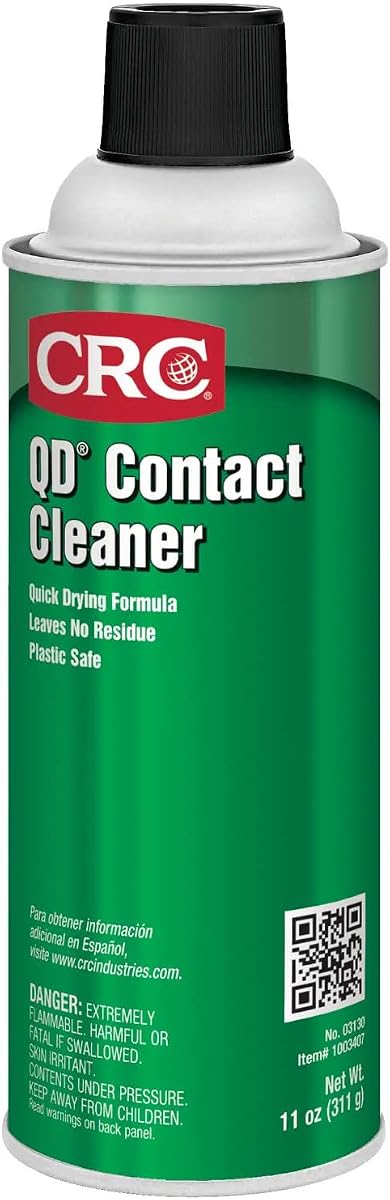
CRC QD Contact Cleaner has a 4.8 rating and is distinguished by its stated safety on all plastics. The eleven-ounce aerosol is engineered to remove dust, light oil, grease, and dirt from sensitive electronic equipment while evaporating quickly and leaving no residue.
We may earn a commission when you buy through this link, at no additional cost to you.
Its application list covers telephones, personal computers, relays, edge connectors, tape heads, busbars, circuits, contacts, printed circuit boards, switches, and breakers. That range makes it a practical general cleaner for mixed electronics maintenance. The product is also NSF K2 registered, a notable credential for professional food-equipment environments.
One condition is that this cleaner should be used where lower-flashpoint cleaners are acceptable. As with any aerosol, careful application matters even though the formula is plastic-safe. Buyers who cannot meet that operating condition should choose another product suited to their environment.
This is a strong choice for maintenance involving plastic housings, computer equipment, connector blocks, and mixed electrical assemblies. Its combination of residue-free performance, all-plastic compatibility, and broad applications makes it particularly well suited to professional service work.
The stated all-plastics compatibility distinguishes this product from cleaners that require more conservative testing. It is useful for switches, edge connectors, computer components, and equipment where plastic surfaces coexist with electrical contacts.
The listed uses extend from telephones and personal computers to busbars, relays, breakers, and circuit boards. This breadth supports maintenance work involving different equipment types rather than a single class of consumer gadget.
We may earn a commission when you buy through this link, at no additional cost to you.
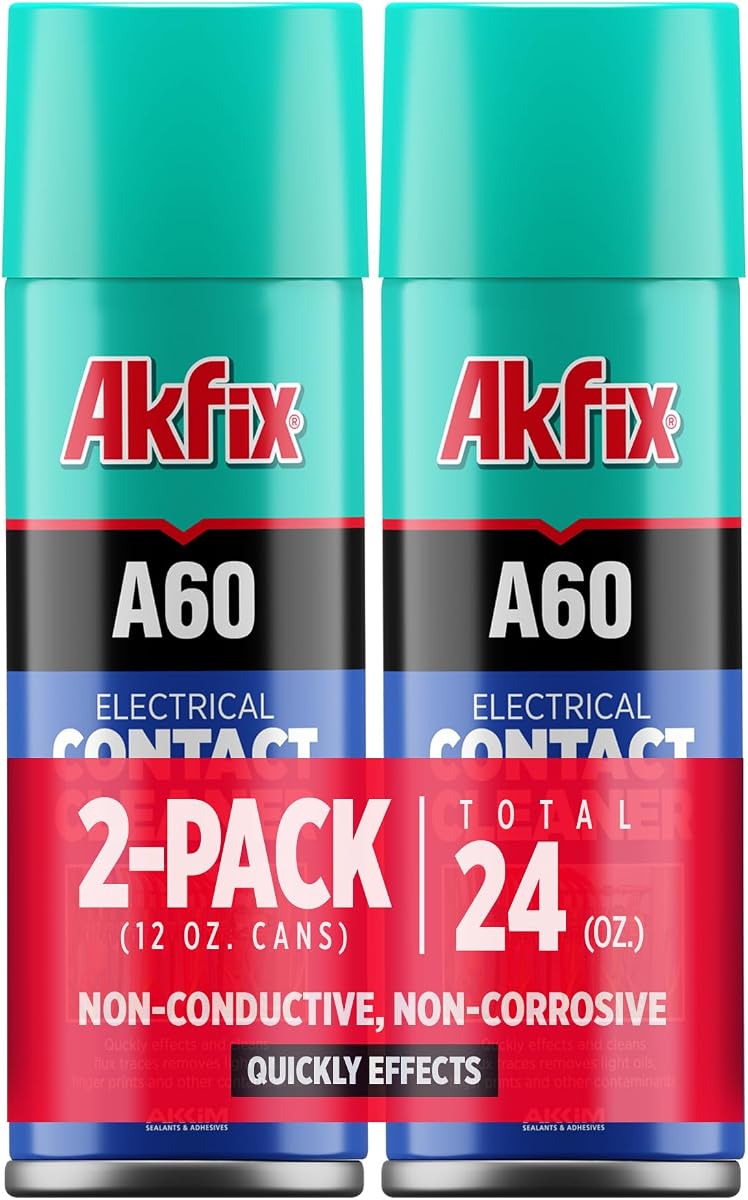
Akfix A60 Electrical Contact Cleaner has a 4.6 rating and arrives in a two-can pack with twelve ounces per can. Its selling point is a non-corrosive, fast-evaporating formula designed to remove dirt, light oil, grease, flux, and dust from electrical equipment and electronic devices.
We may earn a commission when you buy through this link, at no additional cost to you.
The product information specifically presents A60 as a cleaner for delicate electrical components rather than a general solvent for every household object. Stated uses include computers, batteries, keyboards, digital equipment, metal connectors, and contacts. The formula is also described as residue-free and suitable for circuit boards.
The listing recommends testing on sensitive plastics, adhesive-mounted parts, and stressed components. That is an important distinction because a cleaner can be suitable for a contact while still requiring care near vulnerable adjoining materials. The two-can configuration also creates more storage demand than a single aerosol.
This is a practical recommendation for repairers and maintenance users who want substantial supply and regular access to a circuit-board cleaner. It works especially well for mixed electronics servicing where oil, dust, grease, and flux residue may all be present.
A60 targets several common residues encountered during electronics repair. Its ability to address flux, oil, grease, and dust makes it more broadly useful for service tasks than a product formulated only for loose particles.
The stated non-corrosive formula supports use on electrical contacts and connectors. Two twelve-ounce cans provide a generous total supply for workshops or users who expect frequent cleaning sessions.
We may earn a commission when you buy through this link, at no additional cost to you.
CRC 05103 Case 5103 has a 4.8 rating and contains twelve eleven-ounce cans of quick-dry electronic cleaner. The supplied listing focuses on package dimensions, weight, universal fit, and the case quantity, making this the clear bulk-oriented option in the group.
We may earn a commission when you buy through this link, at no additional cost to you.
For repair shops, maintenance departments, electronics schools, or serious enthusiasts, a twelve-can inventory can simplify procurement and reduce interruptions. Each can uses the 5103 quick-dry format, providing a consistent cleaner across multiple workstations, vehicles, service kits, or departments.
For occasional users, however, twelve cans are plainly excessive. The package requires meaningful storage, and cans that remain unused for long periods may lose some of the convenience of a freshly opened single can. The listing also supplies less application detail than the single-can CRC listings.
This pack is best for institutions or technicians with high, recurring demand. A household owner cleaning a switch several times a year would gain little from this configuration, while a professional operation may find it both convenient and economical.
Buying the same 5103 model in quantity simplifies standard maintenance procedures. A workshop can place identical cans at several work areas without mixing formulas or relying on different substitutes for routine contact cleaning.
The twelve-can format is suited to repeated consumption rather than occasional touch-ups. It makes sense when multiple technicians or service locations can use the product regularly and storage space is readily available.
We may earn a commission when you buy through this link, at no additional cost to you.
CRC 05101 QD Electronic Cleaner has a 4.7 rating and delivers the same stated quick-drying, plastic-safe approach in a compact four-and-a-half-ounce aerosol. Made from petroleum distillate and alcohol, it is described as precise, fast-evaporating, and residue-free.
We may earn a commission when you buy through this link, at no additional cost to you.
The product is explicitly intended for sensitive electronics and can be used on computer components, circuits, contacts, sockets, plugs, relay switches, lighting, plastics, nylon, and PVC. Flux removal is included among its applications, while the residue-free formula makes it suitable for routine contact maintenance.
The small can is the defining compromise. It is easy to store and handle, but frequent technicians may replace it sooner than users of an eleven-ounce can or multi-pack. As with any aerosol, it should be applied deliberately to avoid wetting nearby components.
This is a good fit for a home workbench, travel repair kit, or occasional electronics hobbyist who values compact storage. It is especially attractive for precise, limited cleaning jobs on sensitive components rather than continuous workshop consumption.
The smaller canister takes up less drawer or shelf space than a full-size aerosol. That makes it convenient for a compact workbench, portable toolkit, or a user who only performs occasional maintenance.
The product is presented for sensitive electronics and a wide variety of contacts and component types. Quick drying and residue-free performance are especially relevant when the cleaner is used around switches, plugs, relays, and circuit connections.
We may earn a commission when you buy through this link, at no additional cost to you.
The 250ML Electronic Contact Cleaner has a 4.0 rating and offers a noticeably different application method from the aerosol products in this guide. Its liquid is applied directly to an oily area, wiped repeatedly, and allowed to dry, providing users with direct control over where the cleaner reaches.
We may earn a commission when you buy through this link, at no additional cost to you.
The listing emphasizes rapid evaporation, a non-damaging formula for circuit boards and connectors, and suitability for computer motherboards, mobile phone repair, and industrial control boards. It also claims the formula can remove surface contamination and restore optimal conductivity by cleaning electronic components effectively.
Its lower rating and comparatively limited listing information mean buyers have less documented detail to evaluate. Although direct application can reduce overspray compared with an aerosol, users must still confirm compatibility with every material and avoid introducing liquid where it cannot safely evaporate.
This product is worth considering for controlled bench work where users prefer pouring and wiping to aerosol application. It is most appropriate for mobile phone repair, motherboard work, and industrial control board maintenance conducted by someone comfortable handling liquid cleaners directly.
Applying cleaner directly to the contaminated region can make it easier to limit the treatment area. This method benefits controlled work on motherboards, mobile phone components, and industrial control boards where precision matters.
The stated drying time within seconds is designed to minimize liquid residue on circuit boards and connectors. The wipe-and-dry process adds another level of control, although thorough drying remains essential before reassembly.
We may earn a commission when you buy through this link, at no additional cost to you.
Selecting an electronic contact cleaner requires balancing contaminant removal, drying speed, residue control, material compatibility, application precision, and expected frequency of use. The right product should clean the intended contacts without attacking nearby plastic, adhesive, rubber, or coated components.
Fast evaporation is one of the most important qualities in an electronic contact cleaner because liquid that lingers around a live or recently serviced connection can create risks or interfere with operation. A residue-free formula is also preferable to a product that leaves a film after it dries. Several options in this guide explicitly claim quick or rapid evaporation, while the CRC and WD-40 selections describe residue-free performance. Buyers should consider how the cleaner will be applied and how much open time exists before the device must be powered or reassembled.
Prioritize a product that dries quickly and leaves no residue, then allow additional drying time whenever the manufacturer recommends it.
The contaminants present determine which cleaner is most appropriate. Dust and loose particles may be removed with a fast-evaporating spray, while oil, grease, flux residue, and condensation require a solvent with more targeted cleaning action. WD-40 Specialist, Akfix A60, and BW-100 all address several contaminant categories. The 250ML cleaner emphasizes oily areas and surface contamination, while CRC products identify dust, light oil, grease, dirt, and flux removal among their uses.
Match the cleaner to the residue actually present, rather than assuming every contact requires the same treatment.
Contact cleaners often encounter plastics, rubbers, metals, adhesives, screens, and printed labels in the same area as the electrical connection. CRC 05103 is described as plastic-safe, CRC QD states compatibility with all plastics, and several alternatives say they are safe on most plastics while recommending a small-area test. Adhesives are a recurring warning, and WD-40, BW-100, and Akfix advise avoiding or testing around vulnerable parts. Material compatibility should be verified before spraying or applying liquid.
Test a small hidden area when uncertain, and never apply contact cleaner to screens, adhesives, or keyboards without specific permission.
Aerosols cover broad areas quickly, but an extension or Smart Straw can provide a more directed stream. BW-100 includes an extension straw, and the WD-40 Twin Pack includes Smart Straws. For crowded circuit boards, switches, controllers, and compact game devices, precision can help the cleaner reach the intended contact while limiting overspray on surrounding areas. The 250ML product uses direct application and wiping, offering another form of control for bench technicians.
Choose a directed nozzle or direct-wipe method when working in tight assemblies where broad overspray is undesirable.
A general-purpose electronics cleaner may list computer components, switches, relays, circuit boards, and electrical controls, while a specialist product may be framed around contact treatment alone. DeoxIT has the most narrowly defined positioning in the group, whereas the CRC and Akfix products list broad maintenance scenarios. Mobile phone repair, industrial controls, panel maintenance, and computer servicing all benefit from checking the stated applications before choosing.
Choose a cleaner whose published applications closely match the equipment you expect to service.
Container size should reflect consumption rather than aspiration. A four-and-a-half-ounce CRC can is compact and convenient for occasional use, while eleven-ounce and twelve-ounce cans suit regular maintenance. The CRC twelve-pack and Akfix two-pack are better suited to workshops, schools, service departments, and frequent technicians. A larger package may be convenient, but it also requires storage and can be excessive for a household user who only cleans contacts occasionally.
Estimate how often you will clean contacts and select a total supply that matches that frequency.
Some applications demand documentation or stronger assurances than a general electronics claim. CRC QD Contact Cleaner is NSF K2 registered, which can matter in professional settings where cleaner selection is governed by operational requirements. For ordinary consumer electronics, the more relevant evidence remains residue control, material compatibility, application range, and clear handling instructions.
Check for relevant registrations when working in regulated or specialized environments rather than assuming every cleaner is interchangeable.
Contact cleaners are chemical products, and the label instructions should always take priority over general cleaning advice. Use only in a well-ventilated area, avoid inhalation, keep the spray away from heat or ignition sources when directed by the label, and allow the cleaned component to dry fully before energizing it. The product information for BW-100 specifically identifies its formula as non-flammable, while some other cleaners are intended for use only where lower-flashpoint cleaners are acceptable.
Read the full label, ventilate the workspace, and follow the product-specific safety and drying directions.
Before cleaning, disconnect the equipment from power when that is safely possible, remove the component or access the contact according to the manufacturer's service instructions, and identify nearby plastics, adhesives, screens, rubber parts, and coatings. Arrange parts so liquid cannot run into openings that are difficult to dry.
Shake the can as directed, test the spray on a small compatible area if the instructions require it, and apply a controlled amount. Use an extension or Smart Straw for confined spaces, or apply liquid directly and wipe it when using a non-aerosol product. Keep the nozzle clean and avoid spraying from close range when that could saturate the target.
After cleaning, allow the contact and surrounding area to dry fully before reassembly or power-up. Inspect for remaining dust, flux, or residue, and repeat the process only as needed. Store the container upright in a cool, dry area away from heat, direct sunlight, and incompatible materials, and consult the label for storage and disposal guidance.
In this guide, the term electronic contact cleaner refers to products intended for cleaning electronic contacts, connectors, switches, and circuit-board surfaces. Such cleaners commonly target dust, light oil, grease, flux residue, and condensation. They are not necessarily general lubricants, and some exclusions apply around screens, adhesives, and keyboards.
Several products in this roundup are explicitly listed for printed circuit boards, including the CRC, WD-40 Specialist, BW-100, and Akfix A60 options. The cleaner should be applied in a controlled amount, directed away from openings, and allowed to dry completely. Check for nearby sensitive materials and follow all label instructions.
Look for an explicit statement that the product evaporates quickly and leaves no residue. Quick evaporation reduces the time a liquid remains near a sensitive connection, while a residue-free formula helps prevent a new film from interfering with conductivity. Dry the cleaned area fully even when the product advertises rapid drying.
A non-flammable formula addresses one important storage and handling concern, but it does not make every application automatically safe. BW-100 is described as non-flammable, yet its instructions still call for compatibility testing and avoiding keyboards, screens, and adhesives. Ventilation, correct application, and full drying remain essential.
It depends on the product and the exact part being cleaned. WD-40 Specialist and BW-100 explicitly advise avoiding keyboards, while some aerosol options mention Joycons or digital equipment in their use cases. Open a controller safely, target accessible switches or contacts, and avoid spraying liquid into membrane assemblies unless the manufacturer permits it.
Clean contacts when symptoms suggest contamination, such as intermittent operation, visible dust, flux residue, oxidation-like buildup, or a connection that works only after repeated manipulation. Avoid unnecessary routine spraying, which can introduce liquid where it cannot dry. For industrial equipment, follow the manufacturer's preventive-maintenance schedule.
Usually not. A compact four-and-a-half-ounce or five-ounce can is easier to store and less likely to sit unused for a long period. Bulk packs make more sense for workshops, service departments, training facilities, and frequent technicians who can reliably use the supply.
Yes, allow the full area to dry before restoring power or closing the device. A cleaner may feel dry almost immediately while residual liquid remains inside connectors, beneath components, or around trapped areas. Keeping the equipment disconnected until the work area is completely dry reduces unnecessary risk.
The CRC 05103 QD Electronic Cleaner is the strongest all-around selection because it combines quick evaporation, residue-free cleaning, plastic-safe use, and a wide range of applications. WD-40 Specialist Contact Cleaner stands out as the budget pick for removing several contaminant types, while Hosa CAIG DeoxIT is the premium option for buyers seeking a dedicated contact-cleaning formula.
The right choice ultimately depends on the job. Select a small can for occasional precision work, a directed straw for crowded devices, a large supply for a busy workshop, and a direct-wipe product for controlled bench maintenance. In every case, verify material compatibility, follow the label, and let the equipment dry completely.
Prices and availability can change, so compare current listings and seller details before purchasing. Also verify the can size, included accessories, product conditions, and safety instructions against your specific electronic equipment rather than choosing solely from the product name.