
GIGABYTE GC-WBAX210
4.6Editor score
Intel AX210 module
Tri-band 6E connectivity
Up to 2400Mbps wireless speed
Bluetooth 5.2 support
Pcie WiFi Cards for Linux compared by Linux support, Wi-Fi generation, tri-band capability, Bluetooth, antennas, and PCIe fit for desktop setup.
A PCIe Wi-Fi card can give a Linux desktop cleaner, more flexible wireless connectivity than a USB adapter, especially when the system has an unused expansion slot and a free internal USB header. The right card depends on Linux driver availability, the Wi-Fi standard supported by your router, antenna placement, Bluetooth requirements, and whether the enclosure accepts full-height or low-profile hardware.
This guide compares ten PCIe options across chipset generation, 2.4 GHz, 5 GHz, and 6 GHz support, stated Linux compatibility, antenna design, Bluetooth capability, security features, bracket options, and physical installation requirements. It includes both explicit Linux listings and cards built around widely recognized Intel modules, while noting where buyers should confirm kernel and distribution support.
Each review explains who benefits most from the card, what its technical features mean in practice, and where its stated compatibility leaves questions. The leading choices cover different needs, from an explicitly Linux-compatible Wi-Fi 7 design to established AX210-based alternatives. Product ratings and availability can change, so shoppers should verify current driver notes, router capabilities, and pricing before purchasing.
4.6Editor score

4.4Editor score

4.6Editor score
The comparison emphasizes the details that determine whether a PCIe Wi-Fi card will work well in Linux, including stated driver compatibility, radio generation, frequency coverage, Bluetooth support, antenna arrangement, and enclosure fit.
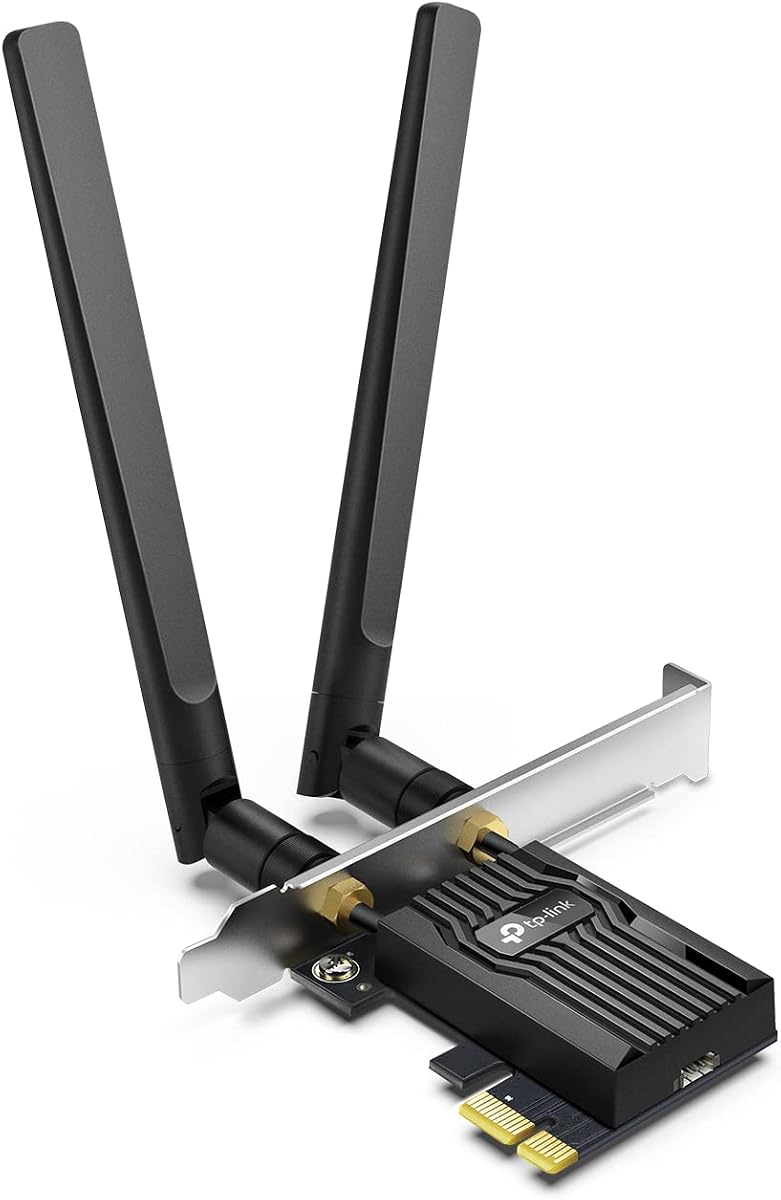


The TP-Link Archer TX55E is a dual-band Wi-Fi 6 PCIe card aimed at desktop users who want modern wireless performance without moving to a tri-band or Wi-Fi 7 platform. It carries a 4.5 rating and advertises a combined maximum of up to 2.4Gbps, divided between 2402Mbps on the 5 GHz band and 574Mbps on 2.4 GHz. That makes it a sensible fit for modern routers that use Wi-Fi 6 but do not provide a 6 GHz network.
We may earn a commission when you buy through this link, at no additional cost to you.
Its strongest physical feature is the pair of external, high-gain antennas. They can be positioned away from a crowded metal enclosure, which may help reception in a desktop located near walls or other electronics. OFDMA and MU-MIMO support target congestion control, while WPA3 support addresses wireless security. The package includes standard and low-profile brackets, making it relevant to both conventional towers and more compact cases.
Bluetooth 5.2 expands the card's usefulness for keyboards, headsets, controllers, and other peripherals. However, the internal Bluetooth USB cable must be connected to a compatible F_USB header. Some desktop cases lack a free internal USB header, and Linux users may need to confirm that the card's Bluetooth component is recognized by their chosen distribution. The product information does not explicitly list Linux support, so that verification should come before purchase.
This card makes the most sense for a Linux desktop with a Wi-Fi 6 router, 5 GHz network, and enough room for adjustable antennas. It is less compelling when a 6 GHz router is available or when the system lacks an accessible internal USB header. Among conventional TP-Link PCIe options, it offers a balanced set of speed, antenna flexibility, and chassis accommodations, but explicit Linux documentation would make it an even stronger recommendation.
The two included high-gain antennas can be moved away from the case and positioned where the router signal is strongest. This is particularly useful in desktops with metal panels, crowded cable spaces, or a location several rooms from the access point. Linux users can then test different antenna positions without moving the entire computer.
Bluetooth does not operate over the PCIe connector alone. The supplied internal USB cable must connect to a compatible F_USB header, so buyers should open the case or check its specifications before buying. Linux compatibility for both Wi-Fi and Bluetooth should also be verified against the exact adapter revision and kernel version.
We may earn a commission when you buy through this link, at no additional cost to you.
The GIGABYTE GC-WBAX210 pairs the Intel AX210 platform with a 4.6 rating, giving it a strong combination of established hardware and positive user feedback. It supports the 2.4 GHz, 5 GHz, and 6 GHz bands, allowing a compatible router to provide access to the clearer 6 GHz spectrum. The listed maximum wireless speed is 2400Mbps, making it a practical tri-band option for a Linux desktop.
We may earn a commission when you buy through this link, at no additional cost to you.
Supporting dual-stream wireless operation across all three bands is important for users who transfer large files, game online, or use a busy 6 GHz network. The AX210 module has been widely used in laptops and desktop adapters, which gives Linux buyers a familiar chipset to investigate. Before purchasing, check the current kernel, distribution, and desktop environment for the relevant in-kernel driver rather than assuming every distribution ships with it enabled.
The main limitation is that the card's stated maximum is lower than many newer tri-band adapters. It does not offer Wi-Fi 7 features such as 320 MHz channels, 4K-QAM, or Multi-Link Operation, and its Bluetooth version is 5.2 rather than the 5.3 or 5.4 offered by alternatives. Those newer features are useful only with supporting infrastructure, but they do narrow the card's future-proofing.
The GC-WBAX210 is best viewed as a value-oriented, mature tri-band choice. It makes sense when the priority is a known module, access to all three main Wi-Fi bands, and a simple expansion-card format rather than bleeding-edge throughput. For a current Linux installation, verifying driver and firmware packaging is a straightforward precaution that can prevent most setup surprises.
Intel AX210-based devices are a common reference point for Linux wireless troubleshooting. Support varies by distribution, kernel, firmware package, and system security configuration, but the chipset gives buyers a specific platform to research. Check the adapter's PCI device ID and use the Linux hardware database before installing.
The 6 GHz band can provide additional channel space where a compatible router and regional regulations allow it. The 5 GHz band remains the usual high-speed choice, while 2.4 GHz offers greater reach. A capable adapter lets a Linux desktop take advantage of whichever band the network and environment favor.
We may earn a commission when you buy through this link, at no additional cost to you.
The TP-Link Archer TBE552E is a high-end Wi-Fi 7 card built around tri-band operation, 320 MHz channels, Multi-Link Operation, and 4K-QAM. Its listed radio maximum is 5764Mbps on 6 GHz, with additional capacity on the 5 GHz and 2.4 GHz bands. This is compelling hardware for a modern network, although the product explicitly states that it is designed only for Windows 11 and is not compatible with Windows 10 or earlier.
We may earn a commission when you buy through this link, at no additional cost to you.
That operating-system statement is the central issue for a Linux-focused roundup. The product data does not claim Linux compatibility, and a Windows-exclusive installation description is a meaningful warning rather than a minor detail. Linux buyers should not assume that the Windows utility or driver supplied for this card will install in their distribution. The card could still operate through generic Linux support for its chipset, but that must be confirmed independently before purchase.
For compatible systems, the card's features are impressive. Multi-Link Operation can combine frequency bands to improve throughput, latency, and reliability. The 320 MHz 6 GHz channel support, OFDMA, MU-MIMO, Multi-RUs, and 4K-QAM all target demanding or crowded wireless environments. Two high-gain antennas, WPA3, and both standard and low-profile brackets support a flexible installation.
The Archer TBE552E is best for a buyer with a Wi-Fi 7 router and a confirmed Linux driver path, provided the desktop case has room and a free internal USB header for Bluetooth. In its present form, it is better suited to a Windows 11 build than a Linux system. Its hardware may be excellent, but explicit operating-system support matters more than headline speed in this category.
A Wi-Fi 7 PCIe card cannot deliver Wi-Fi 7 capabilities through an older router. The access point must support the relevant features, and regulatory rules determine which channels and bands are available. Buyers should treat the card as one part of a broader network upgrade rather than a standalone speed upgrade.
The listing's Windows 11-only setup statement makes this a cautious recommendation for Linux. Confirm that the exact chipset has a functioning in-kernel driver and that the Bluetooth USB connection is supported. Otherwise, the advanced radio features will not make a card suitable for the intended operating system.
We may earn a commission when you buy through this link, at no additional cost to you.
The EDUP PCIE WiFi 7 Card BE6500 stands out in this list because its product information explicitly states compatibility with Linux Kernel 6.7 and later. It also identifies Windows 11 64-bit support and works with Intel and AMD desktop platforms. That combination of stated operating-system coverage and current Wi-Fi 7 hardware makes it the clearest recommendation for readers whose priority is a Linux desktop upgrade.
We may earn a commission when you buy through this link, at no additional cost to you.
The card uses an MT7925 chipset and supports 2.4 GHz, 5 GHz, and 6 GHz operation. Its listed maximum throughput is 6.5Gbps, divided into 688Mbps on 2.4 GHz and 2882Mbps on each of the two faster bands. Multi-Link Operation is included, allowing multiple links to work together for improved stability, throughput, and reduced packet loss. WPA3 and WPA2 support cover contemporary wireless encryption needs.
Bluetooth 5.4 provides another reason to consider the card, with support for as many as seven connected devices according to the listing. The EDUP recommends disabling the PC's built-in Bluetooth before installation to avoid conflicts. A standard PCIe x1 slot is sufficient, and the card works with x1, x4, x8, and x16 physical slots, although users still need an available internal USB header for the Bluetooth lead.
The important caveat is the stated Kernel 6.7+ requirement. Linux distributions that regularly update their kernels may meet that requirement, but a user with an older enterprise distribution should verify its kernel and available backported driver. EDUP also directs buyers to its own driver page, making a check of the supplied instructions sensible. For a modern Linux system with a Wi-Fi 7 router, this card provides the strongest documented fit in the group.
Only a small number of listings explicitly mention Linux, and this card is one of them. Its stated Kernel 6.7+ requirement provides a concrete starting point for compatibility research. Check the running kernel with uname -r and consult the distribution's hardware database before installing.
The card can use a standard x1, x4, x8, or x16 slot because PCIe devices negotiate the lanes they need. This makes installation easier in compact builds where a free x1 slot may be scarce. Low-profile and full-height brackets allow the same adapter to fit a wider range of desktop enclosures.
We may earn a commission when you buy through this link, at no additional cost to you.
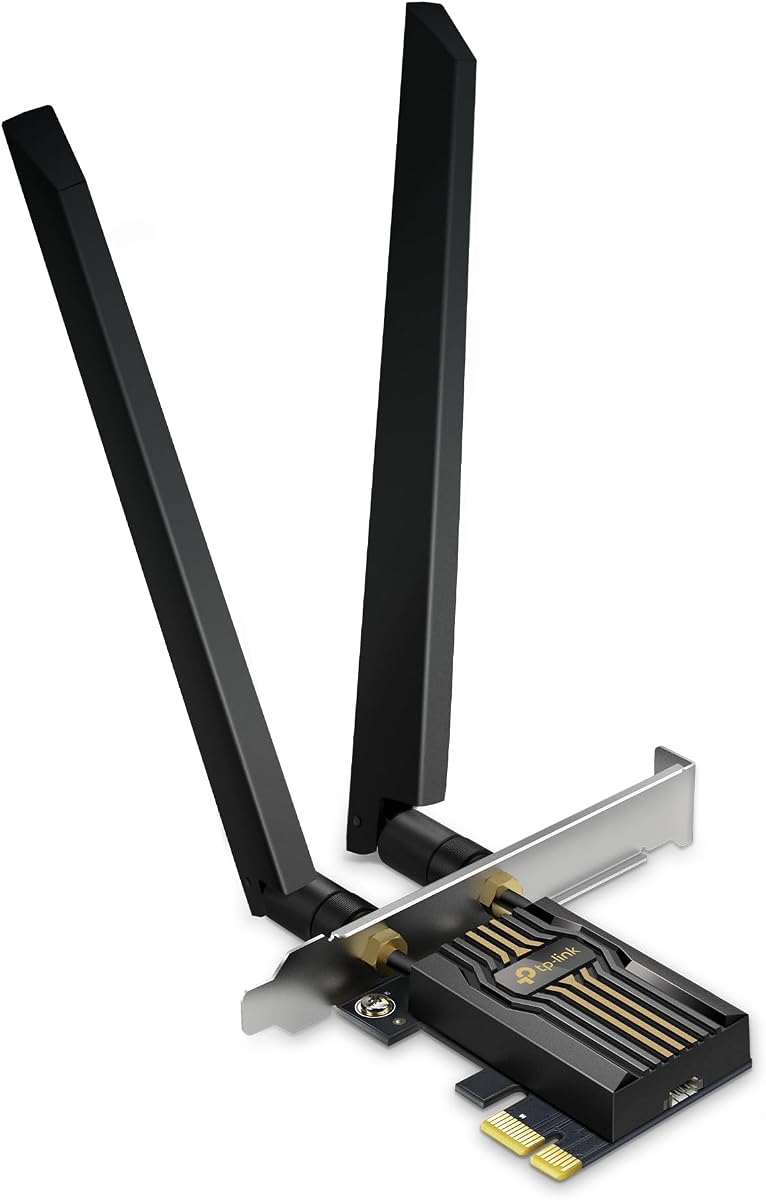
The TP-Link Archer TX3000E has the highest rating in the group at 4.7, giving it an appealing reputation among buyers. It is a dual-band Wi-Fi 6 card with a maximum listed speed of 2.4Gbps, split between 2402Mbps on 5 GHz and 574Mbps on 2.4 GHz. That performance is still relevant for a router that operates on those two bands, even when newer cards support 6 GHz.
We may earn a commission when you buy through this link, at no additional cost to you.
Its most distinctive feature is the magnetized antenna base. The two multidirectional antennas can be placed away from the desktop case, allowing users to find a better location for reception without moving the computer. OFDMA is included to improve efficiency on busy networks, while Bluetooth 5.3 allows the card to handle compatible headsets, controllers, keyboards, and other accessories.
The Archer TX3000E is based on an Intel Wi-Fi 6 platform, but the supplied product details focus on Windows 11 and Windows 10 64-bit installation and do not explicitly promise Linux compatibility. Linux buyers should identify the precise chipset and review support in their kernel and distribution. A CD may be included for driver installation, but a downloadable driver is more practical for many Linux workflows, and Bluetooth firmware may also need to be installed separately.
This is a strong recommendation for a Linux desktop if its exact module is supported and the router is Wi-Fi 6 rather than Wi-Fi 6E. The flexible antenna base is particularly useful in awkward placements. It is not the right choice for a user seeking 6 GHz or Wi-Fi 7, but it delivers a well-regarded dual-band package with useful Bluetooth functionality and adaptable physical installation.
A metal desktop case can weaken internal antennas or force them into a poor location. The magnetic base lets the user place the antenna assembly on a desk, shelf, or other accessible surface. This arrangement can be more meaningful than a small increase in advertised peak speed when the router is distant or obstructed.
Linux wireless operation may work through an in-kernel driver, while Bluetooth can require separate firmware files. Because the listing references firmware downloads for Bluetooth 5.3, check the exact module revision and follow current distribution guidance. Do not rely solely on a generic installer that targets Windows.
We may earn a commission when you buy through this link, at no additional cost to you.
The TP-Link Archer TXE75E combines the Intel AX210 chipset with tri-band operation and a 4.6 rating. It can use the 2.4 GHz, 5 GHz, and 6 GHz bands, with listed maximum speeds of 574Mbps, 2402Mbps, and 2402Mbps respectively. This makes it a solid choice for a desktop that wants 6 GHz access without moving to the more advanced Wi-Fi 7 feature set.
We may earn a commission when you buy through this link, at no additional cost to you.
The magnetic antenna base is a meaningful physical advantage. Users can position the two multidirectional antennas away from the case, which can improve consistency in rooms with walls, furniture, or other radio interference. OFDMA and MU-MIMO support help the adapter manage crowded networks, and the listed security features include WPA3. Bluetooth 5.3 provides support for common wireless peripherals.
The product information specifically notes that 6 GHz use requires Windows 11, and it does not explicitly identify Linux compatibility. AX210-based products can work in Linux, but the adapter's firmware, identifiers, and the chosen distribution's packages all need to be checked. The internal Bluetooth cable also requires a F_USB header, so Linux enthusiasts should confirm that the case offers one and that the header is connected to the intended controller.
The Archer TXE75E is a strong candidate for users who value the AX210 platform, a magnetic antenna base, and 6 GHz capability. It is particularly compelling if the Linux distribution has mature support for the module and the Wi-Fi 6E router can exploit the third band. Without a confirmed driver path, however, its stated Windows orientation means a card with explicit Linux support would be a safer choice.
The detachable antenna base allows the radio to be tested in several positions. Small changes in orientation or distance can matter in a busy environment. This flexibility is useful under Linux because users can compare connection quality through NetworkManager or other desktop tools while moving the antenna.
The 6 GHz band can offer wider channels and reduced interference in areas where compatible access points and regulations permit it. Real throughput still depends on the router, distance, clients, and network load. A Wi-Fi 6E card gives the desktop more options but does not guarantee faster internet service.
We may earn a commission when you buy through this link, at no additional cost to you.
This Intel AX210 Wi-Fi 6E card offers a 4.5 rating and a straightforward route to tri-band wireless on a desktop. It is advertised at up to 5400Mbps, using the 2.4 GHz, 5 GHz, and 6 GHz bands. The product also provides Bluetooth 5.3 and a set of high-gain antennas, covering both network connectivity and wireless peripheral support.
We may earn a commission when you buy through this link, at no additional cost to you.
Its Intel AX210 identity is useful because it gives Linux buyers a specific, widely used chipset to research. The product description focuses on Windows 10 and 11 rather than Linux, however, so compatibility should not be assumed without checking. A Linux user should identify the PCI and USB identifiers, confirm in-kernel Wi-Fi support, install any required firmware, and verify that Bluetooth works in the selected desktop environment.
The card supports WPA3 and older wireless security standards, giving users flexibility when joining networks with different configurations. Full 6 GHz functionality requires a Wi-Fi 6E router and Windows 11 according to the supplied information, so Linux buyers should separately confirm their router and distribution behavior. The included Bluetooth USB cable simplifies the peripheral side, but the system still needs a suitable internal USB header.
This card is best for a Linux builder who specifically wants the AX210 and has already confirmed the adapter's identifiers and firmware requirements. It provides a conventional tri-band package without the complexity of Wi-Fi 7. If that compatibility research goes smoothly, its familiar chipset, external antennas, and Bluetooth support make it a practical desktop upgrade.
A chipset name alone does not guarantee identical behavior across every adapter revision. Confirm the exact PCI identifiers with lspci and review Linux kernel and firmware support for those identifiers. The network interface should also be checked for the regulatory country and 6 GHz settings required by local law.
The external high-gain antennas provide more placement options than a card with permanently attached antennas. They can help at the edge of a home or office, although positioning cannot overcome a weak internet connection or overloaded access point. The radio and router remain the primary limits on throughput.
We may earn a commission when you buy through this link, at no additional cost to you.
The WAVLINK AXE5400 is one of the strongest premium choices because it combines explicit Linux compatibility with a complete wireless feature set. It has a 4.6 rating and uses the Intel AX210 chipset to support all three major Wi-Fi bands. Listed maximum speeds are 574Mbps on 2.4 GHz and 2400Mbps on both 5 GHz and 6 GHz, providing substantial tri-band capacity.
We may earn a commission when you buy through this link, at no additional cost to you.
The magnetic antennas are rated at 5dBi and can be positioned away from the enclosure. The listing also highlights 160 MHz channel support, MU-MIMO, OFDMA, and WPA3. A heat sink is included, which is a thoughtful addition for a card installed in a warm desktop case. These physical and thermal details distinguish it from simpler adapters with fixed antennas.
Bluetooth 5.3 support extends the card beyond networking, and the low-profile bracket improves its fit in compact cases. The product states compatibility with Linux as well as Windows 10 and 11. Linux users should still identify the exact revision and confirm that the distribution packages the necessary firmware, but the explicit claim removes much of the uncertainty that affects other options in this roundup.
The WAVLINK AXE5400 is an excellent match for a Linux desktop owner with a Wi-Fi 6E router who values installation flexibility, cooling, and a mature chipset. It is a more elaborate package than a basic AX210 card, so buyers who need only 5 GHz and 2.4 GHz may find it excessive. For a modern tri-band Linux build, however, it offers one of the most convincing combinations of stated support and physical design.
Wireless adapters are usually modest power users, but placement in a poorly ventilated case can still affect component temperature. The included heat sink provides a larger thermal surface than a bare module. It is a practical feature for a permanently installed desktop card expected to remain connected throughout the day.
The two 5dBi antennas can be moved to improve the view toward the access point. Their gain and placement may help at moderate distances, but they cannot compensate for thick walls, an overloaded radio environment, or an internet connection with a lower cap. Actual performance should be measured at the intended desk location.
We may earn a commission when you buy through this link, at no additional cost to you.
The TP-Link Archer TBE550E is a visually distinctive Wi-Fi 7 card with a 4.2 rating, 320 MHz channel support, 4K-QAM, and Multi-Link Operation. Its listed maximum combined speed reaches 9328Mbps, divided among 5760Mbps on 6 GHz, 2880Mbps on 5 GHz, and 688Mbps on 2.4 GHz. It is aimed at users building a Windows 11 desktop around a Wi-Fi 7 router.
We may earn a commission when you buy through this link, at no additional cost to you.
The magnetic antenna base includes multicolored LED effects and a touch switch, allowing the system to display network status. It can be positioned away from the chassis for better reception while also serving as a visible desktop indicator. OFDMA, MU-MIMO, and Multi-RU target efficiency in busy networks, while WPA3 provides current wireless encryption support.
Linux support is not stated, and the listing explicitly says the Archer TBE550E supports Windows 11 only. That makes this a risky choice for a Linux-focused buyer unless the exact chipset's Linux path has been independently confirmed. The included USB cable is intended to make driver installation convenient on Windows, but the listing does not describe an equivalent Linux workflow.
The card is worth considering for a Windows 11 system and attractive, status-conscious desktop design. For Linux, its advanced features are less useful than its compatibility status. It also carries the lowest rating in this group, so buyers should weigh the premium design and high theoretical capacity against a less emphatic user-rating profile.
The LED base makes network status visible without opening a terminal or checking the monitor. Different colors and touch controls can improve the appearance of a glass-sided build. Users who prefer a subtle enclosure can disable or avoid the lighting, depending on the available controls.
The stated totals are theoretical radio limits under ideal conditions. A Wi-Fi 7 router, compatible client hardware, clean spectrum, and suitable placement are all needed to approach them. Users with older routers will instead benefit from the card's support for established bands, subject to the operating-system and driver issue.
We may earn a commission when you buy through this link, at no additional cost to you.
The MSI Herald WiFi 7 card combines a 4.3 rating with a high-specification tri-band radio. Its listed maximums are 5764Mbps on 6 GHz, 2882Mbps on 5 GHz, and 688Mbps on 2.4 GHz. With support for Multi-Link Operation and 320 MHz channels on 6 GHz, it targets demanding networks where multiple clients and wide channels matter.
We may earn a commission when you buy through this link, at no additional cost to you.
External antennas with a magnetic base provide flexible positioning and help users optimize reception. The design is well suited to a desktop that can be placed away from the router or positioned near structural interference. Bluetooth 5.4 adds peripheral support, although the product information does not describe the required USB header or Linux installation procedure in detail.
The supplied data does not explicitly list Linux compatibility. As with the other Wi-Fi 7 cards, a Linux buyer should identify the chipset, inspect the PCI and USB identifiers, and look for current kernel and firmware support. The availability of high theoretical throughput is irrelevant if the distribution cannot load the required driver, so compatibility should be established before choosing this model.
The MSI Herald is best for a buyer with a Wi-Fi 7 router who values speed and the 6 GHz band, provided Linux support is confirmed. It is less suitable for a standard Wi-Fi 6 network or for someone who needs a card with clearly documented Linux compatibility. Its strong hardware and flexible antenna base make it an appealing upgrade when the software path is in place.
MLO can use multiple links to improve responsiveness and consistency when conditions allow. It may help with latency-sensitive applications and interference-prone environments, but the benefit depends on router and driver support. Users should expect benefits from the overall system rather than a fixed increase in every transfer.
A magnetic antenna assembly is easy to adjust after installation and remains outside the metal chassis. This can produce a more meaningful improvement than a higher aggregate class number when the router is not in line of sight. Test several locations and orientations to find the most stable connection.
We may earn a commission when you buy through this link, at no additional cost to you.
Linux compatibility should come first, followed by radio generation, band coverage, antenna design, Bluetooth requirements, and physical fit. A card with impressive headline specifications is only useful when the operating system, router, and case can support it.
Prefer a card with a well-supported module and a straightforward firmware path. Keep a recovery option available because network access may be needed for downloads, and avoid changing firewall or Secure Boot-related settings without understanding the consequence. In short, identify the device first and confirm the driver path before considering speed.
Choose Wi-Fi 6 for a conventional dual-band router, Wi-Fi 6E for tri-band access, and Wi-Fi 7 when the router already supports it. In every case, the main benefit is better efficiency and potential throughput, not a guaranteed improvement in every online service.
Choose dual-band for basic coverage and a straightforward setup. Choose tri-band if you have, or reasonably expect, a 6 GHz router. More bands provide flexibility, but each added band also places more responsibility on driver and router compatibility.
Favor adjustable or magnetic antennas when the computer will sit in a difficult location. Fixed antennas are simpler and often sufficient in an open room. After installation, compare connection quality at different positions rather than assuming the highest possible link rate is always the most stable.
Treat Bluetooth as a separate feature, not an automatic benefit. Verify header availability, built-in Bluetooth, and the USB connection. If peripherals are the priority, a USB Bluetooth adapter may offer a simpler and more isolated solution.
Bring the case dimensions and slot layout into the decision. Full-height cards may not clear a side panel, while low-profile brackets may not fit a large tower. Measure clearance rather than relying on the general desktop form factor.
Look for a heat sink when the case is poorly ventilated or the card will sit near a warm expansion area. Keep the antenna area unobstructed and follow the vendor's firmware instructions. A card that runs comfortably and receives updates is usually more valuable than one with a higher paper specification.
Favor WPA3, current security support, and a chipset with documented Linux management. Keep the regulatory domain and driver configuration unchanged unless a verified need calls for an adjustment. Manageability is part of long-term usability, not merely a specification-sheet feature.
Before installation, power down the desktop fully, disconnect the power cable, and use the manufacturer's procedure for opening the case. Observe electrostatic precautions and avoid touching the card's contacts or exposed radio components. Install the appropriate bracket, seat the card firmly in a PCIe slot, secure it with the bracket screw, and connect the internal Bluetooth USB cable if Bluetooth is required.
After boot, use the Linux hardware database and distribution package tools to identify the wireless interface, install required firmware, and connect it with NetworkManager or another network manager. Scan for available networks, select the intended SSID, and test multiple bands when the router offers them. If the adapter is missing, review the kernel log, secure boot behavior, firmware paths, and exact PCI identifiers before changing any settings.
To maintain good results, update firmware through the vendor's documented process, keep the regulatory country set correctly, and inspect the antenna connections periodically. Avoid repeatedly unplugging and moving the antenna base while a transfer is active. If performance declines, test the same network near the router, compare 2.4 GHz with 5 GHz, and check for channel congestion before blaming the adapter.
A PCIe card can provide a more stable connection because it does not depend on a USB controller or a USB port that may be shared with other devices. It also avoids USB power-management behavior that occasionally affects wireless adapters. However, it requires an open expansion slot, may need an internal USB header for Bluetooth, and can be harder to move between systems. A USB adapter remains convenient for portable or temporary use.
Find the exact PCI device identifier and check it against your distribution's hardware database and kernel support. Confirm that any required firmware package is available and that the kernel is new enough for the chipset. If a 6 GHz card is involved, also check regulatory-domain support. Sellers that explicitly state Linux compatibility provide useful evidence, but current package documentation remains more authoritative than a generic marketing label.
A Wi-Fi 6 card is sufficient for many homes and offices using 2.4 GHz and 5 GHz networks. Wi-Fi 6E becomes useful when a compatible router provides 6 GHz service, which can offer additional channel space. Wi-Fi 7 is most appropriate for new systems with a Wi-Fi 7 router and compatible client equipment. Buying a faster standard without matching infrastructure adds little in everyday use.
The PCIe connector normally handles the Wi-Fi function, while the small internal USB cable usually enables Bluetooth on the same adapter. The motherboard must expose a compatible internal USB header, and the Bluetooth device may be disabled in BIOS or firmware. Check the case and motherboard before purchase, especially if the case has no accessible internal USB header.
Support depends on the kernel, firmware, regulatory database, adapter, driver, and router. A card may appear to work on 2.4 GHz and 5 GHz while failing to expose 6 GHz, so software support is just as important as hardware. Use a recent stable distribution, install the required firmware, and set the correct regulatory country before investigating 6 GHz channel visibility.
Fixed antennas are simpler and may be sufficient when the desktop has clear line of sight to the router. Magnetic antenna bases are more adaptable because they can be positioned outside a metal chassis and moved when reception is weak. Neither style overcomes an overloaded router or a slow internet connection, so test the desktop in its final location whenever possible.
First confirm that the card is seated correctly, the internal Bluetooth cable is connected if needed, and any firmware package is installed. Use lspci and lsusb to determine whether the hardware is visible, then inspect the kernel log for driver or firmware errors. Check Secure Boot, regulatory settings, and the exact distribution's wireless instructions. Avoid installing arbitrary drivers until the required chipset and firmware version are confirmed.
They can when they provide better signal, reduce retries, or move the desktop onto a less congested band. Wi-Fi 6 and Wi-Fi 7 features such as OFDMA and MLO are designed to improve efficiency under load. The difference may be small near a strong router, and a wired connection generally remains preferable when absolute latency and consistency matter most.
The EDUP BE6500 is the clearest Linux-focused recommendation because it explicitly supports Kernel 6.7 and later while offering a current MT7925-based Wi-Fi 7 platform, tri-band operation, and Bluetooth 5.4. The GIGABYTE GC-WBAX210 provides a mature Intel AX210 alternative at a 4.6 rating, while the WAVLINK AXE5400 combines explicit Linux support with magnetic antennas, cooling, and AX210-based tri-band capability.
For most Linux builders, driver support should outweigh headline speed. Confirm the exact device identifiers, firmware requirements, regulatory behavior, and Bluetooth path before purchasing. Then match the radio to the router, prioritize antenna placement for the intended room, and make sure the card and bracket fit physically. A supported card on a 2.4 GHz and 5 GHz Wi-Fi 6 network can be more useful than an unsupported Wi-Fi 7 alternative.
Ratings, driver packages, operating-system compatibility, and product availability can change over time. Review the current manufacturer documentation, distribution support pages, user feedback, and the final hardware layout before ordering. Checking current prices is also advisable, but the most important value comes from a card that works reliably with the chosen Linux release, router, case, and peripherals.